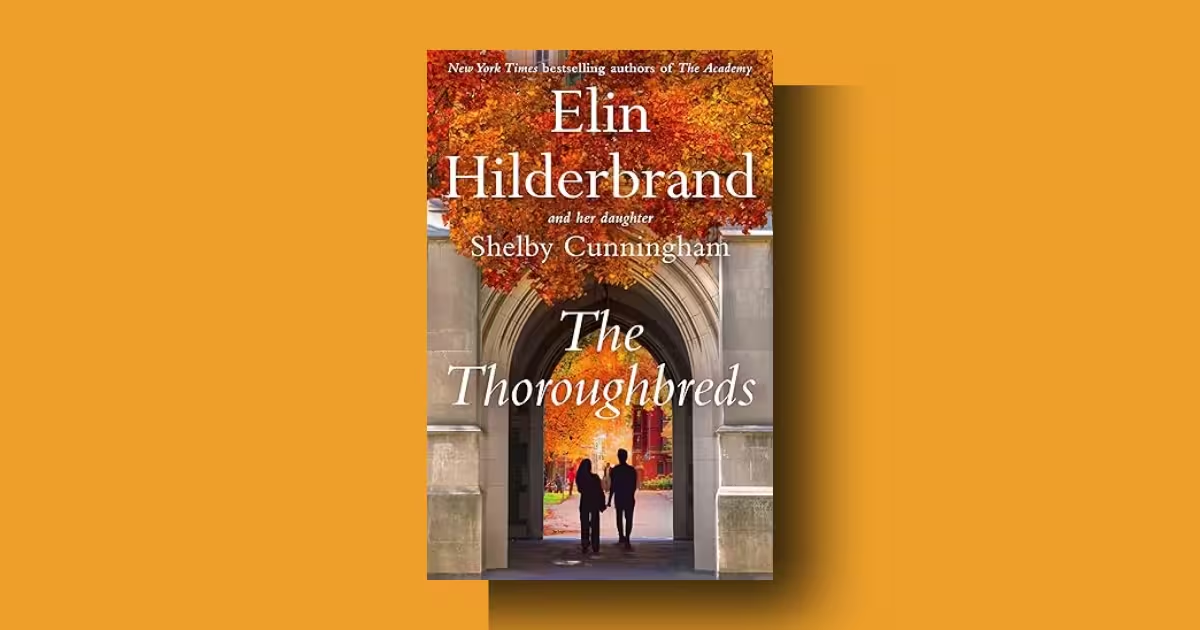

The Thoroughbreds by Elin Hilderbrand and Shelby Cunningham hit shelves in September 2026 as the second book in The Academy series. Set at the fictional Tiffin Academy in western Massachusetts, the novel follows a sprawling cast of sixth-formers through a year defined by a dead girlfriend’s secret, a gay quarterback’s coming out, a $7.3 million budget crisis, and a Halloween party that ends with a student overdosing in a burning pool house.
Reader recommendation: This book will land hard if you loved The Secret History but wanted something with more heart, or if you devoured Curtis Sittenfeld’s Prep and wished it had a soap-opera pulse. Fans of Karen M. McManus and Holly Jackson will appreciate the gossipy tension.
However, if you need a tight, single-POV narrative, this one might frustrate you. It’s a mosaic novel with fifteen-plus significant characters, and it demands attention.
For parents concerned about boarding school content: this is not a sanitized YA novel. The kids drink, do drugs, have sex, and face real consequences. The authors don’t moralize, but they don’t glorify it either.
Table of Contents
Introduction
The Thoroughbreds arrived on September 8, 2026, from Little, Brown and Company, marking the second collaboration between Elin Hilderbrand and her daughter Shelby Cunningham. At 490 pages, it’s an ambitious follow-up to The Academy (2025), continuing the story of Tiffin Academy’s Class of 2027.
The novel operates on a simple premise: boarding school is a pressure cooker, and these kids are all about to boil over. The title refers to Tiffin’s mascot (a horse, naturally) and to the students themselves. These are “Thoroughbreds” in the breeding sense, kids from families with money, legacy, and expectations.
Background
Elin Hilderbrand has published 32 novels, with this being her second cowritten with her daughter. She’s known primarily for her Nantucket beach reads, but The Academy series represents a deliberate pivot toward dark academia.
Shelby Cunningham graduated from St. George’s School in Middletown, Rhode Island, in 2024 and is currently a student at the University of Miami. Her acknowledgments mention Delta Phi Epsilon sorority and “endless material” from college life.
The book is set in 2026, with references to the Zip Zap app scandal from the previous novel, the 115th anniversary of Tiffin Academy (founded 1911), and contemporary touchstones like TikTok influencers, the Harkness table hookup tradition, and college admissions anxiety that would feel familiar to any current senior.
The Thoroughbreds Summary
Part One: Move-In Day to Halloween
The novel opens with Charlotte “Charley” Hicks riding to Tiffin in Andrew “East” Eastman’s black pickup truck, her parlor palm in the bed. She’s a sixth-former now, no longer the terrified transfer student who threw up at Panera. She’s also, as she puts it, “so back.”
East is the school’s golden boy, son of board president Jesse Eastman, and Charley’s boyfriend. Their relationship survived the Simone Bergeron drama from the previous year, though the specter of East’s inappropriate relationship with the former history teacher haunts their dynamic throughout.
Davi Banerjee, Tiffin’s resident influencer with 1.8 million TikTok followers, hangs her new neon sign: COMPARISONS ARE ODIOUS, a line from Evelyn Waugh’s A Handful of Dust. The sign replaces her old one, THIS IS WHERE THE MAGIC HAPPENS, which she pointedly does not give to Olivia Hudezech-Tottingknaffer, who has been stalking Davi’s every move for three years.
Olivia, meanwhile, has undergone a “glow-up” over the summer. She’s lost thirty pounds through intermittent fasting, grown out her hair, and acquired a limited-edition plum Goyard tote. She’s also decided that Tilly Benbow, not Davi, deserves her worship. Tilly is old money, Greenwich and Newport, the kind of girl who attends Christmas cocktails at the country club.
But Tilly is falling apart. She’s been conducting an affair with an older man all summer, someone she’s trying to break up with but can’t quite manage. Her hair is dull, her skin is sallow, and she’s crying on the phone in the woods during the Move-In Day cookout.
The first major event is Dub Austin’s senior speech. Webber “Dub” Austin is the quarterback, a scholarship kid from Durango, Colorado, whose brothers are all football stars. Dub’s girlfriend, Cinnamon Peters, killed herself in her dorm room at the end of sophomore year. Dub has been carrying a secret since then, and in his speech, he reveals it: “I’m gay.”
The chapel erupts in a standing ovation. Even Coach Bosworth is proud. But Hakeem Pryce, Dub’s best friend and star receiver, walks out.
Davi has her own drama. Her father, Vikram, calls during a school day to announce he’s divorcing her mother, Ruby. The reason: Ruby wants to be with Saylem, the third person they brought into their marriage. Davi, who has been bussing tables at a restaurant in Tuscany rather than accepting a paid internship at her parents’ fashion label, is devastated but has to keep moving. She has class in six minutes.
At First Dance, a new character makes an entrance: Philippa “Pippa” Sacks, a day student from New York City. Pippa is the daughter of Sondra Sacks, former Real Housewife of New York turned HGTV host of Gut Punch.
She’s been kicked out of Brearley, climbed Kilimanjaro (a lie, we’ll learn later), and shows up at the dance wearing a sheer black body stocking with floral appliques over her nipples and pubic area. It’s a moment that announces her as the new queen bee, and Davi immediately hates her.
Pippa promptly steals Liam Donovan, the new scholarship kid from Queens, away from Davi. Liam’s brother died of a fentanyl overdose six months ago. He showed up at Tiffin with his possessions in a trash bag. Now he’s wearing Dior Air Jordans (donated by O’Malley, East’s father’s girlfriend), and Pippa wants him.
The real bombshell drops when Audre Robinson, Head of School, discovers that $7.3 million is missing from Tiffin’s operating budget. She calls her financial adviser, Oak Bellamy, who explains that he left Everlast Investments to start Evermore, and he transferred her account without her reading the paperwork.
He invested heavily in a crypto startup that turned out to be run by “bad dudes.” The money is gone.
Audre is consumed by the seven deadly sins: wrath at Oak, greed for the promised returns, envy of Old Bennington’s Head, and most of all, sloth. She didn’t read what she signed. She was too busy moving her parents into their retirement community in New Orleans.
She decides not to tell Jesse Eastman. She’ll try to recoup the losses by March or April.
Part Two: Halloween to Thanksgiving
The Halloween party has a 1960s theme. Audre wears a paisley shift dress from her mother’s closet. Coop, the new history teacher she’s falling for, dresses as Malcolm X. Cordelia Spooner, head of admissions, is Marilyn Monroe. They kiss for the first time outside Audre’s residence.
Rhode Rivera, the English teacher who published a viral short story called “Green Flag / Red Flag,” has been having an affair with a mysterious woman he met at the Alibi. She calls herself “S” and invites him to her She-Shed, a boudoir decorated like Versailles with a canopy bed and dozens of pillar candles. He doesn’t know she’s Sondra Sacks, Pippa’s mother, until the Honor Board hearing months later.
The Haydensboro Massacre happens on a Wednesday afternoon during finals week. Pippa invites Olivia, Tilly, Cassie Lee, Reed Wheeler, and Grady Tish to her house. She provides alcohol, weed, Molly, ketamine, and psilocybin gummies. They play “Circle of Truth.” Liam leaves. The bedsheets catch fire from a candle. Grady overdoses and is rushed to the hospital.
Audre, who has been on a date with Coop in Haydensboro, sees her phone light up with thirteen texts and nine missed calls from Cordelia. The Honor Board meets. Pippa is expelled. Her father, Erik Sacks, offers Audre a bribe. She refuses.
The chapter ends with Audre and Coop officially together. She emails Jesse Eastman to tell him about the relationship. He gives his blessing.
Part Three: December to February
Early Decision results come in. Taylor Wilson gets into Duke. Everyone else is deferred or rejected. Madison J. is deferred from Yale. Royce Stringfellow is deferred from MIT. Davi is deferred from Miami. Pippa is rejected from Miami.
Taylor’s acceptance is complicated by something she hasn’t told anyone: she’s pregnant. She and Hakeem had sex one time without a condom, and now she’s dealing with the consequences alone. She confides in Dub, who makes her an appointment at a clinic in Northampton.
Before they reach the clinic, Taylor starts bleeding. She miscarries in a Cumberland Farms bathroom. She feels a grief she didn’t expect. Real life, she realizes, is “an essay question with a long, twisty answer that doesn’t always make sense.”
Charley’s college essay, “The Dinner Party,” is about her dead father, Thad Hicks, and their shared love of reading. Mav, the college counselor, knew Thad at Colgate. This connection draws Charley closer to Mav, and their art appreciation class becomes a weekly ritual. East hates it.
The Tag Your Friend’s Crush Instagram post from Madison J. spirals. Royce comments: @charlottehicksreads and #Mav. The implication is clear: Charley is Mav’s favorite.
Charley and East break up after the Clark Art Institute field trip, which ends with a flat tire, no cell service, and Mav asking Charley why she’s with East. East demands the truth about Bergeron. Charley demands the truth about the field trip. They both say things they can’t take back.
Part Four: Spring Break to Graduation
Spring break in Harbour Island, Bahamas. Charley, Davi, Taylor, Hakeem, Madison J., Royce, and Willow are in a villa called At Ease. Olivia is staying with fourth-formers at the Doll House. East is at the Dunmore.
Charley avoids Daddy D’s all week until the final night. Davi convinces her to go. At the club, Charley sees East dancing with Pippa Sacks. She storms over and yanks Pippa’s arm.
“Nope,” Charley says. “No way. He’s mine.”
“He is?” Pippa says.
“I am?” East says.
“Yes,” Charley says. “You are mine.”
They make out on the dance floor, and the entire Tiffin contingent cheers.
Dub spends spring break with Cal, his boyfriend from the zip-lining job. At the end of the week, Dub opens his laptop and realizes the file from Cinnamon has been moved. Cal confesses he opened it while Dub was passed out drunk. Dub hangs up and blocks him. He accepts a full ride to Atwater College, where he’ll play quarterback.
Olivia tries to hack into Tiffin’s server to expose East’s deal with the school. She finds emails between Audre Robinson and Jesse Eastman: East gets an independent study in English, keeps his truck, exempt from mandatory activities, not subject to study hall or lights out, and eighteen vaping infractions that never resulted in disciplinary action.
Olivia’s exposé is damning, but she never publishes it. She gets drunk at the 115th-anniversary party instead and bonds with East over his father’s pregnancy announcement.
The Ending Explained
The novel ends with Prize Day. Dub takes the stage before the diplomas are handed out. He explains that Cinnamon sent him an email with an attachment before she died, asking him not to open it until graduation morning. He waited two years. He opens it now.
The attachment is not a suicide note. It’s a recording of Cinnamon singing “Have It All” by Jason Mraz, a benediction for her classmates. “This is for all of you,” she says. “I love you so, so, so, so much. Especially you, Dub. And you, Davi.”
The chapel bells toll twenty-seven times for the Class of 2027. The students throw confetti. Audre announces the class graduates. The epilogue reveals the Sixth-Form Superlatives: Most Likely to Succeed: Madison Jones and Andrew Eastman. Cutest Couple: Hakeem and Taylor.
Most Mismatched Couple: Tilly Benbow and Charley’s stepdad (a cruel joke that the ‘Bred Bulletin actually printed). Biggest Change Since Third-Form: Dub Austin.
Charley and Davi walk to Jewel Pond for one last swim. Davi brings a split of Veuve Clicquot. “High school is over,” Charley says. She strips off her dress and dives in.
The Thoroughbreds Analysis
The Thoroughbreds Characters
Charley Hicks is the closest thing to a protagonist this novel has. She’s the transfer student who arrived in the previous book and has now become the valedictorian, the editor of the school paper, and East’s girlfriend. Her arc is about learning to trust her own judgment.
She’s a reader, a fact she weaponizes in her college essay about her dead father. By the end, she’s choosing Harvard over Colgate (where her father went) and choosing East over Mav.
Andrew Eastman is the boy who has everything and appreciates none of it. His father donated $20 million to the school to keep him enrolled. He built an illegal speakeasy in the tunnels beneath the dorms, which Audre Robinson repurposed for donor events rather than punish him.
He struggles with his parents’ divorce, his mother’s distance, and his father’s new girlfriend O’Malley. When his father announces O’Malley’s pregnancy at the anniversary party, East cries in the tunnel. It’s the most vulnerable we see him.
Davi Banerjee is the influencer who discovers that her phone is an unhealthy coping mechanism. She’s dealing with her parents’ divorce, her mother’s relationship with Saylem, and her own eating disorder recovery.
When she spends Thanksgiving on campus with Liam, she realizes she’s had more fun in four hours without her phone than she’s had all year. Her neon sign, COMPARISONS ARE ODIOUS, becomes the thematic center of the novel.
Dub Austin is the novel’s moral center. He’s the quarterback who comes out during his senior speech, the friend who takes Taylor to get an abortion, the boyfriend who refuses to open Cinnamon’s email for two years because she asked him not to. His biggest flaw is that he’s too good, too patient, too willing to carry everyone else’s burdens.
Taylor Wilson is the Honor Board chair who gets pregnant and miscarries. Her arc is about learning to accept that she can’t control everything. She’s been the perfect student, the perfect girlfriend, the perfect daughter, and she doesn’t know how to handle it when life doesn’t follow the script.
Pippa Sacks is the antagonist, but she’s also a teenage girl who lied about climbing Kilimanjaro to seem interesting and whose mother is a reality TV star. Her expulsion is satisfying, but there’s something tragic about the way she uses drugs and sex to fill a void her parents created.
The Thoroughbreds Themes
The email attachment is the novel’s central symbol. Cinnamon sent Dub a file and asked him not to open it until graduation. Everyone expects a confession, a reason, something that explains her suicide. Instead, it’s a gift. She’s singing. She wants them to have it all. This subverts the typical suicide narrative, where the living demand answers from the dead.
The neon sign (COMPARISONS ARE ODIOUS) appears throughout the novel as a reminder that social media is a trap. Davi is the one who posts everything, but she’s also the one who learns the lesson most deeply.
The She-Shed is where adults behave badly. It’s a Versailles-themed outbuilding where Sondra Sacks has sex with strangers. The novel doesn’t judge Sondra, but it does show the consequences: her daughter is a mess, her house is under construction, and she can’t even call her husband by his name.
The $7.3 million budget crisis is the administrative B-plot that runs throughout the novel. Audre Robinson’s failures as Head of School mirror the failures of the parents. She didn’t read the paperwork. She was distracted. She was in denial. The school is falling apart, and the person responsible is the one everyone trusts.
Evaluation
The Thoroughbreds is an outstanding achievement in the boarding school genre. It’s sprawling, messy, and deeply felt. Hilderbrand and Cunningham have created a world that feels lived in, with characters who make mistakes and face consequences. The novel’s willingness to let teenagers be complicated without moralizing is refreshing.
The prose is propulsive. Short chapters, multiple POVs, and cliffhangers keep the pages turning. There’s a soap-opera quality to the plotting that’s part of the appeal. You want to know what happens next, even when the characters are making terrible choices.
Strengths: The ensemble cast is well-drawn, with distinct voices and motivations.
The novel’s handling of Dub’s coming out is tender and truthful. Cinnamon’s email attachment is a devastating payoff that recontextualizes the entire story. The Thanksgiving break chapters, where Davi and Liam stay on campus alone, are the emotional heart of the book.
Weaknesses: The pacing falters in the middle sections. The financial crisis B-plot occasionally feels disconnected from the teenage drama. Some characters, like Olivia H-T, are more archetypes than fully realized people.
The ending is satisfying, but the epilogue’s “Most Mismatched Couple: Tilly Benbow and Charley’s stepdad” is cruel in a way that doesn’t quite match the novel’s tone.
Impact: This book will resonate with anyone who went to a pressure-cooker high school. It’s about the gap between how things look on the outside and how they feel on the inside. It’s about the lies we tell to protect ourselves and the truths we can’t escape.
Comparison with similar works: This novel is often compared to Curtis Sittenfeld’s Prep, but it’s more like The Secret History meets Gossip Girl. It shares DNA with Karen M. McManus’s One of Us Is Lying and Holly Jackson’s A Good Girl’s Guide to Murder, though it’s less plot-driven than those books.
Adaptation: As of this writing, no TV or film adaptation has been announced. If one happens, it would fit well as a limited series on HBO or Netflix. The multiple POVs would translate well to an ensemble drama.
Personal Insight: The Real Scandal of Elite Boarding Schools
The most important theme in The Thoroughbreds is that money insulates people from consequences. East has a deal with the school: eighteen vaping infractions, zero disciplinary action. His father donated $20 million.
When Dub comes out and Northmeadow forfeits a football game because their coach doesn’t want to play against a gay quarterback, the novel shows how homophobia operates in elite institutions. It’s not usually violent; it’s subtle. It’s schools backing off recruiting a talented quarterback because they’re worried about “distractions.”
Five lessons from the novel:
- Wealth creates different rules for different people. East’s deal with Tiffin is exactly the kind of arrangement that exists at elite institutions. It’s not always written down, but everyone knows.
- Suicide leaves unanswered questions. Cinnamon’s email is a gift, but it’s not an explanation. The novel refuses to provide one because real people don’t come with explanations.
- Social media is a trap. Davi’s neon sign is a warning. Comparisons are odious. The internet will always make you feel like you’re losing.
- Adults are figuring it out too. Audre Robinson loses $7.3 million because she didn’t read paperwork. Rhode Rivera sleeps with a student’s mother. The parents are just as messy as the kids.
- Boarding school is a bubble. The kids at Tiffin live in a world where their biggest problems are college admissions and relationship drama. The novel never lets you forget that the real world is bigger than that.
The Thoroughbreds Quotes
“Comparisons are odious.” — Evelyn Waugh, A Handful of Dust, quoted on Davi’s neon sign
“I’m gay. I’m coming out to all of you here, in my senior speech, because I want to live my truth.” — Dub Austin
“Real life is not multiple choice. Real life is an essay question with a long, twisty answer that doesn’t always make sense.” — Taylor Wilson
“This is for all of you. I love you so, so, so, so much. Especially you, Dub. And you, Davi.” — Cinnamon Peters, from the email attachment
“The only part of high school that matters are the people.” — Charley Hicks
Conclusion
The Thoroughbreds is a worthy successor to The Academy. It’s darker, more sprawling, and more ambitious. Hilderbrand and Cunningham have created a world that feels both escapist and real. The ending, with Cinnamon’s song and the confetti and the tolling bells, is genuinely moving.
Recommendation: This book is for fans of dark academia, ensemble dramas, and boarding school stories that don’t flinch. If you loved The Secret History but wanted more heart, this is for you. If you’re a parent wondering what really happens at boarding schools, this might terrify you. If you’re a teenager navigating college admissions and social pressure, you’ll find something here that speaks to you.
Final reflection: The novel’s biggest strength is its refusal to moralize. The kids drink, do drugs, and make terrible decisions, but they’re also kind, brave, and trying their best. The adults are worse. That’s what makes it feel true.