

Last updated on January 15th, 2026 at 10:38 pm
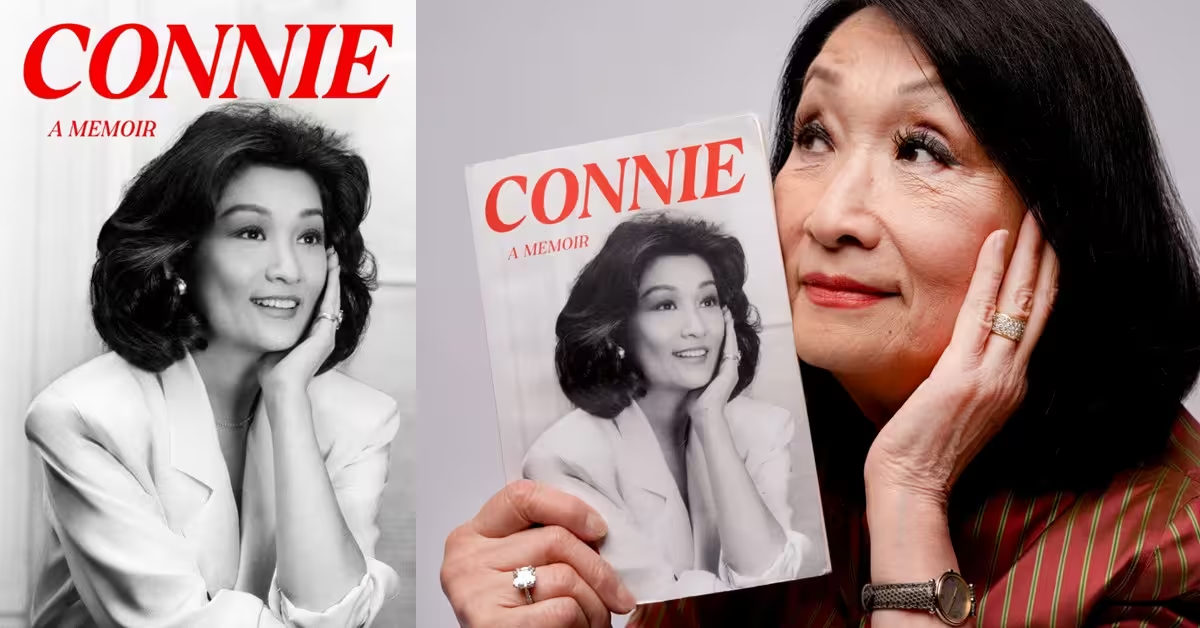
Why do so many of us still feel we have to be “agreeable” to be accepted—and “aggressive” to be respected? Connie: A Memoir answers that question with backstage truth, career bruises, and the kind of hard-earned self-knowledge you only get by living through the camera’s glare.
Connie: A Memoir is suggested for the readers who love full-access media memoirs: newsroom politics, “how the sausage gets made,” and the cost of being first.
Anyone curious about broadcast news history (Watergate, prime-time wars, big exclusives, tabloid drift). and readers who want a memoir that’s both immigrant-family story + American workplace power story (race, gender, credibility, ambition).
Not for
- If you want a quiet, purely reflective memoir with minimal industry detail—this book names names, shows mechanisms, and revisits controversies.
- If you dislike “full spoiler” career arcs and behind-the-scenes conflict (network rivalries, public pile-ons, internal betrayals).
- If you want a strict, linear diary: it’s structured as a life story, but it also functions like a case study in modern media incentives.
Table of Contents
1. Introduction
Book: Connie: A Memoir
Author: Connie Chung
Publisher / Imprint: Grand Central Publishing
Publication date (On sale): September 17, 2024
Length: 336 pages
ISBN-13: 9781538766989
Context
This is a nonfiction autobiography / media-industry memoir by one of the most visible broadcast journalists of the late 20th century.
The publisher frames Chung as a trailblazer who broke into “overwhelmingly white, male-dominated television news,” and highlights that she made history as the first woman (and Asian) to co-anchor the CBS Evening News.
That context isn’t just résumé padding—it becomes the book’s operating pressure: every promotion, every misstep, every “you can’t win” moment is amplified because she’s always being read as an exception and a symbol.
Purpose of Connie: A Memoir
Here’s what I think the central thesis is, based on the book’s own through-line and the way it’s presented by the publisher:
- Being first is not a crown—it’s a grind, especially when the culture wants you to be grateful, quiet, and “pleasant” while also demanding star performance.
- American TV news gradually blurred into tabloid logic, and women (especially women of color) often paid the price when “ratings juice” was prioritized over credibility. The publisher explicitly calls out that “larger theme: how the line between serious reporting and tabloid journalism became blurred.”
- Truth-telling has a personal cost, and sometimes the story you avoid for decades becomes the one that redefines your legacy—something Chung confronts directly when she discusses stepping into public testimony around sexual abuse memories.
2. Background
Connie Chung’s journey to the pinnacle of broadcast journalism was a testament to her resilience, determination, and unique position as a trailblazer. On May 14, 1993, she reached the height of her career, becoming co-anchor of the “CBS Evening News” alongside the legendary Dan Rather.
For Chung, a Chinese American woman who had overcome strict parental expectations and a male-dominated industry, this moment was nothing short of a dream realized.
Yet, as she later recounted in her memoir Connie: A Memoir, the triumphs of her groundbreaking career were often paired with profound challenges, including sexism, racism, and internal politics within the industry.
Before the networks and the anchors’ desks, Chung builds her foundation in an immigrant family story that is both tender and brutally instructive: what gets valued, what gets silenced, what gets demanded.
One early passage that hit me like a cold splash is how gender preference worked inside family expectations: the resentment toward her mother for “not producing a grandson,” and the grief of losing infant sons—plus the striking detail that a sister was dressed as a boy to satisfy tradition’s optics.
That’s not just “backstory.” It’s the template for the rest of the memoir: public performance, private pain, and the constant negotiation between what you are and what others insist you should be.
She also writes with specificity about assimilation pressures and the costs of belonging—citizenship, fear, and the emotional demand to sever contact with relatives in Communist China. On June 13, 1956, the family takes the oath as American citizens, after an “exhaustive investigation,” and the memoir holds both pride and loss in the same hand.
3. Connie: A Memoir Summary
The essentials at a glance
- Immigrant family formation + gender expectations: grandmother’s hostility, pressure for a grandson, and the family’s grief cycles.
- Citizenship and assimilation: investigations, fear of political suspicion, and the oath on June 13, 1956.
- Early career hustle + political reporting: campaign trail life and a clear window into how “being there” becomes everything.
- Watergate’s timestamp: June 17, 1972 (2:30 a.m.), burglary that kicks off what becomes her “most memorable story ever.”
- A personal trauma enters public record: her letter to Christine Blasey Ford insisting that “exact dates… are insignificant,” and the line that lingers: we remember “what happened… and who did it to us.”
- Tabloid gravity and newsroom power: O.J. coverage, competitive “gets,” and the chilling note: “THIS IS GREAT!”
- Bitchgate: a network publicity move turns a long interview into a scandal; she’s labeled with ugly terms; the ethics debate becomes a media feeding frenzy.
- Oklahoma City bombing coverage: April 19, 1995, 168 killed, 19 children—and the backlash machine that follows.
- Later career chapters: rivalry dynamics, firings that become “gifts,” and the pivot toward family life—especially motherhood later in life.
Full summary of Connie: A Memoir
1. A family story where love exists—but hierarchy has teeth
The early sections are a masterclass in how a home can be both safe and pressurized. Chung describes a multigenerational household shaped by tradition, where a mother-in-law’s resentment and a culture’s obsession with male heirs create a climate of blame.
The memoir doesn’t present this as cartoon cruelty; it’s more chilling than that—ordinary, normalized, inherited.
She writes about her grandmother’s animosity toward her mother for not producing a grandson and how, after infant boys died, the family tried to “solve” the problem symbolically: dressing a daughter as a boy. The passage is specific and unsettling, because it’s not metaphor—it’s a family decision captured in photographs.
As a reader, I felt the long shadow of that logic: you can be loved and still be evaluated, and you can be “included” while being reminded you’re conditional.
2. Citizenship, suspicion, and the performance of “acceptable”
Then comes the American chapter that’s never just a clean “arrival.” The family undergoes deep scrutiny by immigration officials, including questions about Communist ties and “derogatory comments.”
Chung emphasizes the emotional price: her parents had to cut off communication with relatives in China.
When she notes that an official “waved” her mother through despite test difficulties, it reads as both mercy and a reminder: so much depends on the discretion of gatekeepers.
The memoir also captures the texture of assimilation—neighbors teaching American dishes, the family slowly building “place settings for twelve” by trading cereal box tops for utensils, and the small joys of holidays that are more about belonging than theology.
3. The political reporter’s education: proximity, stamina, and being underestimated
Chung’s early career energy is pure momentum: the hustle, the being-on-call, the way your body becomes part of the job. A small moment says a lot: after she gets an exclusive, her mother watches and tells her, “You look tired,” and Chung replies you could only see her hand holding the mic. Her mother lands the perfect line: “Your hand looked tired.”
It’s funny—but it also captures the family’s role: proud, worried, emotionally present, and always watching the cost.
4. Watergate: the timestamp that changes the scale of everything
The memoir’s Watergate section gives a crisp chronology that anchors her voice inside a national event. She marks the burglary as 2:30 a.m. on June 17, 1972, and calls Watergate “my most memorable story ever.”
She writes about trying to keep up with Woodward and Bernstein, building relationships at the courthouse, and chasing inside access that never quite delivers what you hope.
What I took from this part isn’t just “history.” It’s the memoir quietly teaching what news actually is: access, documents, timing, and the frustration of being adjacent to the biggest revelations without being the one who breaks them.
5. The personal story she avoided—until she didn’t
One of the memoir’s emotional pivots is her decision to publicly reveal being molested by the doctor who delivered her—discussed in the publisher description, and then given full psychological weight inside the text.
Chung reproduces her own message to Christine Blasey Ford with visceral physical symptoms: “I can’t sleep. I can’t eat,” and the fear that a long career will be reduced to a footnote.
Then she lands the line that—at least for me—becomes one of the book’s moral centers: she tells Ford that “exact dates, exact years are insignificant,” because “We remember exactly what happened to us and who did it to us.”
That’s not just advocacy; it’s a philosophy of memory and truth that runs parallel to her journalism ethic. She also reveals an aftershock: a sister calls to say the same doctor molested her earlier—opening the haunting question of how many others existed outside the frame.
6. The Maury chapter: intimacy, contrast, and why partnership matters
Chung’s portrait of Maury Povich is one of the memoir’s relief valves: funny, human, and oddly instructive about temperament. She writes in a list of opposites—“He is a rule breaker. I am a rule maker… I’m a worrywart…”—and it works because it’s not just cute: it shows how she survives.
Their relationship becomes the memoir’s emotional scaffolding: someone who sees her not as a symbol, but as a person with limits, pride, and fear.
7. Media gravity: when “serious news” starts losing its border
As her career rises, the memoir gets increasingly honest about how network news decisions are made—often with a crude calculus: prestige vs. ratings vs. competitive panic.
One line that tells you exactly where television was headed is Dan Rather’s note during the O.J. Bronco chase: “THIS IS GREAT!”
Chung calls it “a low moment for television news,” but also points out the asymmetry: when others did similar coverage, they didn’t get the same “taint.”
Even more revealing is the internal power dynamic: Rather tells her to “confine” herself to the studio and “just read the news,” while he takes the field reporting—an instruction soaked in old-world gender assumptions about who gets to move and who gets to stay put.
8. Bitchgate: a controversy built from editing, spin, and scapegoating
Bitchgate is one of the memoir’s core case studies in modern media mechanics.
Chung describes how CBS promoted her interview with Newt Gingrich’s mother via a press release featuring a 30-second excerpt—and that excerpt included the mother saying Newt called Hillary Clinton “a bitch.” The memoir frames what follows as a wildfire that nearly “incinerated” her career.
Then the book turns surgical about how scandals are constructed:
- She argues the network yanked the moment out of context and lit the fuse.
- She becomes the target: critics call her “liar,” “predator,” “unethical,” and worse; she receives obscene slurs.
- Gingrich publicly condemns her as a collapse of “Edward R. Murrow tradition,” using the moral authority of journalism history as a weapon.
What’s especially interesting is how the memoir refuses a simple “I’m innocent” posture. Instead, it shows how ethics debates can be real and still get exploited by power.
CBS leadership defends her by describing “between you and me” as a standard interviewing technique associated with Mike Wallace—basically saying: the industry celebrates this tactic until it needs a sacrifice.
And she includes a list of high-profile journalists who supported her—Cronkite, Walters, Stahl, Sawyer—which matters because it documents that the backlash was not a universal professional consensus; it was a spectacle with incentives.
9. Oklahoma City: tragedy, excellence, and the cruelty of rumor
The memoir’s Oklahoma City chapter starts with stark facts: April 19, 1995, the bombing kills 168 people, including 19 children, and was (at the time) the deadliest domestic terrorist bomb attack in U.S. history.
Chung emphasizes what journalists are trained to do: when news breaks, “we run to it.”
She gets there fast, anchors live, and notes she’s the only network anchor on the scene initially.
Then comes the gut punch: she returns to New York and walks into a tornado—Dan Rather is furious that she, not he, covered the tragedy, and rumor warfare ignites.
The memoir documents how scurrilous, unfounded claims spread: fake stories about disguises, handcuffs, being “ordered out of the state”—a portrait of how quickly a woman’s credibility can be undermined by lurid invention.
Even if you don’t care about TV news history, this chapter reads like a blueprint for today’s media ecosystem: truth competes with a more shareable lie, and institutions often fail to protect the person doing the actual work.
10. Later chapters: rivalries, rules, firings—and reframing “loss” as gift
Later sections expand the scope beyond CBS into the broader ecosystem: ABC’s internal “minefield” dynamics with Barbara Walters and Diane Sawyer (and the shock of being barred from competing for interviews they want). Chung writes, “I’d foolishly believed the women would be my comrades,” and the sting there feels like betrayal, not gossip.
Then there’s a recurring pattern: job changes and firings that become involuntary gifts—painful, humiliating, but also freeing. When she’s let go from CNN, she reframes it in family terms: being “cut loose” lets her focus on her son, because she “dearly wanted to get this part of my life correct.”
That line lands because it’s not Hallmark optimism—it’s a woman measuring success by something deeper than airtime.
11. The Marlon Brando episode: fame, weirdness, and boundaries
A surprising (and darkly funny) thread: Marlon Brando repeatedly calls her—first at work, then with long answering machine messages, then with the intimate question of what she wears to bed.
It’s celebrity absurdity, yes, but it also quietly reinforces the memoir’s broader theme: women in media are constantly navigating unwanted access—from powerful executives to famous men who assume proximity.
4. Major Events Summary
1. Reaching the top: CBS Evening News co-anchor
Connie Chung’s appointment as co-anchor of the CBS Evening News is framed as the peak of her professional ascent and a milestone in broadcast history.
She is presented as the first Asian American woman to co-anchor a major network evening newscast, sharing the desk with Dan Rather, successor to Walter Cronkite.
Her promotion is portrayed as the culmination of years of high-profile reporting—especially her work in the 1970s, including coverage linked to Watergate, and later anchoring in Los Angeles, which helped solidify her national reputation.
2. The abrupt fall: internal politics and sexism
The narrative then shifts to how quickly that historic moment unraveled.
After roughly two years, Chung’s co-anchor role ends suddenly—she learns via a call from her agent just before going on air that the broadcast will be her last, and Rather will return as sole anchor.
Chung interprets the ouster as shaped by sexism and internal hierarchy: male “anchormen” are described as ego-driven (“big-shot-itis”), and she is repeatedly steered toward lighter, more sensational assignments while men hold the “serious” stories.
A key example is her being assigned to cover the Tonya Harding–Nancy Kerrigan scandal, which she sees as gendered sidelining even if CBS justified it via Olympics-related incentives.
3. “Bitchgate” and reputational damage
A major reputational turning point is the 1995 interview with Newt Gingrich’s mother, later dubbed “Bitchgate.” The summary argues CBS released a short, out-of-context excerpt that made it look like Chung manipulated the guest into repeating a derogatory label about Hillary Clinton.
The aftermath is described as intense: widespread condemnation, accusations of unethical journalism, and further proof (in Chung’s view) that the network used her for sensationalism and then failed to protect her credibility.
4. Private life as refuge: motherhood after loss
Against this turbulence, her personal life becomes the emotional counterweight. After leaving CBS, Chung and her husband Maury Povich are approved to adopt a baby boy after years of miscarriages. Near age 50, she steps back professionally to prioritize motherhood.
The core takeaway is that she reframes “having it all” as sequential rather than simultaneous—career first, family later—finding peace in that later-life rebalancing.
5. Legacy: “Generation Connie” / “Sisterhood of Connies”
A later chapter highlights a surprising, affirming legacy: in 2019, journalist Connie Wang contacts her, describing how many Asian American families named daughters after Connie Chung.
This “Generation Connie” becomes proof that Chung’s visibility mattered deeply, even when she personally experienced her career as unstable or disappointing. The theme is recognition arriving late—but landing hard.
6. The “good girl / bad girl” survival strategy
Another core idea is the persona tightrope Chung had to walk: being both the “obedient, hardworking” journalist and the sharp, irreverent woman capable of sparring with powerful men. She is depicted as operating in a workplace where she was treated as a token and a threat.
She faced sexist behavior—objectification, flirtation, belittlement—from colleagues and interview subjects, and developed a coping strategy: self-deprecating humor, preemptive jokes, and tactical banter to keep control without derailing interviews.
7. Tabloid gravity: Tonya-Nancy and O.J. as credibility costs
The Tonya Harding–Nancy Kerrigan section is presented as a symbol of the era’s shift toward media spectacle. Chung resists covering it, calls it beneath serious journalism, but executives insist.
She enters a chaotic press scrum at a public rink, even shouting from a wall to get access, and internally questions whether Walter Cronkite would have done the same. Despite high ratings and successful interviews, she feels the work chips away at her professional identity.
That same pattern repeats with the O.J. Simpson story: she considers it tabloid fodder, but CBS wants ratings parity because competitors are winning audience attention. She conducts multiple O.J.-related interviews, experiencing each as another tradeoff between visibility and credibility, while still trying to balance sensational coverage with serious reporting.
8. Conflict with Dan Rather and institutional indifference
Parallel to the tabloid assignments is an escalating power struggle with Dan Rather. He is depicted as increasingly uncomfortable sharing prominence, resenting her field assignments, and ultimately insisting she should stay in the studio while he gets the on-location reporting.
When she raises this with CBS leadership, the response is essentially to endure it—reinforcing her sense that the institution won’t intervene to protect her role or status.
9. Final reflection: integrity vs. the machine
The combined arc becomes a broader reflection on how network television pulled journalists toward spectacle and how that pressure intersected with sexism and internal politics. Chung looks back on what she sacrificed trying to satisfy network demands while preserving integrity.
She credits Maury’s advice—take the work seriously, but not yourself—as a key coping anchor. The conclusion frames these experiences as shaping not only public narratives but also the storyteller’s sense of self.
5. Connie: A Memoir analysis
Does Chung support her claims with evidence and logic?
In the way she tells stories, Chung often behaves like the reporter she is: she anchors scenes with dates, names, and quoted dialogue (or notes) that function like receipts—Watergate’s timestamp, the Gingrich press strategy, the literal note “THIS IS GREAT!”, the documented rumor list after Oklahoma City.
What makes the evidence persuasive isn’t only that it’s “factual,” but that it’s structurally coherent:
- Institutional incentives (ratings, competition, branding) create decision pressure.
- Pressure creates ethically gray choices (or choices made for her).
- When backlash arrives, it lands hardest on the person easiest to isolate—often the “first,” the “different,” or the woman who can be stereotyped.
In other words: the memoir’s logic is systems-based, not just personality-based. That’s why it feels educational, not merely cathartic.
Does the book fulfill its stated purpose?
Yes—especially if we accept the publisher-stated “larger theme” as part of the mission: the blur between serious reporting and tabloid journalism.
Chung doesn’t preach a media-studies lecture; she demonstrates the blur through lived examples:
- Anchors forced toward spectacle coverage (O.J. gravity).
- Promotions engineered through isolated “sexy” clips (Bitchgate excerpting).
- Ethical outrage cycles that ignore institutional responsibility and single out the on-air person.
So the book contributes meaningfully not only to memoir readers, but to anyone studying journalism ethics, media incentives, and gendered credibility in public life.
6. Strengths and Weaknesses
Strengths (what genuinely worked on me)
1) It teaches without sounding like a textbook.
I came away understanding how clips, press releases, competitive booking, and “star hierarchy” shape what the public thinks is “news.”
2) The specificity is the trust-builder.
The memoir doesn’t float in vague empowerment language—it pins moments to dates and concrete actions, like the April 19, 1995 bombing toll and her immediate deployment.
3) Emotional honesty arrives where it counts most.
Her letter’s line about memory—knowing “what happened… and who did it”—hit me as both personal truth and a public argument about how we judge victims.
4) Humor cuts the bitterness.
Even when the stories are brutal, she finds comedy (her mother’s “tired hand,” the relationship contrasts with Maury).
Weaknesses (what didn’t fully work for me)
1) Some sections can feel like repeated proof of the same unfairness.
The accumulation is the point—yet as a reader, there were moments where I wanted tighter compression, because the pattern is already established (institution + ego + gender stereotype = scapegoat). This is a taste issue, not a factual flaw.
2) Network-era name-and-incident density may overwhelm casual readers.
If you don’t already care about who ran what show when, parts might read like a high-speed briefing. For media/history lovers (me), it’s gold; for others, it’s occasionally a firehose.
3) The memoir’s strongest analytic insight (tabloid drift) is mostly demonstrated, not explicitly theorized.
That’s arguably a strength—show, don’t tell—but if you wanted a more direct “here’s what changed in TV news, structurally,” you’ll be doing a bit of synthesis yourself (though the examples are there).
7. Comparison with similar works
If you liked Connie: A Memoir, three adjacent lanes come to mind:
- Barbara Walters – Audition (media titan autobiography): Where Walters narrates the climb to power, Chung’s memoir often narrates the cost of being treated as provisional—valuable, but replaceable. (I’m drawing a thematic comparison; Walters’ book is widely known as her memoir, but this review is anchored mainly in Chung’s text and contemporary coverage.)
- Mike Wallace – Between You and Me (journalist memoir / technique): Chung’s Bitchgate defense explicitly references “between you and me” as a known Wallace technique, making Wallace’s memoir a useful companion for understanding the industry’s double standards.
- Modern media-evolution memoirs that trace “serious news vs. spectacle”: Chung’s book is especially valuable because it’s firsthand from the moment the border visibly cracked (O.J.-era live-chase logic).
8. Conclusion
Would I recommend Connie: A Memoir? Yes—especially if you’ve ever asked yourself:
- Why do women get called “difficult” for doing the exact job description?
- How did TV news slide toward tabloid incentives without admitting it?
- What does it cost to be first—and what does it cost to stay?
Read it if you want a spoiler-full, behind-the-scenes education in American broadcast news, anchored in immigrant-family reality and sharpened by career-long proof that credibility is not distributed equally.
Skip it if you’re hoping for a gentle, anonymous memoir with no controversies, no institutional critique, and no hard truths about how reputations get engineered and shredded.
And if you like long-form memoir analysis in this same “give me everything so I don’t have to go back” style, your own site already has a strong template—your detailed memoir review of The Uncool shows the kind of chapter-by-chapter, thesis-forward structure that pairs naturally with a Connie deep dive.