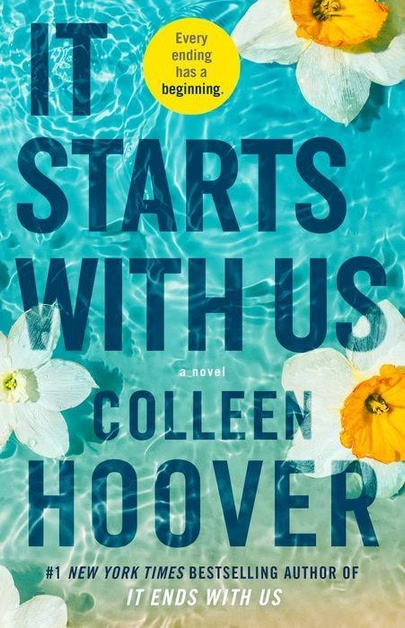
It Starts with Us by Colleen Hoover arrives as the long-awaited sequel to It Ends with Us, picking up exactly where Lily Bloom’s story left off, divorced from Ryle, mother to eleven-month-old Emerson, and unexpectedly face-to-face with Atlas Corrigan after nineteen months apart.
Published by Atria Books in October 2022, the novel was born from a tidal wave of reader demand on BookTok, where fans petitioned for Lily and Atlas to get the future the first book only hinted at.
Hoover has said she never planned a sequel, but the overwhelming response changed her mind, and she set out to write “a much lighter experience” for characters who had already endured enough.
Quick Verdict
- Verdict: A tender, character-driven continuation that earns its happy ending by making its characters work for it, even if the external stakes feel lower than its predecessor.
- Rating: 4.2/5
- Best for: Readers who needed closure for Lily and Atlas, fans of second-chance romance, and anyone navigating co-parenting with a difficult ex.
- Main strength: The alternating POVs capture the messy reality of rebuilding trust while parenting and running businesses.
- Main weakness: The absence of genuine tension in the central romance, once they commit, the path smooths out quickly.
At a glance
It Starts with Us follows Lily (florist, single mom) and Atlas (restaurateur, newly discovered big brother to 12-year-old Josh) over roughly a year in Boston. The novel opens with their awkward sidewalk reunion and ends at their wedding, with Atlas’s vows reframing marriage not as a guarantee but as a witnessed promise worth making anyway.
Key turning points: Lily reclaims her apartment key from Ryle, Atlas takes custody of Josh after finding him sleeping on Corrigan’s steps, Lily tells Ryle she’s dating Atlas, and the blended family moves into a house with a garden Lily has dreamed of since adolescence.
The epilogue-letter structure from It Ends with Us returns, Lily writes to Ellen DeGeneres; Atlas writes unsent letters to Lily, creating continuity while letting each voice process trauma differently.
What Is It Starts with Us About?
Lily Bloom has divorced Ryle Kincaid after he pushed her down stairs and bit her shoulder during a violent episode, trauma documented in the first novel. She owns a flower shop, co-parents Emerson, and has spent nineteen months single.
Atlas Corrigan, her first love from Maine, now runs two Boston restaurants and has just discovered a younger brother, Josh, living in a vacuum of neglect. The novel tracks two parallel arcs: Lily and Atlas navigating a new relationship while Ryle hovers at the edges, and Atlas stepping into a guardian role for Josh while confronting his own childhood abandonment.
No major external plot twists arrive; the tension lives in quiet moments, reclaiming a key, a custody mediation, a tattoo revealed, a garden planted.
Is It Starts with Us Worth Reading? Spoiler-Free Review
Writing Style and Narrative Voice
Hoover retains the dual-POV, present-tense immediacy of the first book, but the texture shifts. Lily’s chapters still include letters to Ellen DeGeneres, a framing device that worked in It Ends with Us as a survival mechanism and here functions more as emotional bookkeeping.
Atlas’s chapters introduce a new correspondent: he writes letters to Lily he never sends, then later reads them aloud as wedding vows.
The device feels earned because we’ve watched him struggle to articulate feelings across 37 chapters. Sentence-level prose remains accessible, dialogue-heavy, and occasionally repetitive (characters “let out breaths they didn’t know they were holding” more than once), but the emotional specificity- Lily flinching when Ryle touches her cheek, Atlas noticing Josh’s “better kind of mean” protectiveness- carries weight.
Characters and Pacing
The novel spans roughly twelve months but moves in fits and starts. Weeks pass between chapters during busy restaurant or flower-shop periods; other chapters cover single evenings in granular detail. This mimics real life but can frustrate readers expecting constant forward motion.
The cast expands: Josh (12, spray-painting vandal turned dishwasher), Theo (Brad’s 12-year-old son, self-appointed therapist), Darin and Brad (Atlas’s loyal staff), Allysa and Marshall (Lily’s best friend and her husband, Ryle’s sister and brother-in-law). Each gets enough page time to feel three-dimensional without crowding the core four.
Ryle remains the most polarizing element; he’s neither villain nor redeemed, just a man who “was on his best behavior” because he knew Lily could destroy his career, and whose cooperation “rests on the notion that he’ll eventually win me back” (Ch. 2, Lily’s letter to Ellen).
Pros and Cons
| Pros | Cons |
|---|---|
| Honest depiction of co-parenting with an abuser | Low external stakes after midpoint |
| Josh’s arc adds dimension to Atlas | Lily’s Ellen letters feel repetitive |
| Wedding vows reframe marriage realistically | Ryle’s threat diminishes without confrontation |
| Garden/house motif pays off thematically | Some dialogue feels expository |
Who Should Read It?
Read this if you finished It Ends with Us needing to know Lily and Atlas actually made it work. Skip if you wanted high-stakes drama or a darker exploration of trauma aftermath, this is, by Hoover’s own admission, “a much lighter experience.”
Spoiler warning: The following sections reveal major plot developments and the ending. Skip to the final recommendation for a spoiler-free conclusion.
It Starts with Us Plot Summary and Ending Explained
The Beginning
The novel opens at Bib’s, Atlas’s first restaurant, where someone has spray-painted “ass whole” across the back door and stolen only croutons. Atlas recognizes the desperation—he once broke into a restaurant and stole a turkey sandwich when he was homeless as a teenager.
He refuses to file a police report. That same morning, he runs into Lily on the sidewalk. She’s rushing to open her flower shop, pushing Emerson in a stroller, meeting Ryle for a custody exchange. They stand there for five minutes.
Atlas tells her, “We finally reached the shore”, a Finding Nemo reference from their childhood. Lily, flustered, asks a series of awkward questions, then promises to text him. She doesn’t for eight hours.
Lily spends her lunch break in her car writing to Ellen.
The letter catches us up: she asked Ryle for a divorce right after Emerson’s birth, choosing sole custody with day visits only because her lawyer warned that pressing domestic violence charges in court would likely still result in joint custody; Ryle had no record, paid support, and was a “willing, successful father.” Lily took the “lesser of two evils.”
She hasn’t kissed Atlas since she was sixteen. She’s terrified Ryle will make her life “a living hell” if she dates again. She’s also lonely.
Atlas, meanwhile, consults Theo—his twelve-year-old pseudo-therapist—about texting etiquette. Theo tells him to just text her. Atlas does: “It was good seeing you today, Lily.” She replies: “You too.” That’s it.
The Middle: Boundaries, Brothers, and a First Date
Lily confronts Ryle about his apartment key. He’s been using it to bring Emerson home after late surgeries, but the frequency feels intentional. When she asks for it back, he threatens to modify the custody arrangement and pursue overnights. Lily holds firm: “When she can talk. So she can tell me if something happens, Ryle.” He hands over the key.
Atlas discovers the vandalism at his new restaurant, Corrigan’s, was committed by a boy who slept on the back steps for two hours before breaking in. Security footage reveals it’s Josh—twelve, hungry, wearing clothes that don’t fit, carrying spray paint.
Atlas recognizes him from a photo in his mother’s obituary: his little brother, surrendered to foster care years ago. He takes Josh in, feeds him, cuts his hair, enrolls him in school near Theo.
Lily and Atlas’s first date: a drive to a restaurant outside Boston. Lily falls asleep in the parking lot for over an hour. They never make it inside. Atlas thinks it’s endearing; Lily is mortified. They start texting daily. Atlas brings lunch to the flower shop, meets Allysa, wins her over. Allysa presses Lily to tell Ryle. Lily delays.
Ryle finds out anyway; Marshall mentions Atlas at a family dinner. Ryle shows up at Lily’s shop, cold and controlled. He asks if Atlas is “the guy from Maine.” Lily confirms. Ryle leaves without a scene, but the temperature drops.
Custody mediation follows. Ryle’s lawyer pushes for overnights. Lily’s lawyer presents the list, seven items, ending with “You did this for your daughter.” The mediator recommends maintaining day visits for now, with a review in six months. Ryle signs. He’s unhappy but compliant.
The Turning Point: Tattoo, Trauma, and Trust
At Lucy’s wedding, Atlas sees Lily’s heart tattoo on her shoulder, the one covering Ryle’s bite marks. He freezes. Later, in the car, he asks about it. Lily tells him the list. He doesn’t flinch. He kisses each scar. “I’m not going anywhere,” he says.
Josh’s mother, Sutton, resurfaces, she wants custody back. Her boyfriend abused Josh; Atlas documented the injuries and called a lawyer. Sutton signs over guardianship without a fight. Atlas adopts Josh legally.
Lily’s mother visits the new house Atlas bought, a place with a backyard garden “almost unheard-of for a place this far into the city.” She reveals she met Atlas once, years ago: caught them asleep on the couch, meant to threaten him, and instead received a hug that “carried this genuine sorrow for me.” She knew all along. “And now look. You have him forever”.
The Ending Explained
The novel concludes at Lily and Atlas’s wedding, two years after their reunion. Atlas’s vows (Ch. 37) are the emotional centerpiece. He acknowledges the 50% divorce statistic and reframes it: “If someone would have told me when I was a teenager that I would have a fifty-fifty chance of living my entire life with you, I would have felt like the luckiest human on the planet.”
He vows gratitude regardless of outcome: “If it’s my destiny to end up a statistic, there’s no one else I’d rather become a statistic with than you.” He ends with a P.S.: “It is my wish for you to be my fish”, the Finding Nemo callback from their first reunion.
The final scene: Lily texts Atlas from the backyard of their new home. “I love you so much, you idiot.” They have built the life the first book only dared imagine.
Characters, Themes, and Symbolism
Main Characters and Their Development
Lily Bloom moves from survival to choice. In It Ends with Us, every decision was reactive—leave Ryle, protect Emerson, endure. Here, she chooses Atlas despite the risk to her co-parenting equilibrium. She chooses the house, the garden, the wedding.
Her agency expands chapter by chapter. The Ellen letters, once a lifeline, become a ritual she eventually outgrows—she stops writing them after the wedding.
Atlas Corrigan carries two abandoned children now: the boy he was, and Josh. His arc is about learning he’s allowed to take up space.
He feeds people: croutons, turkey sandwiches, cookies instead of flowers, a garden for Lily. His restaurants are extensions of his nurturing. The vandalism at Bib’s and Corrigan’s mirrors his past; his refusal to prosecute mirrors his compassion.
Adopting Josh closes the loop his mother’s death opened.
Ryle Kincaid remains the most contested figure. He never apologizes for the violence. He gaslights (“he probably thinks I flinched because I felt a spark”). He threatens court when boundaries tighten. But he also shows up for Emerson, sings to her, brings Thai food.
Hoover refuses to make him a monster or a martyr; he’s a man who caused harm and refuses to name it, which is its own kind of realism.
Josh enters as a delinquent and leaves as a brother. Theo’s assessment, “he’s like a bully to the bullies… he isn’t mean to the nice people”, captures a kid who survived by performing toughness. His casual coming-out to Theo (“I’m not a dumbass”) and request to stay over signal trust. He calls Atlas “Considerate Atlas” the way Lily does, a family language forming.
Relationships and Motivations
The Lily-Atlas relationship is built on history as shorthand. They don’t need to explain the trauma; they lived it together at sixteen. This creates intimacy but also blind spots, they assume they know each other’s reactions.
The novel’s quiet tension comes from discovering who they’ve become: Atlas, the restaurateur with a therapist-son; Lily, the florist with a list in her jewelry box.
The Lily-Ryle dynamic is a study in managed hostility. Lily’s boundary, “When she can talk”, is both practical and symbolic. She’s not keeping Emerson from Ryle; she’s keeping Emerson safe from the version of Ryle that emerges when no one watches. Ryle’s compliance is transactional: he behaves because the alternative is exposure.
Atlas-Josh mirrors Atlas-Lily at sixteen: one homeless, hungry kid taking in another. But Atlas has resources now. He models what he wished someone had modeled for him—consistency, consequences (dishes for crouton debt), pride (haircut, clothes that fit).
Central Themes
Love as witnessed promise. Atlas’s vows interrogate why vows exist: “If we trusted everyone to keep their word, vows wouldn’t be necessary.” The novel argues that public commitment matters because humans are unreliable.
The wedding isn’t the happy ending; it’s the witness.
Breaking cycles through documentation. Lily’s list. Atlas’s ER visit for Josh’s concussion (“Better to get this documented in case we need proof of her abuse at a later date”). The mediation agreement. The adoption papers. Trauma is slippery; writing it down makes it actionable.
The garden as future-making. Lily has wanted a garden since Maine. Atlas buys a house with “the perfect backyard for a garden” before they’re officially together. His mother-in-law asks if he chose it hoping she’d return.
He didn’t, but the garden becomes the physical manifestation of a life they’re building together, not just surviving.
Second chances require new skills. Lily and Atlas don’t just resume their teenage romance. They learn to communicate as adults, texting through busy days, scheduling dates around custody and restaurant crises, introducing partners to children slowly. The “lighter experience” Hoover promised is actually harder work disguised as ease.
Symbols and Their Meaning
| Symbol | First Appearance | Meaning |
|---|---|---|
| “Ass whole” graffiti | Ch. 1 | Atlas’s mother’s insult, reclaimed as humor; class shame made visible |
| Croutons | Ch. 1 | Desperation stealing; Atlas’s past and Josh’s present converge |
| The list (7 items) | Ch. 2, Ch. 4 | Evidence against memory distortion; Lily’s anchor |
| Heart tattoo | Ch. 20 | Reclaiming a wound; Atlas kissing the scars = acceptance |
| Garden/house | Ch. 36 | Chosen future vs. inherited trauma |
| “Be my fish” | Ch. 1, Ch. 37 | Private language surviving two decades; play as resilience |
Critical Evaluation
Overall Critical Judgement
It Starts with Us succeeds at its specific aim: giving Lily and Atlas a future that feels earned without erasing the past. It’s not a thriller, and it doesn’t pretend to be. The stakes are domestic: keys, custody schedules, school enrollment, garden plots and that’s the point. Hoover writes the sequel her readers asked for, not the one critics might have wanted.
Strengths: What Works Best
The custody mediation scene (Ch. 24–26) is the novel’s quiet peak. No shouting match, no dramatic revelation, just Lily’s list read aloud, Ryle’s lawyer doing his job, the mediator splitting the difference. It reflects how family law actually works: incremental, unsatisfying, necessary.
Josh’s integration avoids the “instant family” trope. He washes dishes to pay off “crouton debt.” He bonds with Theo over manga. He calls Atlas “Considerate Atlas” with the same wry affection Lily uses. The adoption feels like paperwork confirming what’s already true.
Atlas’s vows reframe the entire duology. They acknowledge the statistical likelihood of failure and choose commitment anyway. That’s a more honest romance than “love conquers all.”
Lily’s mother’s revelation (Ch. 36) retroactively deepens the first book. She knew. She hugged Atlas. She stayed silent because “I figured you would bring it up to me if you wanted me to know.” It’s a mother respecting her daughter’s agency after a lifetime of having none.
Weaknesses: What Could Be Better
Ryle’s threat evaporates. After the mediation, he’s mostly absent. The “tsunami” Lily feared never fully arrives. A scene of Ryle meeting Atlas, even briefly, would have tested the new equilibrium.
The Ellen letters overstay. By chapter 30, they’re summarizing events we just read. Lily’s voice is strong enough to carry internal monologue without the framing device.
Pacing lulls in the middle. Chapters 18–22 (lunch dates, wedding prep, texting montages) lack tension. The Josh custody arc provides external stakes, but the central romance coasts.
Some dialogue serves exposition. Characters explain things to each other they’d already know—Brad summarizing Josh’s history to Atlas, Allysa asking “Why does Ryle hate Atlas so much?” after years of friendship.
Emotional and Intellectual Impact
The novel lands hardest in its quietest moments: Lily reading her list while touching her tattoo. Atlas documenting Josh’s injuries “in case we need proof.” The garden scene where Lily’s mother admits she knew. These moments accumulate into a thesis: healing is bureaucratic, repetitive, and unglamorous—and that’s why it works.
Comparison with Similar Books
| Book | Similarity | Difference |
|---|---|---|
| It Ends with Us (Hoover) | Same characters, dual POV, letter device | Prequel is crisis; sequel is maintenance |
| The Seven Husbands of Evelyn Hugo (Reid) | Older woman reflecting on love, public vs. private self | Hoover is linear; Reid is retrospective |
| Normal People (Rooney) | On-again/off-again across years, class tension | Rooney is sparser; Hoover is more generous |
| After I Do (Taylor Jenkins Reid) | Marriage as daily choice, not destination | Reid separates couple; Hoover builds one |
Controversy, If Relevant
The It Ends with Us duology has faced criticism for romanticizing a relationship that begins with a power imbalance (Lily was 15, Atlas 16, homeless) and for centering a survivor’s empathy for her abuser.
It Starts with Us addresses this by making Lily’s boundaries with Ryle the condition for her freedom with Atlas. She doesn’t forgive Ryle; she manages him. Whether that distinction lands depends on the reader.
The 2024 film adaptation of It Ends with Us (starring Blake Lively, Justin Baldoni) sparked discourse about casting age gaps and marketing a domestic violence story as a romance. No sequel film has been announced.
What It Starts with Us Reveals About Co-Parenting After Abuse
The novel’s most grounded insight is that leaving an abuser doesn’t end the negotiation, it restructures it. Lily’s “day visits only until Emerson can talk” isn’t punishment; it’s risk management informed by lived data.
Research supports this caution: a 2023 NIJ-funded study found that fathers with documented IPV histories were granted unsupervised overnights in 41% of cases where mothers didn’t present specific safety evidence (NIJ, 2023).
Lily’s list is that evidence, and she uses it strategically rather than litigiously.
The novel also illustrates “post-separation abuse” through non-violent means: Ryle’s key retention, his “casual conversation” interrogation about dating, his threat to modify custody when a boundary hardens. These align with the Power and Control Wheel’s “using children” and “using legal systems” tactics.
Five Specific Lessons from the Book
7. Selected Quotes and Why They Matter
| Quote | Chapter | Context & Significance |
|---|---|---|
| “I broke into a restaurant once. Stole a turkey sandwich.” | Ch. 1 (Atlas) | Establishes Atlas’s empathy for the vandal; his past hunger informs his mercy. |
| “You did this for your daughter.” | Ch. 2 (Lily’s list, item 7) | The list’s anchor. Shifts focus from Lily’s pain to Emerson’s protection. |
| “When she can talk. So she can tell me if something happens, Ryle.” | Ch. 4 (Lily) | The boundary that defines the co-parenting arrangement. Practical, not punitive. |
| “He’s like a bully to the bullies… he isn’t mean to the nice people.” | Ch. 19 (Theo on Josh) | Reframing Josh’s aggression as protection. Theo sees what Atlas can’t yet. |
| “If it’s my destiny to end up a statistic, there’s no one else I’d rather become a statistic with than you.” | Ch. 37 (Atlas’s vows) | The novel’s thesis: commitment because of fragility, not despite it. |
| “It wasn’t a tactic. Considerate Atlas.” | Ch. 36 (Lily, internal) | Lily recognizing Atlas’s consistency across decades. The nickname becomes a verdict. |
Final Recommendation
Read It Starts with Us if you invested in Lily and Atlas and need to see them build something that lasts. It delivers on its promise: a lighter, hopeful continuation that respects the weight of the first book. The romance is low-conflict after the midpoint, but the co-parenting and found-family arcs carry genuine tension.
Skip if you want high-stakes drama, a reckoning for Ryle, or a darker exploration of trauma’s long tail. This novel is about after—the daily work of choosing each other when the crisis has passed.
For the full experience, read It Ends with Us first. The sequel assumes fluency in its history, and the emotional payoffs-Atlas’s vows, the garden, the list-land because you’ve witnessed the cost.
FAQs
Do I need to read It Ends with Us first?
Yes. The sequel opens the morning after the first book ends and assumes knowledge of the abuse, the divorce, the Ellen letters, and Lily and Atlas’s teenage history.
Does Ryle get redeemed?
No. He becomes manageable, not healed. He signs the mediation agreement, returns the key, and largely exits the narrative. He never apologizes for the violence.
Is there a third book?
Not as of November 2026. Hoover has said the duology is complete.
How graphic is the domestic violence content?
The violence occurred in the first book. It Starts with Us references it (the list, the tattoo, Lily’s flinch) but depicts no new incidents.
What’s the “fish” line about?
A Finding Nemo reference from their teenage years. Atlas said “We finally reached the shore” at their reunion; the vows end with “It is my wish for you to be my fish”, a private joke surviving two decades.
Is Josh adopted legally?
Yes. Sutton signs over guardianship; Atlas adopts him before the wedding (Ch. 33).
Does Lily stop writing to Ellen?
The letters taper off after the wedding. The final chapter implies she’s outgrown the device.
How long is the timeline?
Roughly two years: reunion to wedding.