
Last updated on November 6th, 2026 at 11:44 am
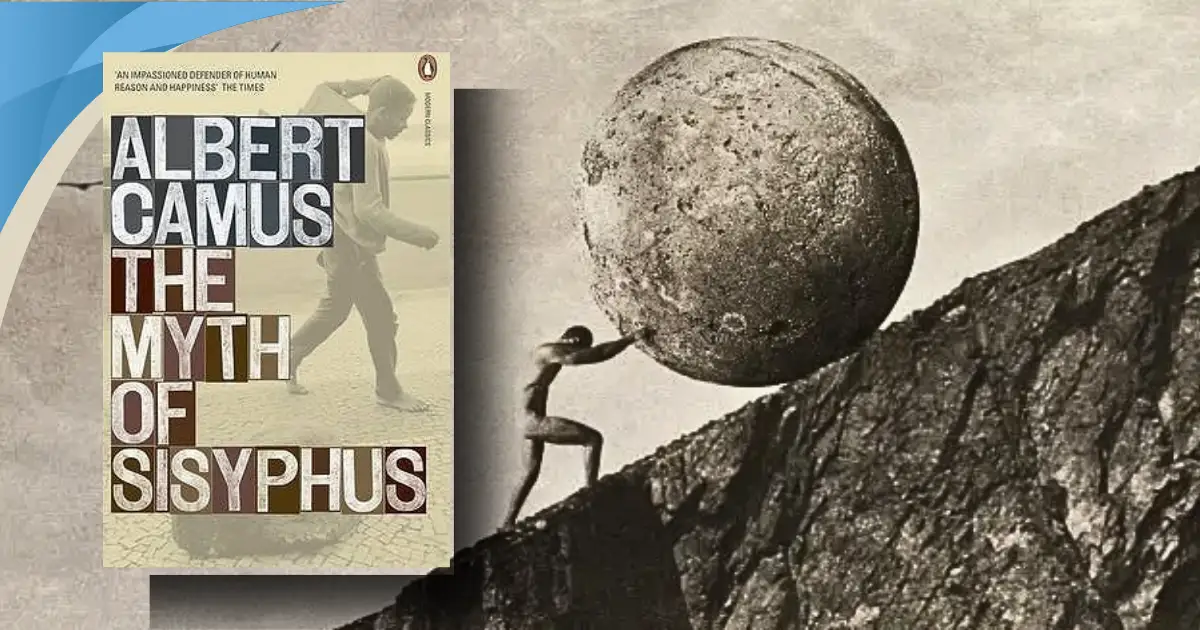
The Myth of Sisyphus was written by Albert Camus, the French-Algerian philosopher, journalist, and Nobel Prize-winning author. It was first published in 1942 during the rise of existential and absurdist philosophy in 20th-century France.
This philosophical essay is a cornerstone of Absurdism, a branch of existential philosophy that explores the tension between humanity’s search for meaning and the universe’s silent indifference. Camus, not just a philosopher but also a novelist (The Stranger, The Plague), believed that the struggle itself is enough to fill a man’s heart.
This text stands side by side with the works of Jean-Paul Sartre, Kierkegaard, and Nietzsche, but Camus took a different path by not subscribing to nihilism or religious escape—he proposes a life fully lived in defiance of meaninglessness.
The central thesis of the book is shockingly powerful:
“There is only one really serious philosophical problem, and that is suicide.” — Camus, p. 3
Camus begins the essay with this line, asserting that if life has no inherent meaning, then the first question is: should we continue living it? He uses the ancient Greek myth of Sisyphus, doomed to push a boulder up a mountain only for it to roll down again, as a metaphor for human perseverance in an absurd world.
His answer to this existential question is not despair but defiance.
Table of Contents
Background
Albert Camus was born in 1913 in Algeria, then a French colony. Raised in poverty, he went on to become a key figure in French literature and philosophy. Although often labeled an existentialist, Camus rejected the label, preferring the term absurdist.
The absurd, to Camus, emerges from the confrontation between our desire for meaning and the cold, mute world:
“The absurd is born of this confrontation between the human need and the unreasonable silence of the world.” — Camus, p. 28
Camus wrote The Myth of Sisyphus during WWII, when death, despair, and totalitarianism loomed. It’s not just abstract thought—it’s a response to a world in crisis.
Summary
Structure of the Book
The essay is divided into four parts and concludes with the famous Sisyphus chapter:
- An Absurd Reasoning
- The Absurd Man
- Absurd Creation
- The Myth of Sisyphus (Conclusion)
Chapter 1: An Absurd Reasoning
“There is but one truly serious philosophical problem, and that is suicide.” — Albert Camus
These haunting opening lines of The Myth of Sisyphus immediately confront us with the raw, unfiltered question at the heart of Camus’ absurdism: Is life worth living? For Camus, this is not a rhetorical challenge but a metaphysical crisis.
This is where he launches his journey into what he calls “absurd reasoning,” attempting to explain the core tension between human consciousness and the silence of the universe.
The Heart of the Absurd
In The Myth of Sisyphus, Camus defines the absurd as the confrontation between our human desire for clarity and meaning and the unreasonable silence of the universe. “The absurd is born of this confrontation between the human need and the unreasonable silence of the world,” he writes (Camus, p. 28).
This isn’t just philosophical poetry. It’s a diagnosis of the human condition. We are rational creatures thrown into an irrational cosmos. We seek order, patterns, explanations—and we find chaos, randomness, and death. That mismatch is what Camus calls the absurd.
Importantly, Camus stresses that the absurd is not merely in the world or in us; it exists in the relationship between the two. We ask questions; the world does not answer. That is the birthplace of absurdity.
Why Not Kill Ourselves?
Camus takes this seriously. If life has no inherent meaning, why continue it? This is where he launches the central philosophical challenge: “Does the realization of the absurd require suicide?” (Camus, p. 11).
Yet Camus rejects suicide as a solution. To him, suicide is a confession—an admission that life is not worth the trouble. But this, he says, is an evasion of the absurd, not an answer to it. “Suicide is not a solution. It is a surrender,” he implies throughout.
Instead of fleeing the absurd through death, Camus calls for a revolt: to live on in full awareness of the absurd, with lucidity and defiance. “Living is keeping the absurd alive. Keeping it alive is, above all, contemplating it” (Camus, p. 54).
This approach is not nihilism. It’s anti-nihilism. Camus doesn’t say “life is meaningless, so give up.” He says: “Life is meaningless—and that is precisely why it is worth living.
Reason, Repetition & The Absurd Life
Camus explores how humans seek meaning by building systems—philosophical, religious, political—but these systems inevitably fall short. He points to philosophers like Kierkegaard, who leapt into faith once rationality failed, and he calls this move “philosophical suicide.”
For Camus, to remain in the absurd is to resist this leap. “I want to know whether I can live with what I know and with that alone,” he writes ([Camus, p. 50]. He chooses to live without appeal—no God, no higher order, no cosmic justice. Only the absurd, and his response to it.
Camus likens this daily confrontation with absurdity to repetition—waking up, going to work, coming home, repeating endlessly. He sees this as a metaphor for life itself. The absurd man is one who acknowledges this loop, but keeps walking anyway.
Camus’ Rebellion: Lucidity Over Comfort
What makes The Myth of Sisyphus enduring is its ethical clarity. Camus does not lie to us. He does not say everything will be okay. He doesn’t claim we’ll find meaning if we look hard enough. Instead, he says:
“The struggle itself toward the heights is enough to fill a man’s heart.” (Camus, p. 123)
The absurd man doesn’t demand meaning from the world. He gives meaning to his life through his attitude toward it. And that attitude is defiance.
Camus does not preach despair. He preaches a heroism of consciousness—to live with eyes open, knowing the truth, and still choosing to go on.
Key Points Summary (for quick reference)
| Concept | Explanation |
|---|---|
| Absurdity | Clash between human desire for meaning and the silence of the world |
| Philosophical Suicide | Escaping absurdity through irrational belief (faith, ideology) |
| Revolt | Embracing the absurd without escape or false hope |
| Lucidity | Living with awareness of the absurd, without illusions |
| Suicide | Rejected by Camus—it denies life and evades the absurd |
Quotations for Reflection
- “There is but one truly serious philosophical problem, and that is suicide.” – Camus
- “What is called a reason for living is also an excellent reason for dying.” – Camus
- “Knowing whether or not one can live without appeal is all that interests me.” – Camus
- “To become god is merely to be free on this earth, not to serve an immortal being.” – Camus
Chapter 2: The Absurd Man
“If the world were clear, art would not exist.” — Albert Camus
In this chapter of The Myth of Sisyphus, Camus shifts from the idea of absurdity to the figure who must live with it—the absurd man. The absurd man, unlike the philosophical or religious escapist, does not seek comfort in illusions. He fully accepts the absurd as an eternal condition and chooses to live within it. His response is not denial, but defiance.
Camus asks: How does one live in a world where meaning is not given but must be made? The answer unfolds through three distinct types of absurd lives—Don Juanism, Drama, and Conquest
Don Juanism – The Lover of Infinite Experience
Don Juan, the legendary seducer, becomes Camus’ metaphor for a man who endlessly seeks new experiences without trying to derive ultimate meaning from them.
“To be different is not necessarily to be superior. What counts is not the best living but the most living.” (Camus, p. 72)
Camus’ Don Juan doesn’t pursue love for emotional permanence or spiritual fulfillment—he loves for the moment. He is aware that no one relationship will give him eternal meaning, but still, he pursues love after love.
This may seem immoral, even empty, but Camus defends Don Juan as someone who lives fully, intensely, and authentically.
In the world of The Myth of Sisyphus, Don Juan is not a sinner—he is a hero. A tragic one, but a hero nonetheless. His tragedy lies in his lucidity. He knows the emptiness of final answers. Yet, he continues to love, not in search of eternity, but to make the most of the fleeting present.
Key quote:
“He multiplies what he cannot unify. Thus he constructs a truth that is not his, but that he supports to the point of death.” (Camus, p. 73)
Drama – The Absurd as Performance
In this subsection, Camus explores art as a way of living within the absurd. Particularly, he focuses on actors and dramatists, who immerse themselves in a thousand different lives, none of which they permanently inhabit.
The absurd actor is one who knows every role is temporary, but still plays each one with conviction. For Camus, acting becomes an existential metaphor: life itself is a stage, not in the Shakespearean sense of illusion, but in the sense of fluidity and multiplicity. There is no one “true self”—only many roles, each sincerely lived.
“The actor teaches us at least that the idea is nothing without its realization.” (Camus, p. 78)
The drama of life, in The Myth of Sisyphus, is not about finding truth but experiencing fullness. The absurd man is the actor who finds freedom in knowing that nothing lasts—and performs anyway.
Conquest – The Man of Action
Next comes the most dynamic figure of absurdism—the conqueror. Not the imperialist or tyrant, but the man who acts with boldness and affirms life through action, even while knowing its futility.
“If I convince myself that this life has no other aspect than that of the absurd, if I feel that its whole equilibrium depends on perpetual opposition between my conscious revolt and the darkness in which it struggles, if I admit that my freedom has no meaning except in relation to its limited fate, then I must say that what counts is not the best living but the most living.” (Camus, p. 82)
Here, Camus invokes conquerors, revolutionaries, creators of empires and ideas, not because they solve absurdity, but because they embody its tension. They act knowing there is no eternal reward.
He even praises Cesare Borgia—not for his morality, but for his total embrace of power, vitality, and defiant energy, regardless of outcome.
The absurd conqueror refuses resignation. He does not escape. He acts. In this way, Camus suggests a new form of existential dignity—living as if your actions mattered, even when you know they ultimately won’t last.
Summary of the Absurd Man’s Traits
| Type | Description | Key Virtue |
|---|---|---|
| Don Juan | Lover of infinite passions | Quantity of life over depth |
| Actor | Embracer of many identities | Sincerity in performance |
| Conqueror | Man of action and ambition | Defiant affirmation |
Each of these figures is not an escape from absurdity but a response to it. They do not seek salvation—they seek intensity, lucidity, and movement.
Central Themes of This Chapter
- Rebellion vs. Resignation: The absurd man does not accept fate passively. He rebels by living fully.
- Multiplicity of Selves: There is no single authentic identity. Meaning comes through role-playing, relationships, and actions.
- Consciousness as Burden and Gift: The absurd man is not unaware—he is painfully conscious. But that is also what makes his life free.
- No Appeal to the Eternal: All three figures—Don Juan, actor, conqueror—live without illusions of immortality or moral justification. That is their bravery.
Chapter 3: Absurd Creation
“If the only meaning of life is death, then we are forced to say that any meaning is better than none.” — The Myth of Sisyphus
In the previous chapters of The Myth of Sisyphus, Camus outlines how awareness of the absurd—the irreconcilable tension between our desire for clarity and the universe’s indifference—leads us to a crisis. But in this third section, he offers a form of salvation that doesn’t betray the absurd: creation. Rather than escape the absurd through hope, Camus insists we create within it.
The absurd artist, like Sisyphus, builds castles in the sand—not because they will last, but because building them is a form of defiance and meaning in itself.
The Core Idea: Creation as Revolt, Not Redemption
Camus begins “Absurd Creation” with a crucial distinction: the absurd artist does not create to explain or to console, but to express. There is no appeal to higher meaning. The act of creation is the act of revolt.
“If the world were clear, art would not exist.” (Camus, p. 92)
This line from The Myth of Sisyphus frames all that follows. Art arises because the world is unclear. It is a response to the absurd, not a resolution of it.
For Camus, the absurd creator lives in a world without appeal—he writes, paints, or composes knowing his work will not explain the universe. But he creates anyway. That is the true rebellion.
Subsection 1: Philosophical Suicide – Escaping Through Meaning
Before affirming art, Camus critiques the temptation to flee from the absurd through systems of thought. He calls this philosophical suicide—the act of killing the absurd by pretending it has been resolved.
“It is essential to die unreconciled and not of one’s own free will.” (Camus, p. 93)
Philosophical suicide comes in many forms: religious faith, ideological commitment, belief in historical progress, or metaphysical systems that promise unity. These may be comforting, but they betray lucidity.
Camus critiques great thinkers like Kierkegaard and Shestov for trying to “leap” into faith, refusing to accept the absurd. For Camus, such leaps may appear heroic, but they are acts of self-deception.
“To an absurd mind reason is useless and there is nothing beyond reason.” (Camus, p. 95)
In The Myth of Sisyphus, philosophical suicide is seen as a betrayal of human dignity. To truly confront the absurd is to stand firm in the void, without illusions.
Subsection 2: Art and Revolt – Expression Over Explanation
If we reject suicide, both literal and philosophical, what remains?
Camus’ answer: Art as revolt. Not art that consoles, but art that illuminates.
“A novel is never anything but a philosophy expressed in images.” (Camus, p. 98)
In absurd creation, the artist does not impose meaning on reality. He does not seek unity or resolution. Instead, he holds the world at a distance and reflects it back with honesty. This kind of art does not explain—it evokes.
Camus praises Kafka, whose novels do not resolve meaning but deepen its mystery. In The Trial or The Castle, meaning is always out of reach—but the portrayal of this hopeless struggle is what makes Kafka’s art profound.
“If the absurd is lucid reason noting its limits, the absurd writer must write knowing that nothing is resolved.” (Camus, p. 99)
The absurd artist embraces constraints. He must avoid nihilism as much as dogma. He must write or create without hope—but also without despair. This tightrope walk is the essence of absurd art.
The Forms of Absurd Creation: Novel, Painting, Music
Camus delves into different forms of art—literature, visual art, and music—as potential expressions of the absurd.
- The Novel: The absurd novelist rejects narrative closure. His characters do not evolve toward salvation. Instead, the novel explores the lived experience of absurdity. Life is not a story—it’s a moment-to-moment revolt.
- The Painter: Camus refers to painters like Van Gogh, who, even in madness, sought not to represent reality but to express a fury of seeing. Painting is a gesture of witnessing, not explaining.
- The Musician: While less detailed, Camus nods to the idea that music, especially modern music that avoids harmony and embraces dissonance, captures the emotional vibration of the absurd.
The Logic of Absurd Creation
To create absurd art, three rules must be followed:
- No Appeals to Eternity – Art must not resolve meaning.
- No Denial of Suffering – Art must express, not escape.
- No Lies or Consolation – The artist must remain lucid.
These principles mirror the absurd man’s ethical code: lucidity, defiance, and honesty. The absurd creator is a mirror, not a prophet.
Summary Table
| Element | Description | Camus’ Verdict |
|---|---|---|
| Philosophical Suicide | Escaping absurdity via belief systems | A betrayal of lucidity |
| Absurd Art | Expression of revolt without resolution | The only honest response |
| The Artist | One who testifies, not solves | A witness to the absurd |
| Kafka’s Novels | Narratives of blocked meaning | Model of absurd literature |
| Rules of Creation | No hope, no lies, no transcendence | Artistic integrity |
Chapter 4: The Myth of Sisyphus
“There is but one truly serious philosophical problem, and that is suicide.”
— The Myth of Sisyphus, Albert Camus, Opening Line
Camus concludes his philosophical essay The Myth of Sisyphus by turning to the figure from Greek mythology who embodies, more than any other, the fate of modern man: Sisyphus. Condemned by the gods to push a boulder up a hill for eternity, only for it to roll back down each time, Sisyphus becomes, in Camus’s hands, the ultimate symbol of the absurd hero—not because he overcomes fate, but because he embraces it.
The Absurd Hero: Who Was Sisyphus?
In the myth, Sisyphus is a cunning king who repeatedly defies the gods. He tricks Death, chains Thanatos, and escapes the underworld twice. But his rebellion doesn’t end well. As punishment, the gods sentence him to an eternal task—rolling a heavy rock up a steep mountain, only to have it fall again every time he nears the top.
Camus does not linger on the divine punishment itself. He is not interested in the theological implications of defiance. Instead, he zeroes in on the image of endless, pointless labor—a man condemned to repeat the same futile task forever.
“The struggle itself toward the heights is enough to fill a man’s heart.”
— The Myth of Sisyphus, p. 123
Here, Camus introduces a profound paradox: Sisyphus is free.
Interpreting the Myth: Consciousness and Revolt
What makes Sisyphus an absurd hero is not that he is defeated by fate, but that he becomes aware of his fate and still endures.
This is the pivotal shift Camus makes in the myth. He asks the reader to imagine Sisyphus descending the mountain, ready to start again. In that moment, the man is conscious of the futility—and that awareness is everything.
“His fate belongs to him. His rock is his thing.”
— The Myth of Sisyphus, p. 122
Camus reclaims ownership from the gods and gives it back to man. By becoming conscious of the absurdity, by not denying it, Sisyphus turns punishment into defiance. He affirms his own absurd condition by choosing it.
Thus, Camus’s ethical framework of The Myth of Sisyphus culminates here: To live without appeal. To rebel without illusion. To continue pushing the stone—not because it will stay, but because we choose to push it.
Sisyphus and the Modern Worker
Camus’s Sisyphus is not just a mythological figure; he’s us. The office worker with a meaningless job, the student stuck in a loop of assignments, the parent navigating endless responsibilities, the soldier in perpetual war, the activist in an indifferent society.
“Sisyphus, proletarian of the gods, powerless and rebellious, knows the whole extent of his wretched condition.”
— The Myth of Sisyphus, p. 121
Camus elevates this weariness into a noble form of revolt. Unlike hope, which expects change, revolt demands no victory. It is sustained, conscious action against the void. That is what makes it powerful—and what makes life livable despite its absurdity.
❝ One Must Imagine Sisyphus Happy ❞
Perhaps the most debated line in all of existential literature, Camus closes The Myth of Sisyphus with a breathtaking affirmation:
“One must imagine Sisyphus happy.”
— The Myth of Sisyphus, p. 123
Not because his task has changed. Not because the gods have relented. But because in accepting the absurd, he removes its power to destroy him. His scorn becomes his triumph. His boulder becomes his purpose—not because it is meaningful, but because he chooses to push it.
Camus’s final vision is startlingly optimistic. In the absence of God, destiny, or purpose, man can still live well. In fact, he must. The absurd is not an excuse for despair—it is a call to freedom.
The Final Integration of All Chapters
Each previous chapter of The Myth of Sisyphus leads naturally to this conclusion:
- In An Absurd Reasoning, Camus poses the fundamental question: Is life worth living?
- In The Absurd Man, he shows how to live without hope.
- In Absurd Creation, he presents art and expression as revolt.
- And in The Myth of Sisyphus, he delivers the image that embodies it all—a man pushing a stone, knowing it is pointless, and yet doing so joyfully.
This is the art of defiance without illusion, of being fully awake in a world that does not care.
There Are No Statistics, but There Is Clarity
Unlike other philosophical essays that back ideas with empirical data, The Myth of Sisyphus is grounded entirely in philosophical clarity and emotional truth. Camus doesn’t appeal to numbers. He appeals to lived experience. His goal is not to prove—but to show that one can live a meaningful life even when meaning is denied.
Final Summary Table
| Concept | Camus’ Insight | Emotional Impact |
|---|---|---|
| Sisyphus | Represents the absurd hero | All of us in the modern condition |
| Consciousness | Turns suffering into revolt | Awareness is freedom |
| Absurd Rebellion | Choosing to live despite futility | Affirms human dignity |
| Happiness | Found not in meaning but in action | We are responsible for our joy |
| The Stone | Symbol of repetitive struggle | Also a symbol of personal triumph |
Main Points/Themes Recap
| Theme | Explanation |
|---|---|
| Absurdism | The conflict between our search for meaning and the meaningless universe |
| Revolt | Choosing to live, love, and create despite the absurd |
| Suicide | Rejected as a denial of life |
| Freedom | Found in accepting the absurd and living without hope |
| Sisyphus | The eternal rebel who embraces his suffering and finds joy in the struggle |
| Art | A form of rebellion against meaninglessness |
| Lucidity | The only “truth” is our conscious awareness of the absurd |
Reception, Criticism, and Influence
Critical Reception
At the time of its publication in 1942, The Myth of Sisyphus was both admired and misunderstood. Philosophers and writers—especially in post-war France—were shaken by Camus’ stance.
While Jean-Paul Sartre and Camus initially shared existential leanings, Sartre criticized Camus’ refusal to cross the bridge into committed political action. Camus’ insistence that absurdism ends in revolt, not revolution, was a point of contention. This disagreement ultimately led to a famous public split between the two thinkers in the 1950s.
However, Camus’ bravery in confronting suicide as a philosophical problem was praised. As French philosopher Raymond Aron once said, Camus brought moral clarity to existential despair, a sentiment echoed in many academic critiques.
Modern readers continue to find The Myth of Sisyphus relatable, particularly among mental health advocates, artists, and thinkers disillusioned by religious or political dogma.
Influence and Legacy
Camus’ absurdism is now a foundational component of existentialist and modern humanist thought. The phrase:
“One must imagine Sisyphus happy.” — Camus, Final Line
has become a cultural rallying cry for those who choose to live with awareness and dignity despite chaos.
The book has inspired:
- Literature (e.g., The Stranger, Fight Club, Infinite Jest)
- Psychology and therapy (existential therapy models)
- Music and film (Radiohead, No Country for Old Men)
- Pop culture memes around “meaningless tasks”
In a world of burnout, economic inequality, climate dread, and algorithm-driven content, Camus’ message is more relevant than ever.
Most Quoted Lines from The Myth of Sisyphus (with Commentary)
- “There is but one truly serious philosophical problem, and that is suicide.”
🔍 Commentary: Camus doesn’t promote suicide—he urges us to confront it head-on. It’s the gateway to the meaning question. - “The struggle itself toward the heights is enough to fill a man’s heart.”
🔍 Commentary: This is the essence of his optimism—joy in the rebellion, not the result. - “At any street corner the feeling of absurdity can strike any man in the face.”
🔍 Commentary: The absurd isn’t hidden in theory—it lives in daily life, in the mundane. - “A world that can be explained even with bad reasons is a familiar world.”
🔍 Commentary: We cling to bad explanations because they feel safer than none. - “To abolish conscious revolt is to elude the problem.”
🔍 Commentary: Camus warns against false solutions—like blind faith or nihilism. - “Living is keeping the absurd alive.”
🔍 Commentary: Existence itself becomes a protest. - “The absurd is born of this confrontation between the human need and the unreasonable silence of the world.”
🔍 Commentary: This quote perfectly summarizes Camus’ definition of the absurd. - “The absurd man is he who is aware of this revolt and scorns hope.”
🔍 Commentary: Hope, for Camus, is just another escape. - “It is essential to die unreconciled and not of one’s own free will.”
🔍 Commentary: To choose life even when it’s meaningless is to defy death itself. - “Happiness and the absurd are two sons of the same earth.”
🔍 Commentary: You don’t need meaning to be happy. You need awareness and rebellion.
10 high-impact takeaways from Albert Camus’ The Myth of Sisyphus
- The “absurd” isn’t in you or the world—it’s in the clash between them.
Camus frames the absurd as a relationship: a “divorce” born from the confrontation between what humans demand (clarity/meaning) and what the world gives (silence/unreason). - The book’s first priority is brutally practical: does the absurd require suicide?
He insists people confuse “life has no meaning” with “life isn’t worth living,” and treats suicide as the central philosophical test—“a logic to the point of death.” - Method rule: never “solve” the absurd by deleting one side of the conflict.
If you destroy either term (the human demand or the world’s unreason), you destroy the absurd itself. Carrying it through requires (his words) absence of hope, continual rejection, and conscious dissatisfaction—and the absurd “has meaning only” so long as it isn’t accepted as a comforting resolution. - The “leap” (to faith/metaphysics) is a temptation—and he calls it evasion.
The absurd person refuses to “leap” into what they don’t fully understand; the demand is to live with what’s certain and see whether it’s possible to live “without appeal” (no higher court, no hidden guarantee). - The coherent response to the absurd is revolt: keep it alive, don’t escape it.
“Living is keeping the absurd alive” by contemplating it; revolt is a constant confrontation (not hope, not resignation). Suicide (and the leap) “settles” the absurd by ending the tension—so it’s the opposite of revolt. - Absurd freedom comes from accepting there’s “no future” in the cosmic sense.
Hope and meaning-making can turn you into “the slave” of a purpose; recognizing “there is no future” becomes the basis for an inner freedom and a release from externally imposed rules. - “Everything is permitted” is not a party slogan—it’s a bitter diagnosis with responsibility intact.
Camus rejects the vulgar reading: the absurd “does not authorize all actions.” It equalizes consequences, strips metaphysical guilt, and treats ethics as lucid responsibility (“ready to pay up”) rather than innocence-to-crime. - Don Juan is Camus’ emblem of “quantity”: multiply lived experience without illusions of eternity.
He’s not redeemed by depth or condemned by “immorality”; he’s lucid, refuses regret (a form of hope), doesn’t “collect” the past, and lives in time by exhausting possibilities. - Creation (art) is the absurd joy: it preserves consciousness—but must not become a religion.
“Creating is living doubly,” yet art can’t become “the meaning and consolation of a life.” Absurd art resists smuggling in a “deeper meaning” it knows is illegitimate; the concrete should signify only itself, and the “true work” is “on the human scale” and says “less.”
(He uses Kafka as an example of how an absurd work operates—forcing rereading and holding paradoxes in tension.) - The ending “spoiler”: Sisyphus wins by owning his fate—so the struggle becomes enough.
Camus lands on the reversal: in a universe “without a master,” Sisyphus’ fate belongs to him; the rock is “his thing.” “The struggle itself towards the heights is enough to fill a man’s heart”—and the closing line is the thesis: “One must imagine Sisyphus happy.”
Comparison with Similar Works
| Work | Comparison |
|---|---|
| Jean-Paul Sartre – Nausea | Sartre’s existential nausea mirrors Camus’ absurd, but Sartre leans toward political engagement and subjective meaning. |
| Kierkegaard – The Sickness Unto Death | Kierkegaard’s leap to faith contrasts sharply with Camus’ rejection of divine meaning. |
| Nietzsche – Thus Spoke Zarathustra | Like Camus, Nietzsche sees the death of God, but turns to the Übermensch, where Camus turns to Sisyphus. |
| Dostoevsky – Notes from Underground | A precursor to absurdism. Camus admired Dostoevsky’s exploration of irrational humanity. |
| Tolstoy – A Confession | Tolstoy lands in faith; Camus refuses that path and insists on living with the absurd. |
| Beckett – Waiting for Godot | A theatrical expression of absurdism. Camus’ ideas breathe through the silence of Godot. |
Each of these thinkers wrestles with meaning, but Camus stands apart in his lucid rebellion—his refusal to jump to metaphysics, revolution, or faith.
Conclusion and Final Recommendation
My Final Verdict
Reading The Myth of Sisyphus is not an academic exercise. It is a human experience. You do not simply learn Camus’ philosophy—you feel it, wrestle with it, and possibly, live by it.
Camus invites us to confront the absurd not with despair, but with rebellion, creation, and dignity. In an age of burnout, noise, and uncertainty, this message matters more than ever.
If you’ve ever:
- Questioned your daily routine
- Felt numb about the future
- Wondered whether meaning is even possible
… then Camus wrote this for you.
Who Should Read This?
| Reader Type | Why They Should Read |
|---|---|
| Philosophy Students | Understand existentialism and absurdism from a foundational perspective. |
| Mental Health Professionals | Offers a philosophical lens for existential therapy and client perspectives. |
| Writers and Creatives | Encourages rebellion through creation rather than escape. |
| General Readers | It speaks to anyone who has ever asked, “Why go on?” |







