
Last updated on October 10th, 2026 at 02:04 pm
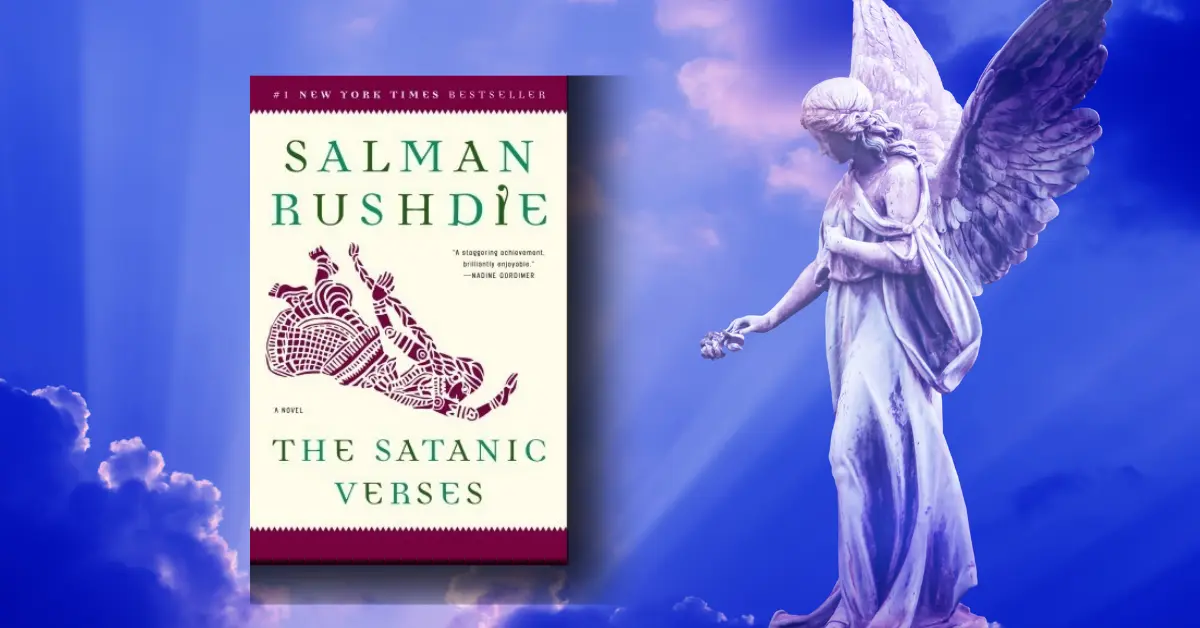
The Satanic Verses is Salman Rushdie‘s 1988 novel about two Indian actors who fall 29,002 feet out of an exploding jet, wash up alive on an English beach, and slowly turn into an angel and a devil. Most people know it only as “the book that got a fatwa.” After reading every page, I can tell you that the fatwa story hides a different novel: a wild, funny, painful book about migrants, fathers, faith and London.
This Satanic Verses summary covers the full plot with spoilers, explains the ending, and shows you, with numbers I counted myself, how small a slice of the book the famous “Mahound” chapters actually are.
Table of Contents
The Satanic Verses at a Glance
The Satanic Verses is a magical realist novel about migration and transformation, not a tract against Islam. Here is the short version:
Author and date: Salman Rushdie, first published by Viking Penguin in London on 26 September 1988 (546 pages in the first edition).
Story: Gibreel Farishta, a Bollywood star who lost his faith, and Saladin Chamcha, an Anglophile voice actor, survive a hijacked plane’s explosion over the English Channel. Gibreel grows a halo and dreams he is the Archangel Gabriel. Saladin grows horns and hoofs and is treated like an illegal immigrant.
The controversial part: Gibreel’s dreams include a fictional prophet named Mahound and the “satanic verses” episode. By my word count of this edition, those two chapters make up about 13.7% of the novel.
The ending: Gibreel murders a producer, is blamed for his lover’s fall from a Bombay skyscraper, confesses to Saladin and shoots himself. Saladin reconciles with his dying father, takes back his Indian name and walks off with Zeeny Vakil.
Aftermath: Ayatollah Khomeini’s fatwa on 14 February 1989, riots that killed people in Pakistan and India, a murdered Japanese translator, and the 2022 stabbing that cost Rushdie his right eye.
My rating: 4.5/5. Brilliant, exhausting, unforgettable.
Recommended Reader for The Satanic Verses
The readers who love it are the ones willing to be lost for fifty pages at a time. If you enjoyed Midnight’s Children, Bulgakov’s The Master and Margarita, or any novel where a city is as alive as its people, you will feel at home.
Migrants, children of migrants and anyone who has ever changed their accent to fit a room will recognise Saladin’s kipper scene so sharply it hurts. Students of postcolonial literature and free speech history need it on the shelf, full stop.
On the other hand, you will probably bounce if you want a clean, linear plot. The book jumps between 1980s London, 1980s Bombay, a dream city in seventh-century Arabia, an exiled cleric’s flat in Kensington, and a village of butterflies in rural India. Readers who dislike wordplay, stammering comic characters, and long digressions will find Part V (the longest section, 22% of the book) a real test.
Also, if irreverent fiction about religious figures upsets you, I would rather tell you now than have you discover it on page 120.
What Is The Satanic Verses, and Who Wrote It?
The Satanic Verses is Salman Rushdie’s fourth novel. Rushdie was born on 19 June 1947 in Bombay and had already won the 1981 Booker Prize for Midnight’s Children. Viking Penguin published The Satanic Verses in the UK on 26 September 1988, and Viking released the US hardcover in 1989.
I read the 2008 Random House Trade Paperback edition, which runs to about 190,000 words in nine parts.
The Satanic Verses was a finalist for the 1988 Booker Prize, losing to Peter Carey’s Oscar and Lucinda, and it won the 1988 Whitbread Award for Novel of the Year.
Quick Verdict
A ferocious, overstuffed and often very funny novel about what migration does to a self. Recommended for patient readers of literary fiction and magical realism, not for anyone who wants a tidy plot.
Should You Read It?
| Pros | Cons |
|---|---|
| Two of the most vivid antiheroes in modern fiction | Five parallel storylines can feel overwhelming |
| Laugh-out-loud satire of Bollywood, advertising and 1980s London | Part V sags under its own weight |
| A moving father-son reconciliation in the final part | Allie Cone, the main love interest, stays thin |
| The dream chapters are daring, strange and beautiful | Heavy wordplay and stammering gags wear thin |
| Sharper on racism and immigration than most novels of its decade | Some 1980s political satire now needs footnotes |
What Is It About?
Two Indian actors survive a terrorist bombing over the English Channel and are transformed: Gibreel into an angel tormented by dreams of a prophet, Saladin into a goat-legged devil who is beaten by police and treated as an alien. Their story is a battle over identity, betrayal and forgiveness that ends in Bombay with one man’s suicide and the other’s homecoming.
Rating: 4.5/5
Background: Why Did The Satanic Verses Cause Such a Storm?
The Satanic Verses caused a storm because its dream chapters retell, in satirical and fictional form, a disputed early story about the Prophet Muhammad, using the medieval Christian insult “Mahound” as the prophet-figure’s name.
The title comes from that story. Early Muslim historians such as al-Tabari recorded an episode in which verses praising three pagan goddesses, al-Lat, al-‘Uzza and Manat, were briefly recited as revelation and then withdrawn as Satan’s work.
The English phrase “Satanic Verses” is attributed to the British scholar Sir William Muir, who used it in 1858. Most Muslim scholars from the medieval period onward have rejected the episode as unreliable, and recent academic work has increasingly doubted it too.
Rushdie fictionalises this inside a madman’s dreams, and it was enough. The events moved fast:
5 October 1988: India banned The Satanic Verses‘ importation.
November 1988: Pakistan banned it.
14 January 1989: Protesters burned copies in Bradford, England.
12 February 1989: Six people were killed at a protest outside the American Cultural Center in Islamabad.
14 February 1989: Ayatollah Ruhollah Khomeini issued a fatwa calling for Rushdie’s death. The 15 Khordad Foundation offered $1 million, or $3 million to an Iranian killer.
24 February 1989: Twelve people died in a riot in Bombay.
July 1991: The Italian translator Ettore Capriolo was stabbed and survived; the Japanese translator Hitoshi Igarashi was stabbed to death days later.
2 July 1993: Thirty-seven people died when a hotel was set on fire in Sivas, Turkey, an attack counted among the violence linked to The Satanic Verses.
11 October 1993: The Norwegian publisher William Nygaard was shot three times outside his Oslo home and survived.
24 September 1998: Iran’s government said it would “neither support nor hinder” attempts on Rushdie’s life.
Rushdie lived under police protection for about nine years using the alias “Joseph Anton,” the title of his 2012 memoir. Then, on 12 August 2022, he was stabbed repeatedly on stage at the Chautauqua Institution in New York.
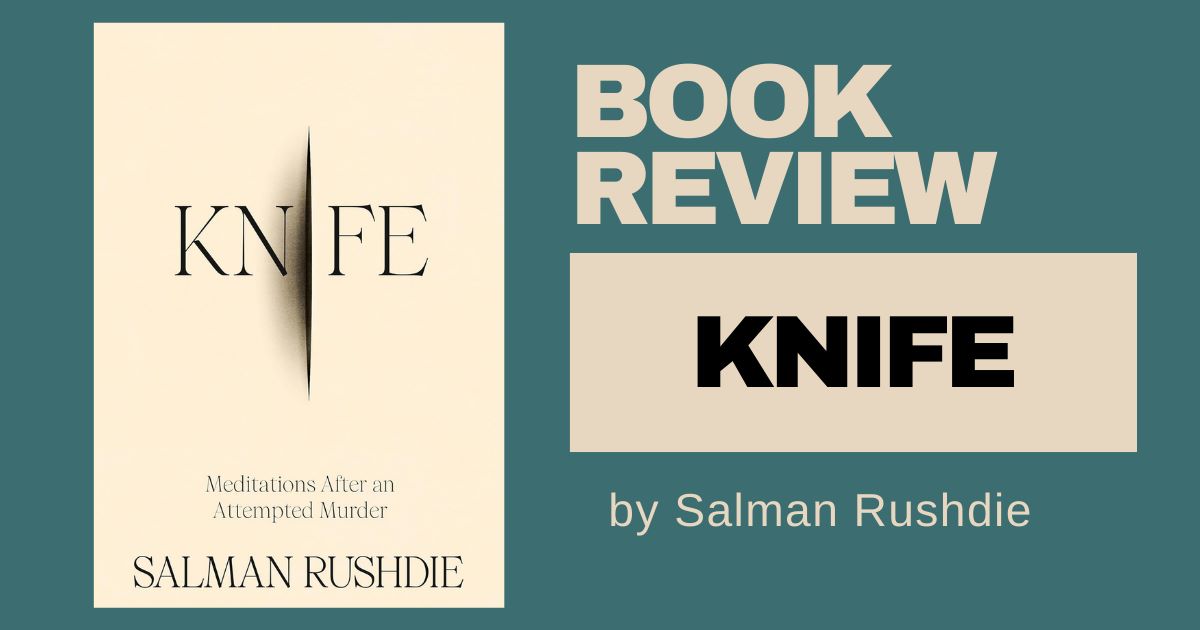
He lost the sight in his right eye and the use of one hand. His attacker, Hadi Matar, was convicted in February 2025 and sentenced on 16 May 2025 to 25 years in prison, with a separate federal terrorism case pending at the time of sentencing. Rushdie wrote about the attack in Knife: Meditations After an Attempted Murder (16 April 2024).
That history is real and it matters. Still, Rushdie himself has described the novel as being about migration, metamorphosis, divided selves, love, death, London and Bombay. After finishing it, I think he was telling the plain truth.
The Satanic Verses Plot Summary
Before the plot, one number that changed how I read this book. I counted the words in each of the nine parts of my edition. Here is what I found:
| Part | Title | Approx. words | Share |
|---|---|---|---|
| I | The Angel Gibreel | 31,300 | 16.4% |
| II | Mahound | 12,400 | 6.5% |
| III | Ellowen Deeowen | 26,800 | 14.1% |
| IV | Ayesha | 13,500 | 7.1% |
| V | A City Visible but Unseen | 42,100 | 22.1% |
| VI | Return to Jahilia | 13,500 | 7.1% |
| VII | The Angel Azraeel | 25,300 | 13.3% |
| VIII | The Parting of the Arabian Sea | 11,900 | 6.2% |
| IX | A Wonderful Lamp | 13,100 | 6.8% |
The two Mahound chapters (II and VI) add up to roughly 13.7% of The Satanic Verses. All four dream chapters together come to about 27%. In other words, nearly three-quarters of the book that sparked the fatwa is a story about two actors in London and Bombay.
These are my own counts from the ebook text, so treat them as close estimates rather than official figures.
Part I: The Fall and Two Lives
The Satanic Verses opens in mid-air. Just before dawn, around New Year’s Day, the Air India jumbo jet Bostan, Flight AI-420, blows apart over the English Channel at 29,002 feet. Two men fall without parachutes.
Gibreel Farishta sings as he tumbles: “To be born again, first you have to die.” Saladin Chamcha, in a grey suit and bowler hat, falls headfirst and orders him to fly. Somehow they do. They land alive in the snow on an English beach.
Then Rushdie rewinds. Gibreel was born Ismail Najmuddin in Poona and grew up in Bombay as the son of a dabbawalla, one of the lunch-carriers who deliver home-cooked tiffins to office workers. H
is mother called him her farishta, her angel. He took that name, became a dabbawalla himself at thirteen, and then, through luck and charm, became for fifteen years the biggest star in Indian cinema, playing gods in “theologicals.” He made up to eleven films at once, wheeled between sets by a team of chair-men.
A mysterious illness makes Gibreel bleed internally. In the hospital he begs God for a sign, gets angry, then feels “a terrible emptiness.” He recovers, and to prove there is no God he walks into the Taj hotel and stuffs himself with pork in front of photographers. “No thunderbolt.
That’s the point,” he shouts. A pale, almost white-haired woman answers him: “You got your life back. That’s the point.” She is Alleluia Cone, the English mountaineer who has climbed Everest. After three days together she flies home, and Gibreel abandons his career, his fans, and his married lover Rekha Merchant, who lives in the apartment below his in the Everest Vilas tower. He boards the Bostan under his birth name.
A week later Rekha takes her two daughters and her son up to the roof of Everest Vilas and jumps with them.
Saladin’s story runs the other way. Born Salahuddin Chamchawala, he is the son of Changez Chamchawala, a giant of a man who made his fortune in agricultural chemicals and keeps a magic lamp in his study that he promises his son “one day.”
Salahuddin hates Bombay and dreams of England. At an English boarding school he is served a kipper and nobody shows him how to eat it. It takes him ninety minutes, and he learns his first lesson about the country: “England was a peculiar-tasting smoked fish full of spikes and bones,” and nobody will tell him how to eat it. He vows to conquer it anyway.
His mother Nasreen chokes to death on a fishbone during an air-raid alarm in the 1965 war.
When his father remarries a woman also named Nasreen, Saladin writes him a cruel letter, and the two break off contact. In London he becomes Saladin Chamcha, a voice actor known as the man of a thousand voices, the star of a children’s TV hit called The Aliens Show, and husband of the very English Pamela Lovelace. A theatre tour of Shaw’s The Millionairess brings him back to Bombay, where he sleeps with an old flame, the doctor and art critic Zeeny Vakil, who mocks his borrowed Englishness.
He quarrels with his father, who later cuts down the walnut tree he planted on the day his son was born and posts Saladin the proceeds in pounds sterling.
Both men end up on the Bostan. Four Sikh separatist hijackers seize it and hold the passengers for 111 days at a desert airstrip. The cool, frightening leader, Tavleen, finally pulls a wire attached to the grenades under her clothes, and the plane explodes.
Part II: Mahound
Gibreel’s dreams begin here. He dreams he is the Archangel Gibreel, watching a businessman-turned-prophet named Mahound climb Mount Cone above the desert city of Jahilia, a city literally built of sand. Jahilia earns its money from pilgrims who visit its 360 idols, especially the shrines of three goddesses: Lat, Uzza and Manat.
The city’s ruler, the Grandee Abu Simbel, and his fierce wife Hind control those temples. Abu Simbel hires a young satirist, Baal, to mock the new faith. Mahound’s first followers are the water-carrier Khalid, the freed slave Bilal and the Persian Salman.
Abu Simbel offers a deal. If Mahound’s God will accept the three goddesses as worthy of worship, the new religion will be tolerated and Mahound will get a seat on the city council. Mahound climbs the mountain, wrestles with the angel, and comes down to recite verses calling the goddesses “exalted birds” whose intercession is desired.
Abu Simbel and Hind kneel; all of Jahilia kneels with them.
Then Mahound returns to the mountain and comes back declaring that the Devil had spoken in the angel’s disguise. He strikes out the verses before the statues. Here Rushdie lands his sharpest twist: the dreaming Gibreel knows that the voice was his both times, “me first and second also me.” Persecution follows. The believers flee to the oasis of Yathrib, and Baal writes a mocking farewell poem.
Part III: Ellowen Deeowen
Back on the beach, the two survivors are taken in by Rosa Diamond, an elderly widow who has spent decades watching the sea from her house.
Rosa’s memories of her youth in Argentina, of her husband Henry and of a gaucho named Martín de la Cruz, start leaking into Gibreel’s head. Meanwhile, Saladin’s body is changing. Police arrive, and when Saladin protests that he is a British citizen, a pair of goat’s horns sprout on his head. Gibreel, standing beside Rosa, says nothing as officers drag his friend away.
From the police van, Saladin looks back and notices there is no light shining around Gibreel’s head.
In the van, three immigration officers beat and humiliate Saladin, who is now growing hoofs and goat’s hair. They take him to a detention hospital filled with other mutants: a manticore, a woman whose skin turned to glass, men with tails.
The manticore explains how it happens: “They have the power of description, and we succumb to the pictures they construct.” With the help of a physiotherapist, Hyacinth Phillips, the inmates break out.
Saladin limps home to London and collapses inside his own front door. Upstairs, Pamela, believing him dead, is in bed with his old college friend Jumpy Joshi, sobbing that her husband exploded and there were no survivors. Back on the coast, Rosa Diamond dies in her bed. Gibreel takes the train to London and finds Allie Cone in the snow, collapsing at her feet.
Part IV: Ayesha
Gibreel’s dreams change channels. First he dreams of an exiled Imam in a Kensington flat, who hates history and clocks and plots against the Empress Ayesha of his homeland, Desh. Gibreel carries the Imam through the sky to the revolution.
The Empress turns out to be the goddess Al-Lat in disguise. Gibreel fights and kills her, and then watches the Imam grow monstrous and swallow his own followers whole as every clock in the capital chimes the end of Time.
The second dream is set in Titlipur, an Indian village under a giant banyan tree. Ayesha, an orphaned epileptic girl, walks home one day dressed in nothing but butterflies and announces that the Archangel Gibreel speaks to her. She tells the villagers to walk to the Arabian Sea, where the waters will part and let them cross on foot to Mecca. Mishal Akhtar, wife of the rich, secular landowner Mirza Saeed Akhtar, is dying of breast cancer, and Ayesha tells her that God will save her.
Mirza Saeed tells Ayesha, “The waters will not open.” She answers that “The sea will part at the angel’s command.” He goes along anyway, determined to stop the madness on the road.
Part V: A City Visible but Unseen
The longest part follows both men through a London that feels on the edge of boiling. At midnight Jumpy brings the horned, hoofed Saladin to the Shaandaar Café in Brickhall, a café and rooming-house run by Muhammad Sufyan, a former schoolteacher who lost his post in Dhaka, with his wife Hind and their daughters Mishal and Anahita.
Hidden in an attic room, Saladin keeps growing. He is fired from The Aliens Show.
Hind Sufyan resents him; Mishal and Anahita find him thrilling. Around them, Brickhall is tense with a string of murders of old women by a killer the tabloids call the Granny Ripper, and with the arrest of Dr Uhuru Simba, a local Black activist, for those crimes. At the Club Hot Wax, a DJ named Pinkwalla melts wax effigies of hated public figures, including one of “Maggie the Bitch,” for a cheering crowd.
One night Saladin, sleeping on the club floor among the waxworks, finally recognises whom he blames for everything: Gibreel, the man who stood on the balcony and let him go. The hatred melts every waxwork into puddles, and by morning Saladin is human again, “humanized,” as the narrator puts it, by the force of his hate.
Gibreel, meanwhile, has the love affair of his life with Allie Cone, whose father Otto, a Polish émigré who survived the camps, killed himself by jumping into an empty lift-shaft. But Gibreel’s jealousy grows, his dreams invade his waking hours, and he begins to believe he truly is the archangel.
One night God appears to him on Allie’s bed as a balding, bespectacled man with dandruff who calls himself Ooparvala, “The Fellow Upstairs.” Gibreel walks out to save London, is clipped by a limousine belonging to the stammering Bombay producer S. S. Sisodia, floats over the city on a cloud threatening “I am going to tropicalize you,” and finally collapses on Allie’s doorstep again.
Part VI: Return to Jahilia
Twenty-five years pass in the dream. Baal, now a fat fifty-year-old, sees a tear of blood on the statue of Al-Lat and knows Mahound is returning in triumph. Salman the Persian turns up drunk and confesses something terrible.
As Mahound’s scribe in Yathrib, he began secretly changing the revelations as he wrote them down, small changes first, then “He said Christian, I wrote down Jew.” Mahound did not notice. Salman calls himself “a man who finds out he has been believing in a ghost,” and he ran away.
Jahilia surrenders. Abu Simbel submits, and Hind kneels at the prophet’s feet. Salman is caught and spared only after he names Baal as a true enemy. Baal hides in The Curtain, the city’s most popular brothel. There, the twelve prostitutes take the names of the prophet’s twelve wives, business booms, and Baal marries all twelve.
When the brothel is raided, the women are sentenced to death by stoning and Baal is put on trial.
He tells his story so honestly that the crowd cannot stop laughing. He is sentenced to be beheaded. As he is led out he shouts that writers and whores are the people Mahound cannot forgive, and Mahound replies: “Writers and whores. I see no difference here.”
Hind, who never truly converted, locks herself away for two years and two months studying occult books. On the day she emerges, Mahound falls fatally ill in Ayesha’s bed. A woman’s voice tells him the sickness is Al-Lat’s revenge. Mahound answers with gratitude, “Still, I thank Thee, Al-Lat, for this gift,” and dies.
Part VII: The Angel Azraeel
Saladin, now human, moves back into Pamela’s house, where she is pregnant with Jumpy’s child. Sisodia plans a comeback for Gibreel: films based on his dreams. At a huge party on a film set at Shepperton, Saladin sees Gibreel and Allie together, and his hatred focuses into a plan. He befriends the couple, joins them on a trip to the north, and learns where Gibreel’s jealousy lives.
Then the phone calls start. Over three and a half weeks, using thirty-nine different voices, the man of a thousand voices calls both of them with dirty rhymes and invented lovers. The last one ends, “I’ve got her right here in my bed.” Gibreel smashes up Allie’s flat, hacks apart the souvenir of her Everest climb, and leaves.
Allie swears she will never take him back.
Brickhall explodes. Dr Uhuru Simba dies in police custody, his neck broken; the police call it a nightmare-induced fall and “a million-to-one shot.” Riots follow.
Gibreel roams the streets with a golden trumpet he names Azraeel, after the angel of death, breathing fire. Pamela and Jumpy die in an arson attack on the Brickhall Community Relations Council offices, where they had been gathering evidence against the police; the official report blames them.
The Shaandaar burns too, killing Muhammad and Hind Sufyan.
Saladin runs into the burning café to save the family. Gibreel follows him in, and his eyes show he knows exactly who made the phone calls. Saladin, trapped under a beam with broken ribs, can only croak broken syllables that mean “forgive me.”
Gibreel lifts him up and carries him out through a path that seems to part the fire like the Red Sea. The narrator calls it “this small redeeming victory for love.”
Part VIII: The Parting of the Arabian Sea
Gibreel’s last dream returns to Ayesha’s pilgrims. They walk about two miles a day, roughly 150 miles over eleven weeks. The Sarpanch’s wife Khadija dies on the eighteenth day. Mishal, grey with cancer, becomes the march’s true leader.
In one town a foundling is left on a mosque’s steps; the local Imam calls it the Devil’s child, Ayesha says only that everything will be asked of them, and the crowd stones the baby to death. Mirza Saeed tries to snatch his wife and Ayesha in his Mercedes, and fails.
At the sea, butterflies dive into the waves. Ayesha walks in. Mishal tells her husband, “The sea only opens for those who are open.” The entire village follows, and every one of them sinks out of sight. Four survivors, the Sarpanch, the clown Osman, the toy merchant Srinivas and Mishal’s mother, each swear to detectives that they saw the sea part and the pilgrims walk away along the ocean floor.
The police point to the swollen bodies washing ashore. Mirza Saeed, the one survivor who saw nothing, goes home to his ruined mansion and starves.
As the banyan tree burns, he has a dying vision of Ayesha calling “Open.” This time, he opens, and the sea parts, and they all walk to Mecca.
Part IX: A Wonderful Lamp, and the Ending Explained
Eighteen months after the fire, which left him with a heart attack, Saladin flies to Bombay because his father is dying of multiple myeloma. Father and son make peace.
Changez admits he has cancer, tells Saladin “you get the lamp, after all,” and dies with a smile. Saladin inherits the lamp and the fortune, starts using his real name, Salahuddin, again, and falls back into love with Zeeny Vakil and her circle of activists.
Gibreel has also come home, and he is falling apart. Allie refused to take him back after Brickhall. His new films flop, and he is sinking his own money into a remake of the Ramayana in which he plays the demon king Ravana as the hero.
Allie visits Bombay. Then the newspapers report two deaths at Everest Vilas: Sisodia shot through the heart in Gibreel’s apartment, and Allie fallen from the roof from which Rekha Merchant once jumped.
Gibreel turns up in Changez’s study holding the magic lamp.
He tells Salahuddin what happened in a broken stream of words. He heard the verses again, the same rhymes from the phone calls, and saw Allie and Sisodia laughing at him. He shot Sisodia. The ghost of Rekha told him to take Allie to the roof. “I didn’t push her,” he says. “Rekha pushed her.” Salahuddin realises that he is the one who planted those verses, and expects to die for them.
Police knock. Gibreel pulls a revolver out of the lamp and, instead of firing at his old friend, puts the barrel in his own mouth.
Salahuddin stands at his childhood window looking at the moonlit sea, where a silver path stretches out “like a parting in the water’s shining hair.”
He no longer believes in such fairy tales. “If the old refused to die, the new could not be born.” Zeeny takes his arm. “My place,” she offers. “Let’s get the hell out of here.” He goes with her.
So what does the ending mean? I read it as the two halves of the migrant self settling their account. Gibreel, who tried to become pure, absolute and angelic, cannot survive his own certainty. Saladin, the man who tried to become a pure Englishman, survives only by accepting that he is mixed, flawed and Indian, by forgiving his father and being forgiven.
The parting-sea image appears three times, for Ayesha’s pilgrims, in the burning café, and at the final window, and only in the last does someone turn down the miracle and choose ordinary life. That refusal, to me, is the book’s quiet answer to everything that came before.
How Good Is The Satanic Verses? Analysis and Critique
Who Are the Main Characters, and Do They Work?
Gibreel Farishta is the novel’s tragic engine. Rushdie gives him a lovely, childlike warmth, so his descent is genuinely upsetting. His problem is not faith or doubt in themselves but his hunger for certainty.
Once he loses God, he needs something just as absolute, first Allie, then his own angelhood. Read now, his collapse looks a lot like serious mental illness, and Rushdie seems to know it: Gibreel himself calls his visions “the sickness.”
Saladin Chamcha is the more interesting man, and to my mind the real hero. Even his name is a joke at his expense: Zeeny teases that he has named himself “Mister Toady,” and Gibreel calls him “Mr Sally Spoon.” He spends half his life living up to it, worshipping England’s manners.
His transformation into a goat is the novel’s cruelest joke: the more English he tries to be, the more monstrous England makes him. His revenge on Gibreel is genuinely evil, yet the book refuses to let him off or to give up on him.
The narrator insists the evil “is not external to Saladin” but comes from inside him.
Mahound is not a cartoon. He is tired, lonely, shrewd, attractive and capable of bitterness, as in the moment he mutters that bringing the faithful the Devil “sounds like me.” The figure is clearly drawn from history, and that is exactly why the portrait offended so many believers.
As a piece of fiction, though, he is a convincing human being under enormous pressure.
Baal and Salman the Persian are the novel’s writers, and both are cowards who become brave too late. Baal’s credo, a poet’s job is “To name the unnamable, to point at frauds, to take sides,” reads very differently after 1989.
Hind, in both Jahilia and Brickhall, is the book’s most stubborn woman, a woman “who did not change.” The doubled names are deliberate. There are three Ayeshas (the prophet’s wife, the Empress, the butterfly girl), two Hinds, and two Mishals, and the echoes make the dreams feel like a hall of mirrors held up to the waking story.
Allie Cone, Pamela and Zeeny are where I wanted more. Allie has a superb backstory (Everest, her father’s suicide, the fallen arches that threaten her climbing) but mostly exists to be loved and suspected. Pamela dies offstage.
Zeeny gets the last word, which is right, but she is more a voice of good sense than a fully drawn person.
Mirza Saeed Akhtar is the secular rationalist who is right about the sea and loses everything anyway. His deathbed vision is one of the most moving passages Rushdie has written.
The Satanic Verses Themes and Symbols
Migration and metamorphosis. This is the centre of the book. Saladin’s horns grow at the exact moment he insists on his British citizenship, and the mutants in the detention hospital are migrants turned into beasts by the way they are described.
The narrator says a man who sets out to make himself up takes on “the Creator’s role,” which is blasphemy from one angle and heroism from another. Rushdie later called the novel “a love song to our mongrel selves.”
Doubt versus certainty. Early on, the narrator asks, “What is the opposite of faith? Not disbelief. Too final, certain, closed.” The answer is doubt.
Every disaster in the book comes from too much certainty: the Imam’s, Ayesha’s, Gibreel’s, Hind’s. The characters who survive are the ones who can live with not knowing.
Who writes the revelation? This is the theme that most upset people and, I think, the cleverest. Gibreel admits he spoke both the verses and their cancellation. Salman edits the recitation and the prophet doesn’t notice.
Then, in the London story, Saladin literally invents a set of “verses,” the poisoned rhymes on the phone, and they destroy Gibreel. In his final confession Gibreel asks, “who do you think makes such damn things up?” The title, it turns out, describes something Saladin does in the present day as much as anything in Jahilia.
Good and evil are not opposites. In Part V, Gibreel decides his enemy is no fallen angel but “pure evil.” The book’s answer is no.
The angel kills two people; the devil runs into a fire to save a family. “Compromise is the temptation of the weak; this is the test for the strong,” the narrator writes as Gibreel stands over his enemy.
Choosing to save him is the strongest act in The Satanic Verses.
Fathers and sons. Changez steals his son’s found wallet, then sends him the money for the walnut tree, then gives him the lamp.
Saladin’s real return home is not to India but to his father. Gibreel has no living parent to return to, and I don’t think that is an accident.
The key symbols:
- The walnut tree: “the tree of his own life,” planted at his birth and cut down when he rejects his family; its stump is still in the garden at the end.
- The magic lamp: the father’s promise, the son’s inheritance, and finally the place Gibreel hides his gun.
- Horns and halo: outward signs that the men’s “true” natures are being written on their bodies by others.
- The butterflies: Ayesha’s cloak of faith, beautiful and deadly at once.
- Everest: Allie’s achievement, Gibreel’s tower, and the death-place of Rekha and Allie. The Bombay skyscraper is even called Everest Vilas.
- The parting sea: three times in the novel, as I noted above, each with a different meaning.
- Bostan and Gulistan: the two gardens of Paradise. Saladin flies home on Gulistan, the surviving twin of the plane that exploded.
Is The Satanic Verses Worth Reading? My Evaluation
Yes. The Satanic Verses is a dazzling, exasperating and deeply human novel, and it deserved a far better fate than to be known mostly by people who never opened it. It is a wonderful literary work. Reading it in 2026, I was struck less by its daring than by its tenderness.
What Works Well
The opening fall is one of the great first chapters in modern fiction, comic and terrifying at the same time.
Saladin’s arc is complete: humiliation, transformation, hatred, guilt, forgiveness and homecoming.
The humour is real. Sisodia’s stammer is overused, but Gibreel’s wheelchair crew, the hijackers who want to be on TV, and the deadpan police officers are very funny.
The prose shifts from slapstick to lyric to political anger without warning, which is exactly what the New York Times blurb on my edition meant when it said the novel “veers daringly from the slapstick to the melodramatic.”
The Titlipur pilgrimage works as a self-contained novella about faith and grief, and its ending wrecked me.
Where It Falls Short
Part V is too long. At around 42,100 words, it is the biggest part of the novel, and the Allie-Gibreel love story inside it stalls.
The women are underused. Pamela, Allie and Hind Sufyan all die with less inner life than they deserved.
The 1980s satire dates. The “Maggie the Bitch” waxwork jokes and media-world gags landed in 1988; today some need explaining.
The dream chapters break momentum. Every time the London plot heats up, we cut away. That’s a deliberate choice, but it can be maddening.
What Was the Impact and Controversy, and How Did It Affect Me?
I came to The Satanic Verses carrying the fatwa in my head, like almost everyone does. What I did not expect was how small and strange the “offensive” parts feel when you are actually inside the novel. They are dreams inside the head of an unwell man who has lost his faith and wants it back.
That does not erase the hurt many Muslim readers felt, and I do not want to dismiss it.
But I came away certain that most of the violence was done in the name of a book its attackers had not read, about a novel that is mostly about a goat-man in Brickhall.
The book’s afterlife is grimly ironic. In September 2012, Rushdie said he doubted the novel could be published in the current climate of “fear and nervousness.” Ten years later he was stabbed on stage. In the week after that attack, The Satanic Verses climbed to number 26 on Amazon’s overall chart and topped its Contemporary Literature and Fiction category, according to Fortune.
On 5 November 2024, after officials told the Delhi High Court that the 1988 import ban order could not be traced, the court said it had no option but to presume the notification did not exist, which effectively let the novel back into India after 36 years. Harold Bloom called it “Rushdie’s largest aesthetic achievement.”
Having finished it, I agree with him.
How Does It Compare With Similar Novels?
Midnight’s Children (1981): Rushdie’s Booker winner is warmer and more coherent. The Satanic Verses is angrier, more experimental and more about leaving India than about India itself.
The Master and Margarita by Mikhail Bulgakov: The clearest ancestor. Rushdie told the scholar Colin MacCabe that Bulgakov’s novel was a helpful model. Both books send the Devil (or a devil) loose in a modern capital and stitch in a retelling of a religious founder’s story.
Shame (1983): The bridge between the two big books, sharper and shorter, aimed at Pakistan’s politics.
Don Quixote: Gibreel is a kind of Quixote, a man whose stories eat his sense of reality. Rushdie made the debt explicit later with his 2019 novel Quichotte.
Knife (2024): Not a novel, but the necessary sequel. Reading the two back to back is a strange and powerful experience.
What Does The Satanic Verses Teach Us About Migration Today?
The most important idea in the novel, for me, is the manticore’s line: “They have the power of description, and we succumb to the pictures they construct.” Saladin does not become a goat because of magic. He becomes one because officers, newspapers and neighbours describe him as an animal until his body agrees. Here are five lessons I took from that, checked against today’s world.
Labels come before laws. In April 2015, the UN human rights chief Zeid Ra’ad Al Hussein condemned a Sun column that called migrants “cockroaches,” noting that Nazi and Rwandan genocide propaganda used the same word. Rushdie’s detention ward full of beasts is that word made flesh.
The numbers make this everyone’s story. The UN counted about 304 million international migrants in 2024, 3.7% of the world’s population, up from 2.9% in 1990. Saladin’s dilemma is no longer niche.
Media frames have measurable effects. A 2013 study in the Journal of Social Issues by Victoria Esses and colleagues found that media messages about disease and disguised terrorists helped dehumanise immigrants and refugees.
Hostile messaging often fails on its own terms. Britain’s 2013 “Go home or face arrest” vans cost nearly £10,000, and the government’s own evaluation linked just 11 departures to them before they were scrapped.
Hatred also deforms the hater. Saladin turns human again only by focusing all his hate on Gibreel, and that hate later kills. The novel’s real warning is that migrants who are described as monsters can be pushed to act like them, and that only forgiveness, like Gibreel carrying him from the fire, breaks the cycle.
The Satanic Verses Quotes
“To be born again,’ sang Gibreel Farishta tumbling from the heavens, ‘first you have to die. Ho ji! Ho ji! To land upon the bosomy earth, first one needs to fly. Tat-taa! Taka-thun! How to ever smile again, if first you won’t cry? How to win the darling’s love, mister, without a sigh? Baba, if you want to get born again …’ Just before dawn one winter’s morning, New Year’s Day or thereabouts, two real, full-grown, living men fell from a great height, twenty-nine thousand and two feet, towards the English Channel, without benefit of parachutes or wings, out of a clear sky.”
“How does newness come into the world? How is it born? Of what fusions, translations, conjointings is it made? How does it survive, extreme and dangerous as it is? What compromises, what deals, what betrayals of its secret nature must it make to stave off the wrecking crew, the exterminating angel, the guillotine? Is birth always a fall? Do angels have wings? Can men fly?”
“England was a peculiar-tasting smoked fish full of spikes and bones, and nobody would ever tell him how to eat it. He discovered that he was a bloody-minded person. ‘I’ll show them all,’ he swore. ‘You see if I don’t.’ The eaten kipper was his first victory, the first step in his conquest of England.”
“‘Tch tch,’ he admonished, pocketing the pounds sterling, ‘you should not pick things up from the street. The ground is dirty, and money is dirtier, anyway.’”
“Question: What is the opposite of faith? Not disbelief. Too final, certain, closed. Itself a kind of belief. Doubt. The human condition, but what of the angelic? Halfway between Allahgod and homosap, did they ever doubt? They did: challenging God’s will one day they hid muttering beneath the Throne, daring to ask forbidden things: antiques. Is it right that. Could it not be argued. Freedom, the old antiques. He calmed them down, naturally, employing management skills a la god.”
“From the beginning men used God to justify the unjustifiable. He moves in mysterious ways: men say. Small wonder, then, that women have turned to me.”
“namely that it was me both times, baba, me first and second also me. From my mouth, both the statement and the repudiation, verses and converses, universes and reverses, the whole thing, and we all know how my mouth got worked.”
“They describe us,’ the other whispered solemnly. ‘That’s all. They have the power of description, and we succumb to the pictures they construct.’”
“Exile is a dream of glorious return. Exile is a vision of revolution: Elba, not St Helena. It is an endless paradox: looking forward by always looking back. The exile is a ball hurled high into the air. He hangs there, frozen in time, translated into a photograph; denied motion, suspended impossibly above his native earth, he awaits the inevitable moment at which the photograph must begin to move, and the earth reclaim its own. These are the things the Imam thinks. His home is a rented flat. It is a waiting-room, a photograph, air.”
“‘The mystical experience is a subjective, not an objective truth,’ he went on. ‘The waters will not open.’
‘The sea will part at the angel’s command,’ Ayesha answered.
‘You are leading these people into certain disaster.’
‘I am taking them into the bosom of God.’”
“City,’ he cried, and his voice rolled over the metropolis like thunder, ‘I am going to tropicalize you.’”
“The trouble with the Engenglish is that their hiss hiss history happened overseas, so they dodo don’t know what it means.”
Note: the stammers are intentional in Sisodia’s speech.
“Your God certainly jumps to it when you need him to fix things up for you.”
“Whores and writers, Mahound. We are the people you can’t forgive.’
Mahound replied, ‘Writers and whores. I see no difference here.’”
“Then she went, and the lamp that had been snuffed out burst once more into a great and gentle light, and the Messenger murmured, ‘Still, I thank Thee, Al-Lat, for this gift.’ Not long afterwards he died.”
“When your enemies are at your mercy: how will you act then? Compromise is the temptation of the weak; this is the test for the strong.”
“so that on a night when the city is at war, a night heavy with enmity and rage, there is this small redeeming victory for love.”
“Mishal whispered: ‘They won’t. Go away, Saeed. You are closed. The sea only opens for those who are open.’”
“To the devil with it! Let the bulldozers come. If the old refused to die, the new could not be born.”
Conclusion: Should You Read The Satanic Verses?
The Satanic Verses is worth reading, but read it for what it is, not for what it became. It is a long, ambitious and sometimes infuriating novel about two men who fall out of the sky and spend the rest of their lives trying to land.
One wants to be an angel and dies of certainty. The other is turned into a devil, does a devilish thing, and is saved by the friend he betrayed. Underneath all the dreams and scandal, it is a book about forgiveness and about going home.
I would recommend it most to readers of literary and postcolonial fiction, fans of magical realism and of Bulgakov, students of censorship history, and anyone who has lived between two countries. If you are new to Rushdie, start with Midnight’s Children and come here second.
And if you only know this book through headlines, give it the one thing its fiercest critics never did: read it to the last page.
The Satanic Verses
The Satanic Verses is Salman Rushdie's 1988 novel about two Indian actors who fall 29,002 feet out of an exploding jet, wash up alive on an English beach, and slowly turn into an angel and a devil. Most people know it only as "the book that got a fatwa." After reading every page, I can tell you that the fatwa story hides a different novel: a wild, funny, painful book about migrants, fathers, faith and London.
URL: https://www.sopranu.com/the-satanic-verses-summary-ending-explained/
Author: Salman Rushdie
4.5
Pros
- Two of the most vivid antiheroes in modern fiction.
- Laugh-out-loud satire of Bollywood, advertising and 1980s London.
- A moving father-son reconciliation in the final part.
- The dream chapters are daring, strange and beautiful.
- Sharper on racism and immigration than most novels of its decade.
Cons
- Five parallel storylines can feel overwhelming.
- Part V sags under its own weight.
- Allie Cone, the main love interest, stays thin.
- Heavy wordplay and stammering gags wear thin.
- Some 1980s political satire now needs footnotes.