
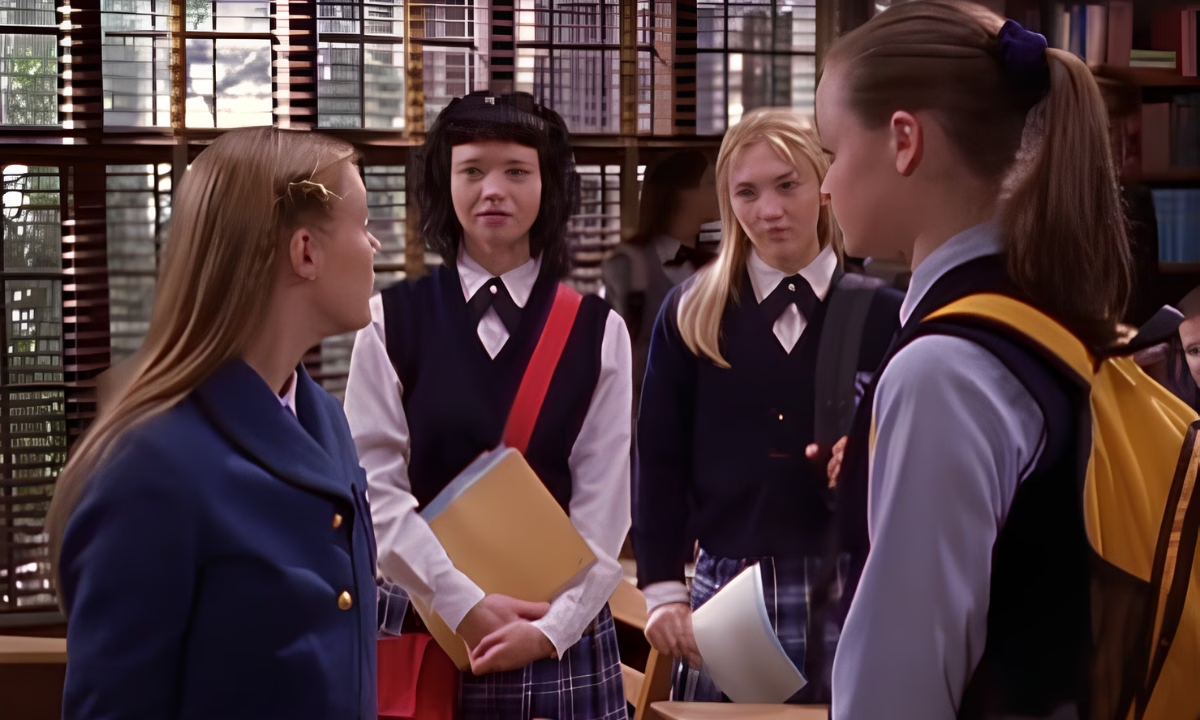

Gilmore Girls is a fast-talking comedy drama about a single mother and her bookish daughter in a picture-perfect Connecticut town, and it is also, underneath the coffee and the Pop-Tarts, a show about who pays the bills. Every major turn in the story, from the first episode to the very last line of the 2016 revival, starts with a check.
If you have only ever watched it as fall comfort TV, this Gilmore Girls review will give you a second way to see it, a full season-wise spoiler guide, and the actual numbers behind its strange, long afterlife.
The show premiered on The WB on October 5, 2000, and ended on The CW on May 15, 2007, with 153 episodes across seven seasons. I came to it late, the way most people under 35 did, through streaming. I stayed for the dialogue. I came back, years later, for something I did not notice the first time: the ledger.
Table of Contents
Gilmore Girls at a glance
What it is: A comedy drama created by Amy Sherman-Palladino, starring Lauren Graham as Lorelai Gilmore and Alexis Bledel as her daughter Rory, set in the fictional town of Stars Hollow, Connecticut.
The hook: Lorelai needs tuition money for Rory’s elite prep school, so she asks her estranged rich parents. They agree on one condition: dinner every Friday night.
Verdict: Seasons 1 to 4 are close to great television. Season 5 is uneven but strong. Seasons 6 and 7 sag badly, and the data agrees with me.
My angle: The show sells itself as a story of independence, yet almost every escape route in it is funded by Hartford money.
Where to watch (US, as of mid-2026): The original series left Netflix in the US on June 30, 2026 and moved to Prime Video on July 1, 2026. The revival, A Year in the Life, stays on Netflix only until November 24, 2026.
Recognition: Ranked No. 99 on The New York Times’ list of the 100 best TV shows of the 21st century. It won exactly one Emmy, for makeup, in 2004.
Best for: Viewers who love dialogue, family friction, and slow-burn romance. Not for: Anyone who needs plot momentum or likable protagonists at all times.
Is Gilmore Girls worth watching in 2026?
Yes, Gilmore Girls is worth watching in 2026, as long as you treat the first four seasons as the real show and everything after as an optional epilogue. I say that as someone who has sat through all 153 episodes more than once.
The writing at its peak is extraordinary. Sherman-Palladino wanted speed, and the scripts averaged about 80 pages per episode, compared with roughly 55 to 60 for a typical hour-long drama. You can feel that density. Characters talk over each other, pivot from grief to a joke about Oscar Levant in one breath, and rarely explain themselves. In other words, the show trusts you.
Critics noticed early. The first season holds a Metacritic average of 81 from 26 reviews, and the show later landed on Time’s “All-Time 100 TV Shows” list. Still, there is a catch, and you should know it going in. The last two seasons are noticeably weaker, for reasons that have as much to do with contracts as with creativity. I get to that below.
What is Gilmore Girls actually about?
On the surface, Gilmore Girls is about Lorelai, who got pregnant at 16, left her wealthy parents’ Hartford mansion, and raised Rory while working her way up from maid to manager at a local inn. Rory is 16 when the show opens, dreams of Harvard, and gets into Chilton, an expensive private school.
That is where the real subject appears. Lorelai cannot afford Chilton. So she drives to Hartford and asks Richard and Emily Gilmore for money. They lend it, on the condition that she and Rory come to dinner every Friday until the loan is repaid.
Think about how strange that premise is for a “family-friendly” show. The central relationship of the series, the one between Lorelai and her own mother, is restarted by a loan agreement. Love arrives with terms attached. Typically, a family drama hides money in the background. Gilmore Girls puts it in the pilot and then spends seven years pretending it is about something else.
Who really pays for everything in Stars Hollow?
The Gilmore grandparents pay for almost everything that matters in Rory’s life, and other people’s money keeps rescuing Lorelai too. Once I started tracking it, I could not stop. Here is the ledger, season by season, using only plot points I could verify.
| Season | What needed paying for | Who actually paid |
|---|---|---|
| 1 | Rory’s Chilton tuition | Richard and Emily, as a loan tied to Friday dinners (source) |
| 3 | Repaying the Chilton loan | Richard again, indirectly: a $75,000 payout from an investment he made when Lorelai was born |
| 3 | Rory’s Yale tuition | Rory borrows from her grandparents, and Friday dinners return |
| 4 | Finishing the Dragonfly Inn renovation | Luke lends Lorelai money when she runs short |
| 5 | Rory’s “year off” from Yale | She moves into her grandparents’ pool house |
| 6 | The rest of Yale | Christopher, after receiving an inheritance, which ends the mandatory dinners |
| Revival | Expanding the inn | Lorelai goes back to Emily for money, and Emily again attaches a condition |
Look at that third row closely. In season 3, Lorelai finally frees herself. She uses Richard’s payout to clear the Chilton debt, and Emily is visibly shocked. For a few episodes, the Gilmore Girls are independent. Then Rory, who wants Yale, walks right back into the arrangement on her own. The trap reopens, and this time the daughter signs.
I find that more honest than anything the show says out loud. The money does not corrupt the Gilmores. It simply holds them together, and nobody can quite admit it.
Paste Magazine made a related argument years ago, describing how the show mocks wealth while still letting its heroines enjoy what money buys. I agree with half of that. Where I part ways is the word “problem.” To me, this tension is the best thing in the series, whether or not the writers meant it.
If the class angle interests you, I wrote about the opposite side of it in Growing Up Poor Leaves 7 Hidden Habits. Read the two together and Stars Hollow looks a lot less like an accident.
Gilmore Girls season-wise plot summary
Spoilers for all seven seasons and the 2016 revival start here. If you have not watched yet, jump to the verdict.
Season 1 (2000 to 2001): The loan and the deal
Season 1 ran 21 episodes, from October 5, 2000 to May 10, 2001. Rory gets into Chilton, Lorelai borrows the tuition, and Friday night dinners begin.
At Chilton, Rory clashes with Paris Geller, an academic rival who later becomes a real friend. In the pilot, she also meets Dean Forester, the tall, sweet Stars Hollow boy who becomes her first boyfriend. Lorelai starts seeing Max Medina, Rory’s English teacher. They split, reunite, and Max proposes in the season finale.
Christopher Hayden, Rory’s father, drifts in and out. Notably, his first real visit ends with a Friday dinner involving his parents that turns into a disaster. The pattern is set: every important conversation in this show happens across a dinner table someone else paid for.
Season 2 (2001 to 2002): Cold feet and a new boy
Lorelai calls off her wedding to Max and takes Rory on a road trip that includes a visit to Harvard. Rory is presented at a debutante ball hosted by Emily’s chapter of the Daughters of the American Revolution, with Dean as her escort.
Then Jess Mariano, Luke’s sharp, sullen nephew, arrives and turns the Rory and Dean romance into a triangle. Rory is drawn to him almost immediately. When Rory and Jess get into a car accident, Lorelai blames Jess, which causes a serious rift between Lorelai and Luke. By the end of the season, Lorelai and Christopher spend the night together, only for Christopher to learn that his girlfriend Sherry is pregnant and return to her.
Emily Yahr of The Washington Post later looked back and called this year “Pretty much a perfect season of television”. I would not argue.
Season 3 (2002 to 2003): Freedom, briefly
Dean breaks up with Rory because he can see she likes Jess, and Rory and Jess finally date. It does not go well. Jess skips school to work, cannot graduate, cannot take Rory to prom, and leaves for California without telling her.
Lorelai dates Alex Lesman and has a brief, painful reunion with Max. On her birthday, Richard hands her the $75,000 investment payout, and she uses it to repay her parents for Rory’s schooling. Fran Weston dies, which allows Lorelai and Sookie to buy the Dragonfly Inn.
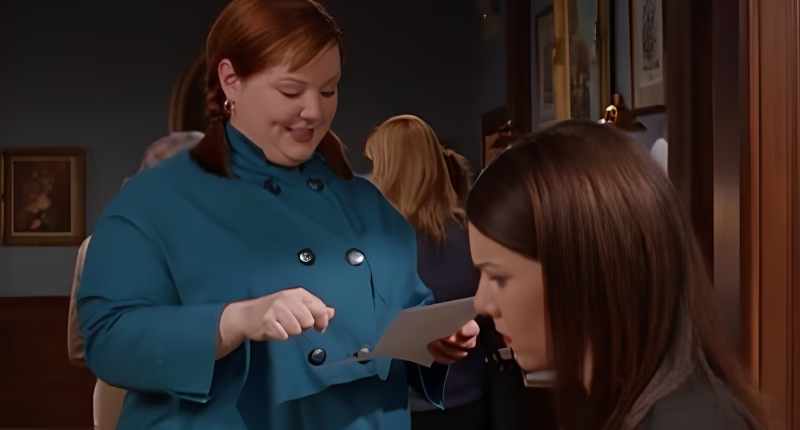
Rory chooses Yale, her grandfather’s school, over her lifelong Harvard dream. Rather than let her mother drain the inn fund, she borrows from her grandparents and accepts the return of Friday dinners. She graduates from Chilton as valedictorian and thanks her grandparents in her speech. It is a lovely scene. It is also a receipt.
Season 4 (2003 to 2004): Yale and the first kiss
Rory starts at Yale and shares a dorm with Paris. Luke impulsively marries a lawyer named Nicole on a cruise, and they soon divorce. Lorelai secretly dates Jason Stiles, Richard’s new business partner, until a lawsuit blows it apart.
The Dragonfly renovation eats through Lorelai’s cash, so Luke offers her a loan. The inn opens, and Luke and Lorelai finally kiss. On the same night, Rory sleeps with Dean, who is now married to Lindsay. It is the end of the Rory everyone in town thinks they know.
Also worth knowing: this season’s episode “The Festival of Living Art” earned the show’s only Emmy, for Outstanding Makeup for a Series (Non-Prosthetic).
Season 5 (2004 to 2005): Logan and the yacht
Lorelai and Luke become a couple. Rory, after a summer in Europe with Emily, drifts back to Dean, then away again. She meets Logan Huntzberger, heir to a publishing family, who brings her into a Yale secret society called the Life and Death Brigade. His parents treat her as unsuitable because she wants a career and because of her background.
Logan’s father, Mitchum, gives Rory a newspaper internship, then tells her she does not have what it takes to be a journalist. Rory reacts by stealing a yacht with Logan, gets arrested, and decides to take time off from Yale. Richard and Emily, who first promised to talk her out of it, let her move into their pool house. Lorelai, cut off and furious, proposes to Luke.
Ratings were healthy here. According to a 2005 Associated Press report carried by Fox News, the show drew 4.7 million viewers for the season so far, up from 4.1 million the year before, while regularly finishing second among adults 18 to 34 against American Idol.
Season 6 (2005 to 2006): The cracks
Rory joins the DAR, serves 300 hours of community service, and barely speaks to her mother for months. Jess, now the author of a novel, visits and tells her plainly that she is wasting her life. She returns to Yale and reconciles with Lorelai in “The Prodigal Daughter Returns”, then becomes editor of the Yale Daily News.
Luke, for his part, learns he has a daughter, April, and does not tell Lorelai. (I will not pretend to love this arc. Few people do.) The wedding gets postponed. Christopher inherits money and starts paying for Yale, so Friday dinners stop being mandatory. At the finale, Lorelai issues Luke an ultimatum, he does not answer it, and she sleeps with Christopher.
Maureen Ryan of the Chicago Tribune called season 6 uneven at best and said the long Lorelai and Rory feud pushed the writers toward filler. That matches my own memory of it.
Season 7 (2006 to 2007): A different show with the same faces
Season 7 aired on The CW from September 26, 2006 to May 15, 2007. Lorelai and Christopher marry impulsively in Paris. It falls apart when Christopher reads a character reference Lorelai wrote for Luke’s custody case and realizes she still loves Luke.
Rory graduates from Yale with honors and Phi Beta Kappa membership. Logan proposes and asks her to move to Palo Alto. She says no. Logan insists on “all or nothing,” and they part. At the last minute, Rory gets a job covering Barack Obama’s first presidential campaign for an online magazine. Luke secretly throws her a town-wide farewell party, and Lorelai and Luke kiss again.
Interestingly, the final season ends with Rory taking a job no grandparent arranged. For the first time in seven years, she leaves Stars Hollow on someone else’s payroll that has nothing to do with family. I wish the revival had respected that.
Gilmore Girls: A Year in the Life (2016): Back to Hartford’s checkbook
Netflix released the four-part revival, Winter, Spring, Summer, and Fall, on November 25, 2016. Edward Herrmann, who played Richard, had died on December 31, 2014, and his absence shapes everything. Emily, newly widowed, is raw and furious and wonderful.
Rory is 32, freelancing, without a stable home. She has a boyfriend named Paul she keeps forgetting, and she is quietly sleeping with Logan, who is engaged to someone else. Job interviews go nowhere. She ends up editing the tiny Stars Hollow Gazette, and Jess suggests she write a book about her life with her mother.
Lorelai, wanting to expand the inn, goes back to Emily for money in a scene that deliberately echoes the pilot, and Emily once again makes the money conditional. Luke and Lorelai finally marry. Then come the “final four words” Sherman-Palladino had planned for years. Sitting at the gazebo, Rory says, “Mom?” Lorelai: “Yeah?” Rory: “I’m pregnant.”
The timing points to Logan as the father, though the show never states it outright.
Why does Gilmore Girls fall apart after season 5?
Gilmore Girls declines after season 5 mostly because its creators left, and Netflix viewing data suggests audiences feel the drop.
In April 2006, Amy Sherman-Palladino and her husband Daniel Palladino announced they were unable to reach an agreement with the studio and would leave when their contracts expired. Variety reported at the time, as summarized by the TV blog Televisionary, that Warner Bros. had offered a one-year deal worth nearly $5 million while the Palladinos wanted two years. I cannot independently confirm the exact dollar figure beyond those reports, so treat it as reported, not proven.
David S. Rosenthal ran season 7. Because the original pair had written or reworked most scripts, the voice changed. You can hear it in the rhythm of the jokes.
Now the numbers. Netflix publishes a twice-yearly engagement report. Using the first-half 2025 report, WhistleOut pulled out views for each Gilmore Girls season:
| Season | Netflix views, Jan to Jun 2025 | Hours viewed |
|---|---|---|
| Season 1 | 5,000,000 | 75.8 million |
| Season 2 | 4,500,000 | 71.9 million |
| Season 3 | 4,400,000 | 69.3 million |
| Season 4 | 4,300,000 | 68.9 million |
| Season 5 | 4,300,000 | 69.0 million |
| Season 6 | 4,000,000 | 63.3 million |
| Season 7 | 3,600,000 | 56.4 million |
| A Year in the Life | 2,700,000 | 16.8 million |
What jumps out is the shape. After the normal first-season drop, the audience barely moves from season 2 to season 5, losing only about 200,000 views over three seasons. Then it falls by 300,000 into season 6 and another 400,000 into season 7. To put it another way, viewers stuck with Rory’s affair, Dean’s marriage, and the yacht. They started leaving when the Palladinos’ last season wobbled and left in larger numbers once the Palladinos were gone.
One caveat. These are views, not a survey of opinion, and people quit shows for many reasons. Still, the pattern lines up neatly with what critics said in 2005 and 2006.
How popular was Gilmore Girls when it first aired?
Gilmore Girls was a modest network hit that never reached mass-market numbers. Across its run, it averaged about 5 million viewers per episode. Here are season averages for total viewers as compiled by TheWrap in 2016:
| Season | Average total viewers |
|---|---|
| 1 | 3.81 million |
| 2 | 5.64 million |
| 3 | 5.81 million |
| 4 | 4.89 million |
| 5 | 5.63 million |
| 6 | 5.54 million |
| 7 | 4.64 million |
Source: TheWrap
A small note of honesty here. Wikipedia describes the show as peaking in its fifth season as one of The WB’s most popular series, while TheWrap’s averages put season 3 slightly ahead. Both can be true, because “most popular” can mean rank within a weak network rather than raw viewers. Based on the available data, I would say the show plateaued between seasons 2 and 6 rather than having one clear peak.
For comparison, those numbers were tiny next to network giants. What changed everything was streaming.
Why do people watch Gilmore Girls every fall?
People rewatch Gilmore Girls every fall because the show feels like autumn, and the streaming data proves the habit is real.
The Hollywood Reporter found that the series got a significant viewing boost every autumn since 2021, when Nielsen began publishing weekly streaming top 10 lists. It was also one of the top 10 library shows of the year by total viewing time from 2021 to 2023. In 2022, Nielsen found it was the seventh most watched title among women aged 18 to 34, and in one October it logged 572 million viewing minutes.
Sherman-Palladino herself has said she thinks the show is bigger now than at any point while it was on the air. Given those numbers, I believe her.
The fandom goes well beyond streaming. According to Wikipedia’s summary of press coverage, an unofficial Gilmore Girls Fan Fest has run in Connecticut every October since 2016, and for the show’s 16th anniversary 200 coffee shops across the US and Canada turned into pop-up “Luke’s Diners”. In September 2025, the Emmys staged a 25th-anniversary tribute in which Graham and Bledel reunited on a porch set and joked about the show’s tight budget.
Here is my honest theory on the fall thing. Autumn is the season of starting over: school, new notebooks, the sense that you can still become someone. Gilmore Girls is a show about a girl preparing to become someone. It makes sense that we return to it right when we feel that pull ourselves.
Is Rory Gilmore Girls a good role model?
Rory Gilmore is a good role model for about three seasons, and after that she becomes something more useful: a warning about praise without pressure.
The internet has a whole genre of “Rory is the worst” essays, and most of them list the same sins. I would rather ask why. Margaret Lyons of Vulture put it well back in 2014, arguing that Rory’s biggest flaw is that her wants always win. I would add one more cause: money.
Notice when Rory falls apart. It is the first time someone with real power, Mitchum Huntzberger, tells her she is not special. Every adult in her life up to that point has praised her, and every major cost has been absorbed by her grandparents. When the criticism comes, she has no practice handling it, and she has a pool house to run to.
Carol Dweck’s work on fixed and growth mindsets describes this almost exactly. If you have never read it, my Mindset book review covers the core idea, and Rory is practically a case study for it.
Alexis Bledel once said Sherman-Palladino’s view was that when Rory messes up, it would be big. It was. The problem, for many viewers, is that the show rarely makes her pay for it, in either sense of the word.
What does Gilmore Girls get right that newer shows don’t?
Gilmore Girls gets women’s intergenerational relationships right in a way few shows have matched since. Three generations of Gilmore women love each other, wound each other, and keep showing up for dinner anyway.
Emily is the secret weapon. Kelly Bishop, a Tony winner cast immediately after her audition, plays her as cold, funny, and quietly desperate to be needed. Lorelai’s running war with her mother is the show’s real love story, more than any romance.
Then there is Paris and Rory. The Atlantic’s Shirley Li called it TV’s last great teenage-girl friendship, built slowly on screen. I agree. The friendship starts as open hostility and turns into loyalty without a single sentimental speech.
Finally, the reading. Rory reads constantly, and fans have turned it into a challenge. Wikipedia notes 339 books referenced on the show, while Epic Reads counts 408 in Rory’s list. The counts differ because people define “referenced” differently, so I cannot confirm a single correct number.
If you want to start your own version, Simone de Beauvoir’s The Second Sex is a fine Gilmore-adjacent pick, and I reviewed it here.
What does Gilmore Girls get wrong?
Gilmore Girls gets several things wrong, and they are worth naming plainly so you know what to expect:
- Diversity. Stars Hollow is overwhelmingly white, and even affectionate rewatch pieces, like one from Refinery29, flag the lack of diversity as the part that ages worst. Lane Kim is the major exception, and in my view her strict mother is too often played for easy jokes.
- Class blindness. The show mocks Hartford society while treating Lorelai’s own comfortable life as scrappy. It is not.
- Accountability. Rory and Lorelai are both often rude to service workers. Vulture’s Lyons made exactly this criticism of Lorelai.
- The April storyline. Introducing a secret daughter for Luke in season 6 has been described as one of the most hated plot devices in the show’s history.
- Awards neglect. This is not the show’s fault, but Lauren Graham never received a single Emmy nomination, which Time later listed among the Emmys’ worst snubs.
Does the revival ending work?
The revival ending works as a structural echo but not as a story, at least for me. Rory at 32, pregnant and alone, mirrors Lorelai at 16. The circle closes neatly.
Yet look at it through the money lens. Lorelai at 16 walked away from wealth. Rory at 32 has been sleeping with a rich man’s heir and has spent a year failing to support herself. One story is about independence. The other is about dependence wearing the same costume.
Sherman-Palladino defended the open ending, telling HuffPost that a life “should not have a bow on it at 32.” Fair enough. Even so, the revival found an audience. Research firm Symphony estimated it averaged about 4.97 million viewers aged 18 to 49 in its first three days. If you are curious about Rory’s revival crisis from the inside, I wrote a separate piece on why a career crisis at 30 feels like failure, and her year fits it almost too well.
Where to watch Gilmore Girls right now
As of mid-2026, here is the situation in the US:
- Seasons 1 to 7: Left Netflix on June 30, 2026 and arrived on Prime Video on July 1, 2026, ending a run that began when the show reached Netflix in October 2014. Hulu also added the full 153-episode series in a nonexclusive deal, though I cannot confirm whether that license is still active today.
- A Year in the Life: Still on Netflix, but Netflix confirmed to What’s on Netflix that it leaves worldwide after November 24, 2026.
So if you want to finish the full story on Netflix, you have roughly six weeks from the date of this review. Streaming deals change often, so check your service before you start.
My viewing plan: how to watch Gilmore Girls in 2026
Here is the practical version, based on everything above:
- First-timers: Watch seasons 1 through 4 straight through. That is 87 episodes and the show at its best.
- Then decide: Watch season 5 if you care about Rory’s Yale years. It is messy but often brilliant.
- Optional: Seasons 6 and 7. Watch them for closure on Luke and Lorelai, not for quality.
- Revival: Watch A Year in the Life only after season 7, and only if you can accept an unresolved ending.
- Rewatchers: Try tracking who pays for what. I promise it changes the show.
Final verdict: My Gilmore Girls review in one paragraph
Gilmore Girls is one of the best-written family shows American television has made, and it is far more interesting than its cozy reputation suggests.
For four seasons, it is funny, sharp, and quietly honest about the cost of love. After that, the creators leave, the plots thin, and the viewers drift, just as Netflix’s own numbers show. What keeps me coming back is the tension the show never resolves: Lorelai built a life to escape her parents’ money, and her daughter spent seven seasons, and a revival, spending it.
If you want my rating, it is 9/10 for seasons 1 to 4, 6/10 for the full run with the revival. For more series worth your time, see my list of the 20 best TV series of all time.
FAQ
How many seasons of Gilmore Girls are there?
There are seven seasons with 153 episodes, plus the four-part 2016 revival A Year in the Life.
Why did Amy Sherman-Palladino leave Gilmore Girls?
She and Daniel Palladino could not reach a contract agreement with the studio before season 7.
What are the final four words of Gilmore Girls?
“Mom?” “Yeah?” “I’m pregnant.” They close A Year in the Life.
Did Gilmore Girls win an Emmy?
Why do Lorelai and Rory have Friday night dinners?
Where was Gilmore Girls filmed?
The pilot was shot in Unionville, Ontario, and the rest of the series on the Warner Bros. backlot in Burbank, California.
Who does Lorelai end up with?
