
Last updated on October 19th, 2026 at 11:48 am
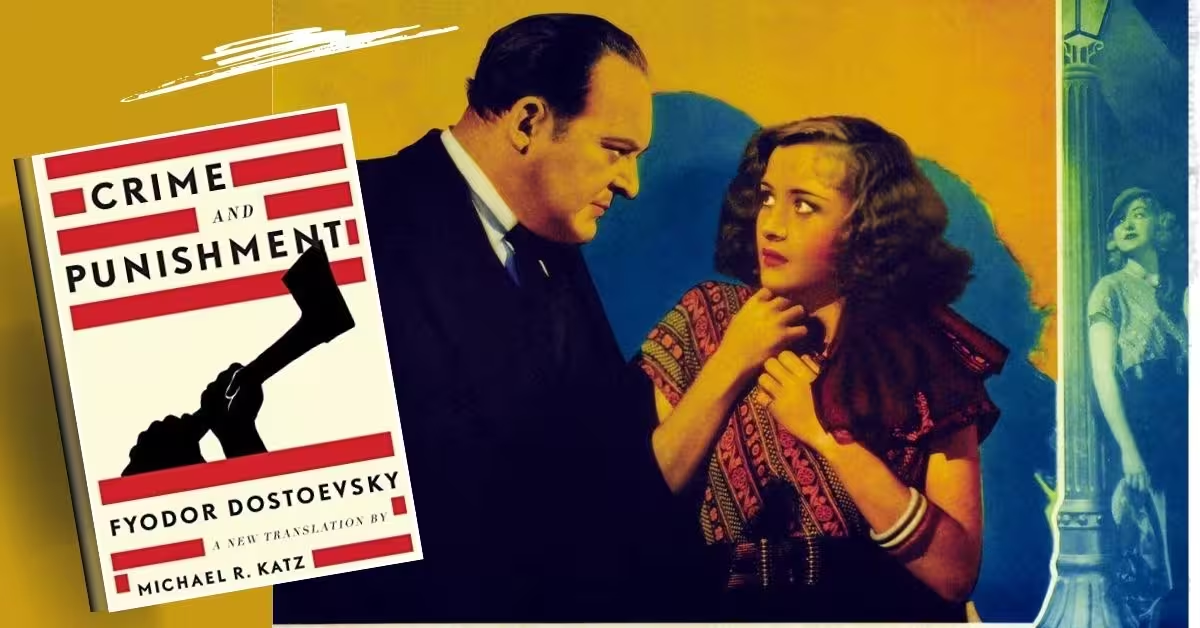
Crime and Punishment by Fyodor Dostoevsky is not a detective story. It is an autopsy of a man who believed he had the right to be extraordinary. When I first read it, I expected a cat-and-mouse chase. Instead, I found something far more unsettling: a novel that does not ask who killed the pawnbroker, but what kind of person believes murder is a reasonable first step in a career plan.
That question has never felt more relevant than it does right now, in a culture that celebrates “founders” and “disruptors” who break things first and apologize later.
Table of Contents
Crime and Punishment at a glance
Reader recommendation for Crime and Punishment: You will love this novel if you want a deep, uncomfortable psychological portrait of a person who rationalizes a terrible act and then discovers that his mind will not obey his theories.
You will struggle with it if you need a fast-paced thriller, a clear moral hero, or a plot that moves in a straight line. The first 150 pages are slow, feverish, and repetitive by design. The final 100 pages, especially the Epilogue, are among the most debated endings in world literature.
This is a book for readers who are willing to sit inside a character’s mental collapse and come out the other side with a clearer view of their own justifications.
The novel was first published in twelve monthly installments in The Russian Messenger during 1866. The first English translation appeared in 1886 through Vizetelly & Co., translated from a French edition rather than directly from Russian. It has never gone out of print in English since the early twentieth century.
Introduction
Title: Crime and Punishment
Author: Fyodor Dostoevsky
Original publication: 1866 (serialized); 1867 (single volume)
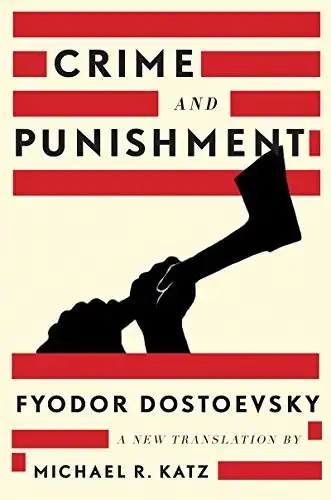
This edition: A new translation by Michael R. Katz, published by Liveright in 2018
The novel is set in St. Petersburg in the 1860s, a decade of turbulent reform in Russia after the emancipation of the serfs in 1861.
Dostoevsky wrote it in the middle of that upheaval, and the city itself functions as a character: hot, cramped, smelling of lime plaster and cheap taverns, filled with people who have nowhere else to go.
The Katz translation deliberately captures the distinct speech patterns of each character, from the drunken civil servant Marmeladov’s biblical cadences to the examining magistrate Porfiry’s playful, needling sarcasm.
Quick Verdict
A bold, unsettling novel that blends murder, social criticism, and spiritual crisis. Recommended for fans of literary fiction who care more about why a crime happens than who committed it.
Should You Read It?
| Pros | Cons |
|---|---|
| Unmatched psychological depth; you live inside Raskolnikov’s rationalizations | The middle section drags with extended philosophical arguments |
| Characters with distinct voices and real contradictions | The Epilogue feels abrupt and has divided readers for 150 years |
| The detective Porfiry is one of literature’s great psychological interrogators | Requires patience with 19th-century serialized pacing |
| The Katz translation balances humor and horror | Some cultural context about 1860s Russian radicalism is helpful |
What Is It About?
A poor former student in St. Petersburg convinces himself that extraordinary people have the right to commit crimes for a greater purpose, murders a pawnbroker and her sister to prove his theory, and then spends the rest of the novel discovering that his conscience is not a theory he can edit.
A detective who understands human nature better than the criminal slowly closes in, while a young woman forced into prostitution becomes the only person who refuses to abandon him.
Rating: 4.5 / 5
Background
Dostoevsky was not writing from a comfortable distance. In 1849, he was arrested for his involvement with the Petrashevsky Circle, a group of intellectuals who discussed banned ideas.
He was sentenced to death, led out to a parade ground to be shot, and then reprieved at the last moment. He spent the next decade in a prison labor camp and exile. By the time he wrote Crime and Punishment, he had already published Notes from the House of the Dead (1860–62) and Notes from Underground (1864), the latter a furious attack on the rational egoism popular among Russian radicals of the 1860s.
The novel grew directly out of that attack, and out of Dostoevsky’s fear that a generation of young people was being trained to believe that moral rules were obstacles for ordinary people but not for “extraordinary” ones.
The 1860s in Russia were a period of rapid and uneven modernization. Judicial reforms, local self-government, and military changes followed the emancipation of the serfs, but poverty, drunkenness, prostitution, and urban crime also rose as people migrated to cities without adequate housing or work.
The novel reflects that social upheaval without ever becoming a social tract. Dostoevsky was more interested in what happens inside a single mind when a person combines genuine suffering with a borrowed theory.
Crime and Punishment Plot Summary
I will retell the novel in four instalments, covering the entire story, including the ending. If you want to read the book without knowing the ending, stop here and come back later. The summary is based on the Katz translation and follows the novel’s own sequence of events.
The Test and the Murder
Rodion Raskolnikov, a former law student living in a tiny rented room in St. Petersburg, is crushed by poverty and has stopped eating regularly. He avoids his landlady because he owes her rent, and he has been sinking into a state of irritable isolation that he himself compares to hypochondria.
He has a plan: to visit an old pawnbroker, Alyona Ivanovna, and test whether he can go through with something he has been imagining for months. He pawns his father’s silver watch, observes the old woman’s apartment, and leaves in a state of revulsion. He is not sure whether he is testing the practical details of a robbery or testing his own courage.
On the way home, he stops in a tavern and meets Semyon Zakharovich Marmeladov, a former civil servant who has drunk away his job and his family’s money. Marmeladov tells Raskolnikov the story of his wife, Katerina Ivanovna, an educated woman who married him out of desperation, and his daughter, Sonya, who was forced into prostitution to feed her starving half-siblings.
The monologue is both pathetic and theatrical; Marmeladov speaks in a biblical cadence and imagines Christ forgiving drunkards and prostitutes at the Last Judgment. This encounter plants a religious theme that will return at the end of the novel.
Raskolnikov later overhears a conversation in a tavern between a student and an officer. The student argues that the old pawnbroker is a worthless, harmful louse and that killing her and using her money to help people would be morally justifiable. Raskolnikov is stunned because the student is expressing almost exactly the idea that has been growing in his own mind.
This coincidence feels like a sign.
He receives a letter from his mother explaining that his sister Dunya is engaged to a wealthy, respectable lawyer named Petr Petrovich Luzhin. Raskolnikov immediately hates Luzhin. He understands that Dunya is marrying for money to help the family, and he sees the marriage as a form of prostitution that is more respectable only on the surface.
He decides that he cannot allow it. The letter pushes him toward action.
A series of accidental discoveries makes the murder seem inevitable. Raskolnikov hears that Lizaveta, the pawnbroker’s timid younger sister who lives with her, will be away from home at seven o’clock the following evening. He realizes that the old woman will be alone. He sews a loop into his coat to hide an axe, steals an axe from the caretaker’s lodge, and goes to the apartment. He rings the bell, enters, and after a tense exchange, he strikes the old woman on the head with the axe. She dies. He searches for her keys, takes a purse and some items from a chest under her bed, and is about to leave when Lizaveta returns unexpectedly.
He kills her too, almost mechanically. He escapes without being seen, returns the axe, and returns to his room in a state of feverish confusion. He hides the stolen items under a stone in a courtyard, but he does not even look inside the purse to count the money.
Conscience and Detection
Raskolnikov falls into a severe fever and delirium for several days. When he recovers, he learns that the police have visited. He is summoned to the district police office for an unrelated matter about an overdue promissory note, but while he is there, he overhears the police discussing the murder.
He faints. The assistant superintendent, Ilya Petrovich, becomes suspicious, but the superintendent, Nikodim Fomich, is more inclined to treat Raskolnikov as a sick young man.
Raskolnikov’s friend Razumikhin, a cheerful and loyal former student, takes care of him and introduces him to the examining magistrate, Porfiry Petrovich.
Porfiry is a small, round, restless man with a habit of pacing and laughing at his own jokes. He has read an article Raskolnikov published in a journal, in which Raskolnikov divided humanity into ordinary people, who must obey the law, and extraordinary people, who have the right to overstep the law if their ideas might benefit humanity.
Porfiry asks Raskolnikov whether he considers himself extraordinary, and whether he would kill to prove it. Raskolnikov is both fascinated and terrified by Porfiry’s playful interrogation. He begins to suspect that Porfiry knows something, but he cannot tell whether the detective is merely provoking him or closing in.
Meanwhile, Raskolnikov’s mother and sister arrive in Petersburg.
Dunya has broken off her engagement to Luzhin after Raskolnikov humiliated him and exposed his petty, controlling nature. Raskolnikov is relieved but also ashamed. He tells his mother and sister that he cannot be with them, that he needs to be alone, and he essentially abandons them. He is not sure whether he is protecting them from himself or punishing himself by cutting them off.
Sonya, the daughter of the late Marmeladov, becomes the only person Raskolnikov allows himself to visit. She is timid, deeply religious, and has been forced into prostitution to keep her family alive. Raskolnikov is drawn to her not because she is pure in a simple sense, but because her suffering has not made her cruel.
He tells her that he will tell her who killed Lizaveta. He does not yet say that he is the murderer, but he is circling the confession.
Marmeladov is run over by a carriage in the street. Raskolnikov helps carry him home, where he dies in Sonya’s arms. Katerina Ivanovna, already ill with consumption and increasingly unstable, is left with three young children. Raskolnikov gives the family the little money he has for the funeral. This act of generosity does not erase what he has done, but it shows that he is not a simple monster.
He is a person who can be moved by suffering and who can also commit murder. The novel refuses to resolve that contradiction.
Svidrigaylov and the Trap
Arkady Ivanovich Svidrigaylov arrives in Petersburg shortly after the death of his wife, Marfa Petrovna. He is a wealthy, dissipated landowner who once employed Dunya as a governess and tried to seduce her. His wife blamed Dunya for the affair and spread rumors about her, but later discovered the truth and tried to restore Dunya’s reputation.
Svidrigaylov is a strange, unsettling figure: he is capable of genuine generosity, as when he arranges for Katerina Ivanovna’s children to be placed in good orphanages and sets aside money for them, but he is also a voyeur and a manipulator. He seems to know Raskolnikov’s secret.
He has been listening through the wall while Raskolnikov confessed to Sonya. He does not go to the police. Instead, he uses his knowledge to toy with Raskolnikov and to approach Dunya.
Svidrigaylov tells Dunya that he knows her brother is the murderer, and he offers to save Raskolnikov by paying for his escape abroad if Dunya will agree to be with him.
Dunya refuses and shoots at him with a revolver, grazing his head. Svidrigaylov does not force her. He gives her the key to leave and then, after a night of wandering and nightmares, he shoots himself on a street in the early morning. His suicide is not a noble act.
It is the end of a man who has exhausted his own capacity for pleasure and meaning, and it serves as a dark mirror to Raskolnikov: both men believed they could step outside moral limits, but Svidrigaylov’s emptiness is total, while Raskolnikov still has something in him that can be reached.
Porfiry Petrovich finally confronts Raskolnikov directly. He tells Raskolnikov that he knows he is the murderer. He does not arrest him immediately. Instead, he advises Raskolnikov to confess voluntarily, promising that a confession will lead to a lighter sentence and that suffering will ultimately help him. Porfiry is not a simple moralist. He is a pragmatist who understands that Raskolnikov’s own conscience is already punishing him more effectively than any prison could. He also understands that Raskolnikov needs to confess not for legal reasons but because he cannot live with the lie any longer.
Raskolnikov goes to Sonya and finally confesses. He tells her that he killed the old woman and Lizaveta. He tries to explain his theory, but his explanation collapses. He admits that he did not kill to help his mother or to become a benefactor of humanity. He killed to prove to himself that he was not a louse. He wanted to know whether he had the right to step over. And he discovered that he did not.
He could not carry the weight of what he had done. Sonya does not reject him. She holds him and tells him that he is the most miserable man in the world. She gives him a cypress cross and asks him to go to the crossroads, bow down to the earth, and confess aloud. He eventually does.
He kisses the ground in Haymarket Square and then walks to the police station, where he confesses to Ilya Petrovich.
The Ending and the Epilogue
Raskolnikov is sentenced to eight years of penal servitude in Siberia. The sentence is lighter than it might have been because of his confession, his previous acts of charity, and the lack of clear evidence that he used the stolen money for personal gain.
Sonya follows him to Siberia. She does not live with him in the prison, but she settles in the town and visits him regularly. She becomes a kind of mother figure to the other convicts, who respect her even though they do not fully understand her.
Raskolnikov, however, does not experience the spiritual renewal that Porfiry and Sonya predicted. For a long time, he feels no remorse for the murder itself. He feels only shame at having failed, at having been weak enough to confess. He is angry at himself for not being the extraordinary man he thought he was. He does not open the Gospel that Sonya gave him. He does not pray.
He is isolated from the other prisoners, who sense that he is different and resent him for it. They call him a gentleman and an atheist.
Sonya falls ill for a while and cannot visit him. Raskolnikov realizes that he misses her desperately. When she returns, something changes in him. He falls at her feet and weeps. He does not fully understand what is happening, but he knows that he loves her.
The novel ends with the two of them sitting together, planning to endure the remaining seven years and to build a new life afterward. The narrator says that this is the beginning of a new story, the story of a man’s gradual renewal.
The Epilogue has divided readers for generations. Some see it as a genuine conversion, a moment of Christian resurrection. Others see it as too sudden, too convenient, a forced happy ending tacked onto a novel that had been honest about the persistence of evil.
Dostoevsky’s own notebooks contain an alternative ending: “Raskolnikov goes to shoot himself”. The fact that he chose the Epilogue instead suggests that he wanted to leave open the possibility of change, even if he could not fully justify it. The novel does not say that Raskolnikov is saved.
It says that he is still alive, still capable of love, and still facing seven years in which he might become someone else.
Analysis and Criticism
Characters
Raskolnikov is not a hero, and he is not a villain. He is a person who has confused intellectual ambition with moral permission. He is capable of real kindness, as when he gives his last money to the Marmeladov family, and he is also capable of calculating murder.
His tragedy is that he is intelligent enough to construct a theory that justifies his crime but not emotionally stable enough to live inside that theory. The novel is essentially the story of his theory collapsing under the weight of his own conscience.
Sonya is often described as a saint, but that description is too simple. She is a young woman who has been forced into a degrading life and who has chosen to endure it because her family would starve without her. Her faith is not naive. She knows what people are capable of.
When she reads the story of Lazarus to Raskolnikov, she reads it with the passionate conviction of someone who needs resurrection to be true. She is not there to save him by preaching. She is there to stay with him, and that is what finally reaches him.
Porfiry Petrovich is one of the great detective figures in literature precisely because he is not a genius. He is a patient, slightly ridiculous man who understands that guilt works on people slowly. He does not need to trap Raskolnikov with evidence. He needs only to let Raskolnikov’s own mind do the work.
His method is psychological, and he is honest about it: he tells Raskolnikov that psychology cuts both ways, and that he is relying on Raskolnikov’s character rather than on physical clues.
Svidrigaylov is the novel’s most disturbing character because he is almost charming. He is generous with Katerina Ivanovna’s children, and he is also a predator who has driven at least one young girl to suicide. He represents what Raskolnikov might become if he fully committed to the idea that morality is a fiction: a person who can do good and evil with equal indifference, and who eventually finds nothing left to care about.
Dunya and Razumikhin represent the possibility of a normal, decent life. Razumikhin is not a genius, but he is hardworking and loyal. Dunya is proud and intelligent, and she refuses to be sacrificed by her brother or anyone else. Their relationship is not idealized.
It is practical and affectionate, and it offers a contrast to the feverish intensity of Raskolnikov’s world.
Themes and Symbolism
The central theme of the novel is the danger of intellectual pride detached from moral feeling. Raskolnikov’s theory is not stupid. It is a recognizable version of ideas that were circulating in Dostoevsky’s Russia: utilitarianism, rational egoism, and the belief that exceptional individuals are entitled to break ordinary rules.
The novel does not refute this theory with arguments. It refutes it with experience. Raskolnikov discovers that his conscience is not a social construct that he can reason away. It is part of him, and it will not be silenced.
The theme of suffering is equally important.
Porfiry tells Raskolnikov that suffering is a great thing, and that Mikolka, the painter who falsely confessed to the murder, was right to want to suffer. This is not a celebration of pain for its own sake. It is the idea that accepting responsibility for one’s actions, even when it is unbearable, is the only way to remain a person. Raskolnikov’s eight years in Siberia are not a happy ending.
They are a chance to become someone who can live with himself.
The symbolism of air runs through the novel. Raskolnikov’s room is described as a coffin, and the city itself is stifling. Porfiry tells Raskolnikov that he needs “air, air, air.” This is both literal and figurative. Raskolnikov needs to leave his cramped little world and breathe the air of real human contact. Sonya is associated with fresh air and light, while Svidrigaylov is associated with dampness and fog.
The novel’s final scene, in which Raskolnikov and Sonya sit by the river in the open air, suggests that he has finally begun to breathe.
The Lazarus story is the novel’s central religious symbol. Sonya reads it to Raskolnikov before he confesses, and it is the story of a man who has been dead for four days and is brought back to life. Raskolnikov is not Lazarus. He is not miraculously resurrected. But the story offers him a framework for understanding what might happen to him: a person can be dead inside and still be called back. The Epilogue leaves open whether he will answer that call.
Evaluation
My feeling about Crime and Punishment can be summed up in one sentence: it is an exhausting, brilliant, occasionally frustrating novel that understands guilt better than almost any book I have ever read.
Strengths
The novel’s greatest strength is its refusal to let Raskolnikov off the hook. He is not a victim of society, and he is not a monster. He is a person who made a choice, and the novel forces us to watch him live with that choice. The interrogation scenes between Raskolnikov and Porfiry are masterpieces of psychological tension.
The Marmeladov monologue is one of the most memorable passages in nineteenth-century fiction.
The Katz translation does an excellent job of preserving the distinct registers of each character’s speech, from Marmeladov’s biblical theatrics to Porfiry’s nervous, teasing humor.
Weaknesses
The novel’s middle section, particularly the extended discussions among Razumikhin, Luzhin, and Lebezyatnikov, can feel static. Dostoevsky was writing for a serial audience that expected philosophical debate alongside plot, but modern readers may find some of these passages repetitive.
The Epilogue remains controversial. It is emotionally powerful, but it also feels rushed compared to the careful pacing of the rest of the novel. Some readers will find the sudden appearance of love as a redemptive force too convenient.
Impact and Controversy
The novel has been controversial since its publication. Some nineteenth-century critics found it incoherent and inartistic, while others praised its realism and psychological depth. In the twentieth century, it became a staple of university courses and a touchstone for writers and philosophers.
Its influence can be seen in detective fiction, existentialist philosophy, and countless novels about guilt and self-justification.
The fact that it remains widely read today, when so many nineteenth-century novels have become historical curiosities, is a testament to its enduring power.
Comparison with Similar Works
Readers who enjoy Crime and Punishment might also appreciate The Stranger by Albert Camus, which explores a similar theme of a man who commits a crime and feels alienated from the moral expectations of society.
Notes from Underground, Dostoevsky’s earlier novella, is a shorter and more bitter version of some of the same ideas. The Brothers Karamazov, Dostoevsky’s final novel, takes up the question of guilt and responsibility on a much larger scale.
Adaptation
The novel has been adapted for film and television many times. The 2002 BBC production, directed by Julian Jarrold and starring John Simm as Raskolnikov, is a two-part television film that won a Royal Television Society Award for Best Tape and Film Editing in Drama.
A 1970 Soviet film starring Georgi Taratorkin is also well regarded. I cannot confirm box-office figures for these adaptations from the sources available to me. The 2002 BBC version is faithful to the novel’s plot but compresses some of the philosophical discussions.
It is a good introduction for viewers who want to see the story before reading the book, but it cannot replace the novel’s interiority.
Personal Insight with Contemporary Educational Relevance
One of the most important lessons of Crime and Punishment is that the stories we tell ourselves about our own greatness can become traps. Raskolnikov did not kill because he was poor. He killed because he had convinced himself that his poverty was evidence that he was meant for something greater, and that ordinary rules did not apply to him. That pattern is not limited to nineteenth-century Russian students. It shows up whenever someone decides that their talent or their vision justifies treating other people as obstacles.
The novel is also a warning about the dangers of isolation. Raskolnikov’s theories grew in a tiny room, with no one to challenge them. It was only when he was forced to confront another person, Sonya, that his theory began to collapse. In an age when people can curate their intellectual environments and surround themselves with ideas that reinforce their own sense of superiority, the novel’s insistence on the value of human contact feels urgent.
Here are five lessons I took from the novel that apply beyond the page:
- A theory that requires you to hurt someone is probably a bad theory. Raskolnikov’s justification for murder was elegant on paper and unlivable in practice. If an idea only works when you ignore the suffering it causes, it is not a good idea.
- Isolation makes bad ideas stronger. Raskolnikov’s plan developed in a room where no one could argue with him. The people who love us are often the best defense against our own worst reasoning.
- Guilt is not a weakness. Raskolnikov thought his conscience was a sign that he was ordinary. It was actually the part of him that was still human.
- You cannot calculate your way out of responsibility. Raskolnikov tried to turn murder into arithmetic: one death for a hundred good deeds. The novel shows that moral decisions are not equations. They are choices that change the person who makes them.
- Redemption is not a moment. It is a direction. The Epilogue does not say that Raskolnikov is saved. It says that he has started walking. That is a more honest picture of change than a sudden conversion.
Quotable Lines and Passages
“Pain and suffering are always obligatory for someone with broad intellect and deep feeling. Truly great individuals, it seems to me, must experience great sorrow in this world.” (Raskolnikov)
“I didn’t bow down to you; I bowed down to all human suffering.” (Raskolnikov to Sonya)
“Go to the crossroads, bow down before the people, kiss the earth because you’ve sinned before it, and say aloud to the whole world, ‘I’m a murderer!’ ” (Sonya to Raskolnikov)
“You’re so strange, Sonya—you hug me and kiss me when I just told you about that. You don’t know what you’re doing.” (Raskolnikov to Sonya)
“I merely killed a louse, Sonya, a useless, vile, pernicious louse!” (Raskolnikov)
“That louse was a human being!” (Sonya)
Conclusion
Crime and Punishment is not a comfortable book, and it is not meant to be. It is a novel about a man who tries to become a great man by committing a small, ugly crime, and who discovers that greatness is not something you can prove with an axe.
I recommend it to readers who love psychological fiction, to anyone interested in the relationship between ideas and actions, and to readers who are willing to sit with a character’s confusion without demanding a quick resolution.
If you prefer fast-paced thrillers or clear moral lessons, this may not be the book for you. But if you want a novel that takes guilt seriously, that refuses easy answers, and that still manages to end with a glimmer of hope, Crime and Punishment is essential reading.
Crime and Punishment

Crime and Punishment by Fyodor Dostoevsky is not a detective story. It is an autopsy of a man who believed he had the right to be extraordinary. When I first read it, I expected a cat-and-mouse chase. Instead, I found something far more unsettling: a novel that does not ask who killed the pawnbroker, but what kind of person believes murder is a reasonable first step in a career plan.
URL: https://www.sopranu.com/crime-and-punishment-sin-guilt-redemption/
Author: Fyodor Dostoevsky
4.5
Pros
- Unmatched psychological depth
- Distinct character voices
- Porfiry's psychological interrogation
Cons
- Slow middle section
- Controversial Epilogue
- Requires patience with 19th-century pacing







