
Last updated on October 21st, 2026 at 11:52 am
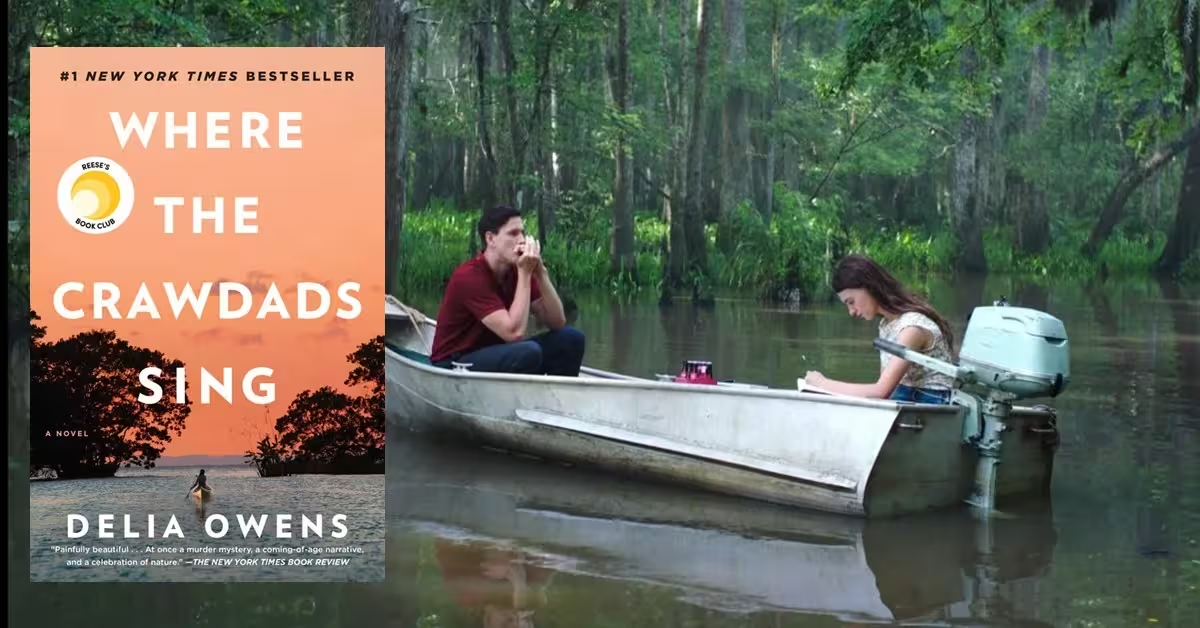
Where the Crawdads Sing by Delia Owens is a 2018 novel about Kya Clark, a girl abandoned in a North Carolina marsh, and the 1969 death of Chase Andrews that puts her on trial. Did Kya kill him? Yes, almost certainly. Owens never narrates the killing, but she hides the proof in Kya’s own poems, a missing shell necklace and a string of nature lessons about fireflies and mantises.
This review gives you the full plot, the ending explained clue by clue, a character and theme breakdown, and an honest verdict on whether Where the Crawdads Sing deserves its fame.
Table of Contents
Snapshot
Is Kya guilty? Where the Crawdads Sing strongly implies she is. The evidence is the shell necklace Tate finds in her hidden compartment and her poem “The Firefly” (ch. 57). The jury, however, finds her not guilty (ch. 54).
Who is Amanda Hamilton? The pen name Kya uses for the poems she mails to local publications (ch. 57).
What does “where the crawdads sing” mean? Far out in the bush, where wild creatures still behave like wild creatures. Tate explains it to Kya in chapter 17, and Ma used to say it to her.
How did it do commercially? It spent 100 weeks on the New York Times bestseller list by August 2020, and Audible reports more than 11 million copies sold.
My rating: 4.5 out of 5.
Who should read it. If you like slow, atmospheric books where the setting does half the talking, and you enjoy a courtroom sequence that makes you argue with the page, this is for you.
It suits readers who loved To Kill a Mockingbird for the trial, Educated for the lonely self-education, or any nature writing that treats animals as teachers. It also rewards people who read endings backward, hunting for clues. Who may bounce: readers who want brisk plotting will find the first half unhurried, since the murder mystery sits in the background for long stretches.
Anyone who dislikes heavily phonetic dialect, or who needs the villain to be complicated rather than plainly cruel, will find Chase and Pa thin.
And if you want a clean moral landing, the ending will annoy you, because it asks you to feel for a killer and then watches a good man help her get away with it.
Where the Crawdads Sing by Delia Owens: quick facts
Title: Where the Crawdads Sing
Author: Delia Owens (her first novel; she previously co-wrote three nonfiction books about wildlife science in Africa with Mark Owens, per the “About the Author” page of the book)
Publisher: G. P. Putnam’s Sons, an imprint of Penguin Random House (ISBN 9780735219090, hardback, per the copyright page)
Published: 2018 (Putnam marked August 14 as its publication anniversary)
Structure: 57 chapters in two parts, “The Marsh” and “The Swamp,” with 1969 investigation chapters cut between Kya’s life story from 1952
Quick Verdict
A tender wilderness coming-of-age story welded to a courtroom puzzle, with an ending that rewards a second read. Recommended for fans of literary mysteries and nature writing.
Should you read it?
| What works | What may bother you |
|---|---|
| Marsh writing so vivid you can smell the mud | Dialect-heavy dialogue that some readers find tiring |
| A trial sequence that is genuinely tense | Chase and Pa are close to one-note villains |
| Clues planted in fireflies, poems and a necklace | The killing itself is never shown, so the ending feels withheld |
| A lonely heroine who teaches herself science | Kya’s reading speed and range can stretch belief |
| Jumpin’, Mabel and Tom Milton as warm secondary characters | Black characters mostly serve as helpers to the white lead |
What is it about?
Kya Clark is left alone in a marsh shack at age ten and survives by selling mussels, learning to read from a boy named Tate, and learning love from a man who lies to her.
In 1969 that man, Chase Andrews, is found dead beneath an abandoned fire tower, and the town that called her “the Marsh Girl” decides she did it.
Rating: 4.5 / 5
Where is the book set, and what history sits behind it?
Where the Crawdads Sing is set on a fictional stretch of the North Carolina coast between 1952 and 1970, around a village called Barkley Cove. Owens opens with a distinction that drives the whole book: “Marsh is not swamp” (Prologue). The marsh is light and grass and water; the swamp is dark, still and quiet, a place that “knows all about death.”
The history she builds in chapter 1 is worth knowing.
She describes the coast as the “Graveyard of the Atlantic,” where wrecks, fugitives, castaways and later freed and runaway slaves ended up squatting on land nobody wanted. That detail matters later, because Kya’s family land turns out to be filed under the “wasteland category” (ch. 31).
Where the Crawdads Sing also shows its era without softening it. Barkley Cove has a white school and a Black school, a beer hall where Black customers could not use the door or the service window, and a courtroom balcony everyone understands is reserved for Black spectators (ch. 2, ch. 38).
Owens herself grew up in rural Georgia, and her mother used to tell her to go “way out yonder where the crawdads sing”, according to Audible’s author profile. The book’s science, Owens’ background as a wildlife scientist, shows in nearly every scene
Where the Crawdads Sing plot summary
Part 1: A mother leaves (1952 to 1956)
In August 1952, six-year-old Kya watches her mother walk down the sandy lane in her fake alligator-skin heels, carrying a blue train case. Ma has a bruise hidden under her scarf, courtesy of Pa, a drunk, violent man whose war injury pays the family’s only income. Ma does not come back.
Over the following weeks Kya’s older siblings, Missy, Murph and Mandy, drift away one by one, and finally her brother Jodie, who taught her birdsong and how to steer a boat through saw grass, tells her he cannot live there anymore. He tells her to cover her tracks and hide from Pa.
Then he is gone.
Kya is left with a father who gives her a dollar a week for groceries, then burns her mother’s paintings, dresses and books in a bonfire. She learns to cook grits, wash overalls and walk four miles to the Piggly Wiggly in Barkley Cove. She goes to school for exactly one day, when the truant officer Mrs. Culpepper collects her.
The class laughs when she spells “dog” wrong, and the girls chant “Where ya been, marsh hen?” on the bus. She never goes back and spends weeks outwitting the truant officer by laying false trails through the marsh.
For a brief season Pa softens. He takes her fishing, hands her an army knapsack for her feathers, and calls her “hon.” Then a blue envelope from Ma arrives, Pa burns it, and the fishing summer ends.
Kya saves the ashes in a little jar. By the winter of 1956, Pa stops coming home.
She is ten, alone, and out of matches. She digs mussels at night and sells them to Jumpin’, a Black man who runs a gas and bait wharf. His wife Mabel organizes clothes and groceries to be traded for Kya’s smoked fish, plants a garden with her, and later explains puberty.
Jumpin’ and Mabel become the only family she has.
Part 2: Tate and the feathers (1960 to 1961)
At fourteen, Kya starts finding feathers left on a stump in an oak clearing. The sender is Tate Walker, the older boy who once guided her home through the marsh when she was seven, now a boy who knows birds because his father, a shrimper called Scupper, taught him.
They play a silent game of gifts until he offers to teach her to read. Her first book is Aldo Leopold’s A Sand County Almanac. She learns numbers, and finally learns what comes after twenty-nine.
Reading changes everything. She finds her family’s names in the old Bible, learns her birthday, and the narrator steps outside her head to tell Pa and Ma’s story: his plantation boasts, the foxhole where he froze while others rescued a wounded sergeant and was wrongly hailed a hero, and Ma’s move from New Orleans to a shack.
When two white boys harass Jumpin’ on a path, Kya swings a sack of jam jars into one boy’s head. She and Tate fall in love. He kisses her among falling sycamore leaves, gives her a cake and paints for her fifteenth birthday, and stops them from going all the way because she is too young.
Then he leaves for college at Chapel Hill. He promises to return for the Fourth of July. He does not. Kya waits for two days at the lagoon, then collapses in despair and promises herself never to trust anyone again.
Part 3: Chase (1965 to 1967)
Years pass. At nineteen, Kya watches the town’s golden boy, Chase Andrews, on a beach and he notices her. He invites her on a picnic, pushes too fast, and she runs. He apologizes, shows her the fire tower, and she gives him a necklace she has made from a shell he found. For a year they are a couple in secret.
He talks about building her a house, takes her to an Asheville motel where they first have sex, then skips Christmas and keeps her out of every town event.
Tate reappears, tells her Chase is seeing other women, and she hurls rocks at him.
In March 1967, Kya spots Chase in town with a group of friends and a blond girl, then reads the newspaper: an engagement announcement for Chase and Pearl Stone. Furious, Kya steers her boat into the sea’s dangerous rips, nearly dies, and ends up on a sandbar covered in perfect shells.
She decides she has to live alone. Meanwhile, Tate’s earlier connection to a publisher pays off. In 1968 she receives her first book, The Sea Shells of the Eastern Seaboard, and a modest income. She installs plumbing, buys a deed (at around eight hundred dollars in back taxes) for her family’s 310 acres, and signs a copy for Tate: “To the Feather Boy.”
Part 4: Jodie, Tate and the necklace (1968 to August 1969)
Jodie, now an army veteran, shows up in uniform with a scar on his face from the night Pa beat him with a poker. He brings terrible news: Ma died two years earlier in New Orleans of leukemia, after a breakdown and a year of silence, and Pa’s cruel reply to her one attempt to reclaim her children sent him back to drink.
Jodie also brings Ma’s paintings of the family. He urges Kya to give Tate a second chance.
In July 1969, a second book arrives, and Tate leaves a compass in a milk carton on the old stump. She is almost ready to forgive him. Then, in August, at Cypress Cove, Chase corners her.
He is drunk, he calls her “mine,” he punches her face, pins her and tries to rape her. She fights back, kicks him in the groin and kidneys, and flees. Two fishermen, Rodney Horn and Denny Smith, watch from the water and later testify that she shouted a threat to kill him.
Hiding her bruises, she lets Tate show her a microscope, and eventually admits to Jumpin’ that Chase hit her.
The 1969 investigation (woven through the book)
On October 30, 1969, two boys find Chase’s body beneath the abandoned fire tower. Sheriff Ed Jackson and Deputy Joe Purdue find no footprints, no fingerprints and an open grate sixty feet up.
Lab results say Chase died between midnight and two a.m. on October 29 to 30. Red wool fibers cling to his jacket. His mother, Patti Love, notices his shell necklace is gone and names the Marsh Girl.
A shrimper says he saw her boat heading toward the tower with no lights. The deputies search Kya’s shack and find a red wool cap. They wait for a way to catch her, and Rodney Horn supplies the motive.
Part 5: The alibi, the arrest and the trial (October 1969 to February 1970)
Kya travels to Greenville by bus on October 28 to meet her editor, Robert Foster, and returns on October 30. She hears about Chase from Jumpin’. Days before Christmas the sheriff’s boats chase her down at sea and arrest her for first-degree murder.
She spends two months in jail, mute, scratching webs into her arms, while a kind guard, Jacob, delivers meals and Jumpin’s basket. A cat named Sunday Justice, who roams the courthouse, slips into her cell and becomes her only comfort. Her attorney, retired Tom Milton, takes the case free of charge. In court, Rodney Horn repeats the “I’ll kill ya” line, but Tom gets him to admit she may have been defending herself. The coroner admits the fibers could be four years old and that nothing proves Chase was pushed.
The sheriff has to admit he never tested whether the tide wiped away footprints, and that he himself wrote a warning to the Forest Service that the grates were deadly. A bus driver cannot confirm a disguise. The shrimper cannot be certain it was her boat. The motel owner says she never left her room (though he admits being busy at the desk).
Robert Foster confirms their dinner. Tom’s closing asks the town whether Kya was different because of who she was, or because they excluded her. After a few hours, the jury returns: not guilty.
Part 6: Freedom, Tate and the ending (1970 and after)
Jodie drives her home. She is angry, exhausted and not ready to be comforted. The next day she sees the sheriff’s airboat pick up Tate in the marsh, and she chases after to find out why.
The news, delivered to Tate, is that his father Scupper has died. At the cemetery, Tate plays Scupper’s favorite opera record, then finds a night heron feather on his boat. Kya is waiting. She tells him she has always loved him. They sleep on the beach that night, and he moves in.
Asked to marry him, she says, “We are married. Like the geese.”
Years pass. Kya publishes seven more award-winning books and never again sets foot in Barkley Cove. Jumpin’ dies, Kya says goodbye to him as “my pa,” and she finally lets her mother go in a daydream. She and Tate never have children. At sixty-four, she dies in her boat, her head against the old knapsack. The town buries her on her land.
While searching her home for a will, Tate opens a trapdoor under the kitchen woodpile. Inside are envelopes of poems signed A.H., Amanda Hamilton, the local poet whose verses Kya has been mailing to local publications for years. One poem, “The Firefly,” describes luring a man, a trap, a fall, and “his eyes still holding mine.” Beneath the poems, laid on cotton, is Chase’s shell necklace. Tate understands.
He burns the poems and the rawhide, walks to the beach and lets the tide take the shell, and Where the Crawdads Sing ends with the gulls calling and fireflies flashing “way out yonder, where the crawdads sing.”
Analysis and critique
Characters
Kya Clark is Where the Crawdads Sing‘s whole engine, and Owens makes her believable in the early chapters by showing her fear before showing her talent. A six-year-old who counts coins badly and boils grits into a rubber ball is more convincing than any later genius moment.
Her defining trait is reading signals.
She reads tides, birds and, most importantly, people’s faces, and she trusts almost nothing a person says. Owens is clever in what she lets Kya misjudge. Kya reads Tate wrongly for years, and she reads Chase wrongly for a few months, but she reads the sheriff, the town and the sea very well.
Her tragedy is not that she lacks love but that every example of it she has seen ends in abandonment. “Leaning on someone leaves you on the ground” (ch. 44), she thinks in jail, and the line explains her better than any backstory.
Tate Walker is the good man Where the Crawdads Sing needs, which is also his weakness as a character. He is patient, scientific, loyal to his father and, in his single serious failure, a coward who vanishes on a July 4. I buy that failure, since it is the only time he behaves like a nineteen-year-old.
I buy his last act less. Burning the poems and the rawhide makes him complicit, and Owens barely lets him struggle with it. He tosses the shell into the sea in a paragraph.
Chase Andrews is the least complicated figure.
He is handsome, charming, a former quarterback and an habitual liar. Where the Crawdads Sing does give him two moments of depth, when he plays the harmonica (“Shenandoah,” “Molly Malone”), and Kya notes that “when Chase played these melancholy tunes was when he most had a soul” (ch. 27).
Otherwise, he fills the role the plot needs: the man who promises and takes.
Jumpin’ and Mabel are the moral center of Where the Crawdads Sing. They give Kya a father and mother figure with no strings attached, and their warmth keeps the book from becoming bleak.
I wish they had interior lives beyond helping. Mabel’s line about girlfriends, “a clutch of women’s the most tender, most tough place on Earth” (ch. 22), hints at depth the book never develops.
Ma and Pa work as two halves of the origin story. Ma, we learn only in chapter 33, left in a breakdown, not out of indifference. Pa is a coward disguised as a bully, which the foxhole flashback in chapter 16 makes clear. It is a humane touch, though it does not excuse him.
Jodie plays the returning brother, and his scene with the paintings (chapter 33) is the quietest, best-written moment in the book. When Kya asks, “Who’s who?” because she has no photographs of her siblings, I felt it.
Tom Milton and Sheriff Ed Jackson are the trial’s mirror pair. Tom is gentle, patient and very good at making a witness say “I can’t be sure.” The sheriff is not a villain, just a man who built a theory and defended it too long. His request to the Forest Service about the dangerous grates, written three months before Chase fell, is the quiet blow that destroys his case.
Sunday Justice, the courthouse cat, deserves a line. The cat’s name is a joke on the book’s ending: the town gave Kya “Sunday justice,” quick and convenient, and she got a legal verdict the facts supported but a moral one nobody could settle.
Themes and symbolism
Abandonment and instinct. Owens keeps returning to the idea that animals abandon young under stress, and that humans carry the same instinct. Jodie compares Ma to a vixen who leaves her kits to heal and breed again. Kya repeats the argument to Jodie in chapter 33.
By the end, the same reasoning applies to Kya herself: instincts that “aim straight at survival” (ch. 1) justify her own act in her own mind. Where the Crawdads Sing never tells us she is wrong, only that nature does not hold the same standards as a court.
Mating as strategy. Fireflies, praying mantises and “sneaky” male frogs run through the novel as commentary on Kya’s love life. In chapter 20, she watches a female firefly change her signal, lure a male of another species and eat him, and reaches the conclusion, “Biology sees right and wrong as the same color in different light.”
In chapter 41, a female mantis bites off a male’s head mid-mating, and Kya thinks, “Female insects, Kya thought, know how to deal with their lovers.” These are not decoration. They are the book telling you what she is about to do.
Prejudice and class. The town calls Kya “swamp trash” and “Marsh Girl,” then convicts her in its head before the trial.
Tom Milton’s closing asks whether she was different because the town excluded her (“did we exclude Miss Clark because she was different, or was she different because we excluded her?”), which is the book’s thesis in one sentence.
The same system shapes how Black characters live: Jumpin’ and Mabel wait outside the courthouse in the rain while whites crowd into the diner.
Credibility and sexual violence. Kya never reports Chase’s attack, because she knows no one would believe the Marsh Girl over the town’s golden boy. The book is clear-eyed about that, and the trial confirms her fear. It is an uncomfortable and honest thread.
Nature versus law. The marsh has its own justice, “quick and just” (ch. 1), while the courtroom prizes procedure. That gap is where the ending lives. Kya is acquitted because the state could not prove its case, and the novel quietly suggests she would also be right under marsh rules.
Symbols worth tracking:
Marsh versus swamp. The prologue separates them, and the book’s two parts are named “The Marsh” and “The Swamp.” Light, life and grass belong to the first half; decay, secrets and Chase’s body belong to the second.
Feathers. They are Kya’s language of love, from Tate’s first heron eyebrow feather to the night heron feather she leaves on his boat when she is ready to say yes.
Gulls and Big Red. The gulls are her family. In chapter 33, Jodie says Missy named the first Big Red, the herring gull with a red spot on its bill that chicks tap to be fed. Kya notes that if the spot is hidden, the chicks starve, which is Owens’ reminder that parenthood is thin.
The shell necklace. It starts as a gift, becomes evidence, then a trophy, and is finally returned to the sea.
The fire tower and its grates. Spots where a person can fall through, and where the town’s rumors fall through too.
Sunday Justice. A cat named for the kind of justice a small town delivers.
“Way out yonder where the crawdads sing.” Ma’s phrase, which Tate translates as a place where creatures behave as creatures. It is the last line, and it is not accidental that the book ends on instinct.
Did Kya kill Chase? The clues in order
The book never shows the killing. It gives us a trail of evidence, and when I reread, I could count at least eight signals.
Jodie’s advice, chapter 2. “Always cover yo’ tracks; I learned ya how.” The prosecution’s missing footprints and fingerprints are exactly the skill she was taught at six.
The firefly, chapter 20. A female changes her signal, lures a male and eats him. The poem Tate finds at the end is also titled “The Firefly.”
“Sneaky Fuckers,” chapter 26. Kya reads that males who send “dishonest signals” almost always end up alone. She files Chase in that category long before he attacks her.
Riptide training, chapter 30. She learns to read currents and ride them, which later makes the prosecutor’s “someone who knew how to use a current” theory plausible.
The necklace, chapter 41. After the Cypress Cove attack, she notes: “She had seen the shell necklace. He still wore it.” She makes the connection that it belongs to her and it ties her to him.
The red cap, chapter 43. Tate tosses her his red ski cap across a sandbar and she throws it back. Where the Crawdads Sing never states how a red wool cap ended up in her house. I cannot confirm from the text alone that this is the cap, but the hat-toss scene is the obvious candidate.
The Three Mountains Motel, chapter 52. Her insistence on a remote motel near the bus station fits her shyness, and also fits a plan. The defense offers the first explanation, the prosecution the second, and the book never chooses.
The poems, chapter 48 and chapter 57. A Hamilton poem declares the heart “Capable of deeds / The mind cannot conceive,” and the final “The Firefly” says “Luring him was as easy as flashing valentines.”
One honest caveat: the scene where Tate imagines her on night buses, catching a riptide and “pushing him backward” is his reconstruction, not the narrator’s confirmation. Strictly, Where the Crawdads Sing hands us a necklace and a poem.
For me that is enough. It is a guilty verdict by implication, which suits a novel that is all about signals you can read and signals you can fake.
Evaluation
Where the Crawdads Sing is a lonely, mud-flecked fable that gets its power from the marsh and its payoff from a trial, and it is at its best when it trusts silence and worst when it explains itself.
Strengths
The setting. Owens writes tides, gulls and light like someone who has lived beside them, and the marsh feels like a character, not a backdrop.
The trial. The cross-examinations are tight, and watching Tom Milton turn “I’m pretty sure” into “I can’t be completely sure” is more satisfying than most thriller set pieces.
The hidden clues. The ending rewards rereading. The fireflies, the mantis and the poems all turn out to be load-bearing.
Small human scenes. Kya learning to count coins, the cake on her fifteenth birthday, and Jodie unwrapping Ma’s paintings hit harder than the plot twists.
Weaknesses
Thin villains. Chase and Pa are drawn in a few colors. A more complicated Chase would have made Kya’s choice harder, and better.
Kya’s polymath leaps. In a handful of years she moves from the alphabet to Einstein, Odum and organic chemistry. It is a stretch, even granting that the novel wants us to see her as a prodigy.
The withheld killing. Leaving the act off the page is a defensible choice, but it also lets the book keep her sympathetic without making us live inside the decision. Readers on Goodreads have asked whether the ending makes Kya’s narration unreliable and some felt it came too fast. I share part of that feeling.
Race handled gently. Jumpin’ and Mabel are written with love, but they are mostly there to rescue the white heroine. The racist language in the path scene (chapter 16) is realistic for the period, yet the book rarely lets Black characters carry their own plotlines.
Impact and controversy
Where the Crawdads Sing‘s reach is hard to overstate.
It was a slow starter, with an initial print run of only 28,000 copies, and it then became a long-running phenomenon. Owens’ own site says it holds the record for most weeks at number one on the New York Times hardcover fiction list, and a book-listing page quoting Wikipedia says it spent 150 weeks on the bestseller list as of February 2022, a figure I could only confirm through a secondary source.
Then there is the author. In 2022, Jeffrey Goldberg reported in The Atlantic that Zambian officials still want to question Delia Owens, her former husband Mark and his son Christopher about the death of a suspected poacher, a case from the mid-1990s that was partly captured on film for an ABC documentary.
Outlets disagree on whether the year is 1995 or 1996, so I will only say mid-1990s. Reporting indicates no charges have been filed, and Zambian officials told Goldberg they do not believe Delia Owens was directly involved in the killing but see her as a possible important witness.
Delia Owens has denied wrongdoing. I cannot verify the underlying events myself, so I am reporting what has been published and no more.
I do not think the controversy changes what is on the page, but I understand readers who find a novel about a woman who gets away with killing hard to separate from it. For me, it added a layer of unease to a book that already makes you root for someone the law cleared and the facts implicate.
Comparison with similar works
To Kill a Mockingbird by Harper Lee: a Southern small-town trial where prejudice decides the story. Crawdads flips the outcome, since the town’s suspect is acquitted, and then complicates it with a private truth.
Educated by Tara Westover: a memoir of a childhood largely outside school and the self-taught escape from it. Kya’s reading chapters share that hunger, though Westover’s account is nonfiction and far less tidy.
The Great Alone by Kristin Hannah: wilderness as both shelter and threat for a family under an unstable father. Hannah’s Alaska is colder, Owens’ marsh is wetter, and Crawdads leans harder on natural science.
Owens’ own nonfiction, such as Cry of the Kalahari, shows where the animal-behavior asides come from.
Adaptation
The 2022 film, directed by Olivia Newman and produced by Reese Witherspoon, stars Daisy Edgar-Jones, Taylor John Smith and Harris Dickinson. It opened in US theaters on July 15, 2022, via Sony Pictures, according to The Numbers.
Box office, as reported by The Numbers: about $90.2 million domestic, $54.1 million international and $144.4 million worldwide against a $24 million production budget. Its opening weekend was about $17 million. Trackers differ slightly: another snapshot of the same site lists $136.5 million worldwide, so treat the total as roughly $137 million to $144 million.
What does the marsh teach us today? Personal insight with contemporary relevance
What problem does Where the Crawdads Sing help us see? It shows how easily something gets destroyed once someone has filed it under “worthless.”
In chapter 31, the county clerk checks Kya’s family deed and finds the land listed in the “waste-land category,” so the back taxes come to around eight hundred dollars.
Developers, Jumpin’ warns her, plan to drain the “murky swamp” and build hotels. A few chapters earlier, the town applies the same label to Kya herself: swamp trash, the Marsh Girl, the missing link. Land and girl are both treated as wasteland, and both are almost thrown away.
That is not only fiction.
The US Fish and Wildlife Service’s 2009 to 2019 report found that wetland loss rates rose by about 50 percent from the prior study, with 670,000 acres of vegetated wetlands, like marshes and swamps, lost. Wetlands cover less than 6 percent of the lower 48 states, about half the area they once did, and salt marsh had the largest net percent reduction of any wetland category, a 2 percent drop or about 70,000 acres.
The same report notes that wetland loss leads to reduced health, safety and prosperity, from flood protection to fish habitat. Kya’s marsh is the coast’s natural buffer, and Owens spent a novel arguing it is worth more than the name on the deed.
Five lessons I took from it:
A label is a decision. “Wasteland” and “swamp trash” are both choices someone made about what deserves protection. Ask who wrote the label and what they gain from it.
What you cannot count, you tend to lose. Kya’s knowledge of the marsh was invisible to the town until it appeared in print. Value that is not measured is the first value to be traded away.
Isolation is made, not born. Kya is different because she was excluded, as Tom Milton argues. If a person or a place seems wild, check what pushed it out.
Ownership is a form of care. Kya keeps her land because she pays the taxes on it, and eventually places it in a conservation easement. Protection often comes down to someone paying a dull bill on time.
A fair verdict needs evidence, not reputation. The jury acquits because the state cannot prove its case. That is the system working, even when a reader’s private suspicion says otherwise.
8. Quotable lines and passages
- “Marsh is not swamp.” (Prologue). The first line, and the book’s whole map.
- “The marsh became her mother.” (ch. 4). The sentence that explains why Kya never leaves.
- “Always cover yo’ tracks.” (ch. 2). Jodie’s farewell advice, and the best clue in the book.
- “Autumn leaves don’t fall; they fly.” (ch. 17). Tate and Kya’s first kiss, and the best sentence about being young in Where the Crawdads Sing.
- “Biology sees right and wrong as the same color in different light.” (ch. 20). Said of fireflies, and it applies to Kya.
- “Unworthy boys make a lot of noise.” (ch. 26). Ma’s old warning, which fits Chase.
- “Female insects, Kya thought, know how to deal with their lovers.” (ch. 41). The mantis scene, a few chapters before the fall.
- “Leaning on someone leaves you on the ground.” (ch. 44). Kya in her cell.
- “It is time, at last, for us to be fair to the Marsh Girl.” (ch. 53). Tom Milton’s last line to the jury.
- “She didn’t hear the rest of it. No one hears the rest of it.” (ch. 37). The arrest.
- “Amanda Hamilton was Kya. Kya was the poet.” (ch. 57). The twist that turns every poem into a clue.
- “Way out yonder, where the crawdads sing.” (final line). The book ending on instinct.
Conclusion
Where the Crawdads Sing is a book of two halves that finally fit together: a patient, beautiful portrait of a girl raised by a marsh, and a mystery whose answer was hiding in the nature lessons all along.
It is not perfect.
The villains are thin, the dialect can wear, and the killing is kept off the page. But the trial scenes crackle, the early chapters ache, and the last thirty pages make you flip back to see what you missed.
I would recommend it to readers of literary mysteries, to anyone who likes nature writing with a pulse, and to book clubs who enjoy arguing about whether an acquittal and an innocent person are the same thing.
It matters because it asks what a community owes the people it throws away, and what happens when the thrown-away learn the rules of survival on their own.
Where the Crawdads Sing
Where the Crawdads Sing by Delia Owens is a 2018 novel about Kya Clark, a girl abandoned in a North Carolina marsh, and the 1969 death of Chase Andrews that puts her on trial. Did Kya kill him? Yes, almost certainly. Owens never narrates the killing, but she hides the proof in Kya's own poems, a missing shell necklace and a string of nature lessons about fireflies and mantises.
URL: https://www.sopranu.com/where-the-crawdads-sing-novel-review/
Author: Delia Owens
Author: Delia Owens
ISBN: 9780735219090
Date Published: 2018
Format: https://schema.org/Hardcover
4.5
Pros
- Array
Cons
- Array







