
Last updated on January 13th, 2026 at 05:17 am
Are you stuck in mental traffic, watching others speed toward their dreams while you’re idling in neutral? This was my exact frustration before I picked up John C. Maxwell’s How Successful People Think: Change Your Thinking, Change Your Life. For years, I chased success through hustle, more hours, and new tactics, only to hit the same invisible ceiling.
The breakthrough didn’t come from doing more, but from thinking differently. Maxwell’s core premise, distilled into one powerful sentence, is this: Success is not a random act; it is the inevitable result of systematically cultivating and applying eleven distinct, learnable thinking skills.
How Successful People Think is a practical manual for anyone who feels their potential is locked behind a door they can’t find the key to. It is not a motivational pep talk but a cognitive toolkit.
Best for: Aspiring leaders, entrepreneurs, career-changers, students, and anyone who feels their results have plateaued and is ready to audit and upgrade their mental operating system. Not for: Readers seeking a quick-fix, secret formula, or those who believe their thinking patterns are fixed and unchangeable.
How Successful People Think requires active participation and a willingness to engage in the “hard work” of thinking, as Einstein called it.
Table of Contents
Introduction: The Mind as the Master Key
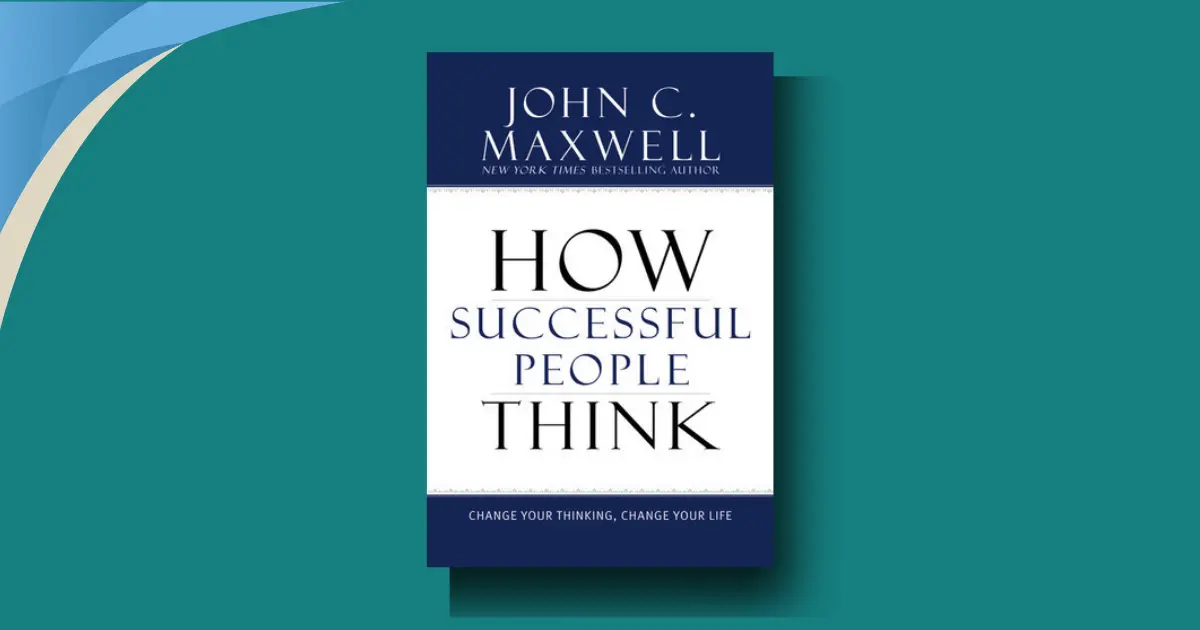
How Successful People Think: Change Your Thinking, Change Your Life by John C. Maxwell, first published in 2009 by Center Street, a division of Hachette Book Group.
Context & Credentials: This book sits at the intersection of leadership, self-help, and personal development. John C. Maxwell is no armchair theorist; he’s an internationally recognized leadership expert whose organizations have trained over 2 million leaders worldwide.
With over 16 million books sold, including bestsellers like The 21 Irrefutable Laws of Leadership, Maxwell’s authority is built on four decades of studying successful individuals. He moves beyond the what of success to the foundational how—the cognitive processes that precede all achievement.
In How Successful People Think, Maxwell’s argument is both simple and profound: “The one thing that separates successful people from unsuccessful ones” is how they think.
He dismantles the myth that good thinkers are born, insisting that effective thinking is a disciplined, learnable process. “If you change your thinking, you can change your life,” he asserts, framing the book as a step-by-step guide to acquiring the thinking habits of high achievers.
A Deep Dive into the Cognitive Toolkit: The Eleven Thinking Disciplines
Maxwell structures his book around eleven dedicated thinking skills. A broad, extended summary of these core concepts reveals the book’s comprehensive blueprint for mental transformation.
1. Cultivate Big-Picture Thinking
Big-picture thinkers see beyond the immediate task to understand context, long-term vision, and interconnectivity. Maxwell argues this is non-negotiable for leadership. “Leaders must be able to… see the vision before their people do,” he writes (Page 20).
This skill combats getting “caught up in the mundane” (Page 21). To develop it, he advises learning continually, listening intentionally to experts, and “look[ing] expansively” beyond your own world (Pages 17-19). It’s about asking, “Am I thinking beyond myself and my world so that I process ideas with a holistic perspective?” (Page 24).
2. Engage in Focused Thinking
This is the antidote to our distracted, multi-tasking culture.
Focused thinking “harnesses energy toward a desired goal” and “gives ideas time to develop” (Pages 25-26). Maxwell is blunt: “No one achieves greatness by becoming a generalist” (Page 27). He shares personal sacrifices, noting, “I can’t know everyone… I can’t do everything… I can’t go everywhere” (Pages 31-32). His practical steps include removing distractions, making sacred time for deep work, and continually questioning your progress. The core question here is: “Am I dedicated to removing distractions and mental clutter so that I can concentrate with clarity on the real issue?” (Page 33).
3. Harness Creative Thinking
Maxwell demystifies creativity, stating it’s “not necessarily original thinking” but often “a composite of other thoughts” (Page 34). Creative thinkers value ideas, explore options, “connect the unconnected,” and crucially, “don’t fear failure” (Pages 35-36). He provides a powerful formula: Think → Collect → Create → Correct → Connect (Page 36).
To unlock creativity, you must first “remove creativity killers” like “It’s never been done” or “Be practical” (Pages 39-40) and develop an environment that encourages risk-taking. He urges readers to ask: “Am I working to break out of my ‘box’ of limitations to explore ideas and options?” (Page 44).
4. Employ Realistic Thinking
As a natural optimist, Maxwell admits this was hard for him. Realistic thinking is “the foundation of our business because we derive certainty and security from it” (Page 46). It “minimizes downside risk” and “provides a foundation to build on” (Pages 46, 48).
The process involves doing your homework on the facts, thinking through pros and cons, and, most importantly, “pictur[ing] the worst-case scenario” (Page 50). This isn’t pessimism; it’s strategic preparation. The guiding thought: “Am I building a solid mental foundation on facts so that I can think with certainty?” (Page 52).
5. Utilize Strategic Thinking
“Most people spend more time planning their summer vacation than planning their lives,” Maxwell quips (Page 53). Strategic thinking is “planning on steroids.” It simplifies the difficult, prompts the right questions, and “reduces the margin of error” (Pages 54-56).
His actionable steps are gold: break down the issue, “ask why before how,” identify real objectives, review resources, and “put the right people in the right place” (Pages 57-59). He illustrates this with the story of Maxwell House Coffee creating free Passover Haggadah booklets for over 70 years—a strategic move that built immense brand loyalty (Pages 59-60).
6. Explore Possibility Thinking
This is the fuel for innovation. Possibility thinkers believe solutions exist. Maxwell uses George Lucas’s founding of Industrial Light & Magic against all odds as a prime example (Page 61). This mindset “increases your possibilities,” “gives you energy,” and “keeps you from giving up” (Pages 61-63).
He advises to actively “stop focusing on the impossibilities,” “look for possibilities in every situation,” and “dream one size bigger” (Pages 65-67). The energizing question: “Am I unleashing the enthusiasm of possibility thinking to find solutions for seemingly impossible situations?” (Page 68).
7. Learn from Reflective Thinking
In our action-obsessed culture, reflection is the “Crock-Pot of the mind” (Page 69). It “gives you true perspective” on experiences and “increases your confidence in decision-making” (Pages 69-70).
Maxwell’s personal system is meticulous: he sets aside distraction-free time, reviews his calendar as a reflective tool, and asks targeted questions about personal growth, adding value, and leadership (Pages 72-74).
He uses symbols in his notes (→ for review, * for filing) to cement learning into action. The reflective prompt: “Am I regularly revisiting the past to gain a true perspective and think with understanding?” (Page 75).
8. Question Popular Thinking
Here, Maxwell challenges conformity. “Popular thinking is… too average to understand the value of good thinking,” he lists, adding it “brings only average results” (Pages 76, 79). He warns it can mean “not thinking” and offers “false hope,” like the students who all claimed to see through a telescope with the lens cap on (Pages 77-78).
To break free, you must “think before you follow,” “appreciate thinking different from your own,” and “get used to being uncomfortable” (Pages 80-83). The defiant question: “Am I consciously rejecting the limitations of common thinking to accomplish uncommon results?” (Page 83).
9. Benefit from Shared Thinking
“None of us is as smart as all of us,” Maxwell quotes (Page 84). Shared thinking is “faster,” “more innovative,” and “stronger than solo thinking” because it creates synergy (Pages 84-86). The key is to “value the ideas of others,” which requires emotional security.
He provides a brilliant checklist for choosing brainstorming partners, including people who “can add value to another’s thoughts” and leave with a “we’ attitude” (Pages 89-90). The collaborative question: “Am I consistently including the heads of others to think ‘over my head’?” (Page 90).
10. Practice Unselfish Thinking
This thinking skill redefines success. Unselfish thinking “brings personal fulfillment” and “adds value to others” (Pages 91-92). It’s about putting others first and investing in people intentionally.
Maxwell shares the powerful story of Merck & Co. giving away millions of doses of a river blindness drug, stating, “We try never to forget that medicine is for the people. It is not for the profits” (Page 94).
The guiding principle for relationships is to ensure the other person wins first. The altruistic question: “Am I continually considering others and their journey to think with maximum collaboration?” (Page 98).
11. Rely on Bottom-Line Thinking
This is about ruthless clarity on desired outcomes. For the Girl Scouts under Frances Hesselbein, the bottom line wasn’t membership numbers but “to help a girl reach her highest potential” (Page 100).
This clarity drove every strategic decision, tripling minority participation. Bottom-line thinking “provides great clarity,” “helps you make the best decisions,” and “ensures your future” (Pages 101-102).
The process involves identifying the real bottom line, creating a strategic plan to hit it, and aligning the entire team. The results-oriented question: “Am I staying focused on the bottom line to reap the full potential of my thinking?” (Page 105).
Strengths and Weaknesses: A Personal Take
My Pleasant Experience (Strengths):
- Actionable Framework, Not Theory: This isn’t philosophy; it’s a cognitive workout plan. Each chapter ends with a “Thinking Question” that forces immediate application. Maxwell’s “Find a place to think, shape, stretch, and land your thoughts” process (Pages 11-14) is alone worth the price of admission.
- Credibility Through Examples: He doesn’t just preach; he shows. Stories from Sam Walton, George Lucas, Rudy Giuliani post-9/11, and his own leadership mistakes ground each principle in reality.
- The Emphasis on Discipline: The repeated message that thinking is “hard work” (Page 8) is refreshingly honest. It removes the guilt of not being a “natural” and replaces it with a empowering, disciplined path.
- The Integration of Shared & Unselfish Thinking: Placing these near the end brilliantly shows that ultimate success isn’t solitary. It connects personal achievement with legacy and contribution.
My Unpleasant Experience (Weaknesses):
- Some Repetition: For readers familiar with Maxwell’s other works, some concepts and anecdotes (like the telescope story) will feel revisited. The core list of 11 skills can make the middle chapters feel somewhat formulaic in structure.
- Depth vs. Breadth: With eleven skills covered in under 200 pages, some readers might wish for a deeper dive into each. It serves as an exceptional overview and starter kit, but mastering a skill like Strategic Thinking may require supplemental reading.
- Anecdotal vs. Data-Driven: While the examples are powerful, those seeking heavy statistical analysis or academic studies might find the evidence primarily anecdotal. Its strength is in relatable application, not clinical research.
Comparison with Similar Works
Compared to Stephen R. Covey’s The 7 Habits of Highly Effective People, Maxwell is less principle-based and more tactic-focused on the specific mechanism of thinking.
Covey’s “Paradigm Shift” is similar to changing your thinking, but Maxwell provides the granular tools. Versus Carol S. Dweck’s Mindset, which brilliantly establishes the foundational “fixed vs. growth mindset” theory, Maxwell’s book is the practical sequel—the “how-to” manual for operating with a growth mindset across life’s domains.
It is more directly applicable than Daniel Kahneman’s Thinking, Fast and Slow (which explores cognitive biases) but is perfectly complementary; Maxwell teaches you how to think better, while Kahneman explains why we often think poorly.
Conclusion
How Successful People Think is a masterclass in taking cognitive control. It successfully argues that your thinking is the single greatest leverage point for change in your life. After reading and applying its lessons, I didn’t just have new ideas; I had a new system for generating, refining, and executing ideas consistently.
I highly recommend this book to:
- Aspiring and current leaders who want to make better decisions.
- Entrepreneurs and creatives stuck in a rut and needing systematic innovation.
- Students and lifelong learners who want to optimize their mental performance.
- Anyone feeling mentally scattered who desires focus and clarity.
It is less suitable for those who want a passive, inspirational read. This book is a mirror and a workshop. You will get out of it exactly what you are willing to put into the “hard work” of thinking. As Maxwell concludes, “You will be tomorrow where your thoughts take you” (Page 106). This book provides the map for that journey.