
Last updated on January 13th, 2026 at 05:19 am
Ever wondered why some books make you feel like you’re fighting for air right alongside the heroine—heart pounding, teeth clenched, still turning the page? We Who Will Die is that kind of story: brutal, emotional, and weirdly cathartic when life has ever asked you to “endure quietly.”
A desperate young woman bargains her life to save her family—then gets pulled into a vampire empire’s arena politics, a vengeful gods-plot, and a love that’s both weapon and wound.
We Who Will Die is best for readers who like Roman-inspired fantasy, vampire court intrigue, deadly trials, morally gray power games, and slow-burn romantasy with real danger (and real consequences).
The “I’ll do anything for my family” drive is the engine here—Arvelle is relentlessly survival-minded (and it shows when she admits her “brothers need me” moment of clarity).
Not for: if you bounce off graphic violence, public punishment, or stories where love and politics are tangled in coercion. Rorrik’s early brutality is not subtle (he makes an example of a spy in a way that’s meant to nauseate).
Table of Contents
1. Introduction
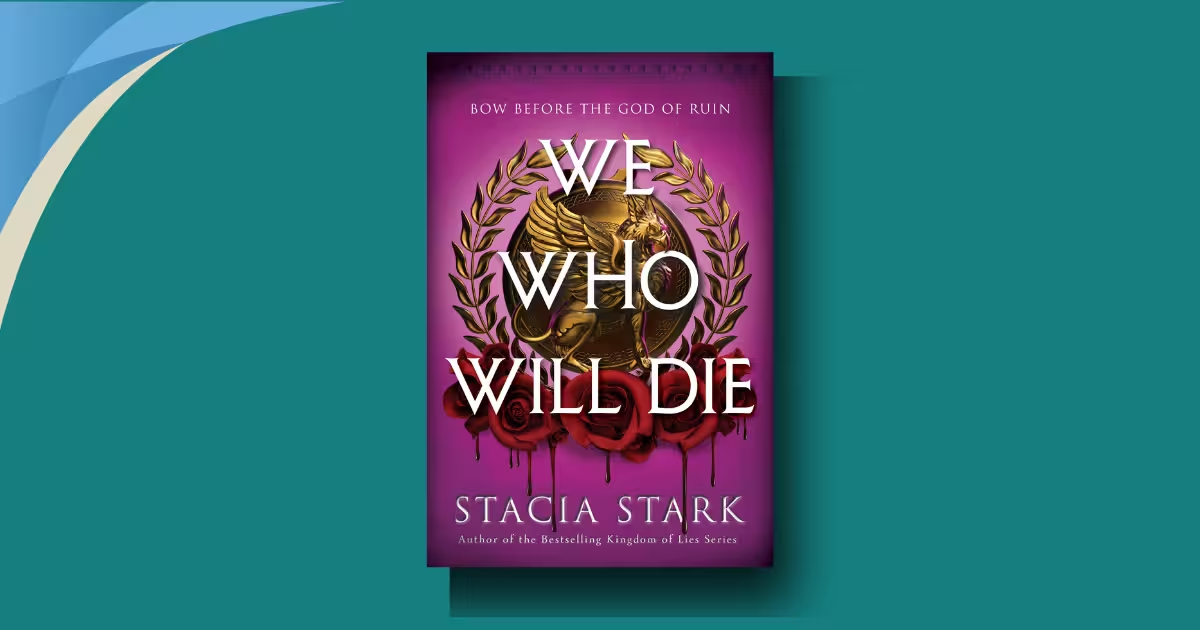
Title: We Who Will Die
Author: Stacia Stark
Series: Empire of Blood (Book 1)
The book is published in different territories (e.g., Avon/HarperCollins in the U.S. and Michael Joseph/Penguin in the U.K.), with listings showing late-2025 release timing depending on edition/market.
If you’re searching for this online (SEO/AEO tip): phrases like “We Who Will Die Stacia Stark summary,” “Empire of Blood Book 1,” “vampire gladiator romantasy,” and “Arvelle Tiernon Rorrik Bran Mortuus” are the most “answer-engine friendly.”
2. Background
Stark frames Senthara as a Roman-tinged empire—arena spectacle, rigid hierarchy, court control—except the ruling class are vampires and the poor are consumable. Official descriptions emphasize a Roman-inspired world ruled by merciless vampires, plus “breathtaking combat” and “vengeful gods.”
The book’s “history” isn’t Earth-history; it’s internal myth-history: gods who shaped the world, wars tied to sigil power, and the haunting presence of Mortuus, associated with ruin and destruction.
When Arvelle tries to reason through what Mortuus represents, the concepts come like a drumbeat: “Decay. Death. Destruction. Chaos.”
That’s the backdrop: this isn’t only a court romance—it’s a world where divine forces and human cruelty reinforce each other.
3. We Who Will Die Summary
Arvelle starts from a place that already feels like a losing war.
She’s from the Thorn district—poor, disposable, and expected to keep her head down. But she doesn’t have that luxury, because her life is welded to her brothers’ survival. When she’s cornered into a bargain with a vampire power-player, she understands the grim arithmetic immediately: she can trade herself for them.
That bargain is the reason she enters the orbit of the vampire empire’s entertainment machine—an arena culture that treats bodies as currency and fear as breakfast.
The first time the reader really meets Prince Rorrik, it’s through cruelty staged as a lesson: he disembowels a spy like it’s nothing, then savors the reaction—“I love the taste of fear-blood in the morning.” That moment clarifies the rules: violence isn’t an accident in this empire; it’s governance.
Arvelle’s assignment (explicit or implied) is to get close enough to the emperor to strike. But the story doesn’t play as a straight line to assassination. It plays like a maze where every corridor is guarded by someone with competing motives.
The emotional landmine: Tiernon
One of the most loaded turns is Arvelle’s collision with Tiernon—not just a court figure, but a piece of her past she never healed from. When she realizes who he is, it lands like a physical hit: she sees what time and brutality have done to him—“any hint of softness has been ruthlessly stamped out.”
He’s colder than the boy she knew, and that coldness becomes a mystery with teeth.
Their history is not a cute “second chance” setup; it’s grief and abandonment and unfinished explanations. Arvelle confronts him with the rawest wound: Kassia is dead, and she waited—for months, for years, for a person who didn’t come back. Tiernon’s shock reads as real, but it doesn’t erase the damage.
As the plot thickens, it becomes clear Tiernon isn’t simply cruel or indifferent—he’s trapped inside a structure designed to break him.
Later, he reveals why he left, and why he believed leaving was the only way to keep her alive: the emperor had him arrested, threatened her, and made it clear Arvelle would become leverage.
Tiernon admits he pushed her away because he couldn’t risk her being “slaughtered in front of me.”
That revelation reframes his “abandonment” as coerced separation—still devastating, but now political.
Rorrik’s attention: a game… and a warning
Rorrik, meanwhile, is not written as a safe alternative. He’s vicious, bored, and intelligent enough to treat people like puzzles.
At one point, his interest locks onto Arvelle as strategy and sport—he calls motivations “predictable,” then offers her a path into the imperius (the emperor’s protective/elite guard structure) if she can “beat” him at his own game.
That dynamic matters: Arvelle is trying to climb into striking distance of the emperor; Rorrik is offering her a ladder—but ladders in this book are made of blades.
The emperor’s court: loyalty as programming
Inside the court, “symbolism” is weaponized. Even the novice guards are used as a loyalty experiment—put them in harm’s way long enough and they’ll internalize the empire as “normal.”
This is one of Stark’s sharper social observations: authoritarian systems don’t just punish; they condition.
The rebel threat and the “innocents will die” dilemma
There are rebels and vampires with reasons to want the emperor dead, but the book refuses to romanticize insurgency when the tactics include mass casualties. Tiernon bluntly predicts catastrophe if an attack succeeds—“The loss of life would be catastrophic.”
During a key confrontation, an aether grenade drops—Arvelle’s internal logic snaps tight: “We’re all going to die… No. My brothers need me.” That’s the story in miniature: terror, then purpose.
Mortuus, sacrifices, and the second (deeper) horror
As if court politics and assassination weren’t enough, the narrative opens a darker door: illegal sacrifices tied to Mortuus. Maeva names it plainly—people “should know better than to sacrifice to Mortuus. There’s a reason it’s illegal.”
Later, Arvelle studies an attempted ritual space and realizes the horror isn’t only myth. Someone is actively trying to free that ruin-god—and Arvelle connects the timing to a huge political event: “Tiberius is dead,” she notes, and the murders continued even after that, meaning the threat is bigger than one ruler.
Bran’s betrayal: the trap inside the trap
Bran is the kind of character who turns “deal-making” into spiritual poisoning. When Arvelle pushes for proof, the book uses a truthstone moment to show how tightly she’s bound—and how many of his words are performance.
Late-book, the mask fully drops. Bran admits he engineered key suffering—following Tiernon, exposing Arvelle, and enjoying the fallout.
He says he “followed Tiernon to the Thorn” and then “made sure the emperor learned” where Tiernon was going. Worse, he reveals the escape clause in his plan: “The bond is irrelevant as soon as one of us is dead.”
That line is pure villain logic—clean, cruel, and legally airtight in-world.
Where it leaves you
By the end, the story has confirmed one major death (the emperor, Tiberius, per Arvelle’s own late reference) while also escalating the larger existential threat: Mortuus’s influence persists beyond regime change.
The romantic and political triangles tighten into a more dangerous shape: Arvelle isn’t just deciding who she loves—she’s deciding what kind of power she’s willing to unleash to protect the people she can’t bear to lose.
So even when you feel the “mission” has been completed, Stark makes sure you understand: the empire’s rot isn’t solved by removing one man. The gods and the structures still hunger.
4. Analysis
4.1 Characters
Arvelle: survival as identity
Arvelle’s defining trait is that she calculates risk like someone who’s had to—because she has. She calls her shots without romanticizing them, and when faced with mass death, her mind returns to the anchor: her brothers.
She also carries grief with a sharp edge—Kassia’s death isn’t “backstory flavor,” it’s a missing limb she still feels.
Tiernon: the “cold hero” with an actual reason
Tiernon’s coldness is textual, not just trope: Arvelle observes the softness beaten out of him.
But he also embodies the theme of coercion: his confession shows how authoritarian fathers weaponize love by turning it into liability—he feared Arvelle would be killed to punish him.
Rorrik: charm, boredom, and violence as a language
Rorrik is introduced through spectacular brutality, and that choice matters: the narrative doesn’t let you forget what he is capable of enjoying.
Yet he’s also perceptive and strategic—he reads motivations and offers Arvelle an “in” if she can keep up. He’s danger with a smirk, not safety with a crush.
Bran: the “contract villain”
Bran’s evil isn’t chaotic; it’s contractual. Truthstone scenes show how bargaining becomes bondage.
Then he admits orchestration and intent—he didn’t merely exploit suffering; he curated it.
Maeva: empathy under fluorescent light
Maeva works as emotional counterweight—she names what Arvelle is doing (“you did what you needed… for your brothers”), offering moral recognition without pretending the system is fair.
4.2 Themes and symbolism
1) Power turns love into leverage.
Tiernon’s backstory is basically: love is not safe in a tyrant’s house.
2) “Loyalty” can be trained like reflex.
The emperor’s novice program is framed as indoctrination through proximity to violence.
3) Spectacle is political anesthesia.
The arena isn’t just sport; it’s social control. Rorrik’s public cruelty is a lesson delivered to a crowd.
4) Mortuus as the metaphor for systemic rot.
Mortuus isn’t merely a “final boss” concept—he symbolizes decay that outlives individual rulers: “Decay. Death. Destruction. Chaos.”
5) Deals that “save” you can still destroy you.
Bran’s bond logic—“irrelevant as soon as one of us is dead”—is the nightmare version of fine print.
5. Evaluation
Strengths (what really works)
- Immediate stakes + visceral atmosphere. The opening brutality doesn’t just shock—it establishes the empire’s moral climate fast.
- A heroine whose competence is emotional, not just physical. Arvelle stays anchored to purpose (“my brothers need me”), which makes her choices believable even when they’re extreme.
- The romance is actually tied to political consequences. Neris’s warning that Arvelle could become Tiernon’s punishment makes the love story feel dangerous in a grounded way.
Weaknesses (what may not land for everyone)
- Intensity can crowd subtlety. The plot stacks threats (arena, assassination, rebel violence, Mortuus cult activity) so the pace may feel relentless rather than luxuriant. Some external reviewers note pacing/worldbuilding tradeoffs in the genre space.
- If you dislike coercive power dynamics, this will be heavy. The whole premise runs on forced bargains and political blackmail.
Impact
The part that lingered for me isn’t just the romance—it’s the recognition that systems can force “choices” that aren’t choices. Arvelle doesn’t get to be “pure.” She gets to be effective, or dead.
Comparison with similar works
Publishers position it for fans of big romantasy names (Carissa Broadbent, Rebecca Yarros, etc.).
Kirkus frames it as a mash-up of popular romantasy touchstones.
My comparison: think deadly trials + vampire court with a heroine who feels more street-smart survivor than chosen-one saint.
6. Personal insight with contemporary educational relevance
One reason We Who Will Die feels so sharp in 2026 is that Arvelle’s “deal” isn’t just fantasy drama—it’s a heightened mirror of what people do when survival has a price tag.
In the U.S., medical cost pressure still pushes real people into impossible corners. KFF reports that about 4 in 10 adults carry some form of health care debt.
Their analysis also estimates Americans owe at least $220 billion in medical debt. And cost doesn’t only create debt—it changes behavior: CDC data on adults 18–64 found 8.2% didn’t take medication as prescribed in 2021 to reduce costs (skipping doses, delaying refills, etc.).
That’s Arvelle’s world, translated into ours: when the system won’t protect you, you start making decisions based on “What will keep my people alive?” not “What is morally comfortable?” Her clarity—No. My brothers need me—is the emotional core.
The lesson I take (and the one I’d teach from this book) is uncomfortable but useful: desperation is not a character flaw; it’s often a policy outcome. When we talk about “bad choices,” we should ask the Arvelle-question first: What choices did the system leave them?
7. We Who Will Die Quotes
- “Kassia is dead.”
- “You’re the Primus.”
- “The loss of life would be catastrophic.”
- “Some part of me… is fascinated by this book.”
- “You do care.”
- “Bran brought me here to die.”
- “There’s a reason it’s illegal.”
- “Decay. Death. Destruction. Chaos.”
- “The bond is irrelevant as soon as one of us is dead.”
- “I love the taste of fear-blood in the morning.”
8. Conclusion
We Who Will Die is a gladiator-vampire romantasy that doesn’t treat survival as a glamorous aesthetic—it treats it as a cost.
If you want a heroine who fights like her life is on fire (because it is), and you enjoy court intrigue where love is genuinely dangerous, this is worth your time.
My recommendation:
- Read it if you like brutal stakes, morally gray power plays, and slow-burn romance under pressure.
- Skip it if you prefer cozy fantasy, low violence, or romances insulated from political cruelty.







