
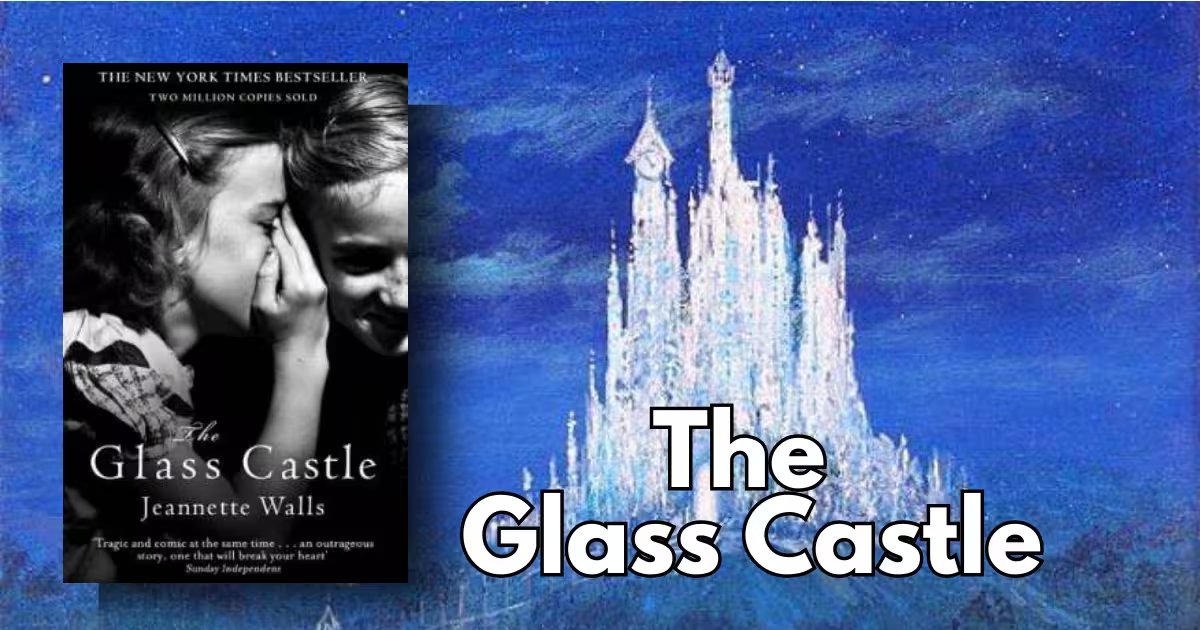
Why do some of us flinch at comfort—like we don’t quite deserve it—and what does it take to finally stop apologizing for surviving? The Glass Castle by Jeannette Walls gave me language for that feeling, and it might give you your own, too.
The Glass Castle is best for readers who love memoirs about resilience, family psychology, childhood poverty, and coming-of-age under chaos; anyone curious about why smart, capable kids can still grow up with hunger, neglect, and fierce love in the same house; and book-club readers who want big emotions + ethical questions (truth-telling, forgiveness, loyalty).
But not a good read for readers who avoid child endangerment, addiction, sexual misconduct, and parental neglect (these themes are central, not side-notes); and anyone looking for a neat villain/hero split—Walls refuses that simplification (and that can be frustrating if you want clear moral closure).
Table of Contents
1. Introduction
Book: The Glass Castle: A Memoir
Author: Jeannette Walls (American journalist and writer)
Publisher: Scribner (Simon & Schuster imprint)
Publication : March 2005
Film adaptation: released Aug 11, 2017 (
The Glass Castle is a memoir—but it reads with the propulsion of a novel because Walls writes like a reporter who learned storytelling the hard way: by surviving what she later had to describe clearly.
She worked in journalism (including celebrity/gossip reporting early on), and Vanity Fair covered how she kept her upbringing hidden even while building a glossy New York media life.
This book became a cultural landmark of modern memoir. One snapshot of its impact: it spent hundreds of weeks on The New York Times bestseller list, with Book Riot citing 260 weeks for hardcover plus 440 weeks for paperback (running until October 2018). It also won an ALA Alex Award.
Walls doesn’t argue in the academic sense; she proves by narrative accumulation. The core thesis I took away is:
A childhood can be both magical and damaging—and telling the truth about it is a form of freedom.
That’s why the memoir opens with adult Jeannette confronting shame head-on: she sees her mother rummaging in trash and admits, “I hid” out of shame. Then her mother delivers the book’s moral dare: “Just tell the truth.”
2. Background
The real-world place behind “Welch”
A big portion of the memoir’s emotional gravity comes from Welch / McDowell County, West Virginia—an area historically tied to coal booms and collapses. Today, the economic struggle is measurable: McDowell County’s poverty rate is about 30.9% (ACS 2023) and median household income about $29,980.
Walls’s story also echoes a major policy history: McDowell County is closely tied to the origins of federal food assistance. Kennedy spoke in Welch in 1960 about poverty there, and West Virginia sources describe early food stamp history in the county (including the first issuance in 1961).
Knowing that context sharpened my reading: this isn’t just “one strange family.” It’s also a portrait of how poverty becomes normal, how communities harden, and how children learn to translate deprivation into destiny.
3. The Glass Castle summary
Highlights
Before I go chronological, here’s the “compressed spine” of the memoir—what keeps repeating like a drumbeat:
- Jeannette’s childhood begins with danger—literal fire—and never fully stops being dangerous. The book’s earliest memory is blunt: “I WAS ON FIRE.”
- Rex Walls (Dad) is charismatic, brilliant, and addicted; he gives wonder (stars, science, stories) and also takes stability, money, safety.
- Rose Mary (Mom) is an artist-intellectual who rejects conventional motherhood; she reframes deprivation as moral superiority and “adventure.”
- The children (Lori, Brian, Jeannette, Maureen) become a self-raised unit, improvising food, warmth, school survival, and emotional triage.
- The “Glass Castle” itself becomes the book’s central symbol: an impossible dream that keeps the kids hopeful while the parents avoid reality. Dad carries the blueprints and promises a house with systems and design.
- The endgame is escape: older siblings pull themselves to New York, Jeannette follows, builds a journalism career, and tries to hold love and truth in the same hand—without lying to herself anymore.
Now the full arc.
The Glass Castle plot summary
The Glass Castle is a harrowing yet resilient memoir by Jeannette Walls that chronicles her deeply unconventional and impoverished childhood under the care of brilliant but profoundly dysfunctional parents.
The narrative unfolds in five sections, moving from the desert Southwest to the depressed coal town of Welch, West Virginia, tracing Jeannette’s journey from a perilous, nomadic early life to her eventual escape and complex reconciliation with her past.
The memoir opens with a powerful, emblematic scene in contemporary New York City. A successful, adult Jeannette, riding in a taxi to a party, spots her mother, Rose Mary, rooting through a dumpster. This moment of shocking contrast—between Jeannette’s life on Park Avenue and her parents’ homelessness—forces her to confront the secret of her origins and propels the narrative into her childhood.
Jeannette’s earliest memory is of catching on fire at age three while cooking hot dogs unsupervised in a trailer in Arizona. This traumatic event sets the tone for her childhood: one of profound neglect punctuated by moments of adrenaline and her parents’ peculiar brand of justification.
Her mother, an aspiring artist, is painting in the other room; her father, Rex, is absent. After weeks in a hospital—a clean, orderly world Jeannette loves—Rex checks her out “Rex Walls-style,” fleeing without paying the bill. Rather than instilling caution, the fire ignites Jeannette’s fascination with flames, a metaphor for the dangerous yet captivating nature of her own upbringing.
Jeannette’s childhood is defined by constant movement. Her family, including older sister Lori, younger brother Brian, and eventually youngest sister Maureen, are always “doing the skedaddle,” fleeing in the middle of the night from bill collectors, the “FBI” (real or imagined), or simply Rex’s restlessness.
They crisscross the deserts of Arizona, Nevada, and California, living in mining towns and trailers. Rex, a charismatic, self-taught engineer and electrician, spins grand tales of his past heroics and future inventions, most notably the “Prospector,” a machine to find gold, and the “Glass Castle,” a magnificent, solar-powered home he promises to build for the family.
These dreams are the pillars of his personality, offering hope but consistently crumbling under the weight of his alcoholism and inability to hold a job.
Rose Mary, meanwhile, is a study in artistic self-absorption and contradictory philosophies. She believes in freedom and “gifting” her children with a lack of rules, seeing suffering as character-building. She values art and abstract knowledge above practicalities like food, shelter, and safety.
While she teaches the children to read early and appreciate nature, she also fails to protect them, leaving them to fend for themselves physically and emotionally.
Life is a cycle of feast and famine. Periods of relative stability, when Rex works, are overshadowed by his binges on “the hard stuff,” during which he becomes violent and destructive.
The children learn to pick his pockets when he passes out. Despite the chaos, there are moments of magic and learning: Rex teaching them geology, physics, and how to shoot a pistol; stargazing in the desert where he “gives” Jeannette the planet Venus as a Christmas present; and their collective, if desperate, ingenuity.
A longer stint in Battle Mountain, Nevada, initially feels like home. They live in an abandoned train depot, and the children enjoy the desert. Jeannette starts a rock collection, and for a time, Rex works at a mine.
However, when he loses that job, the family plunges into severe hunger, scavenging from dumpsters and eating margarine mixed with sugar. Rose Mary is forced to take a teaching job, which she despises, and the children must help her grade papers and create lesson plans to keep her employed.
The tension explodes in a horrific, public fight where Rose Mary dangles from a second-story window. The final catalyst for leaving is a BB gun fight with a troubled neighbor boy, Billy Deel, which brings the police. The family flees in the night.
They arrive in Phoenix, Arizona, after the death of Rose Mary’s mother, inheriting an old, termite-ridden but spacious adobe house. For a time, life improves.
The children attend a good school and are placed in gifted programs. Rose Mary establishes an art studio, and Rex gets union work.
They experience rare luxuries: bicycles, a telephone, a record player. But the stability is short-lived. Rex is kicked out of the union, the inheritance money vanishes, and his drinking escalates into terrifying rampages.
In a poignant, heartbreaking moment, a ten-year-old Jeannette asks for her birthday gift to be for him to stop drinking. He attempts a brutal, agonizing detox but ultimately fails, plunging back into alcoholism and destroying the family’s Christmas tree in a drunken fury.
Defeated, Rose Mary decides to move the family to Rex’s hometown of Welch, West Virginia, hoping his parents can exert some control. The journey in a dilapidated “Piggy Bank Special” is a comically disastrous cross-country trek.
Welch is a shock: a bleak, dying coal town shrouded in mist and coal dust. They move into the decrepit, filthy home of Rex’s parents, Erma and Ted. Erma is bitter and cruel, serving salty, greasy food and forbidding laughter. Uncle Stanley, who lives in the basement they occupy, is a toothless, seemingly simple man.
Welch represents the nadir of the Walls family’s fortunes. The poverty is grinding and inescapable.
The children are enrolled in school, where their accents and lack of records land them in special education classes. They become targets of relentless bullying, particularly Jeannette, who is beaten regularly by a group of girls led by Dinitia Hewitt.
The promise of the Glass Castle is reduced to a set of blueprints Rex occasionally works on in the basement, a symbol of dreams completely divorced from reality. Rex’s drinking becomes a constant, and he often disappears on benders.
Rose Mary mostly retreats into her art and writing, unable to cope.
As Jeannette enters adolescence, a fierce determination to escape crystallizes. She and Lori begin saving money secretly. Jeannette takes on jobs—babysitting, selling newspapers—and excels academically despite the chaos at home.
She clashes constantly with her parents over their choices, particularly when they take the family’s savings to go on a binge. The memoir details horrific scenes of deprivation: the family living for months without plumbing or heat, eating rotten food, and suffering through freezing winters.
The turning point comes when Jeannette, as a teenager, finally confronts her father about his empty promises. She tells him the Glass Castle will never be built. This painful acknowledgment of reality fractures their relationship but liberates her.
With relentless focus, she plans her exit. After a final, violent altercation where Rex tries to molest Jeannette in her sleep (a shocking revelation of his darkest side), her resolve hardens.
The memoir’s final section shows the children’s exodus. Lori escapes first to New York City. Jeannette follows at seventeen, graduating early and moving to New York with only a garbage bag of belongings.
Brian and eventually Maureen also leave. Jeannette builds a successful life as a journalist, yet is haunted by and ashamed of her parents, who choose to become homeless in New York rather than accept her help. The story comes full circle to the opening dumpster scene.
The Glass Castle is ultimately a story of survival and the complex, unbreakable bonds of family.
Jeannette Walls does not portray her parents as monsters, but as deeply flawed, tragic figures—her father, a brilliant man consumed by addiction and broken dreams; her mother, who chose artistic freedom over maternal responsibility.
The memoir explores themes of poverty, shame, resilience, and the arduous journey toward forgiveness and self-definition. Jeannette learns to accept her past not as a shackle, but as the foundation of her fierce independence and strength, finally understanding that while the literal Glass Castle was a fantasy, the act of dreaming it was the one true gift her father could give.
4. Lessons you should take from The Glass Castle
- Love and harm can coexist in the same family.
You can deeply love a parent and still admit they failed you—both truths can sit in the same room. - Charisma is not the same as responsibility.
Rex can inspire wonder, but inspiration doesn’t pay rent, keep kids safe, or put food on the table. - “Adventure” can be a story people use to hide neglect.
Reframing instability as freedom might protect adult pride—but it leaves children to carry the consequences. - Children become experts at survival long before they should.
The Walls kids learn to problem-solve, protect each other, and read danger—skills that look like “strength,” but are also signs of unmet needs. - Poverty isn’t only about money; it’s about options disappearing.
Hunger, cold, and constant moving don’t just hurt physically—they shrink education, friendships, and future choices. - Hope can be weaponized.
The “Glass Castle” dream keeps the kids going, but it also postpones real change—sometimes promises are a form of control. - Truth-telling is a kind of freedom.
Jeannette’s healing begins when she stops hiding and starts naming what happened—without minimizing or romanticizing it. - Shame thrives in secrecy.
The moment you start hiding your story, shame grows; the moment you bring it into daylight, shame loses power. - Boundaries aren’t betrayal.
Leaving a toxic environment isn’t “abandoning family”—sometimes it’s the first act of self-respect. - You can inherit chaos without inheriting its destiny.
Your upbringing shapes you, but it doesn’t have to define your adult life. - Siblings can become lifelines.
In the absence of stable parenting, the kids create their own micro-family—proof that support systems can be built, not just given. - Education and work can be escape tools—but not instant healing.
Success changes circumstances; it doesn’t automatically rewrite the nervous system. - Forgiveness is complex and personal—not a moral requirement.
The book shows compassion without demanding that readers excuse harm. - A parent’s “principles” can be selfish when children pay the price.
Ideals like rejecting “consumerism” or “systems” sound noble—until kids are hungry and freezing. - Resilience is admirable, but it shouldn’t be romanticized.
Surviving doesn’t mean what happened was okay; strength is often what you develop when you had no choice.
5. The Glass Castle quotes
Here are some of the most memorable, impactful, and frequently cited quotes and passages from Jeannette Walls’ memoir The Glass Castle. I’ve selected these based on their emotional depth, thematic significance, and popularity across reader discussions.
1. On optimism and uncertainty:
“Things usually work out in the end.”
“What if they don’t?”
“That just means you haven’t come to the end yet.”
(This exchange between Jeannette and her siblings captures the family’s precarious hope amid constant chaos.)
2. The Joshua tree metaphor:
“Mom frowned at me. ‘You’d be destroying what makes it special,’ she said. ‘It’s the Joshua tree’s struggle that gives it its beauty.'”
(Said by Mom when Jeannette wants to straighten a twisted Joshua tree in the desert, symbolizing how hardship shapes character—a recurring theme in the Walls family’s nomadic, impoverished life.)
3. Jeannette’s earliest memory of fire:
“I was on fire. It’s my earliest memory. I was three years old… I watched the yellow-white flames make a ragged brown line up the pink fabric of my skirt and climb my stomach. Then the flames leaped up, reaching my face. I screamed.”
(This vivid opening to Jeannette’s childhood recollections sets the tone for danger and neglect, as she’s burned while cooking unsupervised, and her parents treat it casually.)
4. Dad’s philosophy on fear:
“‘Good for you… You’ve got to get right back in the saddle. You can’t live in fear of something as basic as fire.'”
(Rex tells young Jeannette this after her burn incident, encouraging her to cook again immediately, highlighting his reckless “tough love” approach that often endangers the kids.)
5. The Glass Castle promise:
“When Dad wasn’t telling us about all the amazing things he had already done, he was telling us about the wondrous things he was going to do. Like build the Glass Castle… He carried the blueprints for the Glass Castle wherever we went, and sometimes he’d pull them out and let us work on the design for our rooms.”
(Rex’s grand dream of a solar-powered glass home represents unfulfilled promises and the family’s transient lifestyle, as they move from place to place evading bills and authorities.)
6. On Christmas and illusions:
“We all laughed about all the kids who believed in the Santa myth and got nothing for Christmas but a bunch of cheap plastic toys. ‘Years from now, when all the junk they got is broken and long forgotten,’ Dad said, ‘you’ll still have your stars.’”
(Instead of gifts, Rex gives the kids stars in the sky one Christmas in the desert, spoofing poverty as adventure—spoiler: this contrasts with later holidays where hunger and cold dominate.)
7. The boundary between chaos and order:
“Dad told us that zone [from the fire] was known in physics as the boundary between turbulence and order. ‘It’s a place where no rules apply, or at least they haven’t figured ‘em out yet,’ he said. ‘You-all got a little too close to it today.’”
(After a hotel fire in San Francisco forces the family to flee, Rex philosophizes their unstable life as exciting science, masking his alcoholism and irresponsibility.)
8. Mom’s response to hunger:
“‘I’m hungry.'”
(Jeannette’s simple statement as a child, to which Mom replies dismissively, revealing the family’s chronic food scarcity—spoiler: this escalates in Welch, where the kids eat from trash while Mom hides chocolate.)
8. Jeannette’s defiance and escape:
“As soon as I finish classes, I’m getting on the next bus out of here. If the buses stop running, I’ll hitchhike. I’ll walk if I have to. Go ahead and build the Glass Castle, but don’t do it for me.”
(Jeannette tells Rex she’s leaving Welch for New York at 17, marking her break from the cycle of poverty—spoiler: her siblings follow, achieving success while parents remain homeless.)
9. On loving flawed people:
“You should never hate anyone, even your worst enemies. Everyone has something good about them. You have to find the redeeming quality and love the person for that.”
(Mom’s advice to Jeannette after a fight, reflecting the family’s complex love despite abuse and neglect.)
10. Grieving the living:
“One of the hardest things you will ever have to do, my dear, is grieve the loss of a person who is still alive.”
(This poignant line captures Jeannette’s emotional distance from her parents, especially as she succeeds in New York while they squat in abandoned buildings—spoiler: it foreshadows Maureen’s mental health struggles and eventual stabbing incident.)
11. Rex’s final moments:
“Despite all the hell-raising and destruction and chaos he had created in our lives, I could not imagine what my life would be like—what the world would be like—without him in it.”
(Jeannette reflects on her father’s death from a heart attack in New York, reconciling her love for him despite his flaws—spoiler: the family gathers for a makeshift Thanksgiving afterward, finding closure.)
Mom’s values vs. Jeannette’s shame:
12. “You want to help me change my life? I’m fine. You’re the one who needs help. Your values are all confused.”
(From the opening lunch scene where adult Jeannette offers help to her homeless mother, who rejects it, emphasizing their philosophical divide.)
13. The power of truth:
“Just tell the truth. That’s simple enough.”
(Mom advises Jeannette on how to handle questions about her parents, tying into the memoir’s theme of unvarnished honesty.)
15. Journalism as revelation:
“I began to feel like I was getting the whole story for the first time, that I was being handed the missing pieces to the puzzle, and the world was making a little more sense.”
(Jeannette discovers her passion for journalism in Welch, which becomes her ticket out—spoiler: she builds a career in New York, contrasting her parents’ refusal to change.)
6.The Glass Castle analysis
Does Walls support her “argument” effectively?
Yes—because her evidence is lived detail, and she writes with a reporter’s discipline. She rarely editorializes; instead, she stacks scenes until your moral conclusions become unavoidable.
Narrative strategy: balance without excuse
A weaker memoir might choose one lane:
- “My parents were monsters” (clean, emotionally satisfying, often dishonest), or
- “My parents were misunderstood geniuses” (romantic, often complicit).
Walls refuses both. That refusal is exactly why critics and institutions have embraced the book. Kirkus calls it a thoroughly American “pull-yourself-up-by-the-bootstraps” story of growing up “dirt poor” in the ’60s and ’70s. The ALA Alex Award page frames it as an “empowering memoir” focused on the children’s strength and creativity amid poverty.
Memoir ethics: the truth-telling dilemma
Memoir always raises questions: memory reliability, family consent, the morality of exposing private people. Walls addresses this indirectly by showing her mother’s advice: “Just tell the truth.”
That’s the memoir’s ethical spine. The book doesn’t ask, “How do I protect my parents’ image?” It asks, “How do I stop protecting a lie that harmed me?”
Does the book deliver its purpose?
Absolutely. It contributes in at least three major ways:
- It expands the public understanding of neglect. Not every neglected child is locked in a basement; sometimes neglect is a thousand daily absences—food not bought, heat not provided, safety not prioritized—while love and laughter still exist.
- It captures the seduction of charisma. Rex is not a cardboard alcoholic. He’s brilliant and magnetic—exactly the kind of person who can keep a family orbiting him even as he burns it down.
- It explains why people don’t “just leave.” The children do leave, but the memoir shows how long it takes to mentally exit a family myth.
Its longevity in bestseller culture suggests it hit a deep nerve: Book Riot notes its unusually long NYT list run.
7. Strengths and Weaknesses
1) The book tells the emotional truth without melodrama
The opening line—“I WAS ON FIRE.”—is dramatic, but Walls doesn’t lean on dramatics afterward. She lets the horror speak through plain detail.
2) The symbol of “The Glass Castle” is genius because it’s realistic
Rex’s blueprints are not just whimsical; they’re how many families survive: by promising a future that never arrives.
3) The memoir nails the push-pull of shame
Adult Jeannette hiding from her mother is one of the most relatable modern scenes in memoir: you can love someone and still feel socially destroyed by them.
4) The writing respects the reader’s intelligence
Walls doesn’t tell you what to think. She gives you Rex declaring “No child of mine…” and then gives you Brian’s quiet rebuttal. That’s craft.
What I struggled with
1) Emotional whiplash can be exhausting
If you’re sensitive to trauma narratives, the oscillation between wonder (stars, stories) and harm (hunger, neglect, assault allegations) can feel like your nervous system is being yanked around.
2) Some readers may want more adult reflection on mental health
Walls shows behaviors vividly, but she doesn’t deeply diagnose or label (which is arguably responsible). Still, certain readers may crave more explicit exploration of addiction dynamics, possible depression, or personality patterns.
3) The “forgiveness” tone may frustrate readers who want condemnation
When Rex refuses to listen during the Erma crisis—“I don’t care what happened!”—some readers will never forgive him. If you read memoir for moral clarity, Walls’s compassion might feel like betrayal. For me, it felt like honesty: love doesn’t always obey justice.
8. Comparison with similar works
If you’re searching “books like The Glass Castle,” here are quick, practical comparisons:
- Educated (Tara Westover): similar arc of self-invention through education; more explicit focus on ideology and isolation.
- Angela’s Ashes (Frank McCourt): poverty memoir with humor; more historically anchored in Irish Catholic context.
- Running with Scissors (Augusten Burroughs): dysfunctional upbringing with dark comedy; often more surreal, less grounded in systemic poverty.
- Hillbilly Elegy (J.D. Vance): Appalachian-linked discussion, but it’s more sociopolitical argument; The Glass Castle is personal narrative first.
- A Tree Grows in Brooklyn (Betty Smith): not memoir, but Walls explicitly connects her identification with hardship literature (she loves A Tree Grows in Brooklyn).
9. Conclusion
Should you read The Glass Castle?
If you want a memoir that doesn’t just describe poverty but shows how it rewires a child’s brain, yes. If you want a book that captures the horrifying truth that a parent can be both the person who gives you Venus and the person who won’t protect you when it matters —then yes, this is essential reading.
Who benefits most?
- General readers who want an unforgettable true story with real psychological insight.
- Students and educators (with content warnings) studying memoir, resilience narratives, or American poverty. (It’s also recognized by institutions like ALA through awards.)
- Anyone healing from complicated family love, where “I love them” and “they harmed me” are both true.
And if you’re curious about how big this book became: it has had an unusually long bestseller lifespan, spawned a major film adaptation (Brie Larson, Woody Harrelson, Naomi Watts), and continues to be referenced as a defining modern memoir.







