
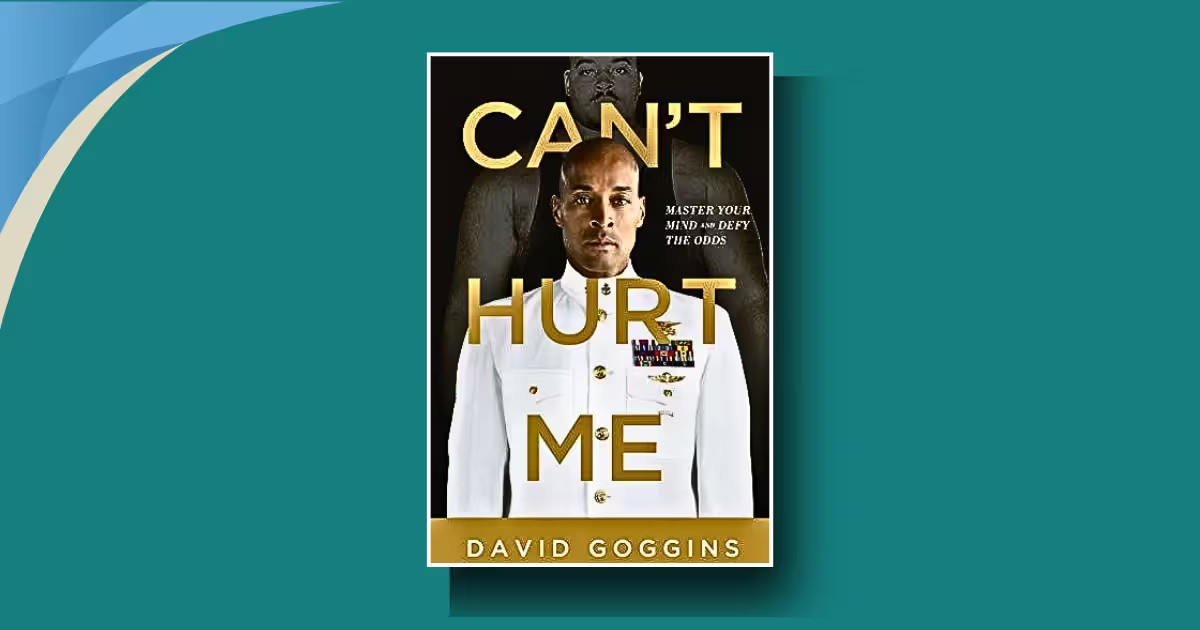
Can’t Hurt Me will show you how to break-free from if you fee like you are living at only 40% of your true capability, trapped in a cycle of comfort and self-doubt, and every pain you’re avoiding is the fuel you need to transform your life.
Can’t Hurt Me is for the individuals feeling stuck, complacent, or burdened by past trauma; those in need of a brutal, no-excuses mindset reset; fans of extreme self-improvement and military discipline.
And not for readers seeking gentle, theoretical self-help; those uncomfortable with graphic descriptions of abuse, violence, and profanity; anyone who rejects the core premise that sustainable change requires embracing immense, voluntary suffering.
Table of Contents
1. Title and Author Information
Can’t Hurt Me: Master Your Mind and Defy the Odds is a 2020 memoir and self-help manifesto by David Goggins, published by Lioncrest Publishing. The book quickly became a New York Times bestseller and a cultural phenomenon, blending a harrowing personal history with a relentless philosophy of extreme self-discipline.
Can’t Hurt Me defies easy genre categorization. It is simultaneously a memoir of staggering childhood trauma, a chronicle of elite military endurance, and a tactical guide for mental toughness.
David Goggins is a former U.S. Navy SEAL (Chief, Retired), and the only member of the U.S. Armed Forces to complete SEAL training, U.S. Army Ranger School, and Air Force Tactical Air Controller training.
He holds numerous ultra-endurance records, making his credentials in the realm of suffering and perseverance unquestionable. The book’s subject matter is the “calloused mind”: the practice of using acute hardship, both past and voluntarily sought, to forge an “armored” mentality impervious to life’s challenges.
The central purpose of Can’t Hurt Me is that human potential is grotesquely untapped due to society’s addiction to comfort and a “victim’s mentality.” Goggins argues that “motivation is garbage” because it is temporary.
Lasting change comes only from “mastering your mind” through intentional suffering, brutal self-honesty, and “callousing” your psyche with repeated exposure to what you fear. The book is his proof of concept, detailing how he transformed himself from a 297-pound, abused, and struggling young man into one of the hardest endurance athletes and soldiers on the planet.
His purpose is not to make you feel good, but to make you better, by any means necessary.
2. Can’t Hurt Me summary
Can’t Hurt Me is structured around Goggins’ life story, intercut with “Challenges” that direct the reader to apply his principles. This is not a passive read; it is a training manual. The following summary integrates key events, themes, and direct citations to provide a comprehensive understanding.
Part 1: The Forging Fire of a Broken Childhood (Chapters 1-2)
Goggins’ origin story is one of profound trauma. He was born in 1975 and raised in Buffalo, New York, by a violently abusive father, Trunnis Goggins, whom he calls “the Devil.” The family presented a facade of affluence on “Paradise Road,” but their reality was nightly brutality at the family-owned Skateland roller rink.
Goggins recounts horrific, premeditated beatings: “He designed it for maximum psychological and physical pain… I was covered in welts from my neck to the crease at the knees” (Page 21). His mother, Jackie, was trapped and powerless. A pivotal moment came at age eight when he fought back during a beating, an act where “my hatred overcame my fear” (Page 17).
This section establishes the book’s core fuel: transforming pain into power. The abuse, combined with the racism he faced after escaping to rural Brazil, Indiana (“Niger we’re gonna kill you!” was scrawled in his workbook, Page 45), created what he terms “toxic stress.”
He explains the science: chronic abuse in childhood puts the brain in a permanent “fight or flight” mode, hindering learning and social development. He became a “poster child… ‘at-risk youth’” (Page 32), cheating his way through school, obese, and filled with rage.
Part 2: The First Awakening and the Accountability Mirror
A pivotal failure—a letter stating he wouldn’t graduate high school due to absences and a D average (Page 52)—forced a confrontation. Staring into a steamy bathroom mirror, he conducted a “solo intervention”: “You are an idiot. You read like a third grader… Nobody is coming to save you!” (Page 53).
This birthed his foundational ritual: the Accountability Mirror.
He began posting goals on Post-It notes on his mirror, forcing raw self-assessment: “If you look in the mirror and you see a fat person, don’t tell yourself that you need to lose a couple of pounds. Tell the truth. You’re fat!” (Page 55).
This practice, combined with relentless study (using memorization and transcription to rewire his brain from a 4th-grade to 12th-grade reading level) and punishing workouts, allowed him to lose weight, pass the ASVAB test, and enlist in the U.S. Air Force in the early 1990s.
Part 3: Failure and the “Impossible Task” (Chapter 3)
His dream of becoming an Air Force Pararescueman (PJ) was shattered by his fear of water. Despite passing swim tests through sheer will, the sustained “water confidence” training broke him.
When offered a medical out due to the Sickle Cell Trait, he took it, later admitting: “on paper I didn’t quit, but I knew the truth” (Page 68). He served his term in Tactical Air Control, burying his shame in food and powerlifting, ballooning to nearly 300 pounds.
By 1999, he was divorced and working a dead-end job as an exterminator for Ecolab, a “cockroach sniper on the graveyard shift” (Page 62).
The catalyst for change was watching a TV documentary on Navy SEAL Hell Week. Seeing men willingly endure that suffering illuminated his own pathetic state. He contacted a recruiter and was given a seemingly impossible mission: lose 106 pounds in under three months to meet Navy weight standards.
His training regimen was insane: 4:30 AM wake-ups, hours on a stationary bike while studying, swimming, circuit training, and running—all on minimal food. He failed the ASVAB’s mechanical section twice, requiring a third attempt.
The night before that final test, a comical yet symbolic infestation of cockroaches raining on him at work became his final straw. “When was enough truly going to be enough?” (Page 76). He passed the test with the exact minimum score needed (a 50), proving his new philosophy: “The only way to guarantee failure is to quit.”
Part 4: SEAL Training and the Birth of a Philosophy (Chapters 4-5)
Goggins’ description of Basic Underwater Demolition/SEAL (BUD/S) training, particularly Hell Week, is the book’s brutal heart. He entered Class 230 but was rolled back with double pneumonia. In Class 231, he began developing his mental tactics. He orchestrated the theft of the Hell Week schedule to gain a psychological edge. More importantly, he invented the concept of “Taking Souls.”
During a moment of extreme exhaustion, when instructors looked comfortable and his crew was fading, he decided to flip the script: “It was time to flip the game and own real estate in their heads” (Page 99).
He rallied his boat crew to perform boat lifts with explosive, aggressive energy, chanting “YOU CAN’T HURT BOAT CREW TWO!” The stunned look on the instructors’ faces was a revelation: he could weaponize excellence and attitude to disarm his tormentors.
However, his body broke down. He suffered a fractured kneecap after the infamous “pool week” knot-tying evolution, where he faced his old nemesis, water, and an instructor named Psycho Pete.
It was here he had his epiphany about the “calloused mind”: “I stopped seeing myself as the victim of bad circumstance, and saw my life as the ultimate training ground instead. My disadvantages had been callousing my mind all along” (Page 113). He realized that past suffering wasn’t a curse to lament, but a hardening process to utilize.
Rolled back again, he faced a third Hell Week with Class 235, now with a pregnant wife and deep debt. This Hell Week was infamous for its cold, rainy misery and a tragedy: a classmate, John Skop, died from pneumonia/pulmonary edema. Goggins passed but was left with multiple stress fractures in both shins. Refusing to quit, he devised an insane solution: wrapping his feet and ankles in layers of socks and duct tape to create makeshift casts.
For weeks, he ran BUD/S evolutions on “broken legs,” enduring 30 minutes of agony each morning until the pain “receded to low tide” (Page 130). He graduated in 2001, becoming the 36th African American to complete BUD/S.
Part 5: The Pursuit of the “40% Rule” and Beyond
The final section explores his post-SEAL life as a perpetual test. He introduces the “40% Rule”: “You are probably living at about 40 percent of your true capability” (Page 8). He sought to disprove this in himself through ultra-endurance racing. With minimal running training, he entered the 2005 San Diego One-Day 24-hour race, aiming for 100 miles.
He famously “tapered” by doing a heavy leg day with SBG the night before. The race was a lesson in hubris and perseverance. He blew up physically but kept moving, learning that the mind gives up long before the body.
Goggins completed 101 miles, a feat that launched his second career as an endurance athlete, eventually completing the Badwater 135, the 2008 Moab 240, and setting a Guinness World Record for pull-ups.
The book concludes by reiterating that the mission never ends. Peace is found not in comfort, but in the continual pursuit of hardship. “It’s not about a trophy… It’s about the journey to find your own impossible and destroy it” (Page 137). The armored mind is not a destination, but a perpetual state of becoming.
3. Can’t Hurt Me: Key Lessons at a Glance
- The 40% Rule: When your mind tells you you’re done, you’re only at 40% of your actual capacity. Your limits are largely mental illusions.
- Accountability Mirror: Use honest, brutal self-talk in front of a mirror daily. Post your insecurities and goals on it. No digital substitutes—physical confrontation is key.
- Calloused Mind: Mental toughness isn’t innate; it’s built like a callus through repeated exposure to hardship, discomfort, and suffering. Your past pain is the primary material for building it.
- Embrace the “Suck”: Actively seek out discomfort daily (e.g., cold showers, hard workouts, tedious tasks). This path of most resistance strengthens willpower.
- Taking Souls: In any competitive or adversarial situation, disarm opponents by performing with such relentless excellence and controlled aggression that you seize the psychological advantage and occupy their thoughts.
- Motivation is Garbage: Relying on feeling motivated is a trap. Lasting change comes from discipline, habit, and scheduled suffering, regardless of how you feel.
- Own Your Story: Don’t hide from your past traumas, failures, and insecurities. Acknowledge them fully, then use them as jet fuel for your transformation. Your pain is your power source.
- Visualize + Execute: Strategic visualization of success and potential obstacles is crucial. But it only works if backed by relentless work. You cannot visualize lies.
- The Cookie Jar: Create a mental “jar” where you store past victories—big and small. When facing a new challenge, reach in to remind yourself you’ve overcome hard things before.
- It’s a Mind Game: Every challenge in life is ultimately won or lost in the mind first. Mastering your internal dialogue—silencing the “quitting mind”—is the fundamental skill.
- No One is Coming to Save You: You are solely responsible for your life. Blaming circumstances, the system, or other people is the victim mentality. The only way out is through your own effort.
- Stay Hard: The mission of self-mastery never ends. Comfort is the enemy. Sustainable growth requires a lifelong commitment to pushing beyond perceived limits.
4. Can’t Hurt Me analysis
Can’t Hurt Me is less a book and more a cultural shockwave. Its power and its problems stem from the same source: David Goggins’ utterly uncompromising, binary worldview.
Evaluation of Content and Argument
Goggins supports his argument not with clinical studies (though he briefly cites science on toxic stress) but with the incontrovertible evidence of his own life. The memoir portions are viscerally effective.
You don’t just read about the beatings; you feel the terror of the dark room and the belt’s sting. You don’t just hear about racism; you sit with him in the Pizza Hut as his date’s father calls him a “nigger.” This narrative evidence is the book’s greatest strength.
It makes his later superhuman feats not just impressive, but logically consistent within his framework: if a person can survive that, then surely they can handle a 4 AM run or a difficult conversation.
His core thesis—that comfort is the enemy and sustainable growth requires callousing the mind through voluntary suffering—is persuasively argued for a specific type of change. He is absolutely correct that most people operate far below their capacity and that motivation is fleeting. His solutions—the Accountability Mirror, embracing the “suck,” the 40% Rule—are practical, actionable, and stripped of all sentimentality.
However, the book’s logical reasoning has gaps. It operates on an extreme survivor bias. Goggins’ methodology worked for David Goggins, a person with a uniquely high pain tolerance and a psyche shaped by extreme trauma.
Goggins universalizes his experience, offering little nuance for different personalities, mental health conditions, or physiological limits. His dismissal of “motivation” and focus solely on “discipline” ignores the vast psychological literature on intrinsic motivation, self-compassion, and sustainable habit formation.
For Goggins, the answer to every obstacle is simply to “harden the fuck up” and do more. This is a powerful mantra, but an incomplete psychology.
5. Strengths and Weaknesses
Strengths
Unmatched Authenticity and Raw Power: The storytelling is gripping and harrowing. You believe every word.
Actionable, No-Bullshit Framework: The Challenges (Accountability Mirror, embracing discomfort) transform the book from a memoir into a manual.
Effective Demystification of Elite Performance: He shows that SEALs and ultra-athletes aren’t magic; they are people who have simply decided to endure more pain for longer.
Profound Reframing of Trauma: The concept of using a painful past as “fuel” rather than a life sentence is potentially transformative for many.
Weaknesses
Potentially Dangerous Advice: The glorification of training through severe injury (duct-taping broken shins) is medically reckless and should not be emulated.
Lack of Nuance and Balance: The philosophy has no room for recovery, joy, or balance. It is a wartime mentality applied to civilian life, which can lead to burnout, damaged relationships, and physical breakdown.
Repetitive Tone: The “stay hard” message can become one-note over 300+ pages.
Minimal Acknowledgment of Support Systems: While he credits his mother and a few key individuals, the narrative overwhelmingly champions the “alone against the world” archetype, underplaying the role of community.
Comparison with Similar Works
Goggins exists in a different universe than most self-help authors. Compared to the research-driven, empathetic approach of someone like Brené Brown (Daring Greatly), Goggins is a drill sergeant.
He shares the focus on discipline with Jocko Willink (Extreme Ownership), but Willink’s philosophy is more about leadership and systems, whereas Goggins is purely about individual, visceral self-conquest.
Goggins is closer to Ernest Hemingway’s concept of “grace under pressure” made literal, or the ancient Stoic philosophy of enduring hardship, but without Marcus Aurelius’s meditation or Seneca’s letters—just pure, unfiltered ordeal.
6. Conclusion
Can’t Hurt Me is a necessary but brutal book. It is not for everyone, and that is by design.
You should read this book if: You feel complacent, entitled, or soft.
If you constantly make excuses. If you have endured trauma and feel defined by it as a victim.
If you need a psychological sledgehammer to break you out of a deep rut. It is excellent for athletes, entrepreneurs, or anyone in a high-stakes field who needs to cultivate relentless resilience.
You should avoid this book if: You are in a fragile mental state, prone to self-harm, or recovering from injury. If you prefer a compassionate, neuroscience-backed approach to habit change. If you believe a balanced, happy life is the ultimate goal, rather than a life of maximal achievement through constant struggle.
Ultimately, Can’t Hurt Me is less about providing a balanced blueprint for life and more about administering a potent, adrenalizing shock to the system. It is a masterclass in what is possible for the human spirit when it divorces itself from the need for comfort and approval.
As Goggins himself commands, it’s time to “go to war with yourself.” Whether you choose to enlist is your first test.







