
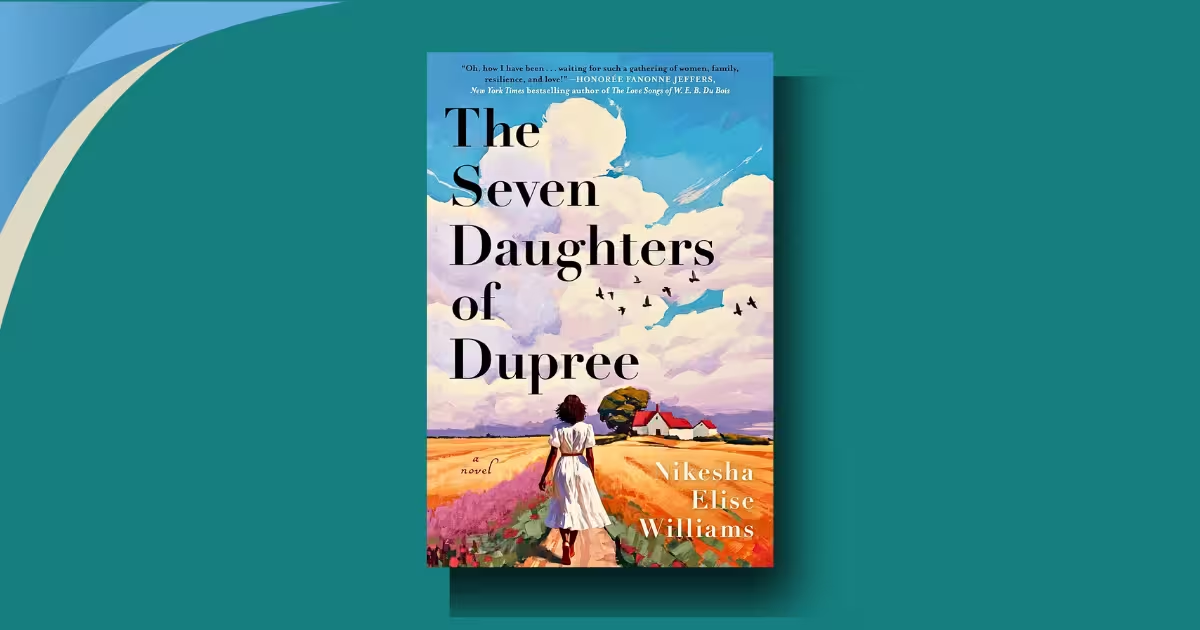
Why do some family “secrets” feel less like gossip—and more like inheritance? The Seven Daughters of Dupree doesn’t just tell a story; it makes you feel how love, silence, and survival travel down a bloodline until someone finally decides to speak.
A seven-generation family epic where one teenage girl’s search for her father cracks open a lineage of buried truths—stretching back to an enslaved ancestor whose stolen name still haunts the women who come after her.
The Seven Daughters of Dupree is best for readers who love multi-generational Black family sagas (Homegoing-style scope); anyone drawn to stories about mother–daughter intimacy, secrecy, and forgiveness; and book clubs that want big themes: race, belonging, colorism, faith, “passing,” and legacy
The Seven Daughters of Dupree is not for readers who want a light, breezy family drama (the opening alone is brutal: “Slavery now, slavery tomorrow, slavery forever” ), and people who dislike nonlinear timelines or generational POV shifts
Table of Contents
1. Introduction

Title: The Seven Daughters of Dupree
Author: Nikesha Elise Williams
Publication: Scout Press / Simon & Schuster (first Scout Press hardcover edition listed as January 2026)
Public descriptions frame it as a “sweeping multi-generational epic” centered on seven generations of Dupree women.
2. Background
The Seven Daughters of Dupree’s “present” story begins in 1995 with 14-year-old Tati determined to learn who her father is.
But Williams builds the emotional logic of that obsession through earlier generations—especially the post-Reconstruction South and a community split “across the tracks,” where whiteness is both shield and weapon.
One of the book’s most important historical threads is the post–Civil War system that kept Black labor and Black bodies controlled through terror, social policing, and economic traps.
The Seven Daughters of Dupree openly names the mechanics of that world—“Forget freedom. It’s not coming for you” —and then shows how its aftershocks echo into the 20th century through family rules: what you say out loud, what you swallow, and what you never write down.
Williams also threads in the South’s racial caste logic through the story of “passing,” where a woman crosses into whiteness not as a victory lap, but as an exhausting, precarious performance: Jubilee claims, “My name is Jubi now” and steps into a new identity because “he couldn’t tell she was colored.”
3. The Seven Daughters of Dupree summary
The Seven Daughters of Dupree is a multigenerational saga spanning from the 1860s to 2024. It explores the lives of seven generations of Dupree women, bound by a legacy of secrets, trauma, and a perceived “curse” regarding the men in their lives.
The story is told non-linearly, weaving between the “present” timelines of Nadia and Tati in Chicago and the historical past of their ancestors in Land’s End, Alabama.
1. The Origin: Sarah and the “Beginning” (1860s)
The lineage begins with an enslaved woman originally from Africa, whom the reader knows as Sarah.
Enslavement
Brought to the plantation of Zephaniah Foster Dupree in Land’s End, Alabama, Sarah(?) is raped repeatedly by Zephaniah. She becomes pregnant with his child.
The Escape Attempt
Sarah learns of a plan by the male slaves to escape to freedom. Using her skills as a braider, she braids a map of the escape route into her hair. Despite being pregnant and initially excluded by the men, she joins them.
The Capture
The escape fails. Zephaniah and his sons hunt them down. Zephaniah discovers the map braided into Sarah’s hair.
The Execution
As punishment, Zephaniah brutally whips Sarah 222 times—one lash for every mile she ran. He then pours a brine of salt and pepper into her wounds. Finally, he cuts off her fingers and decapitates her in front of the other enslaved people.
The Birth
Evangeline, the plantation’s midwife and healer, is forced to cut the living baby from Sarah’s dying body. This baby is Emma.
2. The Matriarchs of Land’s End (1870s–1950s)
The story follows the descendants who remain on the Dupree land, which is bequeathed to Evangeline and Emma by Zephaniah upon his death.
Emma (2nd Generation)
Raised by Evangeline, Emma marries a man named George. They suffer a “curse” where their baby boys constantly die—either stillborn or in infancy. The grief kills George. Emma finally gives birth to a surviving daughter, Jubilee.
Jubilee “Jubi” (3rd Generation)
Light-skinned and resentful of her blackness and the farm life, Jubi runs away across the tracks. She passes as white (“Cajun”) and marries Logan Danube, a wealthy white store owner.
The Betrayal
Jubi becomes pregnant. When she gives birth, the baby, Ruby, comes out undeniably dark-skinned. Realizing Jubi’s deception, Logan threatens to kill the baby. Jubi flees back to Emma and the Dupree farm, living the rest of her life in bitterness.
Ruby (4th Generation)
Dark-skinned and proud, Ruby embraces her heritage and the land. She falls in love with Sampson, a local boy. Sampson leaves for work in Mobile, and Ruby becomes pregnant. Unlike the men before him, Sampson returns to marry Ruby and raise their child. They have a daughter, Gladys.
Gladys (5th Generation)
- The Assault: In 1953, while walking to church, Gladys is attacked and raped by two white men, JB and Carl Darren (a relative of the Danubes).
- The Aftermath: Gladys survives but is traumatized. Jubi confronts Logan Danube about the attack on their granddaughter, forcing him to acknowledge the lineage he tried to erase.
- Leaving the South: Pregnant from the rape, Gladys miscarries the child. To escape the trauma, she marries Eugene Washington, a Pullman porter much older than her, and moves to Chicago.
3. The Chicago Generations (1980s–1990s)
In Chicago, the family secrets are buried. Gladys becomes a strict, religious, and somewhat bitter mother, while her daughter Nadia rebels.
Nadia (6th Generation)
- The Affair: In 1980, Nadia drops out of college and begins an affair with a married man named Roman Brown.
- The Heartbreak: Roman reveals that he is reconciling with his wife, Deborah, because she is pregnant. Nadia discovers she is also pregnant. When she tells Roman, he callously tells her to “Keep it. Get rid of it. Whatever you do, that’s on you”.
- The “Guide”: Devastated, Nadia writes a 20-step note titled “How to carry a child in fear,” detailing her heartbreak and Roman’s rejection. She decides to keep the baby and raises her daughter, Tati, alone, with help from Gladys and Eugene.
Tatiana “Tati” (7th Generation)
- The Search: Growing up, Tati is desperate to know her father. On her 14th birthday, after a family argument, Gladys (Mimi) reveals his name is Roman Brown.
- The Discovery: In 1999, Tati finds Nadia’s heartbreak note hidden in a shoebox. This prompts a confrontation where Gladys finally opens the family Bible and begins to tell Tati and Nadia the true history of the Dupree women—from the curse to the rape to the migration North.
- Meeting Roman: Tati tracks Roman down to his club in Indianapolis. He is cold and dismissive, implying he doesn’t even believe she is his. He reveals his other daughter (with Deborah) is named Faith Merét—sharing the same middle name Tati was given, “Merét,” which was Roman’s mother’s name. Realising he is a “small” man, Tati leaves him behind, finally finding closure.
4. Epilogue: The Return (2024)
- Full Circle: Decades later, Nadia and Tati decide to leave Chicago and move back to the ancestral land in Land’s End, Alabama.
- Reclaiming the Land: They sell their Chicago homes and renovate the old family property. Tati, now a lawyer and writer, meets a man named Joshua Freeman.
- The 8th Generation: Tati gets pregnant and gives birth to a daughter. They name her Sa’rah.
- The Dedication: The Seven Daughters of Dupree concludes with Tati reading a dedication to her new baby, Sa’rah. It acknowledges the ancestor Sarah(?), the “beheaded” and “discarded” mother whose sacrifice allowed the lineage to survive. The curse of silence and shame is broken as they finally speak the names of all the mothers who came before.
The ending doesn’t wrap up with a tidy bow; it returns the family to the origin point—Land’s End—as if the only way to end the curse is to walk back into its geography with eyes open.
Nadia sells the salon she built over decades—an act that feels like “betrayal and freedom,” “the ending of one legacy and the beginning of another.”
She and Curtis (her partner) move South with Tati. Nadia can’t fully explain why, but the novel nails the paradox: the South is “a land of terror and terrible memory… but also of such beauty and rich history, despite the blood.” Tati, the new generation, simply calls it: “It’s the right thing to do.”
Then the final transformation: Tati is no longer only daughter. She is mother. She stands in the mirror repeating “ma, ma, ma,” while her little girl recognizes her: “Yes, I’m mama.”
And Tati reads the dedication of her manuscript—naming all seven daughters in one breath, an act of repair through language: “We speak / Her / And Emma / And Jubilee… And Ruby… And Gladys… And Nadia… And me, Tatiana… And you.”
That is the ending: not revenge, not “closure,” but naming—and choosing remembrance over fear.
4. The Seven Daughters of Dupree analysis
4.1 The Seven Daughters of Dupree Characters
Sa’rah: more symbol than POV—yet emotionally present as the ancestor whose stolen personhood becomes family mythology. Her body is made into warning.
Evangeline: the novel’s most complex “protector.” She withholds names because she understands names are spiritual contracts. She’s not simply secretive; she’s strategic, even superstitious, and deeply maternal in a harsh world.
Emma: the child of unanswered questions, raised inside a truth that’s always incomplete. Her hunger is what later generations inherit as restlessness.
Jubilee (Jubi): the most morally thorny Dupree woman—because she chooses herself, and The Seven Daughters of Dupree doesn’t punish her with caricature. It shows how oppression can make “wrong” choices feel like the only choices.
Ruby: the daughter who becomes living evidence, carrying the consequences of passing and the family’s insistence on containing scandal.
Gladys (Mimi): a mother shaped by what she can’t say. Her love often looks like control—not because she’s cruel, but because she’s terrified.
Nadia: Nadia’s secrecy isn’t merely stubbornness—it’s a trauma response shaped by what happened to Gladys and the older lineage. When she finally opens up, it’s depicted as surgery: “the entombed tumor of her past removed.” Her arc is about letting intimacy exist without control.
Tati: Tati begins as a daughter who thinks a man’s name will fix her. She ends as a woman who realizes the real inheritance is maternal: story, survival, and choice. Her letter admits she’s learned the family’s most dangerous lesson: “there’s always a need for secrets.”
But the ending complicates that—because Tati ultimately breaks secrecy with testimony.
Gladys/Mimi: Gladys is the embodiment of “protection that hardens into harm.” She loves fiercely, but her fear makes her police her daughter’s life.
4.2 The Seven Daughters of Dupree Themes and symbolism
The “Curse” as Intergenerational Trauma
The supernatural “curse” is a brilliant metaphor for the transmission of historical trauma—the trauma of slavery, rape, loss, and racial violence. It manifests biologically (miscarriages), psychologically (emotional distance), and socially (Jubi’s passing). The “curse” isn’t broken by Gladys having sons; it merely morphs into new forms of silence and pain.
Hair as Legacy and Labor
The hair salon is the novel’s central ecosystem. It is a place of economic striving (Nadia’s business), intimate care, brutal truth-telling, and inherited craft. Doing hair is the one skill passed, often intuitively, down the Dupree line, from Ruby’s self-taught braiding to Nadia’s cosmetology license.
It symbolizes the tangible, sometimes painful, work of maintaining Black womanhood.
Secrets vs. Stories
The novel argues that unspoken secrets become toxic heirlooms. Evangeline’s refusal to tell Emma her origin story, Jubi’s fabricated past, Gladys’s hidden assault—all create gaps in understanding that fester into conflict for subsequent generations.
Tati’s journal writing represents the new generation’s need to transform secrets into stories, to name the ghosts.
The Geography of Trauma
The physical journey from the oppressive, haunted land of Land’s End, Alabama, to the promised yet isolating city of Chicago mirrors the internal journey of the characters.
The train is a recurrent symbol of transition, carrying both hope (Eugene’s courtship) and concealed pain (Gladys’s secret miscarriage).
The Ambiguity of Survival
The novel deeply explores what survival costs. Is Jubi a survivor for passing, or a casualty? Is Gladys’s tough love a survival tactic or a perpetuation of harm? Williams refuses easy answers, presenting survival as a complex, often morally ambiguous, state.
5. The Seven Daughters of Dupree evaluation
The Seven Daughters of Dupree is a sharp, unsentimental family epic—less interested in comforting you than in telling the truth about what families demand from women, and what women demand from themselves.
5.1 Strengths
Audacious Narrative Structure
The non-linear, spiraling chronology is the novel’s greatest technical strength. Jumping from 1995 to 1870, then weaving through the 20th century, creates a powerful echo effect.
We see a gesture, a conflict, or a silence in one generation and understand its profound origin three chapters later. It mimics the very process of uncovering family history—disjointed, revelatory, and emotionally jarring.
Unflinching Authenticity in Voice
Williams has a superb ear for dialogue and internal monologue. Each woman’s voice is distinct, anchored in her time and trauma.
The prose in Tati’s 1995 Chicago sections is peppered with youthful slang and R&B lyrics, while Emma’s 19th-century sections carry a heavier, more mythic rhythm.
The scenes in the beauty salon are particularly masterful, crackling with unspoken tensions and the familiar, comforting rituals of Black hair care.
Profound Emotional Resonance
The novel’s exploration of mother-daughter relationships is brutally honest and therefore deeply moving.
It rejects sentimentalism in favor of depicting love as it often is: a complex mix of sacrifice, resentment, protection, and failure. When Gladys finally tells Tati, “You were a blessing in a burden” (Page 97), it captures the entire novel’s heartbreaking thesis in one phrase.
5.2 Weaknesses
Demanding Commitment
The novel’s strength is also its primary barrier to entry. With seven primary perspectives across 130 years, keeping track of the lineage and connections requires active reading. Readers who prefer a tight, single-narrative drive may find the structure challenging.
Male Character Development
The men (Sampson, Eugene, George, Roman) are largely functional, serving as catalysts for the women’s journeys or representing the external world’s pressures.
While this is clearly a deliberate choice to center the feminine interiority, it occasionally leaves the reader wanting a bit more depth from figures like Roman, whose actions profoundly shape Nadia and Tati’s lives.
5.3 Impact
The Seven Daughters of Dupree sat with me for days after finishing. It shifted my perspective on family silence, making me consider what unspoken stories might be woven into my own relationships.
Intellectually, it’s a stunning case study in how to write about historical trauma without exploitation, focusing on the intimate rather than the panoramic. Emotionally, it’s a draining but cathartic journey.
The final image of Tati writing in her journal, transforming pain into poetry, offers a powerful sense of hope—not that the past is healed, but that it can finally be spoken.
5.4 Comparison with Similar Works
Fans of Yaa Gyasi’s Homegoing will appreciate the similar multigenerational, diaspora-spanning structure and thematic focus on inherited trauma.
However, Williams’s scope is more intimate, tightly focused on one maternal line rather than two branches.
The novel also shares DNA with The Vanishing Half by Brit Bennett in its exploration of passing and the fracturing of family identity, though it delves deeper into the historical roots of that fracture.
In its lyrical pain and focus on Southern Black women’s wisdom and grief, it recalls the work of Jesmyn Ward.
6. Personal insight with contemporary educational relevance
One reason this novel feels so modern is that it treats intergenerational trauma as both emotional and structural—not mystical.
The Dupree women inherit patterns: silence, hypervigilance, and the instinct to choose safety over selfhood.
That maps painfully well onto what public health research says about childhood adversity: the CDC defines adverse childhood experiences (ACEs) as preventable traumatic events in childhood and documents that ACEs are common and linked to later health outcomes.
And The Seven Daughters of Dupree’s focus on hair—beauty culture as refuge, labor, identity, and policing—also lands inside a very current policy debate. Hair discrimination remains a documented workplace issue, and the CROWN Act movement exists because “race-based hair discrimination” has repeatedly shaped school and work experiences for Black people, especially Black women.
So the educational takeaway I’d put on the board is this: what families don’t process, children still carry. In the novel, that “carrying” shows up as control, secrecy, and desperate searching (Tati’s father quest).
In real life, it can show up as stress biology, mental health risk, and relationship patterns—often without a single obvious “mark” on the body, like Gladys searching the mirror and finding “no mark.”
If you’re teaching The Seven Daughters of Dupree, it pairs naturally with trauma-informed frameworks (ACEs), legal/cultural discussions of hair bias (CROWN Act), and a larger unit on how history becomes family behavior.
7. The Seven Daughters of Dupree quotes
- “Slavery now, slavery tomorrow, slavery forever.”
- “Forget freedom. It’s not coming for you.”
- “For her pa, write Zephaniah Foster Dupree.”
- “I birthed you… ’Twas the same day yo’ real mammy died.”
- “In their family, trouble always came.”
- “They were women, together, not just mother and daughter.”
- “It’s a trying thing to get people in the North to understand why, as a Black person, you choose to live in the South. A land of terror and terrible memory, yes, but also of such beauty and rich history, despite the blood.”
- “Everything don’t need to be remembered.” – A recurring refrain from Evangeline and Jubi, encapsulating the family’s destructive philosophy of silence.
- “You were a blessing in a burden.” – Gladys to Tati, the agonizing, honest core of so much maternal love.
- “Women do a lot of shit for men. Sometimes it’s love. Sometimes it’s lust. Sometimes it’s a little bit of both.” – Nadia’s weary wisdom to her daughter.
- “The sound mothers make when they lose their young is distinct and distinguishable from any other on Earth. A cry greater than grief, wider than mourning, and deeper than distress.” – The narrator on Emma’s loss.
- “Dear Roman, I finally know your name. Now all that’s left to know is, ‘Am I your shame?’” – Tati’s journal entry, where inherited pain is finally articulated into a question.
8. Conclusion
If you want a novel that treats Black womanhood as lineage—where love is real, but so is the cost—The Seven Daughters of Dupree is worth your time. It’s not written to flatter the reader; it’s written to name what families bury and to show how the buried still breathes.
Recommend for: fans of multi-generational literary fiction, historical-to-contemporary sagas, and readers who like emotionally intense, theme-forward storytelling.
Skip if: you want a light family drama or you prefer linear, single-POV novels.







