
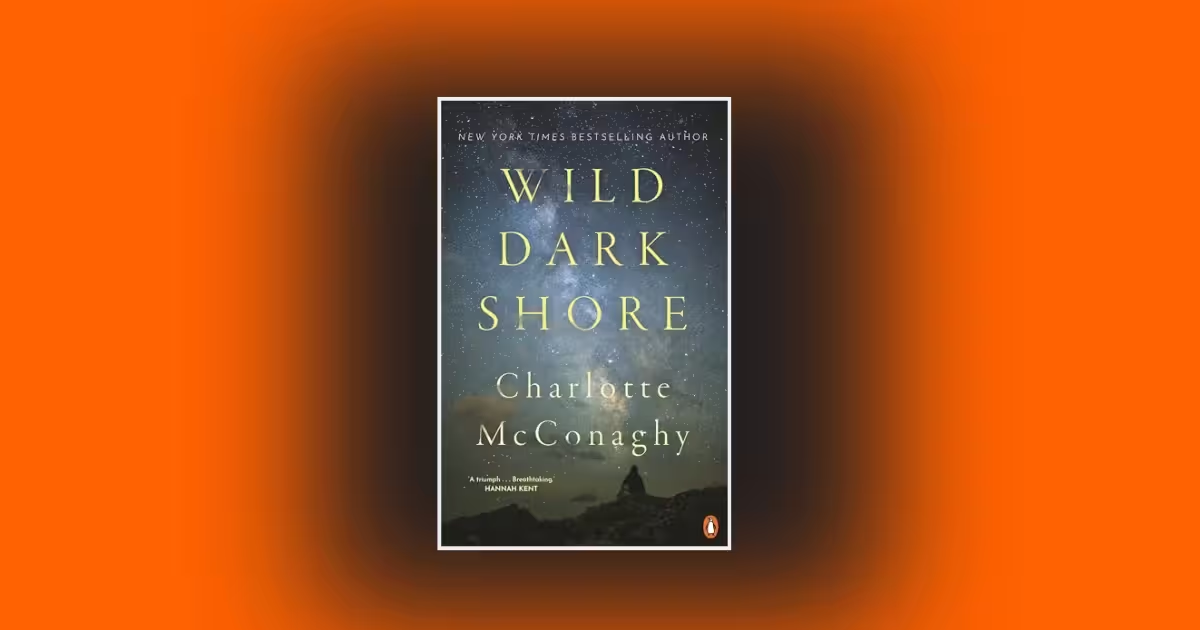
Have you ever wondered what it would feel like to watch your world—both inside and out—slowly be reclaimed by the sea? To be surrounded by a last bastion of wild, screaming beauty, while clinging to the ghosts of what you’ve lost? Charlotte McConaghy’s Wild Dark Shore isn’t just a novel; it’s a visceral experience of climate grief, familial bonds stretched to breaking point, and the haunting question of what we save when everything is drowning.
A mysterious, injured woman washes ashore a remote, doomed sub-Antarctic island, disrupting the fragile existence of a caretaker and his three children as they grapple with isolation, buried secrets, and the impending collapse of their world and its last global seed vault.
The narrative is built on the urgent, real-world context of biodiversity loss and climate displacement. The central setting—the Shearwater Island Global Seed Vault—mirrors real-life “doomsday” vaults like the Svalbard Global Seed Vault, repositories designed to survive catastrophe.
McConaghy’s detailed ecology, from the migratory patterns of albatrosses to the symbiotic stories of seeds like the dandelion and buzzy burr, grounds the fiction in natural science, making the impending loss feel terrifyingly tangible.
Wild Dark Shore is best for readers who crave literary, environmentally-conscious fiction with deep psychological depth, complex family dynamics, and a stark, beautiful setting that acts as a character itself. Not for those seeking a fast-paced action plot or a tidy, optimistic resolution; this is a slow-burn, emotionally gruelling, and atmospherically dense journey.
Table of Contents
1. Introduction
Wild Dark Shore is a 2024 literary novel by the New York Times bestselling author of Migrations, Charlotte McConaghy.
Published by Flatiron Books, this standalone novel plunges readers into the isolating and fierce landscape of a sub-Antarctic island, weaving a gripping tale of survival, secrets, and the profound connections between humans and a dying natural world.
2. Background
While a work of fiction, the novel is steeped in contemporary anxieties. It draws direct inspiration from the real-world climate crisis, rising sea levels, and the existential mission of global seed banks—the last arks of biodiversity in an age of extinction.
The haunting history of 19th-century sealers and whalers, which left scars of annihilation on islands like those in the Southern Ocean, provides a historical layer of guilt and ghosts, mirroring humanity’s enduring legacy of exploitation.
3. Wild Dark Shore Summary
Part 1: The Wreckage
The story unfolds on Shearwater Island, a remote, storm-lashed outpost 1,500 kilometers from any other land. Dominic “Dom” Salt lives there as a caretaker with his three children: seventeen-year-old Fen, a wild spirit who lives more with the seal colony than her family; Raff, her older brother grappling with silent rage and grief; and nine-year-old Orly, a botanical prodigy who whispers to the wind.
They are the last people on an island being evacuated due to dangerously rising seas.
Their final task is to catalog and pack the most crucial specimens from the Shearwater Global Seed Vault before the naval ship RSV Nuyina arrives in six weeks to take them and the seeds away forever. The island’s communications have been mysteriously destroyed, leaving them completely cut off.
Their fragile routine is shattered when a ferocious storm washes a woman ashore, tangled in driftwood. Fen swims out and saves her. The woman, Rowan, is badly injured and hypothermic. Dom and his children nurse her back to health in their lighthouse home.
Rowan claims to have no memory of why she came, but it’s a lie. She is secretly searching for her husband, Hank Jones, the senior botanist and team leader of the now-abandoned research base. His final emails to her were desperate: “I need help. It’s not safe here for me anymore.”
Part 2: Unraveling Secrets
As Rowan heals, she grows increasingly suspicious of Dom’s evasiveness. She explores the deserted, flood-encroached research base and finds a photo of Hank, confirming he was here. Dom, meanwhile, is wary of Rowan, fearing her arrival is connected to the sabotaged comms.
A tense coexistence forms. Rowan bonds with Orly, who teaches her about the island’s unique ecology and seeds. She witnesses the deep fractures in the Salt family: Fen’s self-exile to a boathouse, Raff’s sorrow manifesting in violent sessions with a punching bag, and Dom’s palpable, lonely grief for his deceased wife, Claire, to whom he still speaks.
Rowan convinces Fen and Orly to take her via Zodiac to the wreck of her boat, hoping to salvage its radio. They find the boat destroyed in the deadly “Drift” current and see the devoured body of her captain, Yen. The traumatic sight forces them to turn back, and an furious Dom confronts them. The incident deepens the chasm between Dom and Fen.
Part 3: Burdens of the Past
Through fragmented memories and conversations, truths emerge. Raff was in love with Alex, a seal researcher who left the island. After Alex’s departure, Raff discovered his body hanging from the fuel tanks at the base—a suicide.
Dom and Fen had to cut him down. This trauma is why Fen can no longer bear to be at the lighthouse (“the walls make my skin crawl”) and why Raff’s music—his violin echoing whale song—had fallen silent until Rowan’s arrival strangely catalyzes its return.
Rowan also confesses her truth to Dom: she is Hank’s wife. Dom admits Hank was here but left with the other researchers, seemingly burdened by the impossible task of choosing which seeds would be saved and which would be condemned to extinction—a “burden” that broke him. Rowan is left to wonder if her husband simply abandoned her.
Part 4: The Heart of the Vault and the Final Storm
Dom, Rowan, and Orly journey to the southern seed vault, a freezing cavern built into a mountain. Rowan feels the oppressive weight of Hank’s work. She sees the concrete decaying (“concrete cancer”), a literal metaphor for the fragility of this last hope.
Here, the core themes crystallize: the heartbreak of triage in a dying world, the difference between preserving life (seeds) and living it (the Salt family), and the question of what constitutes true survival.
Back at the lighthouse, tensions peak. Fen, who has been secretly removing her mother’s belongings from Dom’s shrine-like drawer to force him to let go, sees a ghostly figure outside the window.
The island’s violent past and present sorrows seem to be converging. A climactic storm hits, worse than the one that brought Rowan. The lighthouse is battered, and the fragile remaining power systems fail. In the midst of the chaos, the truth about Hank explosively unravels.
The Ending Revealed:
Hank never left the island. Driven to madness by the ethical horror of his task and the isolating, haunted environment, he suffered a psychotic break. In a delusional state, he destroyed the communications system.
The final, devastating revelation is that Dom found Hank dead in the blue field hut—not by suicide, but murdered. In a fit of rage and protection, Raff killed Hank during a confrontation, likely over Alex or a threat he posed.
Dom has been covering it up to protect his son, cleaning the scene and hiding the body. The “burden” Dom spoke of was his own: the burden of this terrible secret and the moral sacrifice of protecting his child at all costs.
The storm passes, leaving them in a shattered silence. The Nuyina arrives on schedule.
There is no clear justice, only the bleak aftermath of survival choices. Rowan must decide whether to expose the truth. In the end, she chooses silence. She boards the ship with the Salt family and the boxes of chosen seeds, leaving the island—and its multitude of dead, both human and botanical—to the rising sea.
The ending is ambiguous, somber, and raw. There is no healing reunion with Hank, no easy forgiveness for Raff, and no salvation for Shearwater. There is only the uncertain journey forward, carrying their respective griefs and secrets into a world that itself is on the brink.
The final image is one of poignant, painful resilience: a family, broken and bound by tragedy, and a stranger, now intertwined with their fate, moving toward an uncertain future.
4. Wild Dark Shore Analysis
4.1. Wild Dark Shore Characters
Rowan: A skilled carpenter defined by profound loss (her home, garden, and animals to a bushfire), she arrives closed-off and distrustful. Her journey is one of painful re-engagement with life and emotion.
Her relationship with Dom begins as hostile suspicion and evolves into a complex, reluctant attraction—a meeting of two equally scarred, capable people. “It’s just a body,” she says of her wounds, a mantra that slowly breaks down as she connects with the children.
Dominic “Dom” Salt: A portrait of stoic, grieving masculinity. He parents with rigid systems to hold his unraveling world together, believing “someone has to, or everything just stays broken.” His love for his children is fierce but inarticulate, often causing more harm. His haunting by Claire’s ghost (“I only hear one [voice]”) symbolizes his refusal to move on, a stasis mirrored by the island itself.
Fen: The wild heart of the novel. She represents a primal connection to nature, feeling more kinship with seals than people. Her self-exile is a response to trauma (discovering Alex’s body) and a rebellion against her father’s suffocating, spectral grief. Her act of saving Rowan is instinctive and pure, contrasting the complex moral compromises of the adults.
Raff: His character arc is defined by suppressed trauma. His anger is a “white-hot rage” channeled into boxing, taught by Dom as the only way to manage it. His music, particularly the violin that mimics whale song, represents his softer, grieving self, which he rediscovers. His act of killing Hank is the novel’s tragic core—an explosion of protective fury with devastating consequences.
Orly: The innocent lens. His encyclopedic knowledge of seeds and ecology (“This is the one I was telling you about, the buzzy burr”) symbolizes hope and continuity.
He is the bridge between Rowan and the family, and his nightmares about “everything burn[ing] or drown[ing] or starv[ing]” voice the novel’s central anxiety in its purest form.
4.2. Wild Dark Shore Themes and Symbolism
Climate Grief and Triage: The entire plot is an allegory for the climate crisis. The seed vault represents the desperate, last-ditch effort to preserve biodiversity.
The act of choosing which seeds to save mirrors the impossible choices facing humanity. The drowning island is our drowning world.
Isolation and Madness: The extreme isolation of Shearwater acts as a pressure cooker, amplifying guilt, grief, and obsession until they fracture into madness—seen in Hank’s breakdown, Dom’s spectral conversations, and Raff’s violence.
Ghosts of the Past: The island is literally haunted by the “spirits of the dead” animals slaughtered by sealers. This historical ghosting parallels the personal ghosts each character carries: Claire, Alex, Hank, Rowan’s burnt home. The past is a tangible, inescapable force.
Seeds as Symbol: Seeds symbolize latent life, hope, and future possibility. Orly’s stories of the dandelion feeding an entire ecosystem and the buzzy burr traveling on an albatross illustrate profound interconnection. The seeds in the vault are potential life in suspended animation, contrasting with the vividly living, struggling humans above.
Parental Sacrifice & Moral Ambiguity: Dom’s ultimate choice—to conceal a murder to protect his son—poses a brutal ethical question. Is the protection of one’s child the highest law, even if it corrupts justice? This theme asks what lines we cross for love in an ending world.
5. Evaluation
Wild Dark Shore is a masterfully bleak and beautiful novel, a significant and haunting contribution to the growing canon of climate fiction. It is not a hopeful book, but a devastatingly honest one.
Strengths: McConaghy’s prose is breathtakingly visceral, especially in describing the savage, majestic landscape and wildlife. The ecological detail is immersive and authentic. The psychological portrayal of grief and isolation is profound and nuanced. The slow-burn mystery is expertly paced, and the final revelation about Hank is both shocking and emotionally inevitable.
Weaknesses: The unrelenting grimness may be exhausting for some readers. Raff’s perspective, while crucial, is less developed than Rowan’s or Dom’s. Some may find the ending’s ambiguity and lack of cathartic justice frustrating, though it is thematically consistent.
Impact: The novel resonates on a deep, emotional level, leaving a lasting impression of aching loss and uneasy questions. It intellectualizes the climate crisis not through data, but through the visceral experience of a family watching their home disappear.
Comparison with Similar Works: It shares the ecological urgency and lyrical prose of McConaghy’s own Migrations, the isolated, psychological intensity of Emily St. John Mandel’s The Glass Hotel, and the thematic depth of Richard Powers’ The Overstory.
6. Personal Insight & Contemporary Relevance
Wild Dark Shore powerfully articulates the psychological phenomenon of “climate grief” or “solastalgia”—the distress caused by environmental change.
A 2021 study in The Lancet found that 45% of young people globally report that climate anxiety affects their daily lives. Rowan’s paralysis after her fire and Hank’s breakdown under the weight of ecological triage are extreme literary representations of this widespread, real-world anguish.
The novel forces us to confront the ethics of conservation in the Anthropocene.
The Shearwater Seed Vault directly mirrors the Svalbard Global Seed Vault, which in 2023 deposited its 1.2 millionth seed sample while the world experienced yet another year of climate-driven disasters.
McConaghy’s story asks: Are we, like Dom, merely caretakers of sealed archives on sinking ships? Or can we, like Fen, find a way to live within the dying world, with tenderness and connection, even as we mourn?
The book’s contemporary lesson is stark: we are all, already, making impossible choices about what to save, and living with the ghosts of what we’ve lost.
7. Wild Dark Shore Quotes
- On grief and presence: “It’s nice and it’s terrible.” – Dom, on hearing his dead wife’s voice.
- On human fragility: “It’s just a body. They either hold on or they don’t.” – Dom to Rowan.
- On ecological interconnection: “Let’s start with the greatest traveler among them, shall we?” – The opening to Orly’s seed narratives.
- On love and risk: “Loving a place is the same as having a child. They are both too much an act of hope, of defiance. And those are a fool’s weapons.” – Rowan’s internal reflection.
- On survival: “Look, you just have to keep going. That’s all. There’s nothing else.” – Dom.
8. Conclusion
Wild Dark Shore is a monumental, gut-wrenching read. It is a novel that settles in your bones with the chill of the Southern Ocean and the weight of its sorrows.
While its unflinching bleakness may not be for everyone, it is an important, beautifully crafted, and emotionally resonant story for our time.
I highly recommend it to readers of literary fiction who are prepared to sit with discomfort, to those fascinated by the natural world and the human psyche under extreme duress, and to anyone seeking a story that truly grapples with the profound moral and emotional complexities of life on a changing planet.
This is not an escape; it’s a confrontation, and a stunning achievement.







