Last updated on November 6th, 2026 at 11:41 am
At some point, almost every thinking person faces the same quiet crisis: What if life has no built-in meaning?
The question may arrive after grief, failure, boredom, betrayal, burnout, or simply too much honest thinking. One day, the old answers stop working. Career, religion, family approval, pleasure, success, ideology, romance—none of them automatically explains why we are here.
This is where two powerful philosophies enter the room: nihilism and existentialism.
Both begin near the same abyss. Both question inherited meaning. Both reject shallow comfort. Both can sound frightening to people who want life to come with a clear instruction manual. Yet they move in very different directions.
Nihilism says there is no inherent meaning, no absolute value, and no cosmic purpose waiting to be discovered.
The Internet Encyclopedia of Philosophy defines existential nihilism as the view that life has no intrinsic meaning or value, while moral nihilism rejects absolute moral values.
Existentialism, especially in its Sartrean form, begins with a similar absence of predetermined essence but turns that absence into responsibility. Sartre’s famous idea that “existence precedes essence” means human beings are not born with a fixed purpose; meaning is shaped through existence, action, and choice.
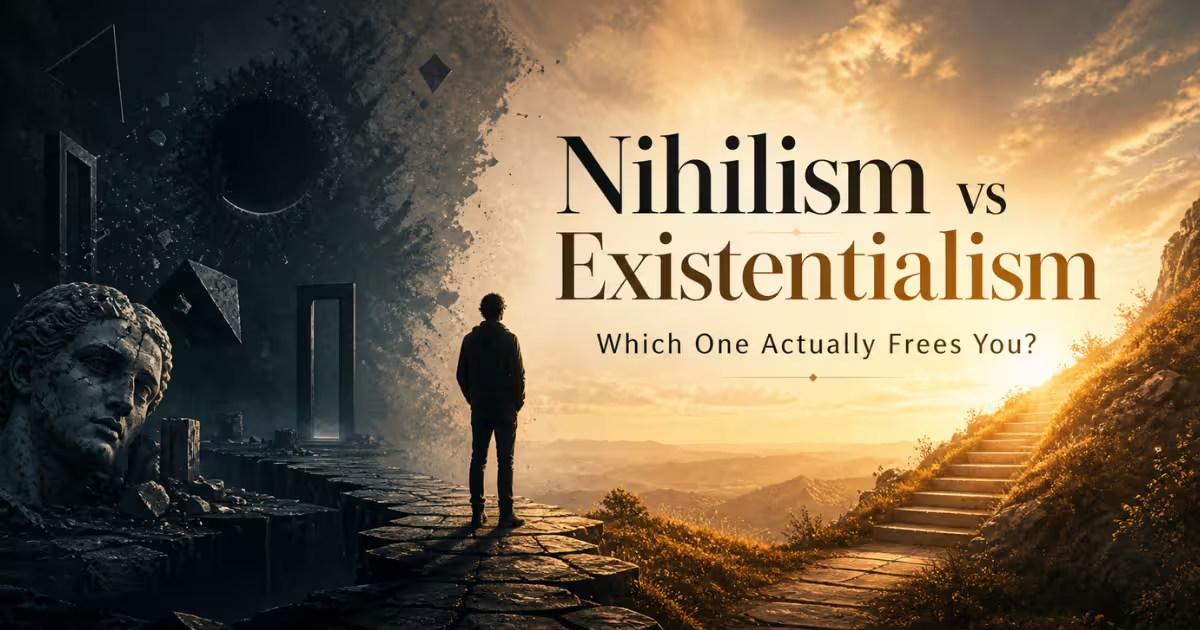
So the real question is not simply, “Which one is true?” The sharper question is: which one actually frees you?
The answer is uncomfortable: nihilism may free you from illusion, but existentialism frees you for life.
Table of Contents
What Is Nihilism?
Nihilism is often misunderstood as teenage gloom, laziness, or dramatic pessimism.
That caricature is too simple. Philosophically, nihilism is the denial or collapse of objective meaning, value, truth, or purpose. In its existential form, it says life has no intrinsic meaning. In its moral form, it questions whether good and evil have any absolute foundation.
That can feel terrifying. But it can also feel strangely liberating.
If there is no cosmic scoreboard, you are not being graded by the universe. If there is no divine script, you are not failing some hidden assignment.
If there is no ultimate purpose imposed from outside, then many of the fears that govern people’s lives begin to look artificial.
You do not have to become what your parents expected.
You do not have to worship social status.
You do not have to pretend your job title is your soul.
You do not have to believe that suffering always has a noble reason.
In this sense, nihilism can act like a philosophical acid. It burns through false meanings. It exposes inherited values that people obey without examining.
It asks: Who told you this mattered? Why did you believe them?
That is why nihilism can feel like freedom at first. It breaks the prison bars of fake certainty.
But the problem is this: once nihilism destroys the prison, it may not tell you where to go.
Nietzsche and the Danger of Passive Nihilism
No discussion of nihilism vs existentialism can avoid Friedrich Nietzsche. Nietzsche is often casually called a nihilist, but that is misleading. He diagnosed nihilism more than he celebrated it.
Nietzsche’s “God Is Dead” explains the phrase not as casual blasphemy but as a diagnosis of the decline of Christian and metaphysical worldviews in modern Europe, along with the existential crisis that follows.
In that reading, the “death of God” is not merely about disbelief; it is about the collapse of the old foundation that once gave Western morality its authority.
This is crucial. Nietzsche saw that when old values lose credibility, people do not automatically become free, brave, and creative. Many become exhausted. They drift. They imitate. They cling to comfort. They may reject religion but keep its moral shadows. They may mock meaning but secretly hunger for someone else to provide it.
My Nietzsche analysis notes the danger clearly: with the collapse of traditional foundations, humanity must create new values or risk falling into nihilism, conformity, and moral stagnation.
That distinction matters because nihilism has two faces.
The first is active nihilism. This is destructive, but not merely destructive. It tears down false idols so that new values can be created.
The second is passive nihilism. This is the more dangerous form for modern life. Passive nihilism says, “Nothing matters,” then sinks into comfort, cynicism, distraction, and resentment.
Active nihilism clears the ground.
Passive nihilism lies down in the rubble.
And much of modern life looks like passive nihilism wearing expensive clothes.
What Is Existentialism?
Existentialism begins with the individual standing in a world that does not hand over easy answers. I
t does not deny anxiety, absurdity, loneliness, or death. In fact, it forces us to look directly at them. But unlike passive nihilism, existentialism does not stop at meaninglessness.
Its central claim is that human beings must live, choose, act, and take responsibility without waiting for a final guarantee.
Sartre’s phrase “existence precedes essence” captures this beautifully.
A manufactured object, such as a knife or chair, is made according to a design. Its essence comes before its existence. But a human being, for Sartre, appears first and defines themselves afterward through action. The Internet Encyclopedia of Philosophy describes Sartre’s existential account of human life as grounded in the idea that existence precedes essence and develops toward a strong notion of freedom.
Sartre’s Being and Nothingness also frames the book around key existential concerns: bad faith, freedom, being-in-itself, being-for-itself, and the struggle for authenticity.
This is where existentialism becomes both liberating and demanding.
It says: you are not a fixed object. You are not merely your past. You are not only your trauma, class, job, nationality, family, or personality type. These things shape your situation, but they do not exhaust your freedom.
You are responsible for what you do with the life in front of you.
That does not mean you can magically become anything. Existentialism is not motivational nonsense. You are born into conditions you did not choose: history, body, culture, economic limits, other people’s actions, mortality. But even inside those limits, you must choose your stance, your projects, your commitments, and your way of being.
That is the existential burden: you cannot avoid choosing. Even refusal is a choice.
Nihilism vs Existentialism: The Core Difference
The simplest distinction is this:
Nihilism says: life has no inherent meaning.
Existentialism says: life has no predetermined meaning, so you must create meaning through action.
They begin with a similar shock but answer it differently.
Nihilism removes false certainty. Existentialism asks what you will build after certainty collapses.
Nihilism can say, “Nothing matters.” Existentialism replies, “Then what will you make matter?”
Nihilism can free you from guilt, superstition, and inherited scripts. Existentialism asks you to become accountable for the script you write next.
That is why existentialism is harder. Nihilism may give you relief from imposed meaning, but existentialism gives you the burden of authorship.
And authorship is not always pleasant.
It is easier to say “nothing matters” than to say “this matters because I choose to live for it.” The first protects you from disappointment. The second exposes you. It makes your values visible. It makes your life answerable.
But that is also why existentialism offers a deeper freedom.
The False Freedom of “Nothing Matters”
There is an emotional stage where nihilism feels intoxicating. You realize that many social rules are arbitrary.
You see that success is often performative. You notice that people chase money, approval, beauty, ideology, and status as if these things will save them from death.
Then the phrase appears: nothing matters.
At first, it feels like breathing fresh air. You can stop pretending. You can stop begging the world for permission. You can laugh at the seriousness of people who worship shallow things.
But “nothing matters” has a trap hidden inside it.
If nothing matters, then cruelty does not matter. Love does not matter. Courage does not matter. Art does not matter. Truth does not matter. Your pain does not matter. Neither does anyone else’s.
Most people who say “nothing matters” do not actually live that way. They still get hurt by betrayal. They still want honesty. They still crave affection. They still admire courage. They still complain about injustice. Their lives reveal values their philosophy refuses to name.
This is where nihilism often becomes dishonest. It claims to have outgrown meaning, while secretly depending on meaning every day.
A person may say love is just chemistry, but still feel destroyed when abandoned. They may say morality is invented, but still rage when treated unfairly. They may say ambition is meaningless, but still envy someone else’s success.
Existentialism does not let you hide in that contradiction. It asks: What do your actions show that you value?
Bad Faith: The Existential Escape from Freedom
Sartre’s concept of bad faith is one of existentialism’s most useful ideas.
Bad faith means lying to yourself about your freedom. It happens when you pretend you are merely a thing, a role, a label, or a victim of circumstances, in order to avoid responsibility.
Someone says, “That is just who I am.”
Someone says, “I had no choice.”
Someone says, “People like me cannot change.”
Someone says, “I am only doing what everyone does.”
Sometimes these statements describe real constraints. But often they also conceal evasion.
Bad faith is comfortable because freedom is frightening. If you are free, then you are answerable. If you are answerable, then your life cannot be blamed entirely on fate, society, childhood, biology, or other people.
Existentialism does not deny that these forces matter. It simply refuses to let them become total excuses.
That is why existential freedom feels heavier than nihilistic freedom. Nihilism may say, “You owe nothing.” Existentialism says, “You are responsible for what you become.”
Camus, the Absurd, and Revolt Against Meaninglessness
Albert Camus is often grouped with existentialists, though he rejected the label. His philosophy of the absurd belongs in this conversation because it offers a middle path between nihilistic collapse and false consolation.
Camus begins with the absurd: human beings hunger for meaning, but the universe remains silent.
The Myth of Sisyphus describes Camus as taking a path that avoids both nihilism and religious escape, proposing instead a life lived fully in defiance of meaninglessness.
That phrase—defiance of meaninglessness—is central.
Camus does not say the absurd can be solved. He says it can be lived. We do not need to pretend the universe has a secret moral plan. But neither do we need to collapse into despair. We can revolt. We can love, work, create, laugh, and resist suffering without claiming that everything is cosmically justified.
This is close to existential freedom. It is not freedom from death, uncertainty, or pain. It is freedom from the need for final permission.
You do not need the universe to applaud before you live.
Which One Actually Frees You?
The answer depends on what kind of freedom you mean.
If by freedom you mean freedom from illusion, nihilism can help. It can strip away false beliefs, inherited guilt, shallow ambition, and borrowed morality. It can teach you not to worship systems simply because they are old, popular, or emotionally comforting.
But if by freedom you mean the ability to live meaningfully, choose honestly, and become responsible for your life, existentialism goes further.
Nihilism opens the cage.
Existentialism asks you to walk out.
Nihilism says the old meanings are dead.
Existentialism asks what you will create in their place.
Nihilism can liberate the mind from obedience.
Existentialism liberates the person into responsibility.
That is the deeper freedom: not the absence of all burdens, but the ability to choose your burdens consciously.
A life with no commitments is not automatically free. It may simply be empty. Real freedom is not floating without attachment. Real freedom is choosing what deserves your attachment.
Why Existentialism Is More Practical Than Nihilism
Nihilism often sounds more intellectually ruthless, but existentialism is more livable.
Try building a life on “nothing matters.” It may work for a late-night conversation, a rebellious phase, or a philosophical mood. But it does not help much when you must decide whether to forgive someone, leave a job, care for a child, write a book, face illness, or rebuild yourself after failure.
Existentialism gives you a framework for action.
It says meaning is not found like a lost object under the bed. Meaning is made through commitment. You discover what matters by living as if it matters, then accepting the consequences.
A friendship becomes meaningful because you show up.
A craft becomes meaningful because you practice it.
A principle becomes meaningful because you defend it.
A life becomes meaningful because you shape it through repeated choices.
Meaning is not a trophy you receive before the struggle. It is what forms through the struggle.
That is why existentialism fits ordinary life better. It does not require optimism. It does not require faith in progress. It does not require belief that everything happens for a reason. It only requires honesty, action, and responsibility.
The Psychological Cost of Each Philosophy
Nihilism and existentialism both have emotional consequences.
Nihilism can reduce anxiety by removing impossible expectations. If nothing has cosmic importance, then your failures may feel less catastrophic. Your embarrassment matters less. Your social role matters less. Your fear of disappointing imaginary judges may weaken.
But nihilism can also drain motivation. If nothing matters, why repair anything? Why love carefully? Why sacrifice? Why resist injustice? Why create?
Existentialism has the opposite problem. It restores agency, but it also intensifies responsibility. If your choices shape your life, then you cannot fully hide. You must confront your evasions. You must admit where you are choosing comfort over courage.
So nihilism risks emptiness. Existentialism risks anguish.
But anguish is not the enemy of freedom. Sometimes anguish is the feeling of realizing that your life is actually yours.
Freedom Is Not Comfort
Many people confuse freedom with comfort. They imagine freedom as a life without pressure, limits, responsibility, or pain. But that kind of freedom does not exist.
Freedom is not the removal of all constraints. Freedom is the capacity to choose within reality.
Heidegger’s existential vocabulary is useful here. Sopranu’s beginner’s guide to Being and Time describes Heidegger as giving language to experiences of being thrown, busy, distracted, and inauthentic.
That idea of “thrownness” matters because none of us begins from nowhere. We wake up already inside a world: a family, a language, a body, a history, a society, a death sentence we did not sign.
Existential freedom is not pretending you are unlimited. It is owning your life within limits.
You did not choose everything that happened to you.
But you participate in what you become next.
That participation is where freedom lives.
Can Nihilism and Existentialism Work Together?
Yes, but only if nihilism is treated as a passage, not a permanent home.
A mature person may need a nihilistic moment. You may need to realize that some of your values were inherited, not chosen. You may need to see that social approval is fragile, that status is theatrical, that many authorities are improvising, and that no institution can fully relieve you of the burden of being alive.
That moment can be cleansing.
But if you stay there forever, clarity becomes paralysis.
The best movement is from nihilistic honesty to existential creation:
- Recognize that life has no obvious built-in meaning.
- Reject false meanings that shrink your life.
- Accept that you are still choosing, even when you pretend not to.
- Create values through action, love, work, courage, and responsibility.
- Live without demanding cosmic guarantees.
In this sense, nihilism can be the doorway, but existentialism is the road.
Nihilism vs Existentialism in Everyday Life
Imagine someone stuck in a career they hate.
A nihilistic response might say: “Careers are meaningless. Success is fake. Nothing matters.”
There is some truth there. Many careers are built around status games. Many people sacrifice their lives for titles that vanish quickly.
But existentialism asks the harder question: “What are you going to do now?”
Will you stay and admit you are choosing security?
Will you leave and accept uncertainty?
Will you change your relationship to work?
Will you build something outside your job?
Will you stop lying about what you want?
Existentialism does not hand you an easy answer. It forces you to become an answer.
Or imagine someone after heartbreak.
Nihilism says: “Love is meaningless. People leave. Attachment is stupid.”
Existentialism says: “Love has no guarantee. Now decide whether you will become bitter, honest, open, guarded, wiser, cruel, or brave.”
That is the difference. Nihilism reacts to pain by dissolving value. Existentialism asks what value can survive pain.
The Verdict: Existentialism Frees You More Deeply
So, nihilism vs existentialism: which one actually frees you?
Nihilism frees you from inherited illusions. That freedom is real, but incomplete. It clears away false gods, fake purposes, and unquestioned moral scripts. It can be necessary, especially when your life has been governed by fear, guilt, conformity, or borrowed dreams.
But existentialism frees you more deeply because it does not stop at negation. It gives you the terrifying dignity of authorship.
You are not free because nothing matters.
You are free because you can choose what matters.
You are not free because life has no script.
You are free because you must write one.
You are not free because the universe is silent.
You are free because silence does not prevent song.
Nihilism is the shock of discovering that no one is coming to give your life meaning. Existentialism is the courage to create meaning anyway.
And that is the kind of freedom that can actually be lived.
FAQ: Nihilism vs Existentialism
Is existentialism the same as nihilism?
No. Nihilism generally denies inherent meaning or value, while existentialism argues that human beings create meaning through choice, action, and responsibility. They overlap in rejecting predetermined meaning, but they differ in their response to that absence.
Is nihilism always negative?
Not always. Nihilism can be intellectually useful because it challenges false certainty and inherited values. However, passive nihilism can become despair, apathy, or cynicism if it never moves toward creation.
Why is existentialism considered freeing?
Existentialism is freeing because it says you are not trapped by a fixed essence or predetermined purpose. Your life takes shape through your choices, commitments, and actions.
Did Nietzsche support nihilism?
Nietzsche diagnosed nihilism as a crisis, especially after the collapse of traditional religious and metaphysical foundations. Nietzsche presents his response as a call for value creation and self-overcoming rather than passive despair.
Which philosophy is better for living?
Existentialism is usually more livable because it moves beyond “nothing matters” toward responsibility, authenticity, and chosen meaning. Nihilism may clear illusions, but existentialism helps build a life after those illusions collapse.