Last updated on November 6th, 2026 at 11:40 am
Ever wonder why love feels more like a transaction than a transformation? The Art of Loving will dismantle everything you thought you knew about connection, and rebuild you in the process.
I started reading Erich Fromm’s The Art of Loving in 2019, at a time what I can only describe as a quiet crisis of the heart. I was 34 years old, sitting in a rented apartment in Bangladesh, surrounded by the debris of a relationship that had just ended—not with a bang, but with the slow, suffocating realization that neither of us had known how to love each other.
We had fallen into the trap that Fromm would later articulate with surgical precision: we believed love was about finding the right object, not about cultivating the right faculty.
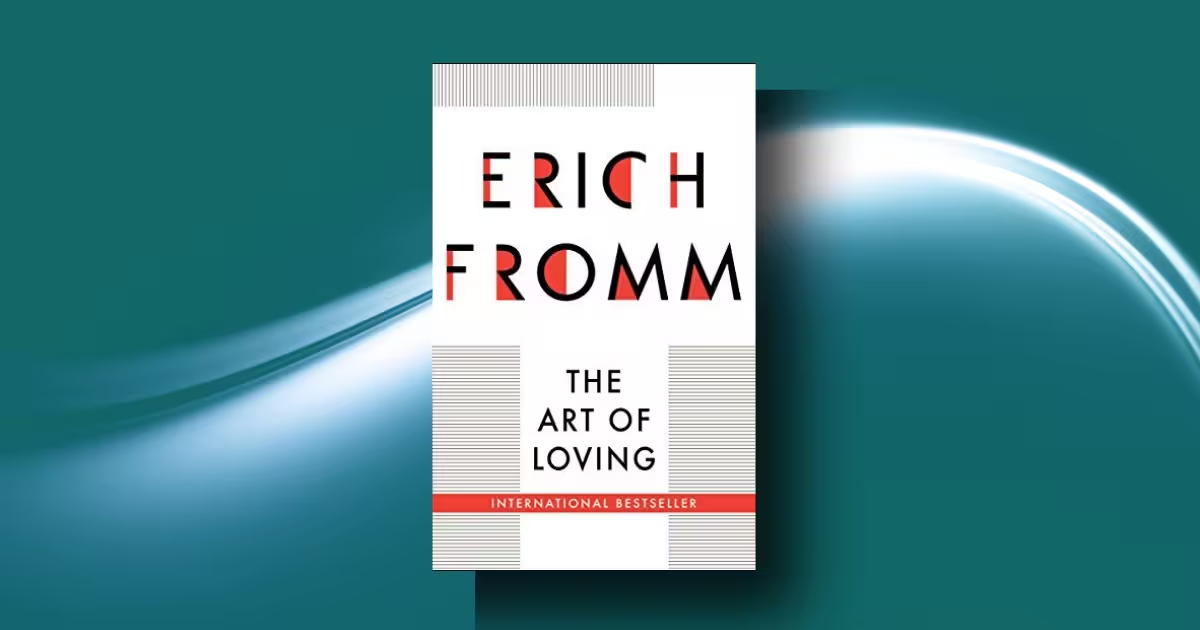
The Art of Loving, originally published in 1956 by Harper & Row, has since sold over 25 million copies worldwide and has been translated into more than 30 languages—yet its core message remains as countercultural today as it was nearly 70 years ago.
The Art of Loving is best for individuals who have ever felt that love is a mystery they never quite solved, despite years of trying. If you are someone who has devoured self-help books, attended relationship workshops, or found yourself repeatedly disappointed by the gap between romantic fantasy and lived reality, Fromm will feel like a wise, slightly stern grandfather who finally tells you the truth nobody else would.
Therapists, counselors, and anyone studying psychology will find this a foundational text.
Philosophy enthusiasts will appreciate its existential depth. And if you are a person of faith questioning what it means to love God in an age of commodified spirituality, Fromm’s chapter on the love of God alone is worth the price of admission.
Not for readers seeking quick fixes, bullet-pointed advice, or the kind of “10 Steps to a Happier Relationship” content that dominates Instagram. Fromm does not offer easy prescriptions.
He explicitly warns in the Foreword: “The reading of this book would be a disappointing experience for anyone who expects easy instruction in the art of loving.”
If you are unwilling to examine your own character structure, your relationship with your parents, and the way capitalism has shaped your most intimate desires, you will likely bounce off this book hard. It demands self-confrontation.
Table of Contents
1. Introduction
Title and Author Information: The Art of Loving was written by the German-born psychoanalyst and social philosopher Erich Fromm (1900–1980).
It was first published in 1956 as Volume IX of the World Perspectives series, edited by Ruth Nanda Anshen, and the Harper Colophon paperback edition followed in 1962. Fromm earned his Ph.D. from the University of Munich and trained at the Psychoanalytic Institute in Berlin before emigrating to the United States.
He was a member of the Frankfurt School of critical theory, alongside figures like Max Horkheimer and Herbert Marcuse, and his work consistently bridged psychoanalysis, sociology, and humanistic philosophy.
The Art of Loving is a slim, dense volume of 164 pages in its Colophon edition, divided into four chapters: “Is Love an Art?”, “The Theory of Love”, “Love and Its Disintegration in Contemporary Western Society”, and “The Practice of Love”. It is not, strictly speaking, a self-help book.
It belongs to the genre of humanistic psychoanalysis and social critique. Fromm’s earlier works—Escape from Freedom (1941), Man for Himself (1947), The Sane Society (1955)—had already established him as a thinker deeply concerned with the ways modern society alienates individuals from their own humanity. The Art of Loving extends this concern into the most intimate sphere of human existence.
Fromm’s central thesis is straightforward yet revolutionary: love is an art, not a sentiment. It requires knowledge and effort, just like the art of medicine or music. The vast majority of people, he argues, operate under the illusion that love is something you “fall into” if you are lucky—a pleasant sensation, a matter of chance.
This belief, he writes, is built on three erroneous premises: (1) that the problem of love is about being loved, not about one’s capacity to love; (2) that love is about finding the right object, not developing the right faculty; and (3) that the initial experience of “falling in love” is the same as the permanent state of “standing in love”.
Fromm’s entire book is an argument against these three fallacies and an exploration of what genuine, mature love actually requires.
2. Background
To understand The Art of Loving, one must understand the intellectual soil from which it grew.
Fromm was writing in the mid-1950s, a period of unprecedented economic expansion in the West, the consolidation of consumer capitalism, and the Cold War’s ideological freeze.
He had witnessed the rise of fascism in Europe, had fled Nazi Germany in 1934, and had seen how easily human beings could be seduced into authoritarian submission.
His earlier Escape from Freedom had explored how modern individuals, terrified by their own freedom and isolation, willingly surrender their autonomy to totalitarian systems. The Art of Loving can be read as a companion volume—an answer to that escape. If the problem is aloneness and the desperate, destructive attempts to overcome it, the solution, Fromm argues, is mature love.
The Art of Loving is deeply influenced by Fromm’s engagement with Marxist humanism and his critique of capitalist alienation.
He quotes Karl Marx directly in the text, notably the passage on love as a productive force: “If you love without calling forth love, that is, if your love as such does not produce love, if by means of an expression of life as a loving person you do not make of yourself a loved person, then your love is impotent, a misfortune.”
Fromm also draws on the Hebrew Bible, particularly the story of Jonah, which he uses to illustrate that “love and labor are inseparable,” and on the paradoxical logic of Eastern philosophy—Lao-tse, Chuang-tzu, and Meister Eckhart—to challenge the Aristotelian, binary thinking that dominates Western thought about love and God.
The Art of Loving was an international bestseller upon release.
By 1962, when the Colophon edition appeared, The Art of Loving had already been reprinted numerous times. Its popularity has never waned; a 2006 Harper Perennial Modern Classics edition introduced it to yet another generation.
The New York Times has described Fromm as “one of the most influential psychoanalysts of the 20th century,” and this book remains his most widely read work.
3. The Art of Loving Summary
What follows is a comprehensive walkthrough of The Art of Loving, organized according to Fromm’s own chapter structure.
I have included extensive direct quotations from the text, which I believe are essential for understanding the precision and depth of his argument. Consider this section a distillation of everything I learned from the book.
Chapter I: Is Love an Art?
Fromm opens with a direct challenge. “Is love an art?” he asks. “Then it requires knowledge and effort. Or is love a pleasant sensation, which to experience is a matter of chance, something one ‘falls into’ if one is lucky?” He immediately identifies the three fallacies that keep people from treating love as an art.
The first fallacy: most people are concerned with being loved, not with loving. In pursuit of lovability, men typically pursue success, power, and wealth; women cultivate attractiveness; and both sexes develop “pleasant manners, interesting conversation, to be helpful, modest, inoffensive.” Fromm’s diagnosis is devastating: “What most people in our culture mean by being lovable is essentially a mixture between being popular and having sex appeal.”
The second fallacy: love is about the object, not the faculty.
In the Victorian era, love was assumed to follow marriage, which was contracted by convention.
In the twentieth century, with the rise of “romantic love,” the focus shifted entirely to finding the right person. Fromm draws a striking parallel to capitalist consumption: “Our whole culture is based on the appetite for buying, on the idea of a mutually favorable exchange.”
He writes, with biting clarity: “Two persons thus fall in love when they feel they have found the best object available on the market, considering the limitations of their own exchange values.”
The third fallacy: confusing “falling in love” with “standing in love”. The initial collapse of barriers between two strangers is exhilarating—”one of the most exhilarating, most exciting experiences in life”—but it is by its nature not lasting. “They take the intensity of the infatuation, this being ‘crazy’ about each other, for proof of the intensity of their love, while it may only prove the degree of their preceding loneliness.”
Fromm then outlines the steps necessary for learning any art: mastery of the theory, mastery of the practice, and a supreme, ultimate concern for the art itself. “Could it be,” he asks, “that only those things are considered worthy of being learned with which one can earn money or prestige, and that love, which ‘only’ profits the soul, but is profitless in the modern sense, is a luxury we have no right to spend much energy on?”
Chapter II: The Theory of Love
This is the longest and most philosophically dense section of The Art of Loving, subdivided into three major parts.
1. Love, the Answer to the Problem of Human Existence
Fromm begins with a theory of man.
The essential fact of human existence is that we have emerged from nature, lost our instinctual harmony, and are now separate. “The awareness of his aloneness and separateness, of his helplessness before the forces of nature and of society, all this makes his separate, disunited existence an unbearable prison.”
This separateness, he argues, is the source of all anxiety. “The deepest need of man, then, is the need to overcome his separateness, to leave the prison of his aloneness.”
Throughout history, human beings have attempted to overcome this separateness in various ways.
The first is orgiastic states: trances induced by drugs, communal rituals, or sexual orgasm. These are intense, involve the whole person, but are transitory and periodical.
The second is conformity with the group: “If I am like everybody else, if I have no feelings or thoughts which make me different, if I conform in custom, dress, ideas, to the pattern of the group, I am saved; saved from the frightening experience of aloneness.”
Fromm notes that even in democracies, the pressure to conform is overwhelming—people “want to conform to a much higher degree than they are forced to conform.” The third way is creative activity, in which the worker unites with his material—but this is only true for productive, artisanal work, not for the modern assembly-line worker who becomes “an appendix to the machine.”
All of these are partial answers. The full answer, Fromm argues, lies in interpersonal union—in love. But not all unions are love. He distinguishes between symbiotic union and mature love.
Symbiotic union has a biological pattern in pregnancy: the mother and foetus are two and yet one. In its passive form, this is masochism—submission, making oneself part of another person who directs and protects. In its active form, it is sadism—incorporating another person, inflating oneself by dominating. Both are “fusion without integrity.”
Mature love, by contrast, is “union under the condition of preserving one’s integrity, one’s individuality. Love is an active power in man; a power which breaks through the walls which separate man from his fellow men, which unites him with others; love makes him overcome the sense of isolation and separateness, yet it permits him to be himself, to retain his integrity.”
This is a paradox: “two beings become one and yet remain two.”
Fromm then defines the active character of love. Drawing on Spinoza’s distinction between active and passive affects, he writes: “Love is an activity, not a passive affect; it is a ‘standing in,’ not a ‘falling for.'” And the most fundamental expression of this activity is giving.
Not giving in the sense of sacrifice or deprivation—”the marketing character is willing to give, but only in exchange for receiving”—but giving as the expression of one’s potency and aliveness. “In the very act of giving, I experience my strength, my wealth, my power.
This experience of heightened vitality and potency fills me with joy.” He quotes Marx’s magnificent formulation: “If you love without calling forth love, that is, if your love as such does not produce love, if by means of an expression of life as a loving person you do not make of yourself a loved person, then your love is impotent, a misfortune.”
Beyond giving, mature love has four essential elements: care, responsibility, respect, and knowledge.
Care is “the active concern for the life and the growth of that which we love”—illustrated by the story of Jonah, where God explains that “the essence of love is to ‘labor’ for something and ‘to make something grow.'” Responsibility is “my response to the needs, expressed or unexpressed, of another human being.”
Respect (from the Latin respicere, “to look at”) is “the ability to see a person as he is, to be aware of his unique individuality.” Knowledge is the penetration to the core—not the sadistic desire to force secrets through power, but the loving knowledge that comes through union. “Love is the only way of knowledge, which in the act of union answers my quest.
In the act of loving, of giving myself, in the act of penetrating the other person, I find myself, I discover myself, I discover us both, I discover man.”
2. Love Between Parent and Child
Fromm traces the development of love from infancy.
The infant experiences mother’s love as unconditional: “I am loved because I am. . . . There is nothing I have to do in order to be loved—mother’s love is unconditional.” This is bliss, but it also cannot be controlled or produced. The negative side is: “If it is there, it is like a blessing; if it is not there, it is as if all beauty had gone out of life—and there is nothing I can do to create it.”
Around the age of eight to ten, the child begins to love—to produce love through activity.
The transition is from “I love because I am loved” (infantile love) to “I am loved because I love” (mature love). Fromm’s famous formulation: “Immature love says: ‘I love you because I need you.’ Mature love says: ‘I need you because I love you.'”
He then contrasts motherly love and fatherly love. Motherly love is unconditional, all-enveloping, and based on equality—”all men are equal, because they all are children of a mother.” Fatherly love is conditional: “I love you because you fulfill my expectations, because you do your duty, because you are like me.” T
he positive side of fatherly love is that it can be earned; its negative side is that it can be lost. Obedience becomes the main virtue, disobedience the main sin.
The mature person, Fromm argues, has internalized both principles. “He has, as it were, a motherly and a fatherly conscience. Motherly conscience says: ‘There is no misdeed, no crime which could deprive you of my love.’ Fatherly conscience says: ‘You did wrong, you cannot avoid accepting certain consequences of your wrongdoing.'”
Neurosis results when one principle dominates—the mother-centered man remains dependent, helpless, seeking a mother figure in all relationships; the father-centered man becomes rigid, authoritarian, incapable of unconditional love.
3. The Objects of Love
Fromm argues that love is not primarily a relationship to a specific person—it is an attitude, an orientation of character. “If I truly love one person I love all persons, I love the world, I love life. If I can say to somebody else, ‘I love you,’ I must be able to say, ‘I love in you everybody, I love through you the world, I love in you also myself.'”
He then examines the different types:
Brotherly Love: The most fundamental kind, underlying all others. It is love for all human beings, characterized by its lack of exclusiveness. “In brotherly love there is the experience of union with all men, of human solidarity, of human at-onement.” Significantly, it begins with love for the helpless—the poor, the stranger, the widow, the orphan. “Only in the love of those who do not serve a purpose, love begins to unfold.”
Motherly Love: This has two aspects—care and responsibility for the child’s survival, and the instilling of a love for life.
Fromm uses the Biblical imagery of milk and honey: “Milk is the symbol of the first aspect of love, that of care and affirmation. Honey symbolizes the sweetness of life, the love for it and the happiness in being alive.”
Most mothers can give milk; only a minority can give honey, because to do so requires that the mother herself be a happy person.
The true test of motherly love, however, is the willingness to let the child separate. “The very essence of motherly love is to care for the child’s growth, and that means to want the child’s separation from herself. . . . Only the really loving woman, the woman who is happier in giving than in taking, who is firmly rooted in her own existence, can be a loving mother when the child is in the process of separation.”
Erotic Love: This is the craving for complete fusion with one other person. It is exclusive, but only in the sense of erotic fusion, not in the sense of deep brotherly love.
Fromm sharply critiques the common confusion of erotic love with the initial experience of falling in love, and with sexual desire. “Sexual desire can be stimulated by the anxiety of aloneness, by the wish to conquer or be conquered, by vanity, by the wish to hurt and even to destroy, as much as it can be stimulated by love.”
Erotic love also requires an act of will: “To love somebody is not just a strong feeling—it is a decision, it is a judgment, it is a promise.”
Self-Love: Fromm dismantles the Calvinist and Freudian assumption that self-love is sinful or narcissistic.
Drawing on Meister Eckhart, he argues: “If you love yourself, you love everybody else as you do yourself. . . . Thus he is a great and righteous person who, loving himself, loves all others equally.”
The selfish person, far from loving himself too much, actually hates himself. “Selfishness and self-love, far from being identical, are actually opposites.”
The “unselfish” person, the one who lives only for others, is often a neurotic case: “he is paralyzed in his capacity to love or to enjoy anything; he is pervaded by hostility toward life.”
Love of God: Fromm traces the evolution of religion from matriarchal (mother-centered, unconditional love, equality of all children) to patriarchal (father-centered, conditional love, hierarchy, and competition).
He then describes the evolution within patriarchal religion from a despotic, jealous God to a nameless, abstract principle of truth, justice, and love.
At the highest stage, love of God becomes identical with the striving for love and justice in oneself.
He introduces the crucial distinction between Aristotelian logic (Western, based on identity and non-contradiction) and paradoxical logic (Eastern, where A and non-A do not exclude each other).
The former leads to dogma and science; the latter to tolerance and the emphasis on right action over right thought. “From the standpoint of paradoxical logic the emphasis is not on thought, but on the act.” This, he argues, is the essence of the mystic’s union with God.
Chapter III: Love and Its Disintegration in Contemporary Western Society
This chapter is Fromm at his most socially critical. He argues that modern capitalism produces a character structure fundamentally hostile to love. “Automatons cannot love; they can exchange their ‘personality packages’ and hope for a fair bargain.”
Modern man has become alienated from himself, from his fellow men, and from nature. He has been “transformed into a commodity, experiences his life forces as an investment which must bring him the maximum profit obtainable under existing market conditions.” The result is a series of pseudo-loves:
The “team” concept of marriage: Two people forming “an alliance of two against the world, and this egoism a deux is mistaken for love and intimacy.”
The idea that sexual satisfaction produces love: “Love is not the result of adequate sexual satisfaction, but sexual happiness—even the knowledge of the so-called sexual technique—is the result of love.” Fromm criticizes Freud for seeing love as essentially a sexual phenomenon and for failing to distinguish between mature and irrational love.
Neurotic pseudo-loves: These include idolatrous love (projecting one’s own powers onto the loved one, then inevitably being disappointed), sentimental love (experiencing love only in fantasy—in movies, songs, or memories of the past), and the use of projective mechanisms (focusing on the partner’s flaws to avoid one’s own).
The avoidance of conflict: “Love is possible only if two persons communicate with each other from the center of their existence. . . . Real conflicts between two people . . . are not destructive. They lead to clarification, they produce a catharsis from which both persons emerge with more knowledge and more strength.”
Fromm also addresses the disintegration of the love of God. Modern man “is rather like a child of three, who cries for father when he needs him, and otherwise is quite self-sufficient when he can play.”
He critiques the best-selling religious literature of his time (he cites Norman Vincent Peale’s The Power of Positive Thinking, published in 1952, which sold over 5 million copies) for reducing God to a business partner: “‘Make God your partner’ means to make God a partner in business, rather than to become one with Him in love, justice and truth.”
Chapter IV: The Practice of Love
Here Fromm is cautious. He will not offer prescriptions. “To love is a personal experience which everyone can only have by and for himself.” But he can discuss the premises and approaches.
The practice of any art requires discipline, concentration, patience, and a supreme concern for mastery.
Modern society, however, makes concentration nearly impossible. “Our culture leads to an unconcentrated and diffused mode of life, hardly paralleled anywhere else. You do many things at once; you read, listen to the radio, talk, smoke, eat, drink. You are the consumer with the open mouth, eager and ready to swallow everything.”
How to practice concentration: Fromm suggests learning to be alone. “To be able to concentrate means to be able to be alone with oneself—and this ability is precisely a condition for the ability to love.”
He recommends a simple meditation exercise: sit in a relaxed position, close your eyes, try to see a white screen, follow your breathing, and have a sense of “I” as the center of your powers.
Do this for twenty minutes in the morning and evening. He also insists on avoiding trivial conversation: “If two people talk about the growth of a tree they both know, or about the taste of the bread they have just eaten together, . . . such conversation can be relevant, provided they experience what they are talking about.”
The specifically necessary qualities for love are: overcoming narcissism, developing objectivity and humility, and practicing faith. Faith, Fromm distinguishes, can be irrational (submission to authority) or rational (conviction rooted in one’s own experience of thought and feeling).
Rational faith in a person means being certain of the reliability of their fundamental attitudes. “Only the person who has faith in himself is able to be faithful to others.”
Faith also means having faith in the potentialities of others—as a mother has faith that her baby will walk and talk, so we must have faith that the human potential for love, reason, and justice can develop given the right conditions.
Finally, Fromm addresses the apparent incompatibility between love and “normal” life under capitalism.
He acknowledges the tension but refuses the cynical conclusion that only a martyr can love. While the principle of capitalism and the principle of love are incompatible, “a salesman of a useless commodity, for instance, cannot function economically without lying; a skilled worker, a chemist, or a physician can.”
He ends with a call for social transformation: “If it is true, as I have tried to show, that love is the only sane and satisfactory answer to the problem of human existence, then any society which excludes, relatively, the development of love, must in the long run perish of its own contradiction with the basic necessities of human nature.”
4. Critical Analysis
The Art of Loving is, quite simply, one of the most important books I have ever read. It is not an exaggeration to say that it fundamentally reorganized my understanding of what it means to be a human being in relation to others.
What makes it so powerful is its refusal to separate love from the total structure of a person’s character and from the social conditions in which that character is formed. This is not a book about “relationships”; it is a book about being—about the kind of self one must cultivate in order to be capable of love at all.
Fromm’s integration of psychoanalysis, Marxist social critique, and humanistic philosophy is masterful.
His critique of Freud is particularly sharp and, I believe, largely correct: Freud made the crucial discovery of interpersonal passions, but then explained them purely physiologically, thereby missing the existential and social dimensions.
Fromm’s reading of the story of Jonah, his analysis of the shift from matriarchal to patriarchal religion, his use of the “milk and honey” metaphor, and his exposition of paradoxical versus Aristotelian logic—all of these are intellectually thrilling and spiritually nourishing.
The Art of Loving’s central distinction between “falling in love” and “standing in love” is, on its own, worth the entire price of admission.
I have returned to this idea again and again, especially in moments when the initial intensity of a connection has faded and the real work of love has begun. Fromm’s insistence that love is an activity, not a passive state of being affected, is a life-changing reframe.
5. Strengths and Weaknesses
Strengths: The first and most obvious strength is The Art of Loving’s philosophical depth. Fromm does not pander; he treats his reader as a serious thinker. His synthesis of East and West—Spinoza alongside Lao-tse, Eckhart alongside Marx—creates a genuinely universal vision of love.
The chapter on the objects of love, especially the sections on self-love and the love of God, addresses confusions that plague millions of people.
His critique of commodified love is, if anything, more relevant in 2026 than it was in 1956. In an age of dating apps, social media performance, and the relentless optimization of the self for market value, Fromm’s warning about treating people as “personality packages” feels prophetic.
According to a 2023 Pew Research Center survey, nearly half of American adults say dating has become harder in the last decade, and the sense of love as a transaction—swiping, matching, exchanging—is a significant factor.
Another strength is the book’s compactness. At roughly 160 pages, it is extraordinarily dense with insight. Every paragraph earns its place. There is no filler, no repetition, no commercial padding.
Weaknesses: Fromm’s prose, while lucid, can occasionally feel dated.
He uses the masculine pronoun as universal, which modern readers may find jarring, and his discussion of the masculine and feminine principles—while he is careful to note that both exist in each individual—can feel essentialist by contemporary standards. “The masculine character can be defined as having the qualities of penetration, guidance, activity, discipline and adventurousness; the feminine character by the qualities of productive receptiveness, protection, realism, endurance, motherliness.”
In 2026, we are more alert to the ways such categorizations can reinforce restrictive gender norms, even if Fromm’s intention is to describe psychological poles rather than prescribe social roles.
Additionally, Fromm’s practical advice in the final chapter, while profound in spirit, is sparse.
The meditation exercises, the call to avoid trivial conversation, the emphasis on discipline and patience—these are valuable, but they are not a systematic “practice” in the way that, say, mindfulness-based stress reduction or dialectical behavior therapy offer structured protocols.
Some readers will finish the book feeling deeply inspired but also at a loss for concrete next steps. Fromm would likely respond that the next steps must come from within the reader’s own productive activity—but the desire for more guidance is understandable.
Finally, Fromm’s social critique, while incisive, sometimes overstates the uniformity of modern capitalist society. He writes in 1956, at the height of the “organization man” era, and his portrait of the modern automaton can feel totalizing.
There is arguably more room for resistance, subculture, and alternative modes of living than he acknowledges.
7. Comparison with Similar Works
The Art of Loving is often compared to two other mid-century classics: C.S. Lewis’s The Four Loves (1960) and Paul Tillich’s Love, Power, and Justice (1954).
Lewis’s book, drawing on Greek categories—storge, philia, eros, agape—is warmer, more literary, and rooted in Christian theology.
Fromm is the psychoanalyst and social critic; his categories are psychological and developmental rather than traditional. Both are valuable, but Fromm’s work has the edge in its analysis of social pathology.
A more recent comparison is bell hooks’s All About Love: New Visions (2000). hooks explicitly cites Fromm as an influence and adopts his definition of love as “the will to extend one’s self for the purpose of nurturing one’s own or another’s spiritual growth.” hooks’s book is more accessible, more personal, and more attentive to race, gender, and the specifics of American culture.
Where Fromm writes from the perspective of a European intellectual steeped in Talmudic and Marxist traditions, hooks writes as a Black feminist engaged with popular culture and lived experience.
I would recommend reading both: Fromm for the theoretical foundation, hooks for the application.
Alain de Botton’s The Course of Love (2016) is a more recent fictionalized exploration of similar themes—the idea that love is a skill, that romanticism has done enormous damage, that the real work begins after the initial infatuation.
De Botton’s book is more novelistic and emotionally tender; Fromm’s is more rigorous and philosophically ambitious.
8. The Art of Loving Quotes
- “Is love an art? Then it requires knowledge and effort. Or is love a pleasant sensation, which to experience is a matter of chance, something one ‘falls into’ if one is lucky?”
— Page 13 (Chapter I: Is Love an Art?)
- “Love is an activity, not a passive affect; it is a ‘standing in,’ not a ‘falling for.’”
— Page 22 (Chapter II: The Theory of Love – Love, the Answer to the Problem of Human Existence)
- “Immature love says: ‘I love you because I need you.’ Mature love says: ‘I need you because I love you.’” — Page 41 (Chapter II: Love Between Parent and Child)
- “Love is primarily giving, not receiving.”
— Page 22 (Chapter II: Love, the Answer…)
- “Giving is the highest expression of potency. In the very act of giving, I experience my strength, my wealth, my power. This experience of heightened vitality and potency fills me with joy.”
— Page 23 (Chapter II: Love, the Answer…)
- “If a person loves only one other person and is indifferent to the rest of his fellow men, his love is not love but a symbiotic attachment, or an enlarged egotism.”
— Page 46 (Chapter II: The Objects of Love)
- “If I truly love one person I love all persons, I love the world, I love life. If I can say to somebody else, ‘I love you,’ I must be able to say, ‘I love in you everybody, I love through you the world, I love in you also myself.’”
— Page 46 (Chapter II: The Objects of Love)
- “Paradoxically, the ability to be alone is the condition for the ability to love.”
— Page 112 (Chapter IV: The Practice of Love)
- “To love means to commit oneself without guarantee, to give oneself completely in the hope that our love will produce love in the loved person.” — Page 127 (Chapter IV: The Practice of Love)
- “Love is an act of faith, and whoever is of little faith is also of little love.”
— Page 128 (Chapter IV: The Practice of Love)
- “Selfishness and self-love, far from being identical, are actually opposites.”
— Page 60 (Chapter II: The Objects of Love – Self-Love)
- “Care, responsibility, respect and knowledge are mutually interdependent. They are a syndrome of attitudes which are to be found in the mature person.”
— Page 32 (Chapter II: Love, the Answer…)
- “There is only one proof for the presence of love: the depth of the relationship, and the aliveness and strength in each person concerned; this is the fruit by which love is recognized.”
— Page 103 (Chapter III: Love and Its Disintegration in Contemporary Western Society)
- “Love is not a sentiment which can be easily indulged in by anyone, regardless of the level of maturity reached by him.”
— Page 9 (Foreword)
- “If love were only a feeling, there would be no basis for the promise to love each other forever.” — Page 56 (Chapter II: The Objects of Love – Erotic Love)
- “Modern man has transformed himself into a commodity; he experiences his life energy as an investment with which he should make the highest profit.”
— Page 105 (Chapter III: Love and Its Disintegration…)
- “Automatons cannot love; they can exchange their ‘personality packages’ and hope for a fair bargain.”
— Page 87 (Chapter III: Love and Its Disintegration…)
- “Love is possible only if two persons communicate with each other from the center of their existence.”
— Page 103 (Chapter III: Love and Its Disintegration…)
- “Mother’s love is unconditional… Father’s love is conditional.” (archetypal summary) — Pages 41–43 (Chapter II: Love Between Parent and Child)
- “The deepest need of man, then, is the need to overcome his separateness, to leave the prison of his aloneness.”
— Page 9 (Chapter II: Love, the Answer…)
9. Conclusion
I recommend The Art of Loving without reservation to anyone who has ever felt that modern life is hollowing out the possibility of genuine connection—which is to say, to nearly everyone.
It is especially suited to readers who are willing to be challenged, who are not looking for simple answers, and who understand that the question of how to love cannot be separated from the question of how to live.
The Art of Loving is not easy. It will ask you to examine your childhood, your relationship with your parents, your values, your work, your faith, your narcissism, and your deepest fears of aloneness.
But it will also, if you let it, offer you a vision of love as something far more solid, more active, and more real than the fleeting emotions we typically mistake for it. “There is only one proof for the presence of love,”
Fromm writes: “the depth of the relationship, and the aliveness and strength in each person concerned; this is the fruit by which love is recognized.”
In the end, The Art of Loving is not about love as we usually imagine it. It is about the kind of human being one must become in order to be capable of love at all. In 2026, in a world of algorithmic desire and digital isolation, that message has never been more urgent.
If you read only one book on love in your lifetime, make it this one.
Related reading: The Pathology of Normalcy Proves Normal Can Be Sick, and Offers a Cure