
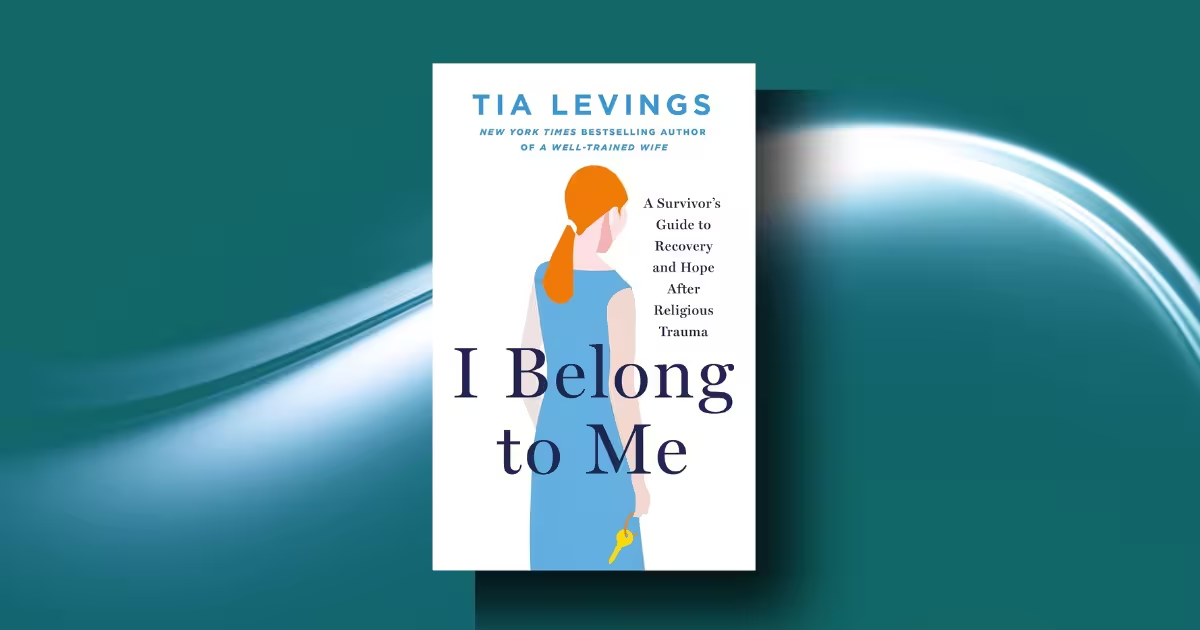

Do you ever wonder what remains of you after faith, family, marriage, and community have all told you who you must be? Tia Levings’ I Belong to Me is the kind of book that does not simply explain religious trauma—it gives language, warmth, and moral courage to people trying to return to themselves.
I Belong to Me is best for readers healing from religious trauma, ex-evangelicals, survivors of Christian patriarchy, people recovering from coercive control, readers interested in deconstruction, trauma recovery, purity culture, cult dynamics, feminist memoir, and self-help rooted in lived experience.
Not for readers who want a neutral academic textbook, a theological defense of organized religion, or a purely chronological memoir. This is more guide than courtroom transcript, more recovery map than exposé.
Table of Contents
1. Introduction: What Is I Belong to Me by Tia Levings?
I Belong to Me: A Survivor’s Guide to Recovery and Hope after Religious Trauma is a nonfiction self-help and recovery book by Tia Levings, published by St. Martin’s Essentials / St. Martin’s Publishing Group. Official Macmillan listings give an on-sale date of May 5, 2026.
Tia Levings is introduced by Macmillan as the New York Times bestselling author of A Well-Trained Wife. Her work focuses on religious trauma, Christian fundamentalism, and patriarchal control; Macmillan also notes that she appeared in the Amazon docuseries Shiny Happy People.
The subtitle tells us almost everything: this is “A Survivor’s Guide to Recovery and Hope After Religious Trauma.” It is not merely a sequel to A Well-Trained Wife; it is the “what happens after escape?” book. The premise clearly: after years of abuse in a violent marriage and high-control religion, Levings escaped with her children, but “leaving was just the beginning.”
From the uploaded PDF, the book’s emotional and intellectual purpose is explicit.
Levings writes that the book exists because it was what she needed when she was trying to put herself back together and did not know who “myself” was. She says the goal is to answer questions like: how do you heal, whom do you trust, can you ever have a spiritual practice again, what about scars, holidays, relationships, and fear?
My immediate feeling as a reader is this: I Belong to Me is not a quiet book. It is tender, yes, but it is also confrontational in the best sense.
It confronts the lie that suffering makes a person holy, the lie that women must disappear to be loved, and the lie that leaving a harmful religious environment means losing all belonging.
2. Background: Religious Trauma, Deconstruction, and Why This Book Matters Now
The background of I Belong to Me is not only Levings’ private life. It is also a larger American religious and political landscape in which many people are questioning inherited faith systems, gender roles, purity culture, and church authority.
Pew Research Center’s 2023–24 Religious Landscape Study reports that 62% of U.S. adults identify as Christian, while 29% are religiously unaffiliated, including atheists, agnostics, and people who identify as “nothing in particular.” Pew also notes that the unaffiliated share is much higher than in 2007, when it was 16%.
That matters because Levings is writing directly into a culture where many readers are not necessarily “anti-religion,” but are asking harder questions about authority, harm, belonging, and spiritual coercion.
In the book, she defines deconstruction not as rebellion for its own sake, but as the process of questioning beliefs, identifying their roots and outcomes, and asking whether you agree with them.
The book also overlaps with domestic violence research. The CDC defines intimate partner violence as abuse or aggression in a romantic relationship, including physical violence, sexual violence, stalking, and psychological aggression.
The CDC also reports that more than 1 in 3 women and more than 1 in 6 men in the U.S. have experienced contact sexual violence, physical violence, and/or stalking by an intimate partner during their lifetimes.
That external data gives Levings’ story a wider frame. I Belong to Me is personal, but it is not merely personal. It is part of a broader conversation about religious trauma, spiritual abuse, coercive control, Christian patriarchy, tradwife ideology, deconstruction, and trauma recovery.
3. I Belong to Me Summary: What the Book Is Really About
At its core, I Belong to Me is about returning ownership of the self to the person who was taught that the self was sinful, selfish, dangerous, or subordinate.
Levings begins by linking sensory memory with religious trauma. A tomato is not just a tomato; red becomes the color of church pews, Christ’s blood, Southern Baptist memory, and bodily panic.
This is one of the book’s most effective early moves. It shows that religious trauma is not only intellectual disagreement with doctrine.
It can live in the body as association, flashback, dread, and grief. She writes that ordinary triggers are everywhere: hymns, Scripture, Easter, public prayer, crosses with flags, scandals in churches, and even tradwife fashion.
The book’s early thesis is sharp: religious comfort and religious trauma can become fused.
For many people, faith is where they go for consolation. But for survivors of spiritual abuse, the same symbols, words, songs, and authorities may be the source of terror. That is why the question “What can you do when your faith is the source of what hurts you?” becomes one of the book’s central questions.
Levings then places herself inside the book not as a guru, but as a fellow survivor. She says she is not a doctor, credentialed therapist, or coach; she calls the book a layperson’s survivor guide and “a cup of coffee with a sister.”
This matters because the tone is intimate rather than clinical. Sometimes the book reads like memoir, sometimes like therapy homework, sometimes like a glossary, and sometimes like a hand on the shoulder.
The main framework: mantras as recovery architecture
The book is structured around short declarative mantras. The uploaded PDF lists them, including: “I am not alone,” “The cycle ends with me,” “I am home base,” “My fear is information,” “My body and voice are my own,” “I speak bravely,” “I am writing a new story,” and “I let my light shine.”
These mantras are not decorative. They are the book’s recovery architecture. Each one names a specific wound caused by high-control religion and then offers a counter-practice.
Where the old system said: obey, submit, silence yourself, distrust your body, fear your own desires, and stay in the role assigned to you—Levings says: notice, name, grieve, regulate, speak, choose, and return.
Solidarity: “I am not alone”
The first major movement is solidarity.
Levings attacks one of the cruelest lies of high-control religion: that outside the group, you will be alone, unsafe, damned, or ruined. In the book’s coffee-shop framing, she tells the reader that there are “thousands, if not millions” of survivors outside.
This is not motivational fluff. For survivors of religious trauma, loneliness is often weaponized.
Churches, families, and controlling spouses may imply that leaving means losing community, moral identity, and spiritual safety.
Levings reframes leaving as the beginning of a different kind of belonging: not belonging to a doctrine, husband, pastor, or group, but belonging first to oneself.
Religious trauma as a developmental wound
One of the strongest parts of the book is its insistence that religious trauma can interfere with identity formation.
Levings describes growing up in church environments where development was replaced by indoctrination.
She learned that her life’s acceptable outcome was maternal service, that she could not say no to God or a man, and that her body belonged to others—husband, children, congregation, community.
This is where I Belong to Me becomes more than a personal recovery book. It becomes a critique of Christian patriarchy as a system of body ownership.
The title itself is therefore radical. “I belong to me” is a direct answer to doctrines and practices that treated women’s bodies, voices, labor, sexuality, and obedience as religious property.
The memoir underneath the guide
Levings briefly summarizes the life story told more fully in A Well-Trained Wife.
She grew up within Southern Baptist and later more fundamentalist Christian contexts, married young, endured church-sanctioned domestic abuse, became involved in patriarchal and quiverfull-adjacent expectations, and escaped with her children in 2007 after escalating violence.
The book states that during thirteen years of marriage, she was pregnant nine times, had five live births, and four surviving children.
This background is crucial because I Belong to Me is not written from theory alone. It is written from the aftermath of escape.
In her timeline, Levings notes that she escaped domestic violence on Halloween 2007, was divorced in 2008, gained full custody in 2009 and again in 2016, began trauma therapy in 2011, started deconstructing in 2016, began somatic and Internal Family Systems therapy in 2021, filmed Shiny Happy People in 2022, and published A Well-Trained Wife as an instant New York Times bestseller in 2024.
This timeline gives the book its authority: healing is not presented as a weekend breakthrough. It is a long, uneven, embodied process.
Audacity: “The cycle ends with me”
The second major idea is audacity.
Levings argues that many survivors minimize their own pain because religious cultures train them to compare all suffering to Christ’s suffering.
She calls this a form of spiritual bypassing: using spiritual beliefs to avoid unresolved emotional wounds.
This section is one of the most important in the book because it exposes the holiness of endurance as a trap. If suffering is always noble, then naming harm can be framed as selfishness. If silence is obedience, then testimony becomes rebellion. Levings pushes back by saying that pain is reason enough to seek relief.
Her line—“Trauma took my past. It doesn’t get my present and future, too.”—is one of the book’s defining phrases. It captures the transition from survival to agency.
Centrality: “I am home base”
Another major argument is that survivors must move from an external locus of control to an internal guidance system.
Levings uses the memory of being “lost” in the woods as a child to complicate what “lost” means. Adults said she was lost because they could not find her; from inside her own experience, she did not feel lost.
That distinction becomes a metaphor for religious recovery. A church may say you are lost if you leave. A family may say you are lost if you no longer obey. But Levings asks: lost according to whom?
This is one of the book’s most beautiful ideas: being “lost” may sometimes mean only that you are no longer visible to the system that controlled you.
Trauma, shock, and the body
The book also gives practical language for trauma.
Levings defines religious trauma as trauma that overwhelms the nervous system and threatens health and safety in a religious context.
She emphasizes that trauma is not only what happened but how the body interpreted and stored what happened.
The chapters on shock are especially useful. Levings explains that people in psychological shock may look fine while being profoundly disoriented. She describes making decisions in shock after escape, including choices she later regretted, and argues that people need safety, warmth, fluids, and supervision after trauma.
For me, this is where the book becomes deeply educational. It helps readers stop asking, “Why didn’t I act perfectly?” and start asking, “What state was my nervous system in when I had to act?”
Complicity, shame, and responsibility
Levings does not let survivors remain in a simplified innocence narrative. She discusses complicity with unusual care.
Complicity is painful in religious trauma because participation is often required: memorizing, reciting, obeying, teaching, policing oneself, and sometimes policing others.
The book’s strength here is balance. Levings refuses both extremes: “It’s all my fault” and “None of it is my responsibility.” She frames accountability as asking, “What part of this is mine?”
That is emotionally mature writing. It is not the internet’s usual language of perfect victims and perfect villains. It allows survivors to grieve harm, name systems, and still grow into ethical responsibility.
4. I Belong to Me Analysis: Does the Book Fulfill Its Purpose?
Yes—mostly, and often powerfully.
I Belong to Me succeeds because it understands that religious trauma recovery is not simply about changing beliefs. It is about the body, voice, nervous system, sexuality, family line, parenting, memory, grief, and language.
The book’s strongest intellectual contribution is its merging of memoir, trauma education, religious deconstruction, and practical recovery tools. Levings does not only say, “I was harmed.”
She asks: What did harm do to my body? What did it do to my children? What did it do to my ability to speak? What did it do to my sexuality? What did it do to my sense of time, memory, shame, and belonging?
The book’s strongest emotional contribution is its tone. It is not coldly diagnostic. It is intimate, direct, and often maternal without being patronizing. Levings knows the reader may be exhausted, ashamed, dissociated, angry, or afraid. The prose makes room for that.
The book answers several high-intent questions:
What is religious trauma?
Religious trauma is trauma connected to religious beliefs, practices, authorities, or communities that overwhelm the nervous system and harm physical, emotional, mental, sexual, or spiritual safety.
What is I Belong to Me about?
It is about healing after religious trauma, especially after high-control religion and Christian patriarchy have damaged a person’s identity, body, autonomy, and belonging.
Is I Belong to Me a memoir or self-help book?
It is both, but it leans more toward a survivor’s recovery guide. Goodreads and NetGalley reviewers also describe it as more therapeutic and self-help-oriented than A Well-Trained Wife.
Do I need to read A Well-Trained Wife first?
Not strictly, but it helps. I Belong to Me gives enough context to understand Levings’ recovery, but the fuller escape story belongs to A Well-Trained Wife.
My personal verdict: I Belong to Me is poignant, brave, and necessary. It is not merely a book about leaving religion. It is a book about what happens when someone who was trained to disappear begins to become visible to herself.
5. Strengths and Weaknesses
Strengths
The first strength is language.
Levings gives names to experiences many readers may have felt but never articulated: spiritual bypassing, religious trauma, fawning, shock, aftermath, complicity, centrality, and reclamation.
This naming matters because unnamed pain often turns into shame.
The second strength is embodiment. Many books about deconstruction remain trapped in doctrine: Was this belief true?
Was that pastor wrong? Levings goes deeper. She asks how belief was stored in the body—through voice, sexuality, fear, obedience, dissociation, panic, and chronic regulation problems.
The third strength is survivor solidarity without guru culture. Levings repeatedly positions herself as a fellow traveler, not a replacement authority. In a field where wounded people can easily move from one high-control system to another, that refusal to become a guru is ethically important.
The fourth strength is feminist clarity. The book understands that Christian patriarchy is not just a private theological preference. In Levings’ account, it shaped marriage, sex, reproduction, money, education, speech, parenting, and safety.
The fifth strength is timeliness.
The resurgence of tradwife aesthetics, Christian nationalism, and debates about gender roles makes this book culturally relevant beyond the memoir shelf.
Weaknesses
The first possible weakness is density. The book contains many mantras, therapeutic concepts, personal stories, side reflections, and recovery tools. Some readers may feel overwhelmed by the abundance of frameworks.
The second weakness is that readers wanting a full narrative of Levings’ marriage and escape may need A Well-Trained Wife. I Belong to Me revisits that material, but its main purpose is recovery, not a full retelling.
The third weakness is that the book is not a clinical manual. Levings is transparent that she is not a doctor or therapist.
For many readers, that honesty will be a strength; for readers seeking peer-reviewed clinical guidance, it means the book should be read alongside professional support.
The fourth weakness is that readers who still identify strongly with evangelical Christianity may feel defensive. Levings does not attack every believer, but she does scrutinize systems, doctrines, and cultures that protected abuse. That distinction may be difficult for some readers.
6. Comparison with Similar Works
Compared with A Well-Trained Wife, I Belong to Me is less about escape and more about recovery. The first book answers, “What happened?” The second asks, “How do I live after what happened?”
Compared with Amanda Montell’s Cultish, which your site has already covered, Levings is less focused on linguistics and more focused on trauma recovery. Still, both books show how language shapes obedience, belonging, and identity.
Compared with Glennon Doyle’s Untamed, Levings is more trauma-specific and more directly concerned with religious abuse. Both books share the theme of women reclaiming selfhood, but Levings’ book is darker, more clinical, and more rooted in high-control religion.
Compared with Joan Didion’s grief writing, which Levings references in her book list, I Belong to Me shares the belief that aftermath has its own geography. But Levings is more instructional; she wants to help readers find tools, not only witness the wound.
7. Conclusion: Should You Read I Belong to Me?
Yes—especially if you have ever felt that your faith community gave you love with one hand and fear with the other.
I Belong to Me is best for readers who are healing from religious trauma, recovering from spiritual abuse, questioning evangelicalism, leaving Christian patriarchy, or trying to understand why their body still reacts to songs, sermons, holidays, Bible verses, or family language long after they have intellectually moved on.
It is also valuable for therapists, partners, friends, and adult children of survivors who want to understand why “just move on” is such an inadequate response to religious trauma.
My recommendation is strong, but with a caution: read it slowly. This is not a book to rush through for content. It is a book to sit with, especially if the subject touches your own history.
The title is the thesis, the mantra, and the destination: I belong to me.
For a survivor of high-control religion, that sentence is not selfish. It is revolutionary.