
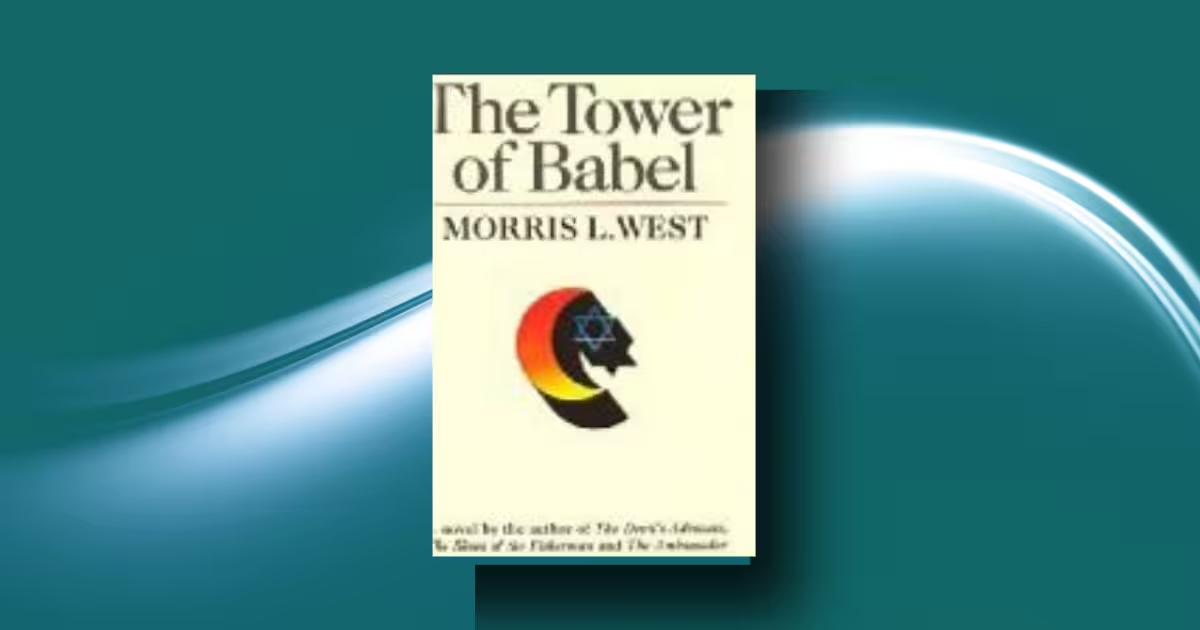
Do you ever grapple with the chilling reality that the political machinations of a select few can effortlessly dictate the life or death of millions? Morris L. West’s geopolitical masterpiece The Tower of Babel plunges directly into this terrifying calculus, offering a narrative that resonates deeply with our modern anxieties about power, identity, and survival.
The Tower of Babel brilliantly exposes how the intertwining of personal loyalties, fanatical ambition, and ethnic hatred creates a precarious modern “Tower of Babel,” where communication inevitably fails and destruction becomes the only shared language.
The Tower of Babel is best for readers who crave dense, politically astute espionage thrillers grounded in complex historical realities, and those who appreciate profound character studies over non-stop action.
Not for those seeking light, fast-paced spy capers or readers looking for simple, black-and-white moral certainties.
Table of Contents
1. Introduction
- Title: The Tower of Babel
- Author: Morris L. West
- Publication Year: 1968
- Genre: Political Thriller / Historical Fiction
2. Background
Set in late 1966, mere months before the historical eruption of the Six-Day War, The Tower of Babel captures the Middle East at a boiling point of multi-factional strife.
The narrative navigates the volatile borders of Israel, Syria, Jordan, and Lebanon. It explores a deeply fractured world plagued by cold-war proxy battles, the Palestinian refugee crisis, pan-Arab nationalism, and the fragile survival of the Jewish state.
West captures a landscape where every nation, and nearly every character, speaks a different ideological language, leading to an inevitable and catastrophic collapse of understanding.
3. The Tower of Babel Summary
The Tower of Babel weaves together five distinct but colliding narrative threads, each anchored by a key player in the geopolitical chess match of the Middle East.
The Spark of Conflict
The narrative ignites with a violent border incident in the demilitarized zone near the Sea of Galilee.
An Israeli tractor driver, Yigael, is killed by a Syrian-laid landmine at Sha’ar Hagolan. In Tel Aviv, Brigadier-General Jakov Baratz, the Director of Israeli Military Intelligence, receives the report. Baratz is a pragmatic, burdened man, balancing the defense of a nation against profound personal tragedy; his wife, Hannah, is confined to a psychiatric hospital, having retreated into a catatonic state triggered by her horrific past in the European holocausts.
Baratz knows that the Israeli government will demand a reprisal, but he is acutely aware of the dangerous political ripples any military action will cause.
The Spy in Damascus
Baratz’s primary concern is his deep-cover agent in Damascus: Adom Ronen, an Iraqi-born Jew who operates under the alias Selim Fathalla.
Fathalla lives a schizoid existence, acting as a wealthy, respected Muslim merchant who supplies the Syrian government, while secretly transmitting military intelligence to Israel from a hidden room behind a faience panel in his home.
The psychological toll of this “mirror-twin” existence is immense.
To maintain his sanity, Fathalla relies heavily on his half-French, Christian mistress, Emilie Ayub, and his close friendship with Dr. Bitar, a humanist Syrian physician who secretly aids the espionage network out of a deep-seated hatred for the brutal Syrian military regime.
The Syrian Conspiracy
Fathalla’s primary adversary—and paradoxically, his patron—is Colonel Omar Safreddin, the ascetic and fanatical Director of Public Security for Syria.
Safreddin dreams of a unified Islamic empire and plots to trigger a massive war against Israel. As a stepping stone, Safreddin orchestrates a plot to assassinate King Hussein of Jordan.
He plans to smuggle arms into Amman using Fathalla’s legitimate merchant trucks as a blind, intending to tip off the Jordanian border guards to the shipment to discredit the Jordanian Palace Guard commander, thereby paving the way for a Baathist sympathizer, Major Khalil, to stage a coup.
The Financial House of Cards
Meanwhile, in the affluent, cynical sanctuary of Beirut, Nuri Chakry, a stateless Palestinian who has clawed his way up to become the head of the powerful Phoenician Bank, faces total ruin.
Chakry needs fifty million dollars to survive an impending run on his bank, driven by panicked withdrawals from Saudi and Kuwaiti investors.
A master manipulator, Chakry operates on the principle that information is the ultimate currency.
He learns of Safreddin’s assassination plot from Idris Jarrah, a venal operative of the Palestine Liberation Organization (PLO). Jarrah sells the information to Chakry for a personal loan of one hundred thousand dollars.
Chakry, in turn, sells this intelligence to both Jordanian and Kuwaiti agents to raise quick cash, effectively blowing the Syrian plot wide open.
The Noose Tightens
With the assassination plot compromised, the Jordanian authorities intercept Fathalla’s trucks at the Rumtha border crossing.
The arms cases, secretly booby-trapped by Safreddin, explode, killing twenty-three Jordanians. Safreddin immediately utilizes the tragedy for propaganda, publicly executing Fathalla’s innocent watchman and blaming the sabotage on an “Israeli spy ring” to mask his own failed coup. Fathalla realizes the net is closing. His situation worsens drastically when an arrogant and inexperienced Israeli courier, Sergio Bellarmino, arrives in Damascus. After a bitter argument with Fathalla over Emilie’s security risk,
Bellarmino takes a foolish trip to Aleppo, is involved in a severe car crash, and is brought to Fathalla’s home critically injured. In his delirium, Bellarmino loudly recites Hebrew prayers (“Barukh atta Adonai…”).
The Tragic Climax
Knowing that if Bellarmino is found by Syrian police the entire network will be exposed, Dr. Bitar makes a harrowing choice.
He guides Fathalla’s hand to inject Bellarmino with a lethal dose of adrenaline, silencing the courier forever to save the lives of the network.
However, Safreddin’s relentless investigations—aided by his sharp protégé, Captain Shabibi—lead him to suspect Fathalla and Bitar. Safreddin raids Fathalla’s home and discovers the hidden transmitter. Fathalla, who was transmitting from a remote ruined church, returns just in time to see Emilie taken by the police.
In a brutal interrogation scene, Safreddin prepares to torture Emilie to break the network. Dr. Bitar, recognizing that human endurance has limits and that Safreddin will show no mercy, makes a final, defiant sacrifice.
He crushes a hidden cyanide capsule under Emilie’s nose, and then under his own, killing them both instantly to rob Safreddin of his victory and to protect Fathalla.
The Reprisal and the Aftermath
While Damascus burns with quiet terror, the Israelis launch Operation Maccabee—a massive armored reprisal against a Jordanian village in the Hebron sector. Idris Jarrah, the PLO traitor who tried to flee to Israel, is captured by his own betrayed comrades (“White Coffee”).
In a sequence of dark irony, Jarrah is tortured by the PLO and ultimately killed by them just as the Israeli tanks obliterate the village.
Fathalla, utterly broken by the deaths of Emilie and Bitar, manages a harrowing escape on foot across the mountains into Lebanon, where he is recovered by Israeli operatives.
In the novel’s closing moments, Jakov Baratz visits his agent. Baratz had secretly hoped to marry Fathalla’s estranged wife, Yehudith, once Fathalla was safely resettled with Emilie.
But Fathalla returns a hollow, traumatized man, clinging desperately to his wife and child for any semblance of sanity. Baratz, accepting his grim duty as a “mercenary” of the state, relinquishes his personal desires.
He and the Chief of Staff stand at the ancient ruins of Masada, reciting the oath of survival—”Masada shall not fall again”—knowing that the cycle of violence is far from over.
4. The Tower of Babel Analysis
4.1. Characters
Jakov Baratz: The Director of Military Intelligence represents the soul of a nation under siege.
Baratz is deeply pragmatic, a man who orchestrates death from a map room, yet he is tormented by the moral cost of his actions.
His philosophical debates with Dr. Lieberman highlight his struggle to reconcile the brutal necessities of statecraft with his fundamental humanity.
Adom Ronen / Selim Fathalla: Fathalla is the embodiment of the fractured identity required by deep-cover espionage.
He creates a complete “mirror-twin” to survive in Damascus, but the psychological toll isolates him from his true self and his family in Israel.
His ultimate tragedy is that in trying to protect the people he loves (Emilie and Bitar), he inadvertently brings about their destruction, leaving him an empty vessel.
Colonel Omar Safreddin: A chillingly effective antagonist, Safreddin is driven not by mere cruelty, but by a fanatical, almost mystical vision of Islamic unity.
He is a man who calculates human lives as mere stones for his political architecture. His willingness to execute an innocent watchman simply to fabricate a political narrative underscores his terrifying ideological purity.
Nuri Chakry: The urbane, stateless banker represents the amoral flow of capital that underpins the region’s conflicts.
Chakry is a survivor who believes in nothing but the power of money. His willingness to sell out both allies and enemies demonstrates that in the modern Babel, finance is the only universal language, albeit a deeply corrupt one.
Dr. Bitar: The moral center of the Damascus narrative. An Arab physician who aids a Jewish spy, Bitar is motivated by a desperate humanism and a loathing for military tyranny.
His final act—euthanizing Emilie and himself—is framed not as a defeat, but as a supreme act of defiance against Safreddin’s barbarism.
4.2. Themes and Symbolism
The Inevitability of Conflict: The overarching theme is the tragic, self-perpetuating nature of the geopolitical struggle.
West portrays the Middle East as a landscape where history dictates destiny. As Baratz reflects, the very texture of the land seems to breed vendettas.
In the brutal arithmetic of war, converting political victories into human casualties is a mathematical unit conversion—like hours to minutes—where the ultimate sum is always tragedy.
The “Tower of Babel” Motif: The title symbolizes a world where communication has catastrophically failed.
Israelis, Syrians, Jordanians, and Lebanese all strive for security and prosperity, but they speak mutually unintelligible languages of ideology, nationalism, and religious fervor. Even within factions (like the PLO or the Lebanese bankers), self-interest prevents true unity.
The Morality of Survival: Through Dr. Lieberman, West introduces a profound definition of evil: “putting so high a price on the self that you will destroy everything else to satisfy it”.
Safreddin, Chakry, and Jarrah all embody this evil. Conversely, Baratz and Bitar struggle to maintain their humanity while navigating a world that demands ruthless survival tactics.
5. Evaluation
The Tower of Babel is an exceptionally poignant and groundbreaking political thriller. Morris L. West elevates the standard espionage narrative into a profound meditation on the human condition in a time of perpetual crisis.
Strengths: The novel’s greatest asset is its geopolitical verisimilitude. West does not deal in caricatures; he provides a deeply empathetic, multi-dimensional view of all sides of the Arab-Israeli conflict.
His characters are psychologically complex, driven by credible, often heartbreaking motivations.
The philosophical dialogues—particularly those concerning the nature of evil and the burden of history—are masterful.
Weaknesses: Readers accustomed to the frenetic pacing of modern thrillers may find West’s deliberate tempo challenging.
The narrative frequently pauses for extensive political exposition, banking maneuvers, and philosophical introspection, which, while intellectually rich, can occasionally stall the narrative momentum.
Impact/Controversy: Published shortly after the actual Six-Day War, the book was incredibly prescient.
It resonated deeply due to its refusal to vilify either side entirely, choosing instead to condemn the fanaticism and political opportunism that render peace impossible. It remains a sobering, relevant text today.
Comparison with Similar Works: It stands proudly alongside John le Carré’s The Little Drummer Girl for its nuanced take on Middle Eastern espionage, and echoes the moral complexities found in Graham Greene’s The Quiet American.
6. Personal Insight & Contemporary Educational Relevance
The Tower of Babel offers profound insights into how vast, interconnected systems—whether geopolitical or digital—collapse when underlying communication is fractured by self-interest.
5 Lessons from the Novel:
- Ideology Blinds Us to Human Collateral: Safreddin’s vision of a unified state justifies the murder of innocents, proving that when concepts elevate above empathy, humanity is the first casualty.
- Financial Power is Inherently Fragile: Chakry’s banking empire, built on confidence and whispers, demonstrates that wealth without a foundation of trust can evaporate overnight.
- Identity is Fractured by Deception: Fathalla’s descent into psychological torment shows that living a prolonged lie fundamentally destroys a person’s core sense of self.
- The Cycle of Reprisal is Futile: The Israeli raid on Hebron achieves a tactical goal but solidifies long-term hatred, highlighting that violence rarely breeds lasting security.
- Empathy is the Antidote to “Babel”: Dr. Bitar’s alliance with a Jewish spy emphasizes that individual human connection is the only true bridge across deep cultural and political divides.
(For further historical context on the era leading up to the 1967 conflict, you can explore resources at the Office of the Historian – Arab-Israeli War.)
7. The Tower of Babel Quotes
- “There is no such thing as luck. Character is destiny. We do what we are. We get what we deserve.”
- “I think that real evil consists in putting so high a price on the self that you will destroy everything else to satisfy it.”
- “When you grow up… you learn that there’s always a bill to pay for being born. Nobody can pay it all at once, so you do it on the installment plan—with interest.”
- “The single formula, the long, strong shout and the banner of the Crescent is unfurled again through the world… ‘What is still needed?’… ‘Blood on the flag.'”
- “Masada shall not fall again.”
8. Conclusion
The Tower of Babel is a brilliant, sobering exploration of a region locked in an endless cycle of suspicion and retaliation. Morris L. West captures the agonizing moral compromises demanded by patriotism and survival.
I highly recommend this book to aficionados of historical fiction, political science students, and anyone who appreciates espionage literature that prioritizes psychological depth and moral inquiry over simple action.
It is a significant, haunting read that holds a mirror up to the enduring tragedies of human conflict.







