
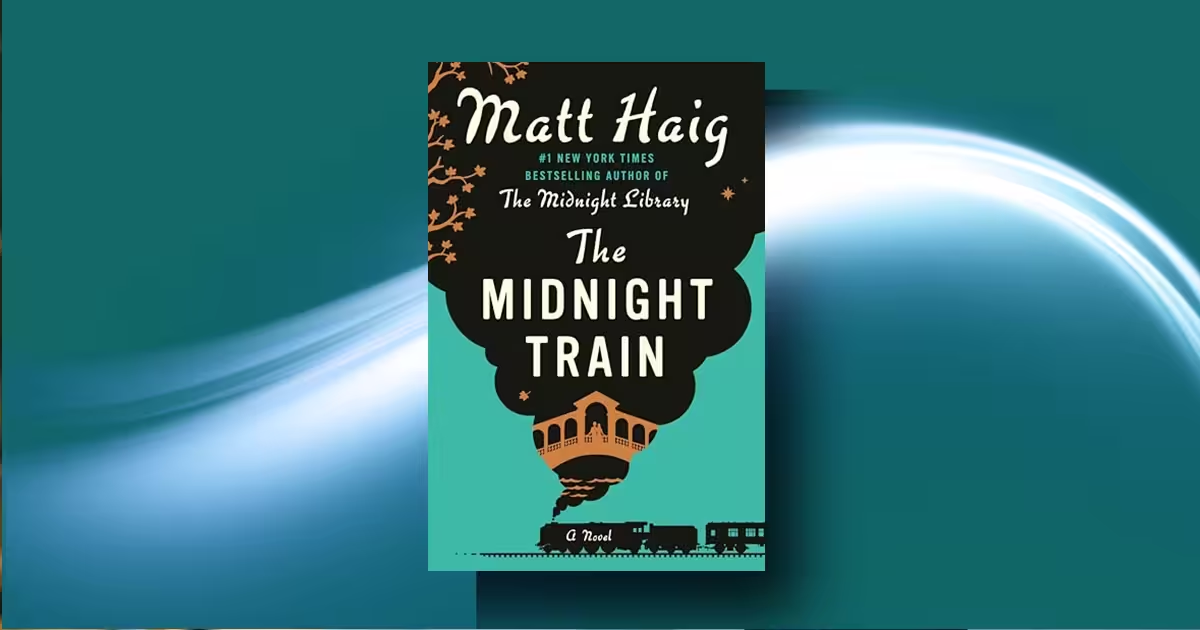
Did you know that as many as 75% of people rate their most common regret as not taking enough risks or prioritizing the wrong things in life? If so, get ready for The Midnight Train—a novel that isn’t afraid to show us why. Matt Haig’s latest work is a profound, heart-wrenching, and ultimately uplifting exploration of love, loss, and the terrifying speed of a life lived on autopilot. It’s a story that will linger in your mind long after the final page.
Matt Haig’s The Midnight Train follows Wilbur Budd, an 81-year-old bookshop chain owner who, after his death, boards a magical steam train that takes him back through the key moments of his life, forcing him to confront the devastating realization that his relentless pursuit of success cost him the one thing that truly mattered: love.
The Midnight Train is best for readers who loved the philosophical, magical realism of The Midnight Library; anyone who has ever wondered “What if?” and wants a book that validates that feeling; fans of heartfelt, character-driven stories that explore universal themes of regret, redemption, and the meaning of a life well-lived; and anyone looking for a poignant, uplifting read that will make you want to call an old friend or hold your partner a little tighter.
Not for readers seeking a fast-paced, plot-driven thriller or a straightforward romance. The novel is contemplative, often somber, and at times repetitive. Also, it requires a willingness to suspend disbelief and accept its magical premise without a scientific explanation. If you’re not a fan of novels that prioritize emotional introspection over action, this might not be your ticket.
Table of Contents
The Midnight Train Summary
On a quiet Saturday in April 2026, 81-year-old Wilbur Budd finishes his weekly piano lesson at his grand but lonely Bedfordshire home. The phone rings. It’s Maggie, his ex-wife—the love of his life, whom he hasn’t spoken to in over thirty years.
Their conversation is brief, stilted, and bittersweet. Maggie says she had a dream about them being happy together. Wilbur, overjoyed and terrified, arranges to talk again. Shortly after hanging up, he collapses on his lawn and dies of a heart attack at one minute past midnight.
In death, Wilbur finds himself standing on a desolate platform bearing his name. A magnificent, deep-blue steam engine—the Midnight Train—pulls up. It is the exact replica of the toy train his brother, Dougie, gave him as a baby.
Greeting him is the ghost of Agnes Bagdale, the former owner of the Sheffield bookshop where Wilbur spent his childhood and later worked as a young man.
Agnes is to be his guide through the afterlife, which for Wilbur will consist of riding the Midnight Train to revisit the most significant moments of his life. He appears as his 29-year-old self—the age at which he was “most himself,” during his honeymoon in Venice.
As the train departs, Agnes warns him of three ironclad rules: 1) He must get off the train at every stop; 2) He must get back on when he hears its whistle; and 3) He must never, ever attempt to speak to his younger self or interfere with the past. Doing so would risk altering his own timeline and cause him to lose his chance at eternity.
The Stops: A Life Revisited
The journey begins in 1945, on Glossop Road in Sheffield. Wilbur sees himself as a crying baby, his older brother Dougie (a troubled, volatile boy), and his mother Edith, a war widow who resents her “other mouth to feed”. At this first stop, the baby stares right at the Ghost, a moment that suggests the barriers between the living and the dead are more permeable than Agnes suggests.
The train then takes him forward, stopping at key junctures: his first meeting with Maggie in 1958, where she smiles at him reading The Old Man and the Sea on his doorstep; his teenage job at Bagdale’s Bookshop, where he discovers his talent for matching people with books; his decision to turn down a scholarship to Oxford after Dougie’s death; and, most devastatingly, the night of July 27, 1964.
At a Rolling Stones concert, Dougie gets into a fight, pulls a knife, and flees with Wilbur. During a high-speed chase with the police, Dougie swerves to avoid a rabbit and crashes into a tree. Wilbur survives, but Dougie is killed. The Ghost watches, helpless, as his younger self is broken by guilt and grief, causing him to abandon his dreams of Oxford and sink into a deep depression.
The Train Slows: A Second Chance?
The journey continues, showing Wilbur his slow ascent as he takes over Bagdale’s, turns it into the successful Budd Books chain, and marries Maggie in 1974. They are blissfully happy on their honeymoon in Venice. Wilbur considers taking out a bank loan to expand his business, a decision he knows—from his future—will ultimately lead him to prioritize work above all else.
Unable to bear the thought of reliving his mistakes, the Ghost disobeys Agnes’s rule. He stays at the Venetian stop, determined to warn his younger self. When his 29-year-old self falls asleep, the Ghost enters his dream.
He becomes the “Dreamer” (the 1974 Wilbur) and the Ghost becomes the guide, showing him the entire trajectory of his life: the miscarriage, the estrangement from his best friend Charlie (whom he heartlessly fires), the decay of his marriage, Maggie’s eventual departure, and his lonely, wealthy, and regret-filled final decades.
Armed with this terrifying knowledge, the Dreamer wakes up on his honeymoon in Venice with his memory of the future intact. He immediately renounces the bank loan, choosing instead to focus on Maggie and a simpler life. He vows to be a better husband, a better friend to Charlie, and a more present son to his mother, Edith.
In the end, the Ghost of the original Wilbur—the one who lived the life of regret—steps into the void, sacrificing his own chance at eternity to give his younger self a second chance at life. The train ride that was meant to end in death becomes a catalyst for a new beginning.
The Midnight Train: Analysis
The Midnight Train Characters
Wilbur Budd: The protagonist is a deeply flawed but sympathetic figure. His journey is not about learning a lesson, but about re-living his life with the gift of hindsight.
Matt Haig masterfully shows us how childhood poverty and a traumatic loss can shape a person’s priorities, turning a warm, bookish boy into a workaholic mogul who is “forever somewhere else, even when [he is] right next to me”.
Wilbur’s character development is the novel’s central thread, moving from a state of regretful observation to active participation in changing his own fate.
Maggie Shaw: Maggie is Wilbur’s moral compass. She is an artist at heart, someone who values “observing not just following”. She is perceptive, kind, and fiercely independent.
Her letter to Wilbur is one of the novel’s most powerful moments, encapsulating her pain and the slow, quiet death of their marriage: “I can’t just be that corporate wife any more”. She is the embodiment of what Wilbur throws away in his pursuit of wealth.
Dougie Budd: Wilbur’s older brother is the novel’s most tragic figure. A “tearaway” with a good heart, Dougie is a product of his environment—a boy who lost his father and his childhood, and who acts out in violence and crime because he feels abandoned. His death in the car crash is the pivotal event that shapes Wilbur’s life, and the Ghost’s ability to finally see Dougie with compassion and understanding is a key part of his healing.
Agnes Bagdale: The ghost of the bookshop owner is Wilbur’s guide through the afterlife. She is a wise, slightly stern, and deeply compassionate figure who represents the value of a life dedicated to passion and people, rather than profit.
She quotes Raymond Chandler and knows the importance of rules, but ultimately allows Wilbur to break them because she recognizes his intrinsic goodness. She is the soul of the bookshop, contrasting with her son Arthur, who runs the store as a mere business.
Charlie Applewood: Wilbur’s best friend from childhood is a gentle, intelligent, and loyal physicist who is fired from Budd Books in one of Wilbur’s most shameful moments. Charlie represents all the authentic connections Wilbur sacrifices in the name of “growth.”
The Midnight Train Themes and Symbolism
Regret and the “Life Not Lived”: This is the novel’s dominant theme. Unlike The Midnight Library, where Nora explores all her other possible lives, Wilbur is forced to examine his own, with all its missed opportunities and bad choices. The novel argues that the most profound regret is not for the things we didn’t do, but for the people we failed to prioritize.
Capitalism and Masculinity: Haig critiques the modern cult of workaholism, which he links to a toxic form of masculinity. Wilbur’s ambition is a direct result of his fear of poverty and his need to “prove himself” after his father’s death.
He mistakes “being caffeinated and adrenalised with being alive”, turning success into an anesthetic for his unprocessed grief. The novel suggests that true success is not measured by financial metrics but by the depth of our human connections.
Time and Memory: The novel uses its magical-realist premise to explore the nature of memory and the fluidity of time. The title itself is a symbol of the relentless, forward-moving nature of a life lived on autopilot. The train’s “stops” represent the moments we should have cherished.
Haig also weaves in Charlie’s theories about quantum physics and the African concept of zamani, suggesting that the past is not a static, dead thing but a living, potent force that is always with us.
The Power of Storytelling: As a book about a bookseller, The Midnight Train is a love letter to reading. Books are shown as “mirrors for the soul”, and the act of matching a person with the right book is portrayed as a kind of magic. Wilbur’s own escape into stories as a boy is what saves him from despair, and his ability to connect people with books is his greatest gift.
Evaluation
The Midnight Train is a poignant, heartwarming, and surprisingly moving novel that serves as a worthy spiritual companion to The Midnight Library. It’s a book that feels both deeply personal and universally relevant, reminding us that the greatest adventure isn’t a journey to a far-off land, but the journey of living a life of genuine presence and love.
Strengths
Emotional Resonance: The novel is incredibly effective at evoking both joy and sorrow. The scenes of Wilbur and Maggie’s early courtship are tender and romantic, while the later scenes of their marital decay are painfully realistic.
Thematic Depth: Haig tackles complex themes—capitalism, masculinity, regret, and the nature of time—with a light touch, never becoming preachy. The philosophy is woven seamlessly into the narrative.
Memorable Characters: Even the supporting cast, like Charlie and Dougie, are well-drawn and leave a lasting impression.
A Satisfying Ending: The conclusion is both hopeful and earned. Wilbur’s sacrifice of his own eternity to give his younger self a chance at a better life is a powerful and redemptive act.
Weaknesses
Pacing: The middle section of the novel, as the train moves through the decades, can feel a bit repetitive. Some readers may find the list of Wilbur’s successes and failures grows monotonous.
Predictability: The structure, reminiscent of A Christmas Carol, means the overarching narrative arc is familiar. Some readers, as noted on The StoryGraph, felt there were “no surprises left once you know how the relationship ends”.
Platitudes: On occasion, Haig’s prose can slip into simple life-coaching aphorisms (“It only takes a moment to die, but a whole lifetime to learn how to live”), which may feel a bit too on-the-nose for some readers.
Impact
For me, the impact of The Midnight Train was both emotional and intellectual. Reading about Wilbur’s life made me acutely aware of my own. The novel’s most powerful lesson—that a life lived in “perpetual motion” is a life half-lived—resonated deeply. This isn’t just a story about a rich, regretful man; it’s a mirror held up to a culture that celebrates busyness over beingness.
Comparison with Similar Works
As many reviewers have noted, The Midnight Train is clearly a companion piece to Haig’s own The Midnight Library (2020). Where The Midnight Library explored the “what ifs” of alternate lives, The Midnight Train explores the “what if” of the life you actually lived.
Another strong comparison is Charles Dickens’s A Christmas Carol, with Ebenezer Scrooge being shown his past, present, and future by ghosts. In this context, Haig’s novel is a softer, more romantic, and less overtly moralistic take on the same concept.
It also shares thematic DNA with It’s a Wonderful Life (1946), where a man gets to see the impact of his existence on others. On the literary side, it recalls the quiet, reflective domestic realism of Anne Tyler or the poignant midlife reckonings in Richard Ford’s The Sportswriter.
Personal Insight with Contemporary Educational Relevance
One of the most devastating scenes in The Midnight Train occurs when Wilbur’s wife, Maggie, tells him she wishes she was “the stock market so you could pay me some attention”.
This line captures the book’s most urgent lesson: in our contemporary world, we have been conditioned to prioritize metrics—growth, profit, productivity—over people. This isn’t just a personal failing of Wilbur’s; it’s a systemic one.
Five Key Lessons for the Contemporary Reader:
Love is a Garden, Not a Destination: Wilbur’s father-in-law Alfred tells him, “Love is a garden. You have to keep tending to it”. This is the novel’s central metaphor.
In an age of instant gratification and transactional relationships, The Midnight Train reminds us that real connection requires continuous, attentive effort.
The Enemy of Happiness is “The Idea of Enough”: Wilbur is never satisfied. He always wants more—more shops, more money, more prestige. The Ghost describes this as being “scared of the idea of enough”. This is a direct critique of consumer culture, which thrives on creating a perpetual sense of lack. The novel asks us to define what “enough” looks like for us, and to have the courage to stop when we get there.
Avoiding Pain Leads to a Life of Regret: Wilbur’s entire career is a massive avoidance strategy. He runs from the grief of Dougie’s death and the poverty of his childhood, only to end up in a gilded cage of his own making. As the Ghost says, “A life without pain is not on the menu”.
The book’s message is radical: we must lean into our pain, not run from it.
The Past is Not a Relic; It’s a Living Force: Charlie’s theories about time and the African concept of zamani—where the past is not a dead record but an ever-present reality—are crucial.
This means the choices we make now are not isolated; they echo backward and forward. We can heal the past not by changing it, but by changing our relationship to it in the present.
Success is the Distance from Where You Started: The Ghost offers a redefinition of success: “Success is just the distance you travel from where you started”. This is a powerful antidote to the culture of comparison.
It suggests that our only true competition is with our former selves, and that the greatest victory is overcoming the limitations and traumas of our past.
The Midnight Train Quotes
- “Life can only be understood backwards; but it must be lived forwards.” – a quote from Søren Kierkegaard that Agnes uses to explain the train’s purpose.
- “It only takes a moment to die, but a whole lifetime to learn how to live.” – The Ghost’s bitter realization.
- “You are forever somewhere else, even when you are right next to me.” – Maggie’s devastating letter to Wilbur.
- “Not every stop is a crash.” – The Dreamer’s realization that slowing down doesn’t mean disaster.
- “Books are mirrors for the soul.” – Agnes Bagdale’s philosophy of bookselling.
- “Sometimes you have to let your heart break in order to stay alive.” – Maggie’s wisdom from her letter.
Conclusion
The Midnight Train is a beautiful, melancholic, and ultimately hopeful novel. It is a book for anyone who has ever looked at their life and wondered where the time went. It’s a story that champions slowness in a fast world, connection in an age of isolation, and love over all forms of achievement.
While it may not have the same lightning-in-a-bottle freshness as The Midnight Library, it is a more mature, more grounded, and in many ways, more profound work. It deserves a place on the shelf of anyone who believes that the best stories are the ones that remind us how to live.
Final Verdict: Highly recommended for fans of Matt Haig, literary fiction, and anyone in need of a poignant reminder to “be nostalgic about the present”.







