
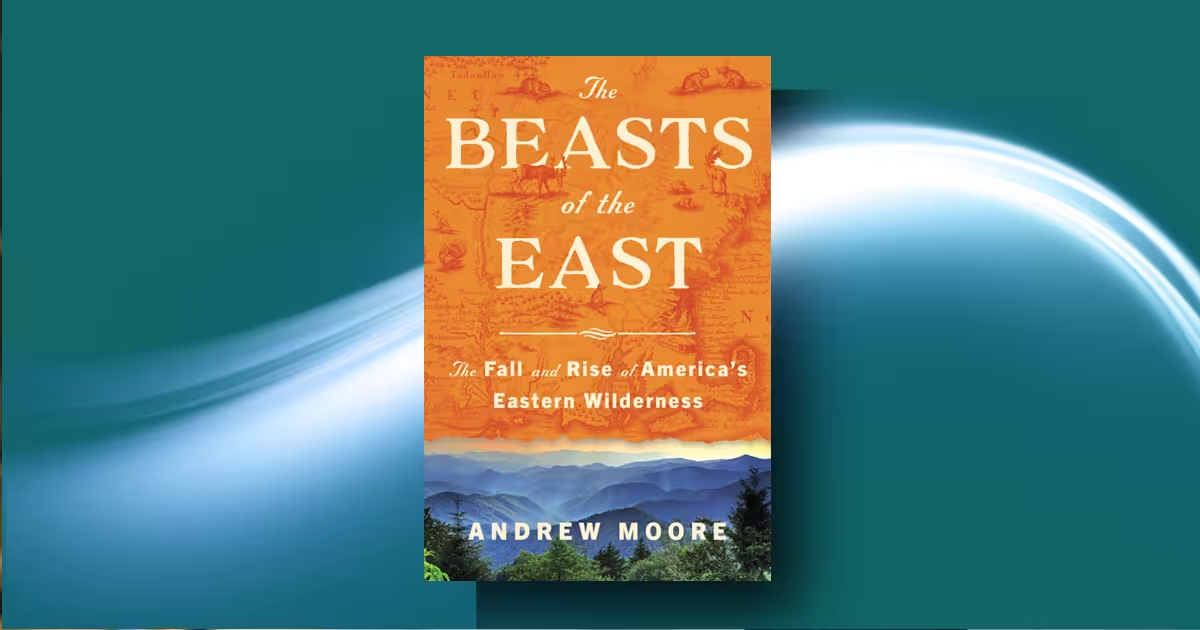
Ever wonder why you can hear coyotes howling in a Chicago suburb or spot a bald eagle over the Ohio River? These aren’t just lucky sightings—they’re the echoes of one of the most dramatic ecological comebacks in American history, a story that environmental journalist Andrew Moore masterfully chronicles in his groundbreaking 2026 release, The Beasts of the East: The Fall and Rise of America’s Eastern Wilderness.
The Beasts of the East is best for nature enthusiasts, amateur ecologists, hunters and anglers, history buffs, environmental science students, and anyone who has ever wondered what truly roamed the woods behind their suburban home. If you find hope in stories of restoration or want to understand the complex reality of rewilding, this is your book.
Not for readers seeking a purely scientific textbook without narrative flair. Those who prefer their environmental news to be overwhelmingly doom-and-gloom might find Moore’s balanced optimism frustrating. It is also not a field guide to animal identification, but rather a deep-dive into the how and why of wildlife recovery.
Table of Contents
1. Introduction: The Book and the Author
The Beasts of the East: The Fall and Rise of America’s Eastern Wilderness by Andrew Moore, published on June 2, 2026, is a seminal work of environmental journalism and narrative non-fiction.
Moore, a James Beard Foundation Award finalist for his previous book Pawpaw, is a writer deeply rooted in the landscapes of the American East. He writes not as a detached academic but as an explorer, bringing a personal, boots-on-the-ground perspective to the story of wildlife restoration.
What is this book about? In essence, Moore dismantles a fundamental myth: that large, charismatic mammals like elk, bison, and wolves belong exclusively to the Rocky Mountains. As Moore reveals, prior to European settlement, the eastern United States was a biological paradise teeming with these “beasts.”
The Beasts of the East traces their catastrophic decline—driven by unregulated hunting and industrial destruction—and then follows the herculean, often controversial, efforts to bring them back.
What is Moore’s central thesis? Moore argues that the restoration of these animals is not merely a nostalgic exercise but a necessary act of ecological healing. As he states in the preface, quoting conservationist Jeffery Larkin: “We have a certain responsibility to return lost portions of biodiversity that we can return.”
However, Moore complicates this heroic narrative by exposing the political, social, and geographical realities of rewilding a landscape now dominated by highways, farms, and suburban sprawl. The book asks a profound question: even if we can bring them back, can we learn to live with them again?
2. Background: The Lost Eden of the East
To understand the “Rise,” Moore first dedicates significant space to the “Fall.” He paints a stunning portrait of the East before the axe and plow. The evidence is staggering. According to Moore, the East was not a dense, impenetrable wall of trees, but a mosaic of old-growth forests, oak savannas, and wetlands.
The Megafauna: Elk roamed as far east as Cape May, New Jersey. Bison grazed in the open savannas of Georgia and Alabama. “In 1737, an expedition into the heart of the rugged mountains would occasionally stumble into vast openings and savannas, up to four miles wide, ‘in which were an infinite quantity of Turkies, Deer, Elks, and Buffaloes,'” Moore writes, quoting a historical account.
The Industrial Slaughter: This abundance was shattered by the industrialization of hunting and the market for hides. The toll was biblical. In one striking example, early naturalists observed a squirrel migration that numbered half a billion animals.
Yet, by the 1950s in Kentucky, Moore notes that the image of wildlife had been reduced to “a bushy-tailed rodent bounding up the shag of a second-growth hickory tree.”
Squirrels, once considered vermin to be eradicated, had become the only game left standing.
This historical context is crucial because it sets the stage for the three monumental case studies that form the heart of the book: the Elk of Kentucky, the Bison of Illinois, and the Red Wolf of North Carolina.
3. The Beasts of the East Summary
Moore divides his narrative into three distinct parts, each focusing on a different species and a different model of conservation.
Part I: The Elk of Kentucky (A Hunter’s Comeback)
The story of elk restoration in eastern Kentucky is arguably the book’s most surprising success. It began not with environmentalists, but with a stubborn hunter named Doug Hensley. Moore introduces Hensley as a man who watched the landscape of his childhood transform due to surface coal mining.
The Unlikely Habitat: Hensley realized that the devastation of mountaintop removal coal mining had accidentally created a new habitat. The flattened peaks and reclaimed grasslands of mines like Starfire resembled the open elk habitat of the West. Moore quotes Hensley directly: “When it was all wooded, I know what we had—we had nothing. We had pretty trees, but you didn’t have no wildlife.”
The Mass Stocking: Defying skepticism about brainworm and habitat loss, Kentucky initiated a massive translocation effort. Between 1997 and 2002, they brought 1,541 elk from western states to the coalfields.
Moore details the grueling logistics—the mid-winter captures in Utah, the deaths from capture myopathy, and the political maneuvering to get the animals on the ground before the legislature could stop them.
The Tensions of Success: The herd exploded to over 10,000 animals, becoming the largest east of the Mississippi.
Yet success bred conflict. Elk wandered into gardens and crashed into cars. Moore captures the frustration of local farmers in Stoney Fork, who complained, “They’re a danger to us, and we want them gone.”
The Ecosystem Impact: Moore is honest about the consequences. He notes that while elk thrive on the invasive autumn olive shrubs that dominate old mines, these monocultures are ecological dead zones for native songbirds. “The reclaimed mine sites were not early successional; they were postindustrial arrested succession,” he writes, quoting a forester.
Part II: The Bison of Illinois (The Engine of the Prairie)
In stark contrast to the Kentucky story, the return of bison to Illinois was driven by botanists and land stewards, not hunters.
The Prairie Paradox: Moore explains that the tallgrass prairie is a “disturbance-dependent” ecosystem. It needs fire and grazing to survive. Without bison, the prairies were filling with invasive brush.
The Human Element: This section is a beautiful piece of micro-history. Moore follows the passion of a farmer named Delbert Schafer, whose rocky, unplowable land held the last remnants of the Illinois prairie. We see naturalists like George Fell and Steve Packard fighting to save these “postage stamp” remnants.
The Gamble at Nachusa Grasslands: The climax of this section is the decision by the Nature Conservancy’s Nachusa Grasslands to introduce bison in 2014. Moore captures the anxiety of the botanists. “Even if there were no scientific values in a prairie, its aesthetic appeal alone would warrant its preservation,” wrote ecologist Robert Betz, a sentiment that drives the project.
The “Adjusted Aesthetic”: Moore introduces the brilliant concept of an “adjusted aesthetic.” Initially, visitors hated the look of grazed land. They saw bare dirt and trampled flowers. But over time, they learned that the bison wallows and grazing lawns created micro-habitats for rare butterflies and birds. As one steward notes, the bison knocked humans “down a peg” in the food chain, restoring a sense of true wildness.
Part III: The Red Wolf of North Carolina (The Perfect Storm)
This is The Beasts of the East‘s most heartbreaking and essential chapter. The red wolf’s story is not one of simple triumph but of political and biological warfare.
The Genetic Swamp: Moore explains how the red wolf (Canis rufus) was driven to the brink not just by bullets, but by hybridization. As wolf populations crashed, lonely wolves mated with encroaching coyotes. By the 1970s, the “pure” red wolf was functionally extinct in the wild.
The Captive Lifeline: The US Fish and Wildlife Service (USFWS) made a desperate choice: they rounded up the last 14 pure animals to start a captive breeding program. This was a “Noah’s Ark” moment, but one fraught with genetic peril.
The Alligator River Release: In 1987, wolves were released into the Alligator River National Wildlife Refuge in North Carolina. Moore provides gripping details of the early days, such as the time a biologist saw a wolf wag its tail like a dog and “snarled at the wolf as he tossed in the food buckets” to discourage the behavior/
The Sabotage: The final act is a political thriller. Moore reveals how local landowners and hunters, fearing wolves would decimate deer populations, launched a relentless campaign to undermine the recovery. A particular target was the 10(j) rule, which designated the wolves as an “experimental, nonessential” population, making it legally difficult to prosecute people who shot them (claiming they mistook them for coyotes).
The Verdict: Moore quotes biologist Mike Phillips, who lays bare the tragedy: “It is absolutely beyond the pale that the program has largely blown up… do we value life so little?”
Unlike the elk and bison, the red wolf’s future remains perilously uncertain.
4. The Beasts of the East Analysis
Is this book effective? Unequivocally, yes. “The Beasts of the East” is an outstanding and important work of environmental journalism.
A Balanced Narrative: Moore avoids the trap of painting conservationists as saints and locals as villains. He humanizes the Kentucky elk hunter, the Illinois farmer, and the North Carolina landowner. This even-handedness gives his arguments immense credibility. “Moore’s optimism and bringing of good news are refreshing but tinged with a cautionary note,” as noted in a Kirkus Starred Review.
Cinematic Storytelling: Moore writes with a novelist’s eye for detail. The opening scene of 32,000 sandhill cranes lifting off at sunrise in Indiana is breathtaking. His prose makes complex ecological concepts—like brainworm lifecycles or trophic cascades—accessible without being patronizing.
A Flawed Paradise: As noted earlier, Moore does not shy away from the messiness. He admits that the Kentucky elk thrive on ecologically damaged mine lands and that the Illinois bison are confined by fences, making them more livestock than wildlife. This honesty prevents the book from becoming naive propaganda.
5. Strengths and Weaknesses
Strengths:
Comprehensive Research: Moore seamlessly weaves together historical accounts, scientific studies, and personal interviews. He has done the hard work.
The “Braided” Approach: By linking the story of the land (mines, prairies, swamps) to the story of the animals, Moore demonstrates that you cannot save a wolf without saving its pack, and you cannot save the pack without saving the territory.
A Cautionary Optimism: In an era of climate anxiety, Moore offers a genuine, evidence-based reason to hope. He shows that extinct-in-the-wild species can be returned, proving that human beings are capable of reversing our ecological sins.
Weaknesses:
Length and Density: At over 400 pages, the book requires commitment. Readers looking for a quick “beach read” about animals might find the deep dives into mining regulations or hunting dog ordinances slow.
The Ghost of the Ivory-bill: The book occasionally references the extinct Ivory-billed woodpecker as a phantom of lost wilderness. While poignant, this specter sometimes distracts from the living, breathing success stories of the elk and bison.
6. Comparison with Other Works
If you have read The Sixth Extinction by Elizabeth Kolbert, you know the power of narrative non-fiction to explain mass die-offs. “The Beasts of the East” acts as a spiritual sequel; where Kolbert tells us what we are losing, Moore tells us what we are getting back.
In contrast to Wild by Design by Laura J. Martin, which focuses on the ethics and policy of restoration, Moore’s work is more visceral and travelogue-driven. It belongs on the shelf next to The Book of Wilding by Isabella Tree, but with a distinctly American flavor—less about grand, empty spaces and more about working landscapes where people live, hunt, and farm.
7. Conclusion: Who Should Read This?
The Beasts of the East is a masterpiece of ecological hope. It proves that the eastern United States is not a “lost” wilderness but a “recovering” one.
You should read this book if you want to understand the complex reality behind a news headline about a wolf being shot or a bison being born. It will change how you view the deer in your backyard and the forest at the end of your street. As Moore eloquently concludes, looking out at the future of the eastern wilds, “It’s a choice we’re making now.”
This book ensures you are informed enough to make that choice.