
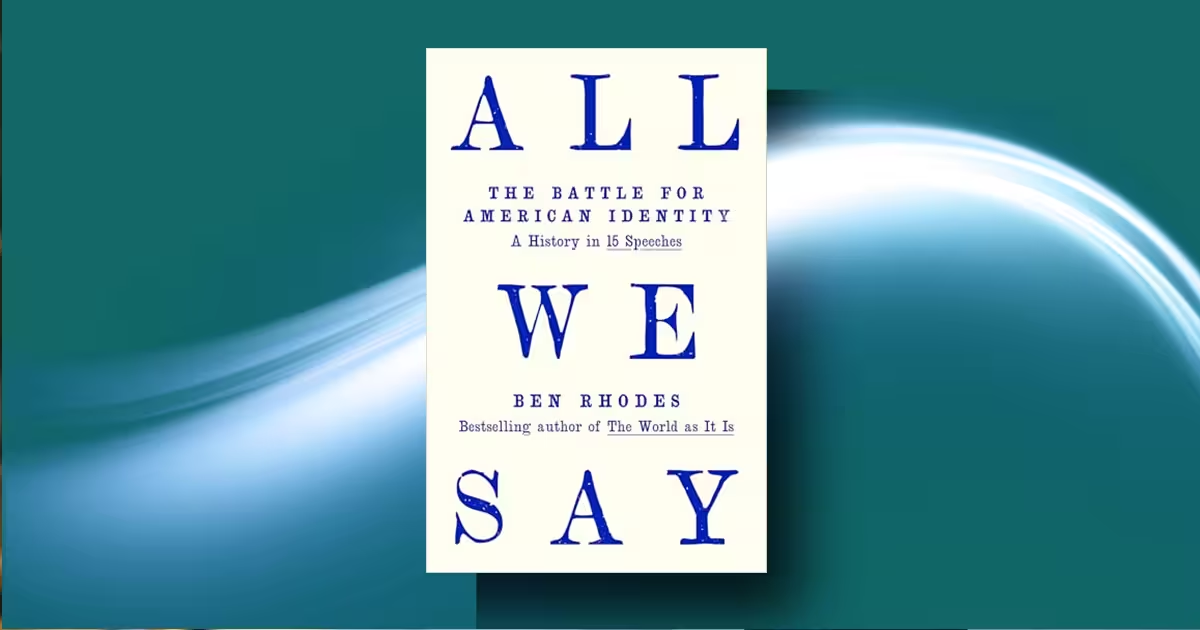
Does a single speech have the power to reshape a nation? Can words spoken by one person standing before a crowd really alter the trajectory of history? Ben Rhodes — former deputy national security advisor and chief speechwriter for Barack Obama — answers that question with a flat, emphatic yes, and he spends 432 pages proving it. All We Say: The Battle for American Identity is one of the most illuminating and frankly disturbing books I have read in years, because it forces you to confront an uncomfortable truth: America has never been a finished nation.
Book at a Glance
| Full Title | All We Say: The Battle for American Identity: A History in 15 Speeches |
| Author | Ben Rhodes (Obama speechwriter, former Deputy NSA) |
| Publisher | Random House (Penguin Random House) |
| Publication Date | May 26, 2026 |
| Format | Hardcover, 432 pages |
| Genre | American Political History, Rhetoric, Non-Fiction |
| Hardcover ISBN | 9780593595121 |
| Also By Rhodes | The World as It Is (2018), After the Fall (2021) |
Best For
- Readers troubled by American political polarisation
- History lovers who want context for the Trump era
- Students of rhetoric, oratory, and speechwriting
- Anyone who wondered why identity politics feels so ancient
- Obama-era political memoir fans
- Literary non-fiction readers drawn to big ideas
Not For
- Readers seeking a politically neutral narrative
- Those wanting short, fast non-fiction
- Readers who dislike extended historical analysis
- Strict conservatives who will find Rhodes’s framing grating
- People looking for solutions, not diagnosis
Introduction: The Question That Will Not Go Away
All We Say begins on July 5, 2025, with Vice President JD Vance at the Claremont Institute’s gala in Rancho Santa Fe, California. Vance, receiving the “Statesman of the Year” award from the think tank regarded as the intellectual backbone of the MAGA movement, poses a question that Rhodes makes the spine of the entire book: “If you were to ask yourself in 2025 what an American is, very few of our leaders have a good answer.”
Whereas Vance’s answer — “America is not just an idea, we’re a particular place with a particular people and a particular set of beliefs and way of life” — might sound uncontroversial in a pub conversation, Rhodes tears it apart with precision.
America is not, he argues, a “particular place” (founded in thirteen coastal states now constituting a fraction of its territory), nor a “particular people” (comprising every race and nationality on Earth), nor a fixed “way of life” (freedom, by definition, means the liberty to choose your own).This leads to All We Say‘s central thesis, stated with quiet force: For 250 years, America has coexisted with two opposing national stories. One sees the nation as inherently right from the beginning — a promised land for a particular (white, Christian) people entitled to their supremacy.
The other sees the nation as perpetually striving toward the ideals embedded in the Declaration of Independence: that all human beings are created equal and deserving of life, liberty, and the pursuit of happiness. As Rhodes puts it, “America has always been both stories: coexisting, competing, and sometimes in conflict with each other.” The fifteen speeches in All We Say are the venues where that conflict has played out, generation after generation.Background: Who Is Ben Rhodes, and Why Does It Matter?
Ben Rhodes is not a disinterested historian. He is something rarer: a practitioner. He spent eight years as Barack Obama’s deputy national security advisor and one of his primary speechwriters.
He helped draft words delivered at Nobel ceremonies, at Hiroshima, and during the most fraught moments of twenty-first-century American foreign policy. He has written two previous New York Times bestsellers — The World as It Is (2018), a memoir of the Obama White House, and After the Fall (2021), a meditation on global authoritarianism.That partisanship is both a strength and a complication. Rhodes writes with the instincts of a speechwriter — every chapter has a clear argument, a memorable narrative arc, and a sense of moral stakes. He also writes with the honesty of someone who has been inside power and knows how compromised it can make you. His admissions about his own disillusionment — particularly in the epilogue, where he acknowledges that the two Trump elections fundamentally altered his view of what America is — lend the book a personal weight that purely academic histories rarely achieve.
Summary and Content Analysis: The 15 Speeches, Speech by Speech
All We Say is divided into three parts spanning American history from the Constitutional Convention in 1787 to Donald Trump’s second inaugural address on January 20, 2025.
Each chapter introduces the speaker, contextualises the historical moment, reproduces a substantial portion of the speech itself, and then analyses what made it consequential. Below is a thorough account of each speech and its meaning within Rhodes’s larger argument.Part I: American Foundations — Revolution to Civil War (Speeches 1–5)
All We Say opens with Benjamin Franklin, eighty-one years old, carried to the Pennsylvania State House in a sedan chair because gout and kidney stones made it impossible for him to walk unaided.
It is September 17, 1787, the final session of the Constitutional Convention, and Franklin has written a speech he cannot physically deliver. He hands it to James Wilson, who reads it aloud to an assembly that includes George Washington, James Madison, and Alexander Hamilton. The speech is a defence not of the Constitution’s perfections — Franklin openly admits he does not approve of several of its provisions — but of the virtue of compromise itself.“When you assemble a number of men to have the advantage of their joint wisdom, you inevitably assemble with those men, all their prejudices, their passions, their errors of opinion, their local interests, and their selfish views. From such an assembly can a perfect production be expected?”
— Benjamin Franklin, Constitutional Convention, Philadelphia, September 17, 1787
Rhodes uses Franklin as the philosophical starting point for everything that follows. The Constitution was, crucially, a document produced by propertied white men representing the interests of propertied white men.
Its three-fifths compromise — by which an enslaved person was counted as three-fifths of a human being for purposes of congressional apportionment — embedded white supremacy into the nation’s legal DNA from day one. Franklin, himself an abolitionist by 1787, said nothing about this in his speech. He chose the path of an insider pragmatist over that of a moral absolutist. All We Say does not condemn him for this, but it does follow the consequences of that silence all the way to the present day.Next comes Red Jacket — or Sagoyewatha, “He Who Keeps Them Awake” — whose 1805 response to a Christian missionary named Reverend Jacob Cram is one of the great rhetorical achievements in American history, though it has largely been forgotten. The speech is logically devastating. Why, Red Jacket asks, if the Christian God intended all people to worship in the same way, did he not give his book directly to the Native peoples? “How shall we know when to believe,” he asks, “being so often deceived by the white people?”
His argument for religious pluralism anticipates, by over a century, the most sophisticated defences of multiculturalism. Rhodes places this speech in the context of the Haudenosaunee Confederacy — the Six Nations whose own model of federal governance Benjamin Franklin explicitly cited when he first proposed an American union in 1754. The very political structure that Franklin helped create consumed the people who inspired it.“Our seats were once large, and yours were very small; you have now become a great people, and we have scarcely a place left to spread our blankets; you have got our country, but are not satisfied; you want to force your religion upon us.”
— Red Jacket, Buffalo Creek, New York, 1805
Maria Stewart follows, and she may be the figure in this book least familiar to modern readers. In 1832, she delivered the first recorded speech by a Black American woman to a mixed-race, mixed-gender audience at Boston’s Franklin Hall.
She was a widow in her twenties, barely financially solvent, and she spoke without institutional backing. What she said was incendiary: she condemned Black passivity as much as white oppression, argued for universal Black education including the education of girls, and insisted that Black liberation required both political action and moral self-improvement. Nearly two decades before the women’s rights movement formally began at Seneca Falls in 1848, Stewart was making the intersectional argument — that race and gender oppression are structurally linked — that would not enter mainstream political discourse for another 150 years.“We have pursued the shadow, they have obtained the substance; we have performed the labor, they have received the profits; we have planted the vines, they have eaten the fruits.”
— Maria Stewart, African Masonic Hall, Boston, 1833
Alexander Stephens’s 1861 “Cornerstone Speech” is perhaps the most chilling document in All We Say, precisely because of its frankness. Delivered in Savannah, Georgia, shortly before the outbreak of the Civil War, Stephens — the Confederate Vice-President — explicitly declared that the “cornerstone” of the Confederate nation was the moral and physical truth of white supremacy. “Our new government,” he said, “is founded upon exactly the opposite idea; its foundations are laid, its cornerstone rests, upon the great truth that the negro is not equal to the white man.”
This is remarkable in its directness, because for the next century and a half, Confederate sympathisers — including Stephens himself, who survived the war and spent the rest of his life as a Georgia congressman — would insist the war was never about slavery but about states’ rights. The Cornerstone Speech is the documentary proof that this claim is false.Part I closes with Lincoln’s Second Inaugural Address — seven hundred and three words that Rhodes, as a former speechwriter, analyses with the authority of someone who has spent years inside the craft.
Lincoln did not use the occasion to celebrate Union victories or lay out a reconstruction plan. He used it to place the entire catastrophe of the Civil War within a theological framework: God willed this war as punishment for the sin of slavery, and both North and South were complicit. “Every drop of blood drawn with the lash shall be paid by another drawn with the sword.” It is not a speech of triumph. It is a speech of reckoning. And its famous conclusion — “With malice toward none, with charity for all” — is not sentimentality but strategy: the architecture of a rebuilt union that could survive.Part II: What Kind of Nation — Radical Republic to Superpower (Speeches 6–10)
Frederick Douglass, Anna Dickinson, Mary Lease, and Louis Brandeis represent the post-Civil War period during which the fundamental question shifted from whether slavery would exist to what kind of democracy America would build in its absence. Douglass was the era’s moral conscience, holding the nation accountable to promises it had already made in blood and law.
Anna Dickinson was a celebrity before the concept had a word for it — a twenty-year-old abolitionist orator who could fill three-thousand-seat halls in the 1860s and who understood, before most of her contemporaries, that politics was performance as much as argument. Mary Lease’s 1890s populism — “Wall Street owns this country” — illustrates how economic grievance and identity politics were fused together long before the internet existed to turbocharge them.Franklin Delano Roosevelt’s “Four Freedoms” speech, delivered to Congress on January 6, 1941 — exactly eighty years before the Capitol insurrection of January 6, 2021, as Rhodes pointedly notes — is perhaps the most consequential presidential address since Lincoln’s Second Inaugural.
Rhodes analyses it not merely as a piece of wartime rhetoric but as the founding document of the postwar liberal international order. Freedom of speech, freedom of worship, freedom from want, and freedom from fear — “everywhere in the world” — became the aspirational basis of the United Nations, the Universal Declaration of Human Rights, and the network of alliances and institutions that defined American global leadership for eighty years. The speech also illustrates what Roosevelt understood and his isolationist opponents did not: that by 1941, “America First” was not a strategy. It was a fantasy. The Axis powers were not going to wait for America to be ready.“In the future days, which we seek to make secure, we look forward to a world founded upon four essential human freedoms.”
— Franklin Delano Roosevelt, State of the Union Address, January 6, 1941
Part III: Contested Nation — Civil Rights to MAGA (Speeches 11–15)
The final section of All We Say is where Rhodes’s own experience most clearly shapes the narrative. He was in the Obama campaign in 2008, walked out of his tiny Chicago studio apartment the night the Jeremiah Wright controversy broke, and wondered whether American racism would consume the first genuinely viable Black presidential candidate.
He helped write the “A More Perfect Union” speech that Obama delivered in Philadelphia — arguably the most sophisticated public address on race by any American politician in modern history — and he analyses it here with a combination of insider knowledge and genuine critical distance that is one of the book’s real achievements.“This is where we are right now. It’s a racial stalemate we’ve been stuck in for years.”
— Barack Obama, Philadelphia, March 18, 2008
Ronald Reagan’s 1983 “Evil Empire” speech at the National Association of Evangelicals reveals, through Rhodes’s analysis, the mechanics of how a political coalition is assembled through identity rather than policy.
Reagan wove together Christian evangelicals, free-market conservatives, and Cold War hawks into a unified movement by framing American politics as a cosmic struggle between God-fearing freedom and Godless statism. The speech — which spends two-thirds of its time discussing abortion, school prayer, and government regulation before arriving at the Soviet Union — is a masterclass in how to make a political agenda feel like a moral imperative. And it worked: the modern Republican Party is, in its essential architecture, the coalition Reagan built in that Orlando ballroom.Martin Luther King’s 1963 speech at the March on Washington is treated here with particular depth. Rhodes contextualises it within the movement dynamics of 1963 — the Birmingham campaign, the Kennedy administration’s simultaneous sympathy and caution, A. Philip Randolph’s decades-long organising — and he also analyses the speech’s rhetorical architecture.
The famous “I Have a Dream” peroration was not in King’s prepared text. He departed from the script, drawing on a phrase he had used before, when gospel singer Mahalia Jackson, standing nearby, called out to him to tell them about the dream. The result was what Rhodes, drawing on his own speechwriting experience, describes as one of the supreme instances of a great speaker achieving perfect alignment between his own authentic voice, an unseen movement’s power, and the communicative possibilities of the moment.“We cannot be satisfied as long as a Negro in Mississippi cannot vote and a Negro in New York believes he has nothing for which to vote. No, no, we are not satisfied, and we will not be satisfied until ‘justice rolls down like waters, and righteousness like a mighty stream.'”
— Martin Luther King Jr., March on Washington, August 28, 1963
All We Say closes with Donald Trump’s second inaugural address, delivered on January 20, 2025 — in the presence of former presidents Clinton, Bush, Obama, and Biden, as well as much of the American tech and financial establishment.
Rhodes reads it as both a culmination of the reactionary strand of American identity that runs from Alexander Stephens through Pat Buchanan and the declaration of something genuinely new: an American president claiming, with apparent sincerity, that God personally spared his life in an assassination attempt so that he could make America great again. “I was saved by God to make America great again.” In place of Lincoln’s “With malice toward none, with charity for all,” Trump offered: “I will fight for you, and I will win for you.” The president as the nation; the nation as the president.“The golden age of America begins right now.”
— Donald Trump, Second Inaugural Address, Washington D.C., January 20, 2025
All We Say Analysis and My Commentary
All We Say is, without doubt, one of the most important American political books of 2026. It is significant in the way that a well-placed mirror is significant: it shows you something you already half-knew and forces you to look at it without flinching.
Rhodes is not telling a new story, but he is telling it with a structural clarity and an accumulation of primary-source evidence — the speeches themselves — that makes the familiar history feel suddenly, almost physically, real.What struck me most, reading through these fifteen speeches in sequence, is how much the language of the two competing American stories has remained constant across 250 years. Benjamin Franklin worried in 1787 that democracy would “end in Despotism…when the people shall become so corrupted as to need despotic Government, being incapable of any other.”
Alexander Stephens in 1861 insisted that his new Confederate nation represented scientific and moral progress, that the Founders had been simply wrong about equality, and that the “proper status of the negro” — subordination — was both natural and benevolent. Pat Buchanan in 1992 declared a “culture war…for the soul of America.” Donald Trump in 2025 declared a “golden age.” The words change; the structure of the argument does not. This leads to a disconcerting conclusion: the battle Rhodes describes is not a product of polarisation, the internet, or any modern phenomenon. It is, as he says, constitutive. It was baked in at the founding, in the compromises that Franklin defended and that enslaved people had no voice in negotiating.Rhodes is particularly strong on what he calls the “alchemy of democracy” — the interplay between movements and power, activists and politicians. Each speech in this book exists at that intersection.
Maria Stewart’s abolitionist radicalism in 1832 would have been unthinkable without the network of the Black church, the free Black press, and the underground abolitionist community in Boston. King’s March on Washington speech would have been impossible without the Birmingham campaign, the Freedom Riders, and the 381-day Montgomery bus boycott. Obama’s Philadelphia race speech in 2008 was made possible by a campaign infrastructure that had, through months of extraordinary grassroots organising in Iowa, convinced enough white Americans to see a Black man as a viable president before the Reverend Wright controversy ever broke. In each case, the speech did not create the movement. The movement made the speech possible. And the speech, in turn, made the movement legible to a wider audience.Accordingly, All We Say is also a study in how language can be weaponised in the service of reaction. Reagan’s “Evil Empire” speech demonstrates with forensic clarity how a political speaker can transform grievance into identity, agenda into moral imperative, and opponents into cosmic villains.
Stephens’s Cornerstone Speech demonstrates that the language of science and progress can be conscripted into the defence of atrocity. Trump’s second inaugural demonstrates — and this is where Rhodes’s analysis is most chilling — that the rhetorical innovations of the entire preceding tradition can be inverted: the lone voice in front of a crowd, once the vehicle of the outsider demanding justice, becomes the voice of power announcing its own divine mandate.Strengths and Weaknesses: What the Book Gets Right and Where It Struggles
What Works Brilliantly
First and foremost, the architecture of the book is inspired.
Using speeches as the organising principle allows Rhodes to do something that purely narrative history struggles with: he can give the reader the primary document itself — the speech, reproduced at length — and then provide the interpretive framework. This means that the reader is not merely being told what to think about, for instance, Lincoln’s Second Inaugural. The reader can read the speech, form an initial response, and then engage with Rhodes’s analysis. The result is a book that is simultaneously a history, a rhetoric textbook, and an anthology of American oratory. Furthermore, as someone who was present for several of the most recent speeches, Rhodes brings a level of behind-the-scenes detail to the Obama and Trump chapters that no purely academic historian could replicate.Moreover, All We Say is admirably honest about America’s villains.
Rhodes does not soften Alexander Stephens, does not look away from Reagan’s dog whistles on race, and does not pretend that the exclusionary tradition in American identity is some aberration from an otherwise pristine story. He follows the logic of each speech to its consequences, even when those consequences are disturbing. The treatment of Red Jacket is particularly striking: here is a figure who has been largely relegated to footnotes in standard American histories, yet whose 1805 speech makes philosophical arguments about religious pluralism and indigenous sovereignty that remain unanswered to this day.Where It Falls Short
Nevertheless, All We Say has genuine weaknesses. Rhodes’s liberal perspective is so thoroughly woven into the fabric of his analysis that readers who do not share his political assumptions will periodically feel, not unreasonably, that the game is rigged.
This is not to say his analysis is wrong — in most cases, I find it persuasive — but a different kind of intellectual honesty would acknowledge the possibility that the two competing American stories he describes are not quite as simple as one story of oppression and one story of liberation. The populist tradition — Mary Lease’s farmers, the working-class whites who felt abandoned by both parties — occupies a complicated position that the book’s binary framework sometimes flattens.Additionally, the selection of fifteen speeches reflects a particular curatorial sensibility. The choice to include Alexander Stephens alongside Lincoln is bracing and important.
But the absence of, say, Ronald Reagan’s 1964 “A Time for Choosing” speech — which launched his national political career and arguably did as much to reshape conservative identity as the “Evil Empire” speech — feels like a notable omission. Similarly, Pat Buchanan’s 1992 Republican Convention speech, which Rhodes discusses at length in the Trump chapter as a precursor to MAGA, is treated as context rather than as a speech in its own right. These choices shape the narrative in ways that are not always acknowledged.Due to insufficient space in fifteen chapters, figures like Dolores Huerta and Frederick Douglass receive shorter treatment than the historical weight of their words demands.
The book’s structural commitment to fifteen speeches means that some chapters feel compressed compared to the expansive Franklin, Lincoln, and Obama sections.Books Like All We Say: How It Compares
| Book | Author | Angle | If You Liked… |
|---|---|---|---|
| Stamped from the Beginning | Ibram X. Kendi | History of racist ideas in America | All We Say’s Stephens & race chapters |
| The Speechmaker | Various | Anthology of American speeches | Readers who want more primary texts |
| Democracy in America | Alexis de Tocqueville | Structural analysis of American democracy | The Franklin & Roosevelt chapters |
| The World as It Is | Ben Rhodes | Obama White House memoir | Readers who want more Rhodes on Obama |
| After the Fall | Ben Rhodes | Rise of authoritarianism globally | Readers who want the global context for the Trump chapters |
| Lincoln at Gettysburg | Garry Wills | Close reading of one American speech | Readers who want more on Lincoln’s rhetoric |
| Frederick Douglass: Prophet of Freedom | David Blight | Definitive Douglass biography | Chapter 6 of All We Say |
The Epilogue: Rhodes’s Most Honest Writing
The epilogue of All We Say is the most vulnerable writing in All We Say, and it is worth dwelling on.
Rhodes begins: “The two elections of Donald Trump changed my view of the United States, which I could no longer see as the country that I wanted it to be.” He then does something unusual for a former senior government official: he admits that his own optimism was, in retrospect, a kind of selective reading of history. “That was a sympathetic yet simplistic way of looking at history,” he writes of his earlier belief that American history bent inexorably toward justice.” Indeed, before Trump’s first election, my own experience of eight years at the center of American politics and foreign policy was enough to disabuse me of any unvarnished version of American exceptionalism. Yet I still clung to a core belief that the American story was — on balance — positive.”What makes this epilogue particularly significant is what Rhodes argues about the relationship between words and democracy.
He makes the case, drawing on the evidence of all fifteen speeches, that the United States — unlike nations with a common ethnicity, religion, or ancestral territory — is uniquely dependent on language as the medium of its collective identity. America has no fixed geographic, ethnic, or religious definition. What it has, Rhodes argues, is words: the words of the Declaration of Independence, which established a civic creed that has served — imperfectly, painfully, incompletely — as the nation’s North Star. And what Trump’s rise represents, in Rhodes’s analysis, is not merely a political shift but a frontal assault on that word-based identity: the replacement of a creed that insists on accountability with a strongman who insists that his own person is the nation.“All we say to America,” Martin Luther King said the night before he was killed, “is ‘be true to what you said on paper.'”
— Martin Luther King Jr., Memphis, April 3, 1968
This is where the title of All We Say comes from. And it is, in the end, both a diagnosis and a call to action. Words matter. Speeches matter. The lone voice in front of a crowd — demanding, explaining, prophesying, persuading — is not an archaic form of political action.
It is, if anything, more necessary now than it has ever been, precisely because the forces arrayed against it — algorithmic fragmentation, social media extremism, the compression of complex arguments into viral clips — have never been more powerful.Conclusion: Should You Read All We Say?
Yes.
Unequivocally yes — with the caveat that you should read it knowing who Ben Rhodes is and what perspective he brings. This is not a neutral history. It is a passionate and deeply researched argument, made by someone who spent eight years helping to write the American story from inside its most powerful office, that the story is now in genuine danger.Indeed, whether or not you share Rhodes’s politics, the architecture of his argument is difficult to dismiss. The fifteen speeches he has chosen are real. The history he traces is documented.
The two competing stories he identifies have been present in American political life since 1787, and the evidence for their continuity — from Stephens’s Cornerstone Speech through Reagan’s “Evil Empire” address to Trump’s Second Inaugural — is laid out with care and specificity that demands engagement, not dismissal.For this reason, All We Say is most valuable to readers who are willing to sit with discomfort — who can read Alexander Stephens’s frank defence of white supremacy without flinching, who can acknowledge the beauty of Lincoln’s Second Inaugural while recognising how incompletely its vision was realised, and who can hold in mind simultaneously the inspiring arc of King’s 1963 speech and the sobering reality of what Trump’s 2025 inaugural represents.
Consequently, this is not a book that offers consolation.
What it offers is something rarer and more valuable: a way of understanding how we arrived at this particular moment, with all its violence and its promise, by listening carefully to the words Americans have spoken to one another across 250 years of an argument that, whatever else may be said about it, has never really stopped.That argument continues. And — as Rhodes insists on the final page — the outcome is not predetermined. History is not, in his telling, a machine that runs in one direction. It is a living dispute, and its resolution depends on who shows up to make the case.


Written by
Probin
I am Probin, a Bangladeshi-born writer and researcher, lifelong bookaholic and devoted cinephile, lover of literature and philosophy and an inquisitor of knowledge. I write reviews and reflections shaped by close reading, careful research and a love of philosophy. Every piece starts with one question: what is this work really trying to say, and does it succeed?





