
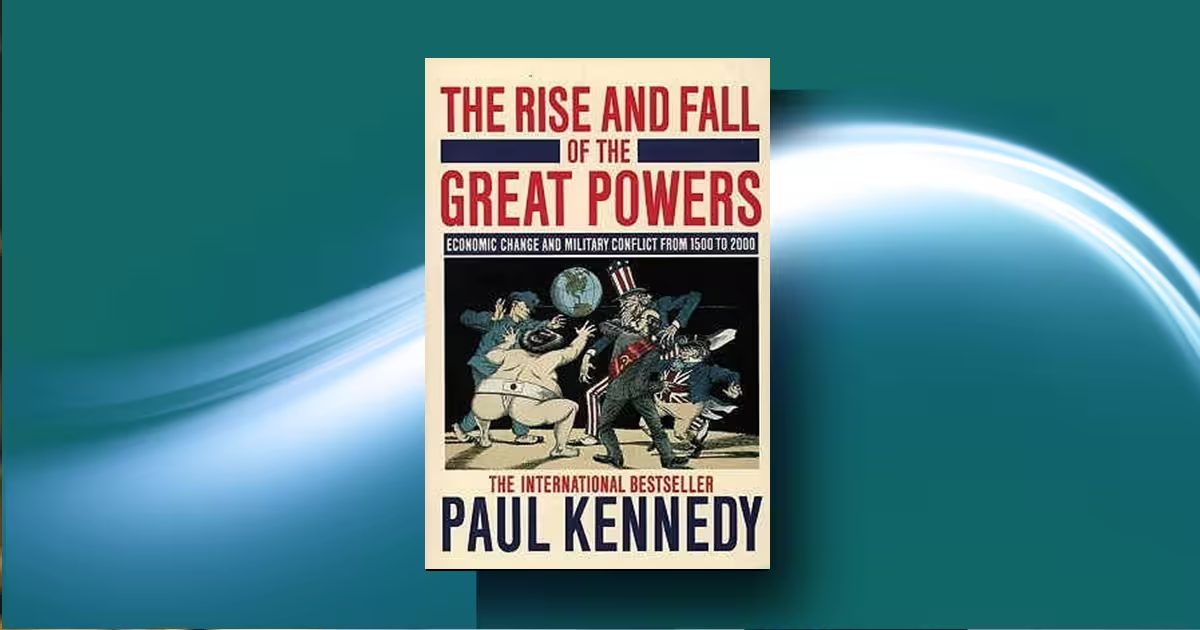
Did you ever question why certain magnificent empires crumble into dust while other, seemingly weaker nations rise to dominate the global stage? The Rise and Fall of the Great Powers will show you how to break free from historical ignorance and understand the deep-rooted economic forces that dictate ultimate authority.
The Rise and Fall of the Great Powers is best for strategic thinkers, historians, geopolitical thinkers, and anyone fascinated by the intersection of economics and military might.
But not for readers seeking a light, fast-paced fictional narrative or those who prefer history focused solely on the personalities of kings and queens rather than systemic economic shifts.
Table of Contents
1. Introduction
The book in question, The Rise and Fall of the Great Powers: Economic Change and Military Conflict from 1500 to 2000, is an exhaustive historical analysis written by Paul Kennedy. Originally published by Vintage Books (a division of Random House) in 1987, this masterwork remains a foundational text for understanding global hegemony and geopolitics.
The Rise and Fall of the Great Powers is a sweeping work of macro-history and geopolitical analysis. The book is about national and international power in the “modern”—that is, post-Renaissance—period. Kennedy, an esteemed historian, traces how various Great Powers have risen and fallen relative to one another over five centuries.
This is not strictly a military history, nor is it purely an economic history; rather, it explores the critical interaction between economics and strategy.
Kennedy’s text explores how nations build enduring global authority through economic foundations.
As one of best books on world order and geopolitics, the central purpose of The Rise and Fall of the Great Powers is that the relative strengths of leading nations never remain constant due to uneven rates of economic growth and technological breakthroughs.
Furthermore, wealth is usually needed to underpin military power, and military power is usually needed to acquire and protect wealth; however, if a state overextends itself strategically by diverting too many resources from wealth creation to military purposes, it runs the risk of long-term relative decline.
2. Background
The year 1500 is typically chosen by scholars to mark the divide between modern and premodern times. Initially, it may seem surprising, but in 1500, it was by no means obvious that Europe was poised to dominate the globe. Other civilizations, particularly in Asia, appeared far more advanced.
Europe was politically fragmented, vulnerable to landward invasion from the east, and lacked the massive populations and fertile plains of India or China. Nevertheless, this fractured geopolitical landscape would eventually become the very incubator for the “European miracle”.
3. The Rise and Fall of the Great Powers Summary
To put it in another way, this summary provides a thematic overview of the text for educational purposes, giving away the facts and summarizing the argument point by point so that you can grasp the entirety of Kennedy’s thesis.
Ming China: The Retreat from the Sea
A major trait of premodern civilization was the undeniable superiority of Ming China. With a population of 100-130 million in the fifteenth century (compared to Europe’s 50-55 million), China possessed a sophisticated culture, an educated Confucian bureaucracy, and immense technological precocity.
By the late eleventh century, China boasted an enormous iron industry producing around 125,000 tons annually—a figure far larger than British output in the early Industrial Revolution. They had invented true gunpowder, paper money, and the magnetic compass.
Between 1405 and 1433, Admiral Cheng Ho led seven official overseas expeditions, commanding fleets with vessels up to 400 feet long, displacing over 1,500 tons.
These fleets visited ports from Malacca to Zanzibar. Yet, in a fateful pivot, an imperial edict in 1436 banned the construction of seagoing ships, and the great warships were left to rot. Why? Kennedy argues it was a mix of strategical concerns about Mongol threats on the northern frontier and the sheer conservatism of the Confucian bureaucracy.
The mandarins viewed warfare and commerce with deep suspicion, preferring a restored agrarian past to overseas expansion. Consequently, Ming China turned its back on the world, neglected its canals and ironworks, and entered a state of relative decline that even the later Manchu dynasty could not permanently reverse.
The Muslim World: Expansion and Overextension
In contrast, the Muslim states formed the most rapidly expanding forces in world affairs during the sixteenth century. The Ottoman Empire pushed westward into Europe, the Safavid dynasty thrived in Persia, and Babur established the Mughal Empire in northern India in 1526.
The Ottomans, armed with a formidable siege train and janissary armies, took Damascus, Egypt, and Hungary, and besieged Vienna in 1529. Their naval power expanded across the eastern Mediterranean, leading to the capture of Cyprus in 1570-1571.
However, there are drawbacks to massive expansion.
By the second half of the sixteenth century, the Ottoman Empire showed signs of strategical overextension. Maintaining a large army in central Europe, an expensive navy in the Mediterranean, and battling the Shi’ite challenge from Persia drained the empire’s resources.
Furthermore, the despotic, centralized system suffered under incompetent sultans.
The bureaucracy hardened, preferring conservatism; printing presses were forbidden, trade was ruined by unpredictable taxes, and the janissaries resisted modernizing their weaponry.
Similarly, the Mogul Empire in India, despite its brilliant courts and massive population, was weakened from within by rigid Hindu social taboos (like the caste system) and a predatory tax system that plundered the peasantry to fund the conquerors’ conspicuous consumption.
Two Outsiders: Japan and Russia
Whereas China and the Islamic empires stagnated, Japan and Russia showed unique trajectories. Japan’s insularity offered protection, and the decentralized feuding of clans initially permitted lively trade and the adoption of European muskets and cannon. This led to the consolidation of authority under Hideyoshi and eventually the Tokugawa shogunate.
Yet, like Ming China, the Tokugawa clan decided to cut Japan off from the outside world to ensure unchallenged domestic control. In 1636, the construction of oceangoing vessels was stopped, and foreign trade was heavily restricted.
Thus, Japan’s military system ossified for two centuries until Commodore Perry arrived in 1853.
Russia, conversely, used imported European muskets and cannon to overcome the horsemen of the Asian plains, expanding steadily eastward through Siberia to reach the Pacific coast by 1638.
Despite severe social defects—such as military absolutism, serfdom, and a venal bureaucracy—the Russian Empire survived and expanded because it borrowed just enough military technology from Europe to preserve itself, while firmly resisting western social modernization.
The “European Miracle”: Pluralism and the Arms Race
What made Europe different?
Geography played a crucial role. Europe’s fractured landscape of mountains and forests prevented the establishment of a unified empire by a horse-riding horde. This political fragmentation meant no single centralized authority could suppress commercial development or decree a halt to overseas exploration.
Because of this, a flourishing market economy emerged. Rulers entered into a symbiotic relationship with merchants, providing domestic order in exchange for taxes.
Moreover, the decentralized states system engendered a primitive arms race. City-states and kingdoms constantly competed, forcing artisans to improve crossbows, armor plate, and eventually firearms and cannons.
While the Ming government and the Tokugawa shogunate monopolized and thus neglected weapons development, Europe’s free-market system drove constant innovations in bronze artillery, star-shaped fortresses (trace italienne), and gunned, long-range sailing ships.
By mounting smaller, more powerful cannon amidships on stoutly built, three-masted sailing vessels, Europeans gained the potential to control the oceanic trade routes.
This resulting imperialism—spearheaded by the Portuguese in the Indian Ocean and the Spanish in the Americas—brought immense wealth back to Europe (spices, silver, timber), stimulating further economic and technological breakthroughs.
Europe advanced because it possessed a combination of economic laissez-faire, political and military pluralism, and intellectual liberty.
The Habsburg Bid for Mastery
In the sixteenth and seventeenth centuries, the Habsburg dynasty attempted to dominate Europe. Through a series of brilliant marriage compacts, the Emperor Charles V inherited Spain, Austria, the Netherlands, Burgundy, Naples, Sicily, and eventually claimed the crowns of Hungary and Bohemia.
This dynastic-military bloc threatened to establish a universal monarchy in Europe, further complicated by the religious strife of the Protestant Reformation.
France, seeing itself encircled, made it its chief aim to break Habsburg influence. The German princes, fearing the loss of their liberties, also resisted. Ultimately, no single dynastic-military bloc was capable of becoming the master of Europe.
The Habsburgs, despite their vast resources and Peruvian silver, repeatedly overextended themselves strategically. They were forced to fight on too many fronts—against the French, the Protestant German princes, the rebellious Dutch, and the Ottoman Turks.
By 1659, when Spain acknowledged defeat in the Treaty of the Pyrenees, the political plurality of Europe was guaranteed.
4. The Rise and Fall of the Great Powers Analysis
The Rise and Fall of the Great Powers is an outstanding, groundbreaking achievement that masterfully unpacks the economic undercurrents of global history.
Kennedy brilliantly supports his arguments with undeniable evidence and logical reasoning. He does not fall into the trap of crude economic determinism; he acknowledges that geography, military organization, national morale, and individual folly all play their parts.
However, his central thesis remains rock solid: in a long-drawn-out Great Power war, victory has repeatedly gone to the side with the more flourishing productive base.
This leads to a profound understanding of international relations.
The book flawlessly fulfills its stated purpose by proving that wealth and power are always relative. As the seventeenth-century mercantilist writer von Hornigk observed, whether a nation is mighty and rich depends principally on whether its neighbors possess more or less of it.
Kennedy’s rigorous exploration of how technological stagnation doomed the Ming and Ottoman empires serves as a vital lesson for modern strategists: innovation and adaptability are the true currencies of survival.
5. Strengths and Weaknesses
Strengths:
What I found incredibly compelling about this book is its broad, sweeping comparative approach. Typically, history books focus myopically on one region.
Kennedy, in contrast, zooms out to give a macroeconomic view of the globe. His analysis of why the “European Miracle” occurred—attributing it to political fragmentation and geographic diversity rather than innate cultural superiority—is both objective and highly informative.
Demonstrating this, his meticulous breakdown of the “arms race” driving European maritime dominance provides a seamless logical bridge between economic competition and military supremacy.
Weaknesses:
If there is a shortcoming to be found, it is that the sheer volume of data and the macro-level perspective sometimes obscure the human element of history.
Due to this issue, the personal tragedies, the individual acts of heroism, and the cultural nuances of the societies discussed can feel minimized. The focus on economic indices and military overextension occasionally reads like a dry audit of historical ledgers, which might deter readers who prefer a more narrative-driven historical account.
6. Comparison with Similar Works
When compared to other monumental works of macro-history, Kennedy’s book holds a distinct space. Guns, Germs, and Steel by Jared Diamond also attempts to explain western dominance, but Diamond focuses heavily on environmental determinism, geography, and biology.
Kennedy, as a consequence, focuses much more on political economy, statecraft, and technological competition.
To give another example, Why Nations Fail by Daron Acemoglu and James A. Robinson aligns closely with Kennedy’s views on the importance of inclusive (pluralistic) institutions over extractive (centralized) ones, yet Kennedy explicitly ties these economic structures directly to military outcomes and global power balances in a way Acemoglu and Robinson do not.
7. Conclusion
Therefore, I offer my highest recommendation for potential readers who wish to understand the grand mechanics of history. This book is an absolute must-read for specialists in geopolitics, economics, and strategic planning.
It is also highly suitable for general audiences who possess the patience to digest dense, rewarding, and highly educational material. Anyone interested in why current superpowers might be facing relative decline today will find the historical parallels laid out by Kennedy to be deeply enlightening.







