
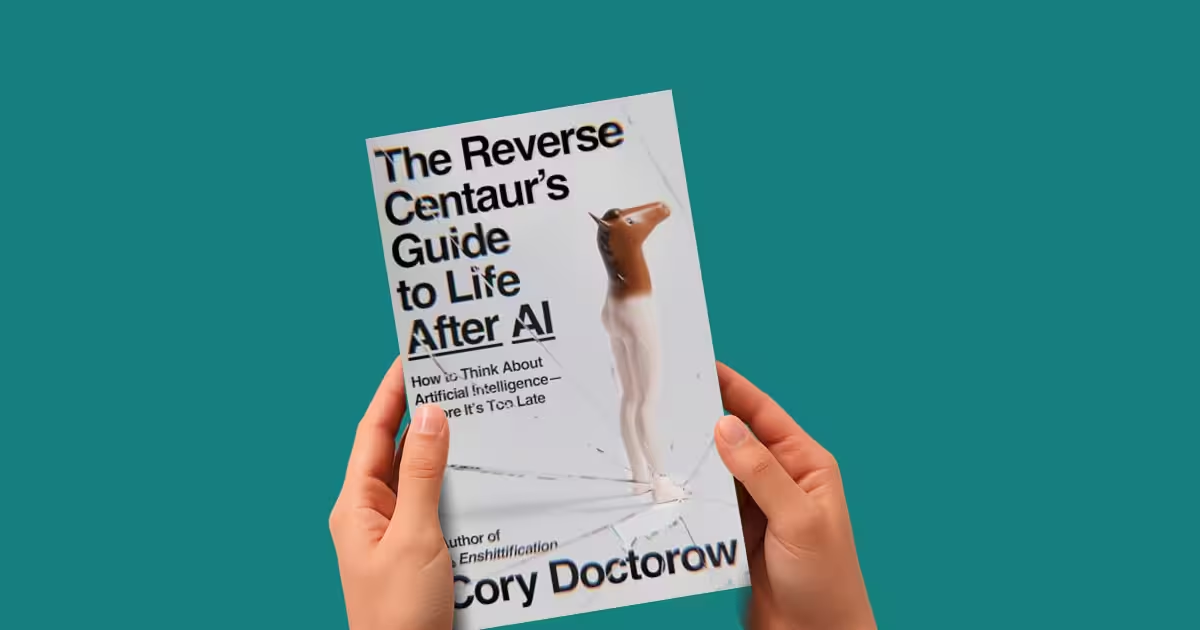
Does AI work for you, or do you work for it? That single question sits at the centre of Cory Doctorow’s sharpest, most urgent nonfiction The Reverse Centaur’s Guide to Life After AI, and if you have ever found yourself accidentally summoning a chatbot while trying to send a text, or rubber-stamping AI output at a speed no human brain was designed for, you already know the answer Doctorow is going to give you.
The Reverse Centaur’s Guide to Life After AI (Farrar, Straus and Giroux / MCD, first edition June 2026) is a ferociously readable, politically blunt, and factually well-grounded argument that the current AI wave is an investor bubble dressed in workers’ clothing. Doctorow does not hate technology.
He hates the social arrangements that make technology serve capital at the expense of labour. The Reverse Centaur’s Guide to Life After AI is part economics primer, part labour manifesto, part science-fiction theory of technology, and it is, taken as a whole, one of the most important pieces of critical nonfiction published in 2026.
The Reverse Centaur’s Guide to Life After AI is best for anyone who feels vaguely uneasy about AI but cannot quite articulate why; tech workers, writers, illustrators, and programmers watching their jobs get squeezed; readers who liked Doctorow’s Enshittification (2025) and want the AI-specific follow-up; anyone who suspects the hype is outrunning the reality but lacks the economics vocabulary to say so clearly.
Not for readers looking for a neutral, on-the-fence overview of AI’s pros and cons. Doctorow is not neutral. He takes sides, loudly and with evidence. If you want a balanced “it’s complicated” take, you will find this book frustrating rather than clarifying.
Table of Contents
Introduction
The Reverse Centaur’s Guide to Life After AI is a work of nonfiction by Cory Doctorow, published in its first edition in 2026 by MCD / Farrar, Straus and Giroux in the United States, with Verso Books handling the UK edition. The subtitle, How to Think About Artificial Intelligence — Before It’s Too Late, signals both Doctorow’s alarm and his pragmatism: he is not writing a eulogy for humanity but a tactical guide for people who still have time to push back.
Doctorow is a Canadian-American author, journalist, blogger, and digital rights activist. He has written more than thirty books, including the Little Brother trilogy, the novel Walkaway, and the nonfiction works Chokepoint Capitalism, The Internet Con, and the bestselling Enshittification: Why Everything Suddenly Got Worse and What to Do About It (2025). For more than twenty years, he has worked with the Electronic Frontier Foundation on digital rights.
He maintains a daily newsletter at Pluralistic.net and was co-editor of Boing Boing for nineteen years. Born in Toronto, he now lives in Burbank, California.
The Reverse Centaur’s Guide to Life After AI is about AI, but its central claim is not really about artificial intelligence as a technology. It is about power. Specifically, it is about who gets to decide how a technology is used, who benefits from it, and who is made to serve it.
Doctorow’s thesis, stated plainly in the introduction, is this: “The most important thing about the gadget isn’t what it does, it’s who it does it for and who it does it to.” Everything else in The Reverse Centaur’s Guide to Life After AI is a sustained, evidence-packed elaboration of that single idea.
Background
To understand The Reverse Centaur’s Guide, it helps to know where it sits in Doctorow’s larger body of work. His 2025 book Enshittification explained why digital platforms degrade over time: they first attract users, then advertisers, then extract maximum value from both while delivering as little as possible to either.
The Reverse Centaur’s Guide is, in a real sense, a sequel. The same companies that enshittified search engines, social media, and streaming platforms are now leading the AI charge, and Doctorow’s argument is that they are pulling the same scam with a bigger budget.
He also draws on How to Destroy Surveillance Capitalism (2020), in which he dismantled the myth that ad-tech had invented a “mind-control ray,” and Chokepoint Capitalism (co-written with Rebecca Giblin, 2022), which exposed how consolidated entertainment companies exploit creative workers.
The Reverse Centaur threads all of these together. The Reverse Centaur’s Guide to Life After AI reads like the capstone of a decade-long intellectual project: first he showed us why the internet got worse, then he showed us why creative workers were getting squeezed, and now he shows us why AI is the next move in the same game.
The Reverse Centaur’s Guide to Life After AI Summary
The Centaur and the Reverse Centaur
Doctorow opens with two stories about freelance writers using AI. The first is Marco Buscaglia, a Chicago journalist who, in May 2025, produced a syndicated sixty-four-page “Best of Summer” supplement for King Features Syndicate using chatbots. Ten of the fifteen books on his summer reading list did not exist. The AI had hallucinated them. Buscaglia was publicly humiliated and confessed to a reporter at 404 Media.
The second writer is Doctorow himself. He needed to find a quote from a podcast he had listened to but could not remember the name of. He downloaded Whisper, a free open-source speech transcription model, fed it thirty to forty hours of podcasts, let it run in the background, and found the quote in minutes. He writes: “This was a great experience. It was a great AI experience.”
Two freelance writers, using AI. One miserable outcome, one delightful one. Why the difference?
The answer, Doctorow argues, lies in the concept of the centaur and the reverse centaur, drawn from automation theory. A centaur is a person assisted by a machine: a cyclist, a car driver, someone using a hearing aid or a calculator. The human is in charge.
A reverse centaur is a human conscripted into acting as an assistant to a machine. Doctorow writes: “A reverse centaur is a human who is conscripted into acting as an assistant to a machine.” The I Love Lucy chocolate factory episode, where Lucy and Ethel have to work at superhuman speed to keep up with a conveyor belt, is the comic version.
Amazon warehouse workers, monitored by AI cameras that penalise “time off-task” and generate injury rates that Doctorow describes as “the highest level of on-the-job injuries in the U.S. warehouse sector,” are the horror-movie version. Workers who cannot visit the toilet because doing so would blow their quota — and thus resort to urinating in bottles — are the reality of what reverse-centaur labour looks like in 2025.
Buscaglia was a reverse centaur. He was set up, Doctorow argues, not to use AI but to absorb blame for AI’s failures. His job was to do the work of dozens of writers, researchers, editors, and fact-checkers in a timeframe that guaranteed errors. Doctorow, using Whisper on his own terms, was a centaur. The difference was not the technology. It was the power relationship.
“The centaur/reverse centaur distinction,” Doctorow writes, “is the heart of the paradox at the heart of the debate about the usefulness of AI tools. When you find yourself surrounded by people swearing that a given tool is worse than useless and others swearing that it has made their lives easier and better, you can bet that the former group is made up of reverse centaurs who’ve had AI imposed upon them, the latter group is all centaurs who’ve gotten to make up their own minds about where, when, and how to use AI tools.”
Against Inevitabilism
The second major thread running through The Reverse Centaur’s Guide to Life After AI is what Doctorow calls “inevitabilism”: the argument, made explicitly or implicitly by tech company executives and their allies, that there is only one possible way to deploy AI and that workers have no choice but to adapt.
He traces this back to Margaret Thatcher, who repeated “There is no alternative” so frequently that critics nicknamed her “Tina.” Doctorow argues that tech bosses — Zuckerberg, Cook, Bezos, Schmidt — are practising the same rhetorical move: insisting that their behaviour is not a choice but an inexorable response to market forces or technological progress. This is, he argues, a bully’s trick. Technology does not determine its own social arrangements. People do.
He illustrates this with a beautifully simple analogy: the cash register. Before the cash register, a skilled grocery clerk commanded power because the skills required to sum up orders accurately and make change reliably were genuinely scarce.
After the cash register, the pool of potential clerks widened dramatically, and bosses could cut wages, add duties, or reduce staff. But Doctorow points out that this was not inevitable.
In a unionised shop or a worker-owned cooperative, the same cash register could instead free clerks from boring arithmetic, let them spend more time with customers, and, if the store’s profits increased, give workers a share of those gains. “The boss who tells you that the only way to use a cash register is to fire your coworkers and make you do their jobs, too, is practicing vulgar Thatcherism,” he writes. “They’re trying to bamboozle you with inevitabilism.”
Science fiction, Doctorow argues, is the natural opponent of inevitabilism. By imagining many different possible futures, each of which feels real and achievable, science fiction reminds us that the future is not fixed.
The current arrangement of AI — imposed on workers, designed to shrink wage bills, aimed at investors rather than users — is a choice, and it can be unchosen. William Gibson’s famous maxim, “The street finds its own use for things,” is the rejoinder to Thatcher’s “There is no alternative.”
Really Weird Math: The AI Bubble
The longest and most economically detailed section of The Reverse Centaur’s Guide to Life After AI explains why AI is, in Doctorow’s assessment, a financial bubble rather than a genuine technological revolution.
He walks through the structure of growth companies: the reason a company like Tesla, losing money every year in 2020, was valued at a price-to-earnings ratio of more than 1,000:1 while the profitable Ford traded at less than 10:1. Investors pay enormous premiums for growth because a company that is growing is a company whose future revenues are unknowable — and therefore, at least theoretically, unlimited.
The problem is that mature companies cannot sustain growth indefinitely. Once a company’s market share plateaus, it must find new territories to conquer. Hence Google jammed Google+ into every product it owned in 2011 and then spent tens of billions of dollars every year to maintain its search monopoly.
Hence Facebook paid $60 billion chasing a metaverse nobody wanted.
Hence every major tech platform is now “pivoting to AI” — not because AI is transformatively useful to ordinary users, but because AI is a story that can convince Wall Street that otherwise mature companies still have vast new markets ahead of them.
Doctorow details the accounting gimmicks that inflate the apparent scale of AI investment. Microsoft, for instance, “invests” tokens in OpenAI that can only be spent on Microsoft data centre access. When those tokens are redeemed, Microsoft books them as AI revenue. He compares this to an ice cream parlour giving you tokens for the video-game machines on the back wall and then counting both the gift and the spending as real economic activity. OpenAI books Microsoft’s investment at face value, assuming retail pricing for wholesale quantities of computation — the equivalent of expecting a bulk order of ice cream to cost the same per scoop as a single cone.
In a paper published in the Journal of Hospitality Marketing and Management in June 2025, two business school professors reported that more than 90 percent of survey respondents said they were less likely to use a product advertised as AI-based.
This raises an obvious question: what accounts for all those impressive quarterly statistics about “increasing AI adoption” and “AI engagement”? Goodhart’s Law, Doctorow argues. When a metric — user engagement with AI — becomes a target, employees find ways to make the number go up that have nothing to do with users actually wanting AI.
He describes accidentally activating Google’s AI assistant while taking a picture, switching apps, sending a text, replying to a text, dictating an email, and searching settings for a way to turn AI off.
Each of those accidental activations is logged as an “engagement.” In 2025, seven companies — Nvidia, Microsoft, Alphabet, Apple, Meta, Tesla, and Amazon — accounted for 35 percent of the value of all U.S. stocks, with Nvidia alone representing 19 percent of those seven. “The entire U.S. economy hangs in the balance,” Doctorow writes, and he is not using hyperbole.
The Funny Math Gets Dangerous: What AI Is Actually Selling
Morgan Stanley and other investment banks have published market analyses claiming AI could be worth $16 trillion. Doctorow unpacks how these figures are generated: analysts identify categories of workers whose jobs AI might theoretically perform, multiply the number of workers by their average salary, apply a discount to estimate what employers would pay for AI to do the same work, and add up the totals.
There are approximately 32,000 radiologists in America, earning an average of $360,000 a year. If AI could do their work and hospitals would pay 80 percent of that equivalent sum for the software, that is $9.216 billion in addressable market from radiology alone.
But this analysis, Doctorow argues, confuses two entirely different ways of deploying AI in radiology. The first, which he calls the centaur configuration, pairs each radiologist with an AI that offers a second opinion. Where the human and the AI disagree, the radiologist checks the X-ray again. This costs more than current practice — more radiologists or the same number doing fewer studies plus an AI licence — but it improves patient outcomes. Companies do not get rich selling this. The second configuration is the reverse centaur version.
The hospital fires most of its radiologists. The survivors become “humans in the loop,” confirming AI diagnoses at a rate no human brain can sustain meaningfully. The medical literature on “automation blindness” is robust: when people are tasked with reviewing a system that is almost always correct, they rapidly lose the ability to detect the rare cases when it is wrong.
The TSA, Doctorow notes, excels at spotting water bottles — something that happens often — but government red-team tests of TSA security find that agents almost always fail to detect concealed weapons — something that rarely happens, and therefore never gets practice.
The same pattern repeats across every industry where AI is being pushed hardest. Lawyers filing AI-generated briefs full of hallucinated citations to cases that do not exist. Academic publishers producing textbooks full of AI-generated nonsense.
Springer Verlag, one of the world’s largest scientific publishers, published a $169 AI textbook called Mastering Machine Learning: From Basics to Advanced that was, according to watchdog publication Retraction Watch, filled with hallucinated references to imaginary papers. When contacted, Springer’s spokesperson said the company relied on “full human oversight.”
Amazon’s programmers, described in a spring 2025 New York Times investigation by reporter Noam Scheiber, were transformed from engineers solving technical problems to workers frantically rubber-stamping AI-generated code they did not have time to scrutinise properly, under quotas that could only be met by using AI and therefore accepting its errors. In other words, Amazon was treating its engineers the same way it treats its warehouse workers.
Doctorow also details the 2017 story about AI replacing truck drivers — which turned out to conflate professional long-haul drivers with delivery drivers for whom the “last-mile” problem is entirely irrelevant to automation.
The Bureau of Labor Statistics category “driver/sales workers and truck drivers” includes florists’ van drivers, water delivery workers, furniture delivery teams — all roles where a human still has to ring your doorbell, carry the parcel up the stairs, and get your signature. “Congratulations, you’ve just invented a shitty version of a train,” Doctorow writes of proposals for autonomous long-haul convoys running on dedicated interstate lanes.
AI Art: Not Theft, But Not Art Either
One of The Reverse Centaur’s Guide to Life After AI‘s most philosophically interesting chapters deals with generative AI and creative work. Doctorow is careful to separate two questions that often get conflated: whether AI art is theft (a legal and copyright question) and whether AI art is good (an aesthetic question).
He spends most of the chapter on the second.
His definition of art is precise and personal: art is what happens when an artist has “a big, numinous, irreducibly complex feeling” and infuses it into a medium — a novel, a painting, a song — in hopes of making a facsimile of that feeling materialise in the minds of the audience. Art is, in Doctorow’s framing, a communicative act. It transmits something that cannot be precisely stated, via a very strange but very satisfying means.
A finished novel represents millions of micro-decisions — word choice, sentence structure, pacing, character — most of them made below the threshold of conscious deliberation, each one in service of that original numinous feeling.
An AI image generator, by contrast, makes statistical guesses about pixels. It has no feeling to transmit. The only communicative content in an AI-generated image is whatever was in the human prompt. Everything else — all those millions of pixels — is, in Mark Fisher’s term, “eerie”: “there is something present where there should be nothing.”
The image has the appearance of intention without an intender. As Doctorow puts it: “AI art is often dismissed as ‘soulless,’ but I think a better term is ‘eerie.'”
He predicts that as audiences become accustomed to seeing brushstrokes without an intender behind them, the eeriness will fade and the soullessness will remain.
He is careful not to rule out the possibility that an AI and a human artist might someday collaborate to produce something genuinely moving — but points out that every example he has seen of impressive AI art involved enormous amounts of human labour: many rounds of prompting, extensive selection among variations, substantial post-processing with tools like Photoshop.
In those cases, the human artist is doing most of the communicative work, and the AI is just a very unusual medium.
The copyright argument, Doctorow says, is a tactical mistake by creative workers. Copyright has expanded enormously over the past forty years — longer terms, wider coverage, stiffer penalties — and yet the share of entertainment industry profits going to actual creators has fallen, not risen, over the same period.
This is because copyright is an alienable property right, and creators almost always have to sell it to a consolidated entertainment industry to get their work in front of audiences. “Economism,” the reduction of all policy questions to economic equations, treats more copyright as automatically benefiting creators, but ignores the power asymmetry between atomised individual artists and the five big publishers, four big studios, three big music labels, two big app companies, and one dominant ebook retailer that currently control the industry.
The AI labour fight is a labour fight, Doctorow insists, not a copyright fight.
The Labour Argument: Why Bosses Love AI
One of The Reverse Centaur’s Guide to Life After AI‘s most pointed claims is straightforward: bosses want AI not because it is good at doing workers’ jobs, but because it frightens workers.
A boss who can credibly threaten employees with replacement has enormous leverage in negotiations over wages, conditions, and unionisation. “The mere existence of a widely accepted AI story can help suppress the wages of workers, even before AI is deployed,” Doctorow writes. Workers who anticipate replacement accept lower wages, drop demands for better conditions, and avoid organising collectively.
He quotes AI consultant Elijah Clark, who told Gizmodo: “AI doesn’t go on strike. It doesn’t ask for a pay raise.” That is not a description of AI’s technical capabilities. It is a description of what bosses find appealing about it.
The Hollywood writers’ strike of 2023, during which Doctorow spent time on the picket line with members of WGA and IATSE 839, illustrated this dynamic clearly. Studio executives did not want chatbots because chatbots write better screenplays than WGA writers.
They wanted chatbots because chatbots do not push back on bad ideas, do not walk off set, and do not demand residuals. One picketing writer put it perfectly: “You prompt a chatbot exactly the way a studio exec gives notes to a writers’ room: ‘Make me E.T., except it’s about a dog, and there’s a love interest, and give it a car chase in the third act.'”
The difference is that writers are “bolshie and mouthy” and tell executives when their notes are stupid. Chatbots are not, and do not.
Actual, Existing AI: What It Is Really Being Used For
Doctorow draws a sharp distinction between AI as it is being hyped — superintelligent, job-replacing, world-transforming — and AI as it actually exists and operates in commercial deployments right now.
The most commercially lucrative existing AI applications, he argues, are things like surveillance pricing and algorithmic wage discrimination.
Delta Air Lines announced a partnership in July 2025 with an Israeli surveillance pricing firm called Fetcherr, stating publicly that the company would use AI to charge each passenger a different price based on commercial surveillance data about them. (Delta subsequently insisted the announcement had been misunderstood — but Doctorow notes that other airlines made similar announcements around the same time.)
Amazon charges different prices depending on whether you are logged in as a Prime member.
Uber uses data about how often drivers accept bad rides to infer their financial desperation and lower the wages offered to drivers it identifies as more economically vulnerable. Legal scholar Veena Dubal has named this “algorithmic wage discrimination,” and Doctorow describes its spread to nursing, where four apps now dominate contract nurse placement, using nurses’ credit histories to lower wages offered to those with high debt.
He also devotes a chapter to what he calls “Absent Indians and Gujarati People Typing”: the recurring phenomenon of AI systems that turn out to be backed by low-paid human workers.
Amazon’s cashierless grocery stores, which the company claimed used “AI cameras” to automatically track purchases, were in fact monitored by up to three workers in Indian call centres per shopper. GM’s Cruise subsidiary, which operated “self-driving” taxis in San Francisco until a pedestrian was struck and dragged twenty feet, turned out to have every vehicle supervised by 1.5 engineers at all times — at higher cost than a conventional taxi driver.
Elon Musk’s 2021 “Tesla Bot” robot was a dancer in a robot suit.
Builder.ai, once valued at more than $1 billion by investors including Microsoft, claimed to build apps using AI but was actually farming the work out to eight hundred to one thousand low-paid Indian programmers. “The GPT in ChatGPT stands for Gujarati People Typing,” is the joke now circulating among Indian software workers.
After the Bubble: What Survives
Every bubble produces some residue, Doctorow argues. The dot-com bubble funded the training of millions of people in HTML, JavaScript, and Python, and that expertise remained after the collapse. WorldCom’s fraudulent fiber-optic overbuilding left behind a global dark fiber network that still carries internet traffic today.
The crypto bubble will leave behind a handful of cryptography experts and familiarity with new programming languages. What will the AI bubble leave?
Doctorow is honest about the environmental cost: AI training runs consume water and energy at a scale that imposes climate costs on everyone on the planet for generations, and those costs are already locked in.
The economic crash, when it comes, will affect pension savings, index funds, and ordinary savers around the world. “We’re talking about a crash that will put 2008 in the shade,” he writes.
But there will be some useful residue. Open-source, stand-alone AI models — the kind that run on a personal computer or phone, without connecting to a corporate cloud — are genuinely useful, Doctorow argues. Whisper, the OpenAI transcription model released as open-source software, is an example. It does one thing well, consumes modest computing resources, and because it is open-source, it can be maintained indefinitely by anyone who wants to. On-device image processing is already impressive: his two-year-old Google Pixel phone can remove people from the background of photos, generate alternative versions of images, and transcribe text in photographs.
These capabilities will outlast the bubble, distributed freely across the open-source ecosystem.
After the bubble pops, Doctorow envisions a world in which excellent speech-to-text transcription, better translation tools, and a handful of genuinely useful AI-powered utilities exist as boring, familiar features of everyday software — like spell-check, not like Skynet.
He also highlights the Human Rights Data Analysis Group (HRDAG), founded by mathematician Dr. Patrick Ball, as an example of genuinely beneficial AI use. HRDAG uses machine learning to process terabytes of unstructured data from police departments — scanned documents, audio recordings, video footage — to identify patterns in wrongful arrests, racial discrimination in parole decisions, and extrajudicial killings in conflict zones.
In Colombia, HRDAG used machine learning to de-duplicate fifty years of records from the country’s civil war and attribute killings to specific parties. In California, it quantified racial discrimination in parole board decisions. This is AI serving human rights rather than investor portfolios.
The Reverse Centaur’s Guide to Life After AI‘s final pages contain Doctorow’s clearest statement of his broader argument: “The future is up for grabs. It is not inevitable. AI isn’t a genie that can’t be put back into a bottle. How we use AI is up to us. Whether we use AI is up to us. The future can be ours, if we never stop remembering that the most important fact about a technology isn’t what it does, it’s who it does it for, and who it does it to.”
The Reverse Centaur’s Guide to Life After AI Analysis
The Reverse Centaur’s Guide to Life After AI is an important, ferociously well-argued, and at times exhilarating book. Let me be direct: it belongs on the same shelf as Shoshana Zuboff’s The Age of Surveillance Capitalism, Nick Srnicek’s Platform Capitalism, and Kate Crawford’s Atlas of AI — books that refuse to treat technology as neutral and insist on asking who benefits and who pays.
What Doctorow gets absolutely right is the investor-audience insight. The observation that AI hype is aimed at Wall Street, not at ordinary users, reframes everything. Once you understand that Google’s quarterly statistics on “AI engagement” are designed to maintain a growth story for investors — not to describe actual user satisfaction — the entire landscape of AI coverage looks different.
The billboards on Route 101 advertising AI products to commuters are not aimed at the commuters; they are aimed at the twelve venture capitalists in the cars that happen to also be on that road. This is not a conspiracy theory. It is a description of how growth-stock capitalism works, and Doctorow explains it more clearly than anyone I have read.
The centaur/reverse centaur framework is also genuinely useful. It cuts through the binary “AI is good” versus “AI is bad” debate by recentering the question on power. The same technology can be either, depending on whether the worker is choosing to use it on their own terms or being conscripted to serve it.
That is not an ideological claim. It is an empirical observation, supported by the testimonies of Amazon engineers in the New York Times, of call-centre workers absorbed into chatbot systems, of radiologists whose expertise is being demoted to human QA for algorithmic diagnoses.
Where The Reverse Centaur’s Guide to Life After AI is harder for me is in its certainty about the bubble’s imminent collapse. Doctorow is very confident that the AI bubble will burst, and relatively soon. He may well be right — the unit economics he describes really are terrible, every major AI company really is losing money, and Stein’s Law genuinely does apply. But he does not engage seriously with the possibility that one or two of these companies might reach genuine profitability through some combination of capability improvements, cost reductions, or novel applications he has not considered. The dot-com bubble did burst, but it did not kill the internet.
The bubble’s collapse may not restore the world to the pre-AI status quo any more than 2001 restored us to the pre-web economy.
There is also a gap in the practical guidance. Doctorow tells workers to organise, to resist inevitabilism, to fight the boss rather than the technology. He is right that this is the correct strategic frame.
But for a nurse whose hospital has deployed an AI-backed scheduling app that cuts her wages algorithmically, or a programmer whose code review quota has tripled because Amazon bought a chatbot, “organise collectively” is correct but insufficient.
Reviewer and critic Russell Brandom noted in The Verge that even self-driving car advocates like Andrew Ng were essentially asking pedestrians to change their behaviour to accommodate the limitations of the technology — and Doctorow sees this clearly in the AI context.
Nevertheless, a chapter on what individual workers or small groups can do right now, before the union arrives, would have strengthened the book considerably.
Strengths and Weaknesses
Strengths:
The prose is outstanding. Doctorow writes with the confidence of someone who has spent twenty years explaining complex digital-rights concepts to non-specialist audiences, and it shows.
The ice-cream-parlour token analogy for Microsoft-OpenAI accounting is one of the best pieces of explanatory writing I have read this year. The cash-register illustration of how technology’s social effects are determined by power rather than function is elegant.
The P/E ratio explanation — which demystifies why tech companies are so fixated on growth — is genuinely revelatory. One reviewer at It’s A Binary World called it the moment “late stage capitalism finally made sense to me,” and I found the same.
The Reverse Centaur’s Guide to Life After AI is also admirably specific. Doctorow does not deal in vague claims about AI’s potential to transform industries. He cites the 2025 paper in the Journal of Hospitality Marketing and Management. He names Jason Koebler of 404 Media.
He refers to the New York Times report by Noam Scheiber. He cites Veena Dubal’s research on algorithmic wage discrimination. He acknowledges the HRDAG by name. The book reads like the work of a journalist who has done his homework, not a polemicist recycling talking points.
The aesthetic argument in the AI Art chapter is also original and carefully reasoned. The definition of art as a communicative act, the identification of AI art as “eerie” in Mark Fisher’s sense, and the prediction that eeriness will fade to soullessness as audiences become habituated — these are not common arguments and they deserve serious engagement.
Weaknesses:
Repetition is a real problem. Several examples — the Amazon warehouse worker, the Air Canada chatbot, the Hollywood writers’ strike, the truck-driver statistics — recur multiple times across different chapters.
This is partly a consequence of Doctorow’s blog-based writing process (many of these ideas were developed publicly on Pluralistic.net before being compiled into a book), and partly because the centaur/reverse centaur framework is so flexible that it illuminates almost every example he uses. But a tighter editorial hand could have trimmed perhaps fifteen percent of the text without losing any of the argument.
The Reverse Centaur’s Guide to Life After AI also underplays some genuine uncertainties.
Doctorow is very confident that AI’s current capabilities will not improve enough to justify the investment. This may be true — the evidence he presents on unit economics is compelling.
But the history of technology contains many examples of capabilities that improved faster than expected once the right engineering insight was found. DeepSeek, which he discusses in the book’s closing section, is itself an example: a $6 million model from a hedge fund’s AI team that matched the performance of models costing hundreds of billions to develop. Doctorow uses this to argue that the big companies are wasting money.
But one could equally read it as evidence that AI capabilities can improve sharply when engineers stop throwing money at problems and start solving them with ingenuity.
Books like Reverse Centaur’s Guide
Readers who found The Reverse Centaur’s Guide compelling will want to read these alongside it:
Kate Crawford, Atlas of AI (2021): Crawford’s rigorous, field-researched examination of what AI systems actually require — rare earth mineral extraction, low-paid data labellers, enormous physical infrastructure — complements Doctorow’s political-economy analysis. Crawford is less polemical but no less critical.
Shoshana Zuboff, The Age of Surveillance Capitalism (2019): Zuboff’s foundational work on how tech companies monetise behavioural data is essential background for Doctorow’s surveillance-pricing chapter. More academic in tone, but deeply compatible in argument.
Nick Srnicek, Platform Capitalism (2017): A shorter, denser analysis of why tech companies converged on data-extraction business models. Doctorow’s work can be read as a popular extension of Srnicek’s economic argument.
Emily M. Bender and Alex Hanna, The AI Con (2025): Co-authored by two of the researchers Doctorow cites in The Reverse Centaur’s Guide (Bender is referenced multiple times), this book catalogues specific harms from existing AI deployments in employment, finance, and the justice system. Doctorow calls it “an excellent job cataloguing these abuses.”
Hagen Blix and co-author, Why We Fear AI (2025): Cited positively by Doctorow in the book’s introduction, this offers a somewhat different perspective on AI risk that readers wanting a more nuanced view of existential concerns may find useful.
Conclusion
The Reverse Centaur’s Guide to Life After AI is a bracing, specific, and surprisingly hopeful book. Surprisingly hopeful because Doctorow does not end on a note of apocalypse.
He ends by arguing that the future is genuinely open, that the current arrangements are not inevitable, that open-source models running on commodity hardware represent a real and usable residue of an otherwise destructive bubble, and that the most important question — who does this technology do it for, and who does it do it to? — is one we still have the power to answer.
It is a book that will make AI boosters angry and AI doomers confused, because it refuses both the techno-utopian and techno-apocalyptic scripts. What it offers instead is a materialist, labour-centred, power-conscious framework for evaluating AI claims — one that cuts through the fog of investor hype and existential panic to ask the questions that actually matter.
If you are a writer, a programmer, a nurse, a radiologist, a delivery driver, or anyone else whose working life has been touched by AI — whether with genuine delight or grinding frustration — The Reverse Centaur’s Guide to Life After AI will give you the vocabulary and the analytical tools to understand exactly what is happening to you, and why. That alone is worth the cover price.







