Last updated on November 6th, 2026 at 11:38 am
Why does the man voted “Citizen of the Year” turn out, years later, to have raped and strangled thirty-three young men in his spare time? That is the question sitting underneath every page of Robert I. Simon’s Bad Men Do What Good Men Dream, and it kept me up two nights in a row.
Not because the case histories are gruesome, though several are, but because Bad Men Do What Good Men Dream keeps turning the question back on the reader.
Overview
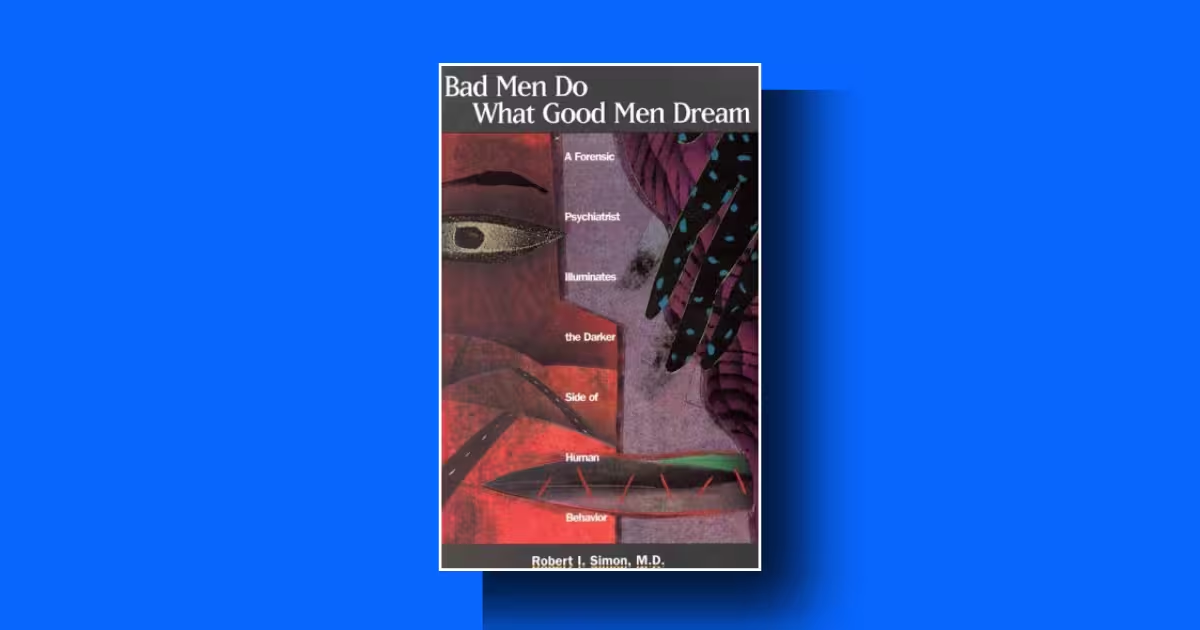
Bad Men Do What Good Men Dream: A Forensic Psychiatrist Illuminates the Darker Side of Human Behavior is a 2008 revised edition from forensic psychiatrist Robert I. Simon, M.D., who spent more than four decades evaluating criminal defendants and treating private patients out of the same office.
His argument, repeated across twelve chapters on psychopaths, rapists, stalkers, workplace killers, cult leaders, sexually abusive therapists, and serial sexual murderers, is simple to state and hard to sit with: the psychological raw material behind the worst crimes in this book (envy, rage, the wish for total control, the urge to punish someone for how we feel) is present in every one of us.
What separates a “bad” man from a “good” one is mostly whether that material stays in fantasy or gets acted out. Bad Men Do What Good Men Dream is strong on case material and clinical reasoning, weaker on some of its statistics, which have not aged well since 2008. I still think it is worth reading, with that caveat firmly attached.
Bad Men Do What Good Men Dream is a good fit if you read true crime for the psychology rather than the gore, if you are a psychology, social work, criminal justice, or pre-med student who wants a clinician’s account of antisocial and psychopathic behavior instead of a Wikipedia summary, or if you have ever wondered why an ordinary-looking neighbor turned out to be capable of something monstrous.
It is not for you if you want current crime statistics (many of the numbers here date to 2005 and 2006), if you are looking for a tidy self-help program, or if descriptions of sexual violence and child abuse, handled clinically rather than graphically, are more than you want to read about right now.
Table of Contents
Introduction
Bad Men Do What Good Men Dream: A Forensic Psychiatrist Illuminates the Darker Side of Human Behavior is a 2008 revised first edition from Robert I. Simon, M.D., published by American Psychiatric Publishing (ISBN 978-1-58562-294-8, 340 pages).
Simon was Clinical Professor of Psychiatry and founding Director of the Program in Psychiatry and Law at Georgetown University School of Medicine, and he served as President of the American Academy of Psychiatry and the Law from 2005 to 2006.
He wrote or edited roughly twenty books over his career, including the standard Textbook of Forensic Psychiatry, and his earlier work Clinical Psychiatry and the Law was cited by the U.S. Supreme Court in Washington v. Harper (1990). Simon died in 2016, and this book, alongside his suicide-risk and forensic-ethics textbooks, is generally regarded as part of his lasting contribution to the field.
Bad Men Do What Good Men Dream itself is a mix of clinical textbook and true crime narrative, built around real case files (Ted Bundy, Jeffrey Dahmer, the BTK killer Dennis Rader, John Wayne Gacy, spy Jack Walker, cult leaders Jim Jones and David Koresh) alongside composite patient vignettes drawn from Simon’s own forensic and clinical practice. Its central thesis, stated plainly in the preface, is that “bad” and “good” people are not different species.
Both carry the same aggressive and self-serving impulses. What separates them is whether those impulses stay contained in fantasy, get channeled into work, art, or competition, or get translated directly into destructive action.
Background
Bad Men Do What Good Men Dream has a longer history than its 2008 copyright page suggests. American Psychiatric Press first published it in 1996, and it was reviewed positively enough in venues like the American Journal of Psychiatry and the Dutch journal Psychologie to justify a second printing in 1999.
This 2008 edition is a genuine revision rather than a reprint: Simon added material on internet-enabled stalking, corporate psychopaths, cyberstalking, school shootings (the 2007 Virginia Tech killings appear directly in the text), and a new cast of serial killers and terrorists, including the September 11 hijackers.
That update matters for how you should read the book today. It means the psychiatric reasoning is current to a working forensic psychiatrist writing in 2007 and 2008, while a portion of the crime statistics are frozen at that same moment, which is now nearly two decades in the past.
Bad Men Do What Good Men Dream Summary
1. Illuminating the Darker Side of Human Behavior
Simon opens with Bad Men Do What Good Men Dream‘s whole argument in miniature. Forty years of forensic and clinical practice, he writes, convinced him that there is no real gulf between the “everyday, upright citizen” and the criminal defendant.
He walks through evidence for this from several directions: the Milgram-style observation that ordinary people loot after disasters and cheat on their taxes without ever considering themselves criminals, the fact that even the Dalai Lama has described violent dreams to interviewers, and Hannah Arendt’s account of the “banality of evil,” in which ordinary bureaucrats, not monsters, kept the paperwork running for the Nazi death camps.
He also introduces Jeffrey Dahmer’s trial as a test case for his own thesis, since a killer who ate parts of his seventeen victims looks like the strongest possible counterexample to “bad men are just like us.”
Simon’s answer is that Dahmer’s most extreme, and rarest, traits (necrophilia, cannibalism, ritualized dismemberment) sit on the far end of a continuum whose milder end includes ordinary sadism, ordinary dominance-seeking, and ordinary cruelty that never needs to be a serious crime.
2. Human Killing Machines and Us: A Psychology of Evil
Chapter two asks why serial killers fascinate the public, and answers with a Jekyll-and-Hyde framework: men like Rader (a church council president and Cub Scout leader by day), Gacy (a children’s party clown), and Bundy (a charming law student) all hid in plain sight because their ordinary daily selves were, by every outward measure, genuinely ordinary.
Simon defines evil, for his own clinical purposes, as the intentional or reckless infliction of harm, and argues the psychological engine behind it is a failure of empathy paired with devaluation and projection onto the victim. Killers like Gacy and Bundy called their victims “trash” and “damaged goods” for exactly this reason: dehumanizing language makes cruelty psychologically possible.
The same mechanism, on a vastly larger scale, explains how ordinary Nazi functionaries who were certified mentally “normal” by psychiatrists at trial could spend the day organizing genocide and the evening listening to music with their families.
3. Psychopaths: The Predators Among Us
This is the book’s clearest clinical chapter. Simon traces the diagnosis from Hervey Cleckley’s 1941 description of the “mask of sanity” through the DSM’s shift from “psychopath” to “sociopath” to today’s antisocial personality disorder, and profiles FBI double agent Robert Hanssen and the Walker family spy ring as real-world illustrations.
He cites a national survey putting lifetime psychopathy risk at 5.8% of men and 1.2% of women, and notes that psychopaths make up roughly 20% of the U.S. prison population while committing more than half of violent crime, rising to 75% or more inside maximum-security units.
The chapter’s most useful distinction, for a general reader, is between passive-parasitic psychopaths (con artists, embezzlers, the doctor who fakes credentials) and aggressive ones (the minority who become violent).
Simon is also blunt about treatment: psychopathy has one of the worst treatment records in psychiatry, and some studies show therapy actually makes psychopathic patients better manipulators rather than healthier people.
4. Why Do They Rape? The Inner Life of Rapists
Simon opens with the case of Henry Hubbard, a decorated police officer unmasked as a serial rapist after forensic evidence (bite marks, sand on his clothes, an engraved flashlight) connected him to a beach assault.
From there he lays out the four-part clinical typology still used in forensic rape evaluation: the compensatory rapist, driven by fantasies of romantic conquest that mask deep feelings of inadequacy; the exploitative rapist, whose assault is opportunistic and driven by circumstance more than fantasy; the sadistic rapist, for whom the victim’s suffering is the actual point of arousal; and the displaced-anger rapist, for whom sex is almost incidental to pure rage, often set off by an unrelated humiliation.
He backs this up with figures that remain sobering regardless of their age: in the mid-2000s, roughly one in four American women could expect to be raped in her lifetime, only about 16% of assaults were reported to police, and less than 5% of accused rapists ever went to prison.
Simon is also careful to push back on the “stranger in the bushes” stereotype. Roughly two-thirds of rape victims know their attacker, and acquaintance rape is chronically underreported because it does not fit the stereotype victims themselves have been taught to expect.
5. Stalkers: Forever Yours
Using the 1992 murder of art student Kristin Lardner by an ex-boyfriend who had already served probation for a prior knife attack on a different woman, Simon sketches a typology of stalkers: the immature romantic (typically an infatuated adolescent whose pursuit fades with maturity), the dependent, rejection-sensitive stalker (an adult version of the same pattern, often violent), the borderline stalker (prone to sudden swings between idealizing and hating the same person), and the celebrity stalker (often psychotic, exemplified by Mark David Chapman and by Robert John Bardo, who killed actress Rebecca Schaeffer after she sent him a friendly thank-you note for a fan letter).
The statistics here are genuinely alarming: more than a million American women and 370,000 men are stalked annually, and in cases that later became fatal, 76% of victims had been stalked by the partner who eventually killed them, while 54% of women who had already reported stalking to police were later murdered by their stalker anyway.
6. Workplace Violence: Is Your Job a Dead End?
Simon opens with Gian Luigi Ferri’s 1993 rampage through the San Francisco law firm of Pettit and Martin, which killed eight people including Ferri himself, then broadens out to a typology of mass murder (classic, family, spree, serial) using cases from Charles Whitman’s 1966 University of Texas tower shooting through the 2007 Virginia Tech massacre.
He is specific about risk factors: paranoia combined with depression, a recent loss of status or a relationship, and access to weapons, and he notes that roughly 40% of psychiatrists report being assaulted at some point in their careers, almost always during a first meeting with an unfamiliar patient.
He closes the chapter with a genuinely practical checklist that clinics and offices can use to flag a potentially violent employee or patient before, not after, a crisis.
7. Multiple Personality and Crime: A Real Whodunit
Anchored by the unusual 1990 Wisconsin trial in which a rape victim with dissociative identity disorder had several of her named “personalities” separately sworn in to testify, this chapter is really about the roots of dissociation in childhood trauma.
Simon reports that 97% of diagnosed cases involve severe abuse before age six or seven, and walks through how “destructive” alternate personalities, formed in response to that abuse, can occasionally commit violent acts the “host” personality has no memory of.
He also uses Susan Smith’s 1994 killing of her two sons to make a related point: he found no support in the clinical literature for cold, calculated child murder by mothers, and traces most such cases to acute depression, panic, or dissociation rather than premeditated cruelty.
8. The Ultimate Betrayal: Sexual Misconduct in the Helping Professions
This chapter of Bad Men Do What Good Men Dream documents real disciplinary and malpractice cases against psychiatrists (Jules Masserman, a former American Psychiatric Association president accused of sedating and abusing patients), against Harvard psychiatrist Margaret Bean-Bayog in the Paul Lozano case, and against clergy, lawyers, and teachers, framing all of it around how “boundary violations” creep in gradually rather than happening all at once.
The most useful statistic here cuts against the obvious assumption: in surveys, 95% of male therapists and 76% of female therapists admitted feeling sexually attracted to a patient at some point, yet only 9.4% of the men and 2.5% of the women ever acted on it. Simon’s point is that attraction itself is not the problem. Failing to recognize and manage it, session by session, is.
9. You Only Die Once, But Did You Intend It? The Forensic Psychiatrist As Sleuth
Simon walks through his own specialty within a specialty: the “psychological autopsy,” used to determine whether an ambiguous death was suicide, accident, or murder.
He reconstructs the disputed deaths of White House Counsel Vincent Foster, Marilyn Monroe, and publisher Robert Maxwell, then contrasts them with a composite case in which forensic pathology (an oddly tied noose, a body found nude when the victim’s history made that inconsistent) helped convict a husband of staging his wife’s murder as a suicide.
It is the closest Bad Men Do What Good Men Dream comes to a procedural thriller, and it is genuinely well built.
10. Messianic Madness: Killer Cults to Holy Warriors
Opening with the September 11 hijackers, then moving through David Koresh’s Branch Davidians at Waco and Jim Jones’s 1978 Jonestown mass suicide of more than 900 people, Simon defines a cult less by its beliefs than by its structure: a charismatic leader, an enmeshed membership, and total submission of individual judgment to the group.
He cites estimates that 500 to several thousand cults operate in the United States at any time (the range itself, he admits, is genuinely disputed among researchers), with something like 5 to 7 million Americans having belonged to one at some point. He is careful to note that only a minority of cult members show significant pre-existing mental illness.
Most are drawn in during an ordinary period of loneliness, grief, or transition, which is precisely what makes the phenomenon worth taking seriously rather than dismissing as something that only happens to unstable people.
11. Serial Sexual Killers: Your Life for Their Orgasm
The most difficult chapter in Bad Men Do What Good Men Dream opens with Andrei Chikatilo, the Soviet-era “Rostov Ripper” convicted of at least fifty-two murders, and Simon uses the case to explain what actually separates serial sexual murder from other categories of killing: an eroticized fantasy of total control over another person, refined and escalated over years, in which the killing itself becomes the point rather than a means to another end.
He works through FBI figures putting the true number of active serial killers somewhere between 50 and 500 in the U.S. at any time, responsible for a few thousand deaths annually, and flags the frequently repeated claim that the United States produces roughly 75% of the world’s serial sexual killers as likely an artifact of better American crime detection and record-keeping rather than a real behavioral difference, a caveat that gets dropped whenever the statistic is quoted elsewhere online.
12. Character and Destiny: The Making of Good Men and Women
Bad Men Do What Good Men Dream ends by turning the diagnostic lens around.
Instead of another catalogue of pathology, Simon lays out what psychological health actually looks like in ordinary adults: a stable sense of self that does not depend on constant outside approval, a conscience that is firm without being punishing, the capacity to feel guilt and make repairs rather than shift blame, and the ability to sit with painful feelings in fantasy long enough to choose a constructive action instead of a destructive one.
He is candid that no one hits all of these consistently, quoting Yale chaplain William Sloane Coffin’s line, “I’m not okay, you’re not okay, and that’s okay,” and closes on a genuinely hopeful note: the same raw psychological material that produces monsters, when it is acknowledged rather than denied, is also the material out of which ordinary decency, creativity, and love get built.
Bad Men Do What Good Men Dream Analysis
Bad Men Do What Good Men Dream is, at its best, a serious attempt to explain criminal behavior without either excusing it or treating it as alien.
Simon does not sit in judgment of the people he describes, and he does not pretend to fully understand men like Bundy either. What he does instead, consistently, is trace behavior back to a mechanism: failed empathy, projection, dehumanization of the victim, a childhood pattern of abuse repeating itself in adulthood.
That mechanism holds up remarkably well across twelve very different subjects, from spies to stalkers to cult leaders, and it is what separates this book from a straightforward true crime anthology. The forensic cases are also genuinely well chosen.
Several, like the psychological-autopsy chapter on Vincent Foster and Marilyn Monroe, or the multiple-personality rape trial in chapter seven, are cases I had not encountered in any of the more famous true crime books I had already read, which is a real point in the book’s favor for a reader who feels oversaturated with Bundy and Dahmer content specifically.
Where the book runs into trouble is accuracy, and it is worth being direct about this rather than glossing over it. A working forensic psychologist reviewing the book on Goodreads called it “basic and oversimplified” and flagged specific factual errors, and other reader reviews echo the same complaint about loosely sourced statistics.
Having checked a sample of Simon’s own citations against his bibliography, I think the criticism is fair on specifics even where the underlying argument holds. Some of the crime figures (rape reporting rates, cult population estimates, the “75% of serial sexual killers are American” claim) come from single studies or FBI estimates that were already contested when Simon wrote them down in 2007 and 2008, and criminology has moved on in the years since.
Readers who want current numbers should treat every statistic in Bad Men Do What Good Men Dream as a starting point for their own search, not a settled fact.
Strengths and Weaknesses
What works: Simon’s forty years of combined clinical and forensic practice give the case material a texture that a journalist writing from the outside could not produce.
His composite patient vignettes, drawn from his own private practice rather than lifted from other true crime books, add clinical detail that generic serial killer content generally skips, particularly around the far more common (and far less discussed) categories like workplace violence, therapist sexual misconduct, and dissociative identity disorder.
The final chapter’s reversal, from pathology to a working definition of psychological health, gives the book an ending with actual use, rather than leaving the reader simply unsettled.
What does not work as well: the statistics problem described above is real, and it means this cannot function as a citable reference text without independent verification.
The book’s dual audience (clinicians and general readers) occasionally shows: some chapters read like a psychiatric textbook with a plot, others like a true crime magazine feature, and the tonal shift between them can be jarring.
A few sections, particularly the more graphic case vignettes used to illustrate rape and sexual sadism typologies, are more clinically explicit than most general readers will expect from the cover copy, and readers sensitive to depictions of sexual violence and child abuse should know that going in.
Comparison With Similar Other Works
Simon’s book sits closest to Robert D. Hare’s Without Conscience, which covers similar psychopathy research with a tighter clinical focus and none of the true crime narrative framing.
It also predates, and in my opinion argues its underlying thesis with more clinical weight than, Jon Ronson’s later bestseller The Psychopath Test, which covers overlapping ground (corporate psychopaths, the Hare checklist) in a lighter, more journalistic register aimed at a mass audience.
Readers who enjoyed the FBI profiling material in John Douglas and Mark Olshaker’s Mindhunter will recognize some of the same serial-killer case files here, filtered instead through a treating psychiatrist’s clinical reasoning rather than a criminal profiler’s investigative one.
And Simon’s repeated invocation of Hannah Arendt’s “banality of evil” connects this book directly to Arendt’s own Eichmann in Jerusalem, which is worth reading alongside this one if the workplace-violence and cult chapters interest you specifically.
On the philosophical side, Simon’s argument that the line between good and evil runs through every person rather than between people echoes Fyodor Dostoevsky, whom Simon quotes directly in two separate chapter epigraphs; readers drawn to that idea in fiction rather than clinical case study form should look at The Brothers Karamazov or Nietzsche’s Beyond Good and Evil.
Conclusion
I finished Bad Men Do What Good Men Dream convinced of its central argument and skeptical of a meaningful share of its supporting statistics, and I think both of those reactions are the correct ones to have.
As a case-driven introduction to forensic psychiatry for a curious general reader, a psychology or criminal justice student, or a true crime reader who wants the clinical reasoning behind the headlines rather than another rehash of the same six killers, it earns its place on the shelf.
As a source of current crime statistics, it does not, and I would send anyone doing research or citing figures professionally to primary FBI, DOJ, or peer-reviewed sources instead. Read it for the psychology. Verify the numbers yourself.
If Simon’s argument about ordinary human darkness interests you, you may also want to look at Robert Greene’s The Laws of Human Nature for a less clinical, more strategic take on the same material, Ernest Becker’s The Denial of Death for the deeper existential roots of destructive behavior, or Sopranu’s own roundup of the 100 Best Psychology Books of All Time for where this one fits in the wider field.
Frequently Asked Questions
What is the main argument of Bad Men Do What Good Men Dream?
Robert I. Simon argues that there is no fundamental difference between “good” people and violent criminals. Both carry the same aggressive, self-serving psychological impulses. The difference is whether those impulses stay in fantasy and get channeled into ordinary life, or get acted out as crime.
Who is Robert I. Simon, the author?
Robert I. Simon, M.D. (1934 to 2016) was Clinical Professor of Psychiatry and founding Director of the Program in Psychiatry and Law at Georgetown University School of Medicine, and served as President of the American Academy of Psychiatry and the Law from 2005 to 2006. He authored or edited roughly twenty books on forensic psychiatry over his career.
Is Bad Men Do What Good Men Dream based on true stories?
Yes. Most cases are drawn from real, publicly documented criminal trials, including Ted Bundy, Jeffrey Dahmer, BTK killer Dennis Rader, spy Robert Hanssen, and cult leaders Jim Jones and David Koresh, alongside anonymized composite patients from Simon’s own clinical and forensic practice.
Is Bad Men Do What Good Men Dream scientifically accurate?
Its clinical reasoning on psychopathy, empathy, and trauma holds up well and reflects mainstream forensic psychiatry. Several of its specific crime statistics, drawn from mid-2000s sources, have been disputed by other reviewers and should be checked against current FBI or DOJ data before being cited as current fact.
What are the 12 chapters of the book about?
The chapters cover, in order: Bad Men Do What Good Men Dream‘s core thesis, the psychology of evil, psychopaths, rapists, stalkers, workplace violence, dissociative identity disorder and crime, sexual misconduct by therapists and clergy, forensic psychological autopsies, cults, serial sexual killers, and a closing chapter on the traits of psychological health.
Who should read Bad Men Do What Good Men Dream?
It suits general readers interested in criminal psychology, students in psychology, social work, or criminal justice, and true crime readers who want clinical reasoning rather than sensational retelling. It is not the right choice for anyone who needs current crime statistics or wants to avoid clinical descriptions of sexual violence and child abuse.
Related reading: The Stranger Beside Me: The Haunting True Crime Classic That Redefined the Genre