
Last updated on November 6th, 2026 at 11:37 am
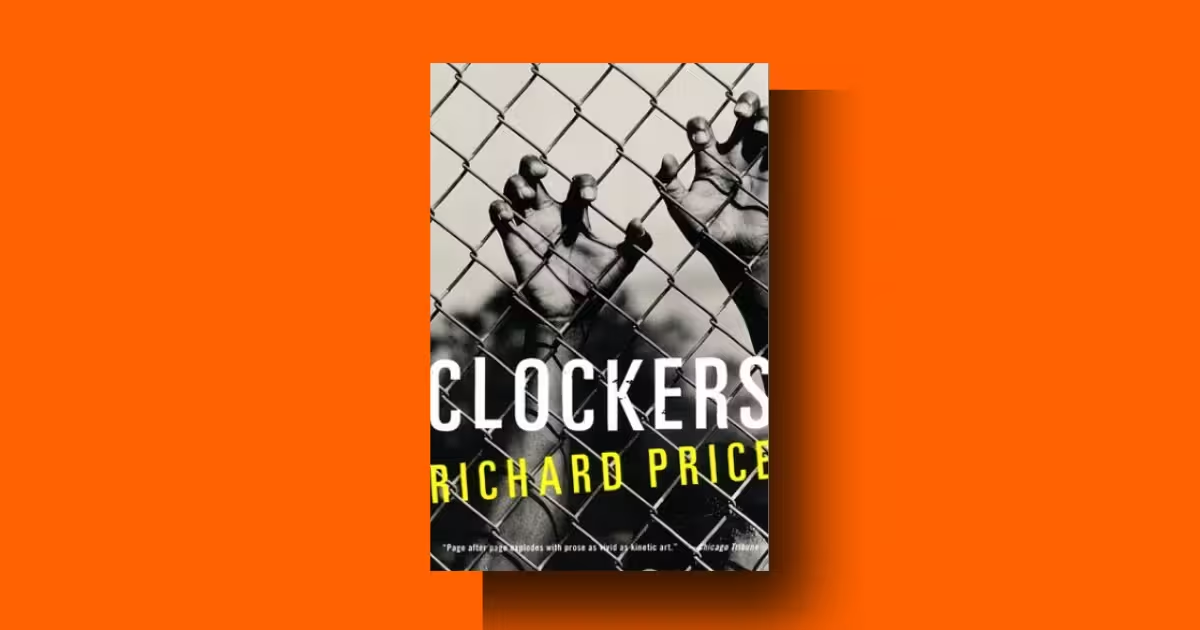
Did you ever wonder why some people are forced to grow up before they even have a chance to be kids? It is a question that haunts every page of Richard Price’s urban classic, Clockers.
Overview
In Clockers, Richard Price paints an unflinching portrait of a young street dealer and a burnt-out cop trapped in a mutual game of survival where trust is the most dangerous weapon.
Clockers is perfect for readers who appreciate deeply researched police procedurals and raw human drama, but it will not work for those looking for lighthearted escapism or neat happy resolutions. Price shows us exactly why survival on the street means following rigid rules like “trust no one, don’t get greedy, and never do product.”
Table of Contents
1. Introduction
Title: Clockers
Author: Richard Price
Publication Details: Published in 1992 by Houghton Mifflin/Bloomsbury.
Context of Clockers: This novel is an incredibly detailed look at the drug trade in the fictional city of Dempsy, New Jersey. Richard Price spent years riding along with real police officers and talking to street dealers to capture the exact vernacular and daily grind of this world.
2. Background
The story takes place in the early 1990s, right in the middle of the crack epidemic that swept across American cities. Dempsy is an industrial wasteland right across the river from Manhattan.
It is a place where economic desperation makes selling drugs one of the only viable careers for young men. The narrative is split between two perspectives.
One side shows the Clockers, the lowest rung of drug dealers who work around the clock. The other side shows the homicide detectives who police them.
3. Clockers Summary
The Grind on the Benches
Our story begins in the Roosevelt Houses in Dempsy, where nineteen-year-old Ronald “Strike” Dunham manages a crew of young drug dealers. Strike is completely stressed out. He suffers from a bleeding ulcer and constantly chugs vanilla Yoo-Hoo to soothe his stomach.
He manages his crew with a mixture of fear and strict rules, constantly scanning the area for the housing police known as the Fury.
He relies on marketing novelties like “two-for-one Happy Hours, Jumbos, Redi Rocks and Starter Kits” to keep the money flowing. Strike hates depending on the young girls who hang around to hold the product, knowing they can be unpredictable.
He faces constant harassment from cops like
Big Chief and Thumper, who routinely strip-search him right on the street. Strike survives by keeping his hands clean and making sure he never carries the product himself.
Rodney’s Demands
Strike wants to move up in the drug world and get off the street. His boss is Rodney Little, a local drug lord who operates out of a candy store called Rodney’s Place. Rodney drives a beat-up, rust-colored Cadillac decorated with suction-cup Garfield cats in the windows. Rodney treats Strike like a favored son, but it is a toxic relationship.
The store itself is a front that openly sells the trinity of base coke preparation: baking soda, Chore Boy scouring pads, and rubbing alcohol. Rodney eventually pulls Strike aside with a dangerous request.
He casually suggests that Strike needs to kill another dealer named Darryl Adams who has been stealing from the operation. Strike is terrified of violence. He does not want to do it, but he knows that refusing Rodney could mean his own death.
The Confession and the Cop
Strike happens to run into his older brother, Victor. Victor is the complete opposite of Strike. He is a hardworking family man holding down two low-paying jobs to support his wife and children.
He is exhausted and frustrated by his poverty, especially when he sees drug dealers making easy money. Strike vents to Victor about his problem with Rodney and Darryl.
Shortly after this conversation, Darryl Adams is found shot dead. Enter Rocco Klein and his partner Larry Mazilli, veteran homicide detectives who catch the case.
They expect it to be just another routine drug killing. But then, to everyone’s surprise, Victor Dunham walks into a police station and confesses to the murder. Mazilli is thrilled to have a closed case, but Rocco smells a rat.
He looks at Victor’s clean record, his two jobs, and his family, and he simply cannot believe this man committed a cold-blooded murder. Rocco discovers that Victor’s brother is Strike, a known drug dealer. Rocco immediately assumes that Strike manipulated his innocent brother into taking the fall for a drug hit.
The Pressure Cooker
Rocco makes it his personal mission to bring Strike down.
He begins aggressively harassing Strike on the street, letting the other dealers know that Strike is talking to the police. This is a deliberate tactic to make Strike look like an informant, which puts a massive target on his back.
Rodney Little starts to get paranoid. Rodney thinks Strike might snitch on the whole operation to save himself. Strike is trapped. He is squeezed by Rocco on one side and Rodney on the other. His ulcer flares up constantly, and he finds solace only in playing with model trains, his secret hobby and a symbol of his desperate desire to escape Dempsy.
The Climax and the Ending Explained
The tension reaches a boiling point. Rodney orders a hit on Strike, forcing Strike to go on the run. Meanwhile, Rocco digs deeper into Victor’s life and finally realizes the tragic truth. Strike did not manipulate Victor. Victor actually committed the murder.
The sheer exhaustion of working himself to the bone while still living in poverty finally broke him. Victor snapped when he saw Darryl Adams flaunting his drug money, and he shot him in a fit of exhausted rage.
Rocco is devastated by this realization. He wanted the bad guy to be the drug dealer, not the hardworking citizen. In the end, Victor goes to prison.
Strike, having narrowly survived a murder attempt by one of Rodney’s enforcers, realizes he can never go back to his old life. Rocco, feeling a strange sense of responsibility, actually helps Strike get a bus ticket out of town.
The book ends with Strike sitting on a bus heading west, finally leaving Dempsy behind. He is alive, but he has lost everything. The cycle of the streets continues without him.
4. Clockers Analysis
4.1. Clockers Characters
Strike Dunham: Strike is incredibly complex. He is a criminal, but he is not a monster.
He is terrified of the violence around him. His entire existence is based on hyper-vigilance. He is smart, but his intelligence is entirely focused on staying out of jail and staying alive.
Rocco Klein: Rocco starts out as a cynical, burnt-out cop who just wants to slide into retirement. His obsession with Strike is partly about justice, but it is mostly about his own ego. He wants to prove he is still a great detective. By the end, his worldview is completely shattered when he realizes the “good” brother is the actual killer.
Victor Dunham: Victor represents the crushing weight of poverty. He plays by the rules, works hard, and gets absolutely nowhere. His transition from a model citizen to a murderer is the tragic core of the story.
Rodney Little: Rodney is a ruthless businessman who actively profits off the destruction of his own community. He masks his cruelty with a paternal, mentoring attitude toward his young dealers, but he will gladly sacrifice them to protect his profits.
4.2. Clockers Themes and Symbolism
A major theme is the failure of the American Dream. Victor tries to achieve it through hard work and fails. Strike tries to achieve it through illegal capitalism and ends up running for his life.
Another theme is the blurred line between the police and the criminals. The cops and the Clockers share the same streets, use the same slang, and play a never-ending game of cat and mouse.
Symbolism is heavy in Strike’s habits. His model trains represent his deep desire for control and his wish to travel far away from his current life.
The vanilla Yoo-Hoo he constantly drinks is a symbol of his youth and the physical toll the street takes on his body. He is practically a child, but the stress is literally eating a hole in his stomach.
5. Clockers Evaluation
Clockers is an unsparing, gritty masterpiece of suburban-adjacent urban collapse.
Strengths: The dialogue is absolutely perfect. You feel like you are standing on the corner listening to these people talk. The procedural details of both selling drugs and investigating murders are meticulously researched.
Weaknesses: The pacing slows down heavily in the middle sections. The constant back-and-forth between Rocco and Strike can feel repetitive before the final climax kicks in.
Impact: The book changed how crime fiction handles urban environments. It proved that you could write a thriller that also functions as serious sociological fiction.
Comparison with similar Works: It heavily inspired television masterpieces like The Wire. In fact, Richard Price later wrote for The Wire, and the DNA of Clockers is evident in how that show treats its street-level dealers.
6. Personal insight with contemporary educational relevance
The reality of this book gives us profound lessons about society today. If you look up urban sociological literature on www.sopranu.com, you will often find resources analyzing these exact community dynamics. Here are five practical lessons drawn from the story:
The myth of easy money: Young people are lured into the drug trade by the promise of wealth, but the reality is constant fear, low wages for the street-level workers, and a high probability of death or prison.
The physical cost of anxiety: Strike’s bleeding ulcer is a prime example of how chronic stress physically destroys the body. This is highly relevant today as we study the health outcomes of people living in high-crime neighborhoods.
The limits of law enforcement: Rocco Klein’s massive blind spot regarding Victor shows how confirmation bias affects police work. Cops can become so fixated on a narrative that they miss the actual truth standing right in front of them.
Economic despair creates violence: Victor’s downfall shows that when people work themselves to exhaustion and still cannot feed their families, the psychological pressure can lead to tragic, explosive actions.
The need for safe spaces: Strike’s obsession with model trains shows a desperate need for a hobby or a safe haven. Without community centers or safe outlets, youth in these environments have nowhere to escape the pressure.
7. Clockers Quoted
- “You can’t trust nobody, so keep your back to the wall and your eyes open 24, 7, 365.”
- “A bunch of sneaker dealers: get ten dollars, run out and buy a ten-dollar ring.”
- “The kids around the pool table and the video game were mostly here by default, half of them living on the street or with mothers on the pipe.”
- “Everything was smoke. Everything was pay phones in the middle of the night.”
8. Conclusion
Richard Price has created a living, breathing world in this novel. The detailed observations of both police procedure and street survival make it a truly unforgettable read.
I highly recommend this book for fans of realistic crime fiction, urban sociology, and anyone who appreciates complicated character studies.
The story forces you to look past the headlines and see the terrified, exhausted human beings caught in the gears of the city.







