
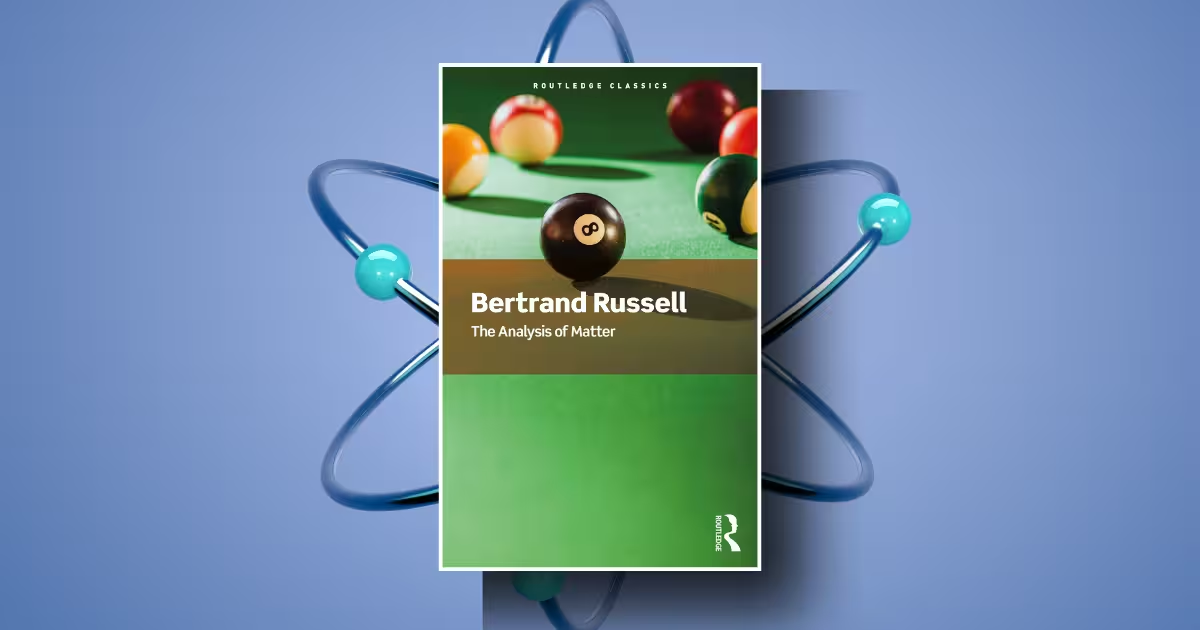
Have you ever wondered if the table in front of you actually exists? We live in a world where we trust our senses implicitly—until we don’t. The Analysis of Matter by Bertrand Russell challenges everything you think you know about physical reality. This isn’t another dry physics textbook; it’s a philosophical excavation of what matter actually means in the age of relativity and quantum mechanics.
If you’ve ever questioned whether the chair you’re sitting on is “real” or just a collection of mathematical relationships, Russell’s work will forever change how you understand the physical world.
Overview
Bertrand Russell’s The Analysis of Matter (1927) represents a monumental attempt to reconcile the abstract, mathematical world of modern physics with the concrete, perceptual world of human experience.
At its core, the book argues that matter is not a substance but a logical construction composed of events, and that the traditional divide between mind and matter is philosophically indefensible.
Russell demonstrates that the objects of physics—electrons, protons, space-time points—are all complex structures built from more fundamental entities called “events,” and that perception itself is a physical process happening within the brain.
The book achieves something remarkable: it shows that physics, for all its mathematical precision, reveals only the structural properties of the physical world, never its intrinsic character. This profound insight explains why we can know the equations governing electrons without ever knowing what an electron “feels like.”
Suitable readers
The Analysis of Matter is perfect for:
- Philosophy students grappling with the relationship between perception and reality
- Physicists who want to understand the philosophical implications of their work
- Anyone fascinated by the intersection of science and philosophy
- Readers who enjoyed The Principles of Mathematics or Mysticism and Logic
- Those interested in the history of scientific thought and the development of relativity theory
- Individuals who want to understand how logical analysis applies to empirical science
- Students of epistemology seeking clarity on what we can truly know about the external world
The Analysis of Matter is not for:
- Casual readers looking for a light introduction to physics
- Those without at least a basic understanding of calculus and logic
- People seeking practical applications of scientific principles
- Readers who prefer concrete examples over abstract reasoning
- Anyone who finds mathematical notation intimidating
- Those looking for modern quantum mechanics explanations (the physics here is from 1927)
Table of Contents
Introduction
Title: The Analysis of Matter
Author: Bertrand Russell (1872-1970)
First Published: 1927
Paperback Edition: 1992 (Routledge)
Pages: 417 pages
Preceded By: The ABC of Relativity (1925)
Followed By: The ABC of Atoms (1923) [actually preceded]
Bertrand Russell was one of the most influential philosophers and logicians of the twentieth century. A Nobel laureate in Literature (1950), Russell made groundbreaking contributions to mathematical logic, epistemology, and the philosophy of science.
His work with Alfred North Whitehead on Principia Mathematica (1910-1913) revolutionized formal logic and provided the foundation for much of his later philosophical work.
The Analysis of Matter represents the culmination of Russell’s thirty-year engagement with the philosophical foundations of physics.
As he writes in the introduction, “The Analysis of Matter is the product of thirty years of thinking.” The book emerged from his Tarner Lectures delivered at Trinity College, Cambridge, during the Michaelmas Term of 1926, but contains extensive additional material.
The historical context is crucial: Russell was writing at a time when physics was undergoing revolutionary changes. The theory of relativity had been confirmed in spectacular fashion by Arthur Eddington’s 1919 eclipse observations, and quantum mechanics was rapidly developing through the work of Heisenberg, Schrödinger, and Bohr.
As Russell notes in his preface, “the theory of quanta and of atomic structure is developing with such rapidity that it is impossible to guess what form it will take a few years hence.”
Purpose: The Analysis of Matter‘s central aim is that physics must be interpreted through the lens of logical analysis, revealing that what we call “matter” is not a substance but a logical construction from events and perceptions.
Russell aims to bridge the gulf between the abstract world of physics and the concrete world of perception, arguing that “matter is less material, and mind less mental, than is commonly supposed.”
Background
To fully appreciate The Analysis of Matter, we must understand Russell’s intellectual trajectory. According to John G. Slater’s introduction, Russell first turned his attention to the philosophical foundations of physics in 1896, after completing An Essay on the Foundations of Geometry (1897). At that time, he was still under the influence of neo-Hegelianism, a philosophical position he would later describe as “complete nonsense.”
Russell’s early work on the problem of matter was hampered by the philosophical assumptions he inherited from his Cambridge education.
However, as Slater notes, Russell concluded that “he could make no progress on the problem of matter until mathematics had a firm foundation.” This realization led to the monumental collaboration with Whitehead on Principia Mathematica, which occupied Russell from 1903 to 1913.
The success of Principia provided Russell with two essential tools for his later work: first, confidence in his logical methods; second, a vast array of logical techniques ready to be applied to physics. As he wrote to Lady Ottoline Morrell in 1912, “The sort of thing that interests me now is this: some of our knowledge comes from sense, some comes otherwise; what comes otherwise is called ‘a priori.’ … The analysis of a piece of actual knowledge into pure sense and pure a priori is often very difficult.”
Russell’s grand aim, as Slater explains, was to “distil from physics its a priori part and to axiomatize it; having done that, he would then attempt to define its central concepts in terms of the symbols of mathematical logic.”
This approach mirrors what Whitehead and Russell had achieved for arithmetic: Peano’s axioms for arithmetic contained three non-logical concepts (zero, number, successor), which were given logical definitions in Principia Mathematica, and Peano’s five axioms were proved as theorems from purely logical axioms.
However, Russell encountered significant obstacles. Two concepts central to physics—sensation and causality—proved resistant to logical analysis. Sensation raised the whole question of our knowledge of the external world, forcing Russell to set aside the problem of matter to tackle the problem of knowledge itself.
The outbreak of the First World War interrupted Russell’s work, and it wasn’t until the 1920s that he returned to the problem of matter.
By this time, Russell had embraced “neutral monism”—the view that “the fundamental building blocks of the universe are events, and that events themselves were neutral as between mind and matter.” According to Slater, “mental and material entities differed from one another by the laws by which they were organized out of events.”
This philosophical position, combined with the new physics of relativity and quantum mechanics, finally provided Russell with the framework he needed to complete his analysis.
The Analysis of Matter Summary
Part I: The Logical Analysis of Physics
Russell begins by establishing the philosophical problem: how do we reconcile the abstract world of physics with the concrete world of perception? As he states in Chapter I, “The laws of physics are believed to be at least approximately true, although they are not logically necessary; the evidence for them is empirical. All empirical evidence consists, in the last analysis, of perceptions.”
Chapter II: Pre-Relativity Physics
Russell provides a schematic account of Newtonian physics, noting that it possessed a “perfection which is absent from the physics of the present day.”
The Newtonian system, as Russell summarizes it, posits “an absolute space, composed of points, and an absolute time, composed of instants; there are particles of matter, each of which persists through all time and occupies a point at each instant.”
Russell acknowledges the logical faultlessness of this system while noting that it was criticized on two grounds: “that absolute space and time were meaningless, and on the ground that action at a distance was inconceivable.” He argues that “neither objection had any force from a logical point of view,” noting that “Kant’s antinomies, and the supposed difficulties of infinity and continuity, were finally disposed of by Georg Cantor.”
Chapter III: Electrons and Protons
Russell discusses the atomic structure of matter, noting that “both matter and electricity are concentrated exclusively in certain finite units, called electrons and protons.” He explains that “Protons all have the same mass and the same amount of positive electricity. Electrons all have the same mass, about 1/1835 of the mass of a proton.”
Russell introduces a crucial epistemological point that will become central to his argument: “In the last analysis, all our knowledge of matter is derived from perceptions, which are themselves causally dependent upon effects on our body. … nothing in visual perception alone can enable us to distinguish between two theories which give the same result as regards the light-waves which reach human eyes.”
Chapter IV: The Theory of Quanta
Russell explains Planck’s discovery of the quantum constant (h), noting that “there is a certain constant (h), known as Planck’s constant, such that (\epsilon/\nu) is (h), or (2h), or (3h), or some other small integral multiple of (h). Vibrations with other amounts of energy do not occur.”
He then discusses Bohr’s theory of the hydrogen atom, which explains line spectra through quantum transitions. Russell highlights a significant lacuna in the theory: “we do not know in the least why an electron chooses one moment rather than another to jump from a larger to a smaller orbit.”
Russell also introduces Heisenberg’s new quantum mechanics, noting that “the electron ought to be represented by measurable quantities such as the frequencies of its radiation.” He quotes Heisenberg’s admission that “the time apparently has a different role from the space co-ordinates, and is formally differently treated.”
Chapter V: The Special Theory of Relativity
Russell explains the Lorentz transformation and its implications, noting that “we cannot therefore regard space and time as independent, as has always been done in the past.” He emphasizes that “the order of events in time is not definite: in one system of co-ordinates an event A may precede an event B, while in another B may precede A.”
Chapter VI: The General Theory of Relativity
Russell describes how the general theory “demands an abandonment of all direct relations between distant events, the relations upon which space-time depends being primarily confined to very small regions.” He notes that “geometry and physics are no longer distinct, so long as we are not considering the parts of physics which introduce atomicity, such as electrons, protons, and quanta.”
Chapter VII: The Method of Tensors
Russell explains the mathematical technique that allows physics to express laws independent of coordinate systems. He notes the significance of tensor equations: “if two tensors of the same kind are equal in one system of co-ordinates they are equal in any system of co-ordinates, so that tensor equations express conditions which are independent of the choice of co-ordinates.”
Chapter VIII: Geodesics
Russell explains that “a particle not subject to constraints moves in a geodesic.” He draws a striking analogy: “In the old theory, the sun was like a despotic government, emitting decrees from the metropolis; in the new, the solar system is like the society of Kropotkin’s dreams, in which everybody does what he prefers at each moment, and the result is perfect order.”
Chapter IX: Invariants and Their Physical Interpretation
Russell discusses Eddington’s view that “practically all theoretical physics is a vast tautology or convention.” He notes that “the appearance of deducing actual phenomena from mathematics is delusive; what really happens is that the phenomena afford inductive verification of the general principles from which our mathematics starts.”
Chapter X: Weyl’s Theory
Russell examines Weyl’s attempt to incorporate electromagnetism into relativity theory through the concept of gauge invariance. He expresses some frustration with the abstractness of the theory, noting that “it is difficult to disentangle the conventional elements from those having physical significance.”
Chapter XI: The Principle of Differential Laws
Russell explains that physics assumes “that any connection which may exist between distant events is the result of integration from a law giving a rate of change at every point of some route from the one to the other.” He notes that quantum theory appears to violate this principle, representing a “discrete series of possible sudden changes” governed by statistical laws.
Chapter XII: Measurement
Russell tackles the fundamental problem of measurement, asking “what do we mean by measurement?” He argues that measurement must be connected with important empirical properties: “We do not say that the books in the British Museum are ‘measured’ by their press-marks.”
Chapter XIII: Matter and Space
Russell discusses the nature of matter versus empty space, noting that “the difference between ‘matter’ and ’empty space’ is, I believe, merely a difference as to the causal laws governing successions of events, not a difference expressible as that between the presence or absence of substance.”
Chapter XIV: The Abstractness of Physics
Russell draws important philosophical conclusions: “Physics started historically, and still starts in the education of the young, with matters that seem thoroughly concrete. … But in proportion as physics increases the scope and power of its methods, in that same proportion it robs its subject-matter of concreteness.”
He explains that “the data of sight, analyzed as much as possible, resolve themselves into coloured shapes. But the physical analogue of a colour is a periodic process of a certain frequency relative to the eye of the observer. The physical world, it seems natural to infer, is destitute of colour.”
Part II: Physics and Perception
Chapter XV: From Primitive Perception to Common Sense
Russell traces the development of common sense from infant experience, noting that “very young infants do not possess the common-sense notion of an ‘object.'” He explains how the hand-eye coordination develops through experience, and how “common sense consists of a set of beliefs, or at least habits, which work well in practice.”
Chapter XVI: From Common Sense to Physics
Russell identifies three types of physics based on different sensory experiences: “muscular physics,” “touch physics,” and “sight physics.” He argues that “sight-physics has more and more predominated, and has achieved an almost complete victory over the others in the theory of relativity.”
Chapter XVII: What Is an Empirical Science?
Russell distinguishes between analytic and synthetic propositions, arguing that “propositions which form part of logic, or can be proved by logic, are all tautologies.” He explains that empirical knowledge depends on perception and cannot be deduced from logic alone.
Chapter XVIII: Our Knowledge of Particular Matters of Fact
Russell argues that what we take as knowledge of objects is actually inference from percepts. He states: “I have come to regard these things as inferences. I do not mean that I inferred them formerly, or that other people do so now. I fully concede that I did not infer them. But now, as the result of an argument, I have become unable to accept the knowledge of them as valid knowledge.”
Chapter XIX: Data, Inferences, Hypotheses, and Theories
Russell discusses the nature of scientific evidence, noting that “what is recorded as the result of an experiment or observation is never the bare fact perceived, but this fact as interpreted by the help of a certain amount of theory.”
Chapter XX: The Causal Theory of Perception
Russell presents the causal theory of perception, explaining that “when we ‘see the sun,’ there is a process, starting from the sun, traversing the space between the sun and the eye, changing its character when it reaches the eye, changing its character again in the optic nerve and the brain, and finally producing the event which we call ‘seeing the sun.'”
Chapter XXI: Perception and Objectivity
Russell defines objectivity as “the more correct are the inferences we can draw from a percept as to other events (whether percepts or not) belonging to the same group.” He distinguishes three sources of subjectivity in perception: physical, physiological, and psychological.
Chapter XXII: The Belief in General Laws
Russell examines the foundations of scientific law, noting that “the belief in general laws is rooted in the properties of nervous tissue.” He suggests that “the apparent regularity of the world will be due to the absence of laws” in quantum phenomena.
Chapter XXIII: Substance
Russell criticizes the notion of substance, arguing that it is derived from linguistic structure rather than metaphysical necessity. He writes: “The question is: Are electrons and protons part of the ultimate stuff of the world, or are they groups of events, or causal laws of events?”
Chapter XXIV: Importance of Structure in Scientific Inference
Russell introduces the concept of structure as crucial to scientific inference. He explains that “when two relations have the same structure (or relation-number), all their logical properties are identical.” He notes that “the inference from perceptions to their causes, assuming such inferences to be valid, are concerned mainly, if not exclusively, with logical properties.”
Chapter XXV: Perception from the Standpoint of Physics
Russell argues that percepts are physical events located in the brain. He states: “I shall therefore assume that this is the case, when we are speaking of physical, not sensible, location.” He notes that “the whole of a man’s visual space is, for physics, inside his head.”
Chapter XXVI: Non-Mental Analogues to Perception
Russell argues that physical instruments like cameras and dictaphones have something analogous to perception. He writes: “We may suppose that a great many events are taking place everywhere, since both light and sound can be recorded by instruments and observed by percipients.”
Part III: The Structure of the Physical World
Chapter XXVII: Particulars and Events
Russell introduces his constructive metaphysics, defining “particulars” as the ultimate terms of the physical structure. He explains that “science is concerned with groups of ‘events,’ rather than with ‘things’ that have changing ‘states.'”
Chapter XXVIII: The Construction of Points
Russell develops a method for constructing space-time points from events using the relation of compresence (overlapping). He defines a point as “a co-punctual group of events which cannot be added to without ceasing to be co-punctual.”
Chapter XXIX: Space-Time Order
Russell shows how to develop the ordinal structure of space-time from the relation of compresence. He explains that “the transformations of co-ordinates which are admissible in tensor analysis are not unlimited; they are such, only, as leave relations of neighbourhood unchanged.”
Chapter XXX: Causal Lines
Russell defines material units as causal lines. He writes: “Each material unit is a causal line whose neighbouring events follow each other according to a differential law.”
Chapter XXXI: Extrinsic Causal Laws
Russell examines the Einsteinian theory of gravitation, noting that “the theory consists in ascribing to every region of space-time a metrical structure which is obtained (roughly speaking) by superposing a number of structures which are symmetrical about centres.”
Chapter XXXII: Physical and Perceptual Space-Time
Russell explores the relationship between physical space-time and the space of perception. He notes that “the whole of our perceptual world is, for physics, in our heads, since otherwise there would be a spatio-temporal jump between stimulus and percept which would be quite unintelligible.”
Chapter XXXIII: Periodicity and Qualitative Series
Russell discusses the role of periodicity in physics and suggests that “fundamentally, periodicity is constituted by the recurrence of qualities.”
Chapter XXXIV: Types of Physical Occurrences
Russell proposes a division of physical occurrences into “steady events, rhythms, and transactions.” He explains that “quantum changes consist of ‘transactions,’ i.e. of the substitution, suddenly, of one rhythm for another.”
Chapter XXXV: Causality and Interval
Russell attempts to interpret interval in terms of causal action. He suggests that “we can regard a time-like separation as the measure of the maximum amount of causal action on the various causal routes which lead from one point to another.”
Chapter XXXVI: The Genesis of Space-Time
Russell summarizes his construction of space-time from events, noting that “space-time, as it appears in mathematical physics, is obviously an artefact, i.e. a structure in which materials found in the world are compounded in such a manner as to be convenient for the mathematician.”
Chapter XXXVII: Physics and Neutral Monism
Russell presents his philosophical conclusion: “the events out of which we have been constructing the physical world are very different from matter as traditionally conceived.” He notes that “what are called ‘mental’ events, if we have been right, are part of the material of the physical world.”
Chapter XXXVIII: Summary and Conclusion
Russell summarizes his argument and notes the limitations of his analysis due to the incomplete state of physics. He writes: “In the present state of physics, many questions of considerable philosophical importance cannot be answered.”
The 10 Most Important Takeaways
1. Matter Is Not a Substance—It’s a Logical Construction
Russell argues that what we call “matter” is not a permanent, indestructible substance but a logical structure composed of events. As he writes in Chapter XXIII: “The question is: Are electrons and protons part of the ultimate stuff of the world, or are they groups of events, or causal laws of events?”
Key Quote: “Science is concerned with groups of ‘events,’ rather than with ‘things’ that have changing ‘states.'”
2. We Only Know the Structure, Not the Intrinsic Nature
Perhaps The Analysis of Matter‘s most profound insight: physics can only tell us about mathematical relationships and structures, never what things actually are in themselves.
Key Quote (Chapter XXIV): “When two relations have the same structure (or relation-number), all their logical properties are identical… the inferences from perceptions to their causes, assuming such inferences to be valid, are concerned mainly, if not exclusively, with logical properties.”
Practical Implication: We can know the equations governing electrons without ever knowing what an electron “feels like” or what its intrinsic qualities are.
3. The Physical World Is “Destitute of Colour”
Russell challenges the common-sense notion that physical objects possess the qualities we perceive them to have.
Key Quote (Chapter XIV): “The data of sight, analyzed as much as possible, resolve themselves into coloured shapes. But the physical analogue of a colour is a periodic process of a certain frequency relative to the eye of the observer. The physical world, it seems natural to infer, is destitute of colour.”
This Means: Our perceptions of color, sound, and texture are not properties of the external world—they are how our brains interpret physical processes.
4. Perception Happens in the Brain
According to Russell, if we accept the causal theory of perception, all our percepts are physically located in our heads.
Key Quote (Chapter XXV): “The whole of a man’s visual space is, for physics, inside his head.”
Important Distinction: This is physical location, not sensible location. When I say I see a tree “over there,” the perceptual space is different from physical space.
5. Mind and Matter Are “Neutral Stuff”
Russell rejects both materialism and idealism, arguing instead for “neutral monism”—the view that mind and matter are both composed of the same neutral events, organized differently.
Key Quote (Chapter XXXVII): “What are called ‘mental’ events, if we have been right, are part of the material of the physical world… The distinction between physical and mental is superficial and unreal.”
Why This Matters: It dissolves the traditional mind-body problem—there’s no mysterious interaction between two different substances because they’re made of the same fundamental stuff.
6. Space-Time Points Are Constructed from Events
Russell provides a logical construction showing how space-time points can be built from overlapping events.
Key Quote (Chapter XXVIII): “A ‘point’ is defined as a co-punctual group of events which cannot be added to without ceasing to be co-punctual.”
What This Means: Points aren’t fundamental entities in the world—they’re convenient mathematical structures we create to describe relationships between events.
7. Physical Laws Are Differential, Quantum Phenomena Are Statistical
Russell notes a fundamental tension in physics: the laws of relativity are continuous and differential, while quantum phenomena involve discrete jumps governed by statistical laws.
Key Quote (Chapter XI): “In quantum theory, we have a discrete series of possible sudden changes, and a certain statistical knowledge of the proportion of cases in which each possibility is realized; but we have no knowledge as to what determines the occurrence of a particular change in a particular case.”
The Problem: We don’t know when an electron will jump between orbits—only the probabilities.
8. Measurement Is Not as Simple as It Seems
Russell reveals the philosophical complications underlying the apparently straightforward process of measurement.
Key Quote (Chapter XII): “We do not say that the books in the British Museum are ‘measured’ by their press-marks… There must be properties of importance connected with the numbers assigned.”
The Insight: Measurement isn’t just assigning numbers—it involves theoretical assumptions about what those numbers mean.
9. Common Sense Is a Useful Illusion
While common sense works well in practice, Russell argues it’s theoretically inadequate for understanding physics.
Key Quote (Chapter XVIII): “I have come to regard these things as inferences. I do not mean that I inferred them formerly, or that other people do so now. I fully concede that I did not infer them. But now, as the result of an argument, I have become unable to accept the knowledge of them as valid knowledge.”
The Lesson: Just because something feels obvious doesn’t mean it’s philosophically justified.
10. Induction and Causality Remain Philosophical Problems
Russell acknowledges that science depends on induction and causality, but admits these principles cannot be logically justified.
Key Quote (Chapter XXII): “The belief in general laws is rooted in the properties of nervous tissue… This origin, of course, affords no warrant for the truth of the belief.”
The Confession: We believe in causation because we’re wired to, not because we can prove it. Science rests on faith in regularity—and that faith has pragmatic justification but not logical certainty.
The Analysis of Matter‘s Three Most Surprising Claims
| Claim | Page Reference | Why It’s Surprising |
|---|---|---|
| Percepts are in our heads, not “out there” | Chapter XXV | Contradicts everything we experience |
| Physics tells us nothing about intrinsic qualities | Chapter XXIV | Most people assume science reveals reality |
| Mind and matter are made of the same neutral stuff | Chapter XXXVII | Challenges both materialism and idealism |
One Sentence Summary of Each Major Section
| Section | One Sentence Summary |
|---|---|
| Part I: Logical Analysis of Physics | Modern physics (relativity and quantum mechanics) can be logically analyzed to reveal what it actually asserts—and what it assumes. |
| Part II: Physics and Perception | Perception provides the empirical evidence for physics, but we must critically examine what we can and cannot infer from it. |
| Part III: The Structure of the Physical World | The physical world can be constructed from events and causal lines, with space-time points as logical constructions rather than fundamental entities. |
The Analysis of Matter Analysis
The Brilliance of Russell’s Project
Russell’s The Analysis of Matter stands as one of the most impressive philosophical examinations of physics ever written. What makes The Analysis of Matter remarkable is not just its sophisticated logical analysis but Russell’s willingness to engage with the physics itself.
In contrast to many philosophers who rely on second-hand accounts of science, Russell demonstrates genuine mastery of relativity and quantum mechanics, as evidenced by his earlier popular works The ABC of Atoms and The ABC of Relativity.
The Analysis of Matter‘s central insight—that physics reveals only structural properties, never intrinsic qualities—remains profoundly relevant today.
As Russell writes in Chapter XXIV, “the inferences from perceptions to their causes, assuming such inferences to be valid, are concerned mainly, if not exclusively, with logical properties.” This explains why we can know the equations governing fundamental particles without knowing what those particles are “in themselves.”
Russell’s neutral monism provides an elegant solution to the mind-body problem. By arguing that “mental and material entities differed from one another by the laws by which they were organized out of events,” Russell avoids both the dualism of Descartes and the reductive materialism that would later dominate philosophy of mind.
The Limits of Russell’s Approach
Despite its brilliance, the book has significant limitations. The physics is dated, as Russell himself acknowledged in his preface: “the theory of quanta and of atomic structure is developing with such rapidity that it is impossible to guess what form it will take a few years hence.”
Heisenberg’s matrix mechanics, which Russell discusses, was only published in 1925-26, and the full development of quantum field theory lay decades in the future.
The book’s mathematical demands are considerable, and Russell sometimes fails to provide sufficient non-technical explanations. As he writes in the preface, “some modern doctrines, however, perhaps because they are still recent, I have not succeeded in translating into non-mathematical language.”
Russell’s treatment of quantum theory is also incomplete. He notes the problem of quantum indeterminacy but doesn’t fully explore its philosophical implications. His suggestion that “the apparent regularity of the world will be due to the absence of laws” in quantum phenomena anticipates later interpretations of quantum mechanics but remains underdeveloped.
A Perspective from the Modern Era
From our contemporary vantage point, Russell’s project appears both prescient and limited. His emphasis on the structural nature of physical knowledge anticipated the structural realism that would become influential in philosophy of science. His neutral monism foreshadowed contemporary attempts to resolve the mind-body problem through neutral frameworks.
However, Russell could not anticipate the full development of quantum field theory, the standard model of particle physics, or the ongoing debates about the interpretation of quantum mechanics. The Heisenberg theory he discusses has been superseded by more developed quantum mechanical frameworks.
Nevertheless, the book’s methodological contribution remains invaluable. Russell’s use of logical analysis to clarify physical concepts provides a model for how philosophy can contribute to scientific understanding. His careful distinction between what physics actually asserts and what it assumes provides a framework for understanding scientific theories.
Strengths and Weaknesses
Strengths
- Logically Rigorous: Russell applies the full apparatus of mathematical logic to physical concepts, providing unprecedented clarity about the structure of physical theories.
- Broad Scope: The Analysis of Matter covers relativity, quantum mechanics, and the philosophy of perception, integrating these domains into a coherent framework.
- Neutral Monism: Russell’s solution to the mind-body problem remains one of the most elegant proposals in the philosophy of mind.
- Epistemological Sophistication: Russell’s analysis of what we can and cannot infer from perception provides essential guidance for understanding the relationship between science and experience.
- Historical Value: The book captures a crucial moment in the development of modern physics, documenting the revolution from classical to quantum physics.
Weaknesses
- Dated Physics: The quantum theory discussed is primitive by modern standards, and some of Russell’s speculations are based on incomplete evidence.
- Mathematical Demands: The book requires significant mathematical sophistication, limiting its accessibility.
- Incomplete Treatment of Quantum Phenomena: Russell acknowledges the limitations of quantum theory but doesn’t fully explore their philosophical implications.
- Over-Reliance on Eddington: Russell’s treatment of relativity closely follows Eddington’s interpretation, which is not universally accepted.
- Constructive Ambiguity: Russell’s proposed construction of matter from events is suggestive but not fully worked out.
Comparison with Similar Works
The Principles of Mathematics (1903) by Bertrand Russell
The Principles of Mathematics presents Russell’s earlier work on the foundations of mathematics, arguing for the logicist thesis that mathematics is reducible to logic. The Analysis of Matter extends this logicist approach to physics, attempting to show that physical concepts can be analyzed into logical structures.
Science and the Modern World (1925) by Alfred North Whitehead
Whitehead’s work, published two years before The Analysis of Matter, shares Russell’s concern with the relationship between physics and perception. However, Whitehead adopts a more metaphysical approach, arguing for a process philosophy that Russell found unacceptable.
The Concept of Nature (1920) by Alfred North Whitehead
Whitehead’s early work on the philosophy of nature influenced Russell, particularly the distinction between the “bifurcation of nature.” However, Russell’s logical approach differs from Whitehead’s more speculative method.
Space, Time and Gravitation (1920) by Arthur Eddington
Eddington’s popular account of relativity influenced Russell’s interpretation of Einstein’s theory. However, Russell provides more rigorous logical analysis of the philosophical implications.
The Structure of Scientific Revolutions (1962) by Thomas Kuhn
Kuhn’s later work on paradigm shifts provides a complementary perspective on how scientific theories develop. While Russell focuses on logical analysis, Kuhn emphasizes the sociological and historical dimensions of scientific change.
Conclusion
The Analysis of Matter by Bertrand Russell remains essential reading for anyone seriously interested in the philosophical foundations of physics. Despite its dated physics, the book’s methodological insights continue to illuminate the relationship between scientific theories and the world they describe.
Russell’s central argument—that physics reveals only structural properties, not intrinsic qualities—provides crucial guidance for understanding the scope and limits of scientific knowledge. His neutral monism offers a sophisticated alternative to the simplistic materialism and idealism that dominate popular discussions of mind and matter.
The book’s greatest value lies in its demonstration of how philosophical analysis can clarify scientific concepts. Russell shows that the objects of physics—electrons, protons, space-time points—are not simple entities but complex logical constructions.
This insight remains essential for understanding the relationship between the abstract world of physical theory and the concrete world of human experience.
Recommendation: This book is essential reading for philosophers, physicists, and anyone seriously interested in the relationship between science and philosophy. However, readers with limited mathematical background may find the technical sections challenging.
I recommend reading Russell’s more accessible works (The ABC of Relativity, The ABC of Atoms) before tackling this book.
The ideal reader is someone who wants to understand what physics really tells us about reality, beyond the mathematical formalism. Russell’s analysis of measurement, perception, and inference provides the conceptual tools needed to interpret scientific theories without falling into naive realism or radical skepticism.







