
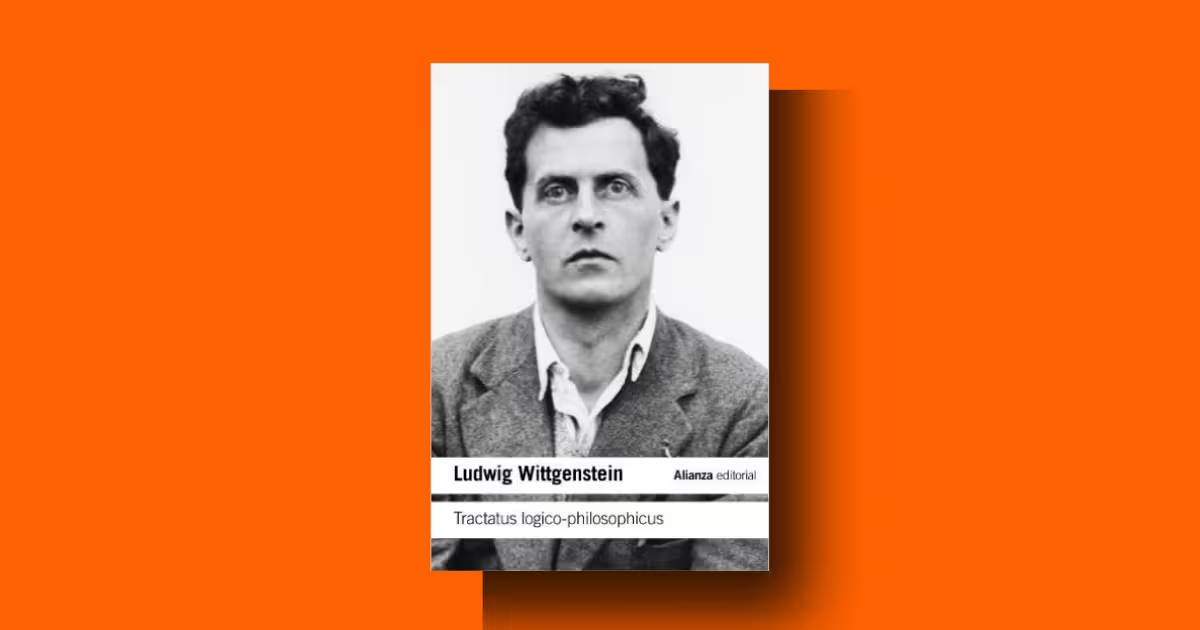
Do you ever feel like the most important things in life—love, meaning, ethics, God—slip through the net of words the moment you try to capture them? If that question lands anywhere near you, then Ludwig Wittgenstein’s Tractatus Logico-Philosophicus isn’t just another philosophy book. It’s a mirror held up to the very limits of your thinking.
First published in German in 1921 (and in English in 1922), this 75‑page masterpiece has been called “one of the most important philosophical works of the twentieth century” and “one of the founding texts of analytic philosophy”.
But here’s the kicker: the book ends by telling you that its own propositions are nonsense. Yes, you read that correctly. Wittgenstein spends over a hundred numbered propositions building an intricate theory of language, logic, and reality—only to declare at the end that you must “throw away the ladder” after using it to climb up.
This is not a book you read. This is a book you survive—and if you survive it, you’re never quite the same.
Overview
The Tractatus Logico-Philosophicus is a fiercely ambitious attempt to draw a boundary around what can meaningfully be said—and to show that everything worth saying (ethics, aesthetics, religion, the meaning of life) lies on the other side of that boundary, in the realm of the unsayable.
Wittgenstein argues that language pictures reality, that all meaningful propositions are truth‑functions of elementary propositions, and that logical propositions (like those of mathematics and logic itself) are “senseless” tautologies that say nothing but show the logical structure of the world.
Tractatus Logico-Philosophicus is notoriously difficult, aphoristic, and self‑undermining: its final proposition (7) commands silence about what cannot be spoken, and proposition 6.54 tells you to recognise the book’s own propositions as nonsensical.
Written in the trenches of World War I and completed during a military leave in the summer of 1918, it influenced the Vienna Circle, logical positivism, and the entire trajectory of analytic philosophy. Yet it also contains a mystical core that later Wittgenstein himself would spend the rest of his life trying to undo.
Reader suitability
Tractatus Logico-Philosophicus is suitable for:
- Philosophy students and academics who want to understand the foundations of analytic philosophy and the linguistic turn
- Readers fascinated by the intersection of logic, language, and mysticism
- Anyone who has ever felt that words fail when confronting life’s deepest questions
- Fans of dense, aphoristic, puzzle‑like texts that reward slow, repeated reading
- Those interested in the history of ideas and how one slim volume reshaped an entire discipline
Tractatus Logico-Philosophicus is not suitable for:
- Casual readers looking for an easy, relaxing read—this is intellectual heavy lifting
- Anyone who expects a straightforward argument with clear conclusions
- Readers who dislike self‑referential paradoxes or books that undermine their own claims
- Those seeking practical advice or self‑help dressed as philosophy
- Beginners with no background in logic, Frege, Russell, or basic propositional logic
Table of Contents
1. Introduction
Book Title: Tractatus Logico-Philosophicus
Author: Ludwig Wittgenstein (1889–1951)
Original German Title: Logisch-philosophische Abhandlung
First Published: 1921 (German in Annalen der Naturphilosophie), 1922 (English translation by C.K. Ogden and F.P. Ramsey)
Notable Editions: Second English translation by D.F. Pears and B.F. McGuinness (1961, revised 1974); new translation by Michael Beaney (Oxford World’s Classics, 2023)
Dedication: “To the memory of my friend David H. Pinsent”
Motto: “… and everything one knows, not merely heard as rumbling and roaring, can be said in three words” – Kürnberger
Context of Tractatus Logico-Philosophicus
The Tractatus Logico-Philosophicus is a work of analytic philosophy that presents a sophisticated version of logical atomism combined with the picture theory of meaning.
Wittgenstein wrote it while serving as a soldier in the Austro‑Hungarian army during World War I, drafting notes in notebooks and completing the manuscript during a period of leave in the summer of 1918.
He was captured by the Italians in November 1918 and spent ten months in prisoner‑of‑war camps, during which he managed to send a corrected copy to Bertrand Russell.
Wittgenstein was deeply influenced by two giants of logic: Gottlob Frege (1848–1925) and Bertrand Russell (1872–1970).
As he acknowledges in his preface: “I am indebted to the magnificent works of Frege and the writings of my friend Mr Bertrand Russell for a large part of the stimulation of my thoughts”.
Frege had invented modern quantificational logic; Russell had discovered the paradox that bear his name and developed the theory of types to resolve it. Wittgenstein saw both the power and the problems in their work—and set out to “clarify” everything by drawing a limit to language from within language itself.
Purpose of Tractatus Logico-Philosophicus
The book’s primary purpose is stated in the preface with characteristic bluntness: “what can be said at all can be said clearly; and of what one cannot talk, about that one must be silent”.
Wittgenstein’s aim is “to draw a limit to thinking, or rather, not to thinking but to the expression of thoughts”.
He believes that the problems of philosophy arise from “misunderstanding the logic of our language”, and that once we understand how language works—how it pictures reality—we will see that most philosophical questions are not false but nonsensical.
The book’s value, Wittgenstein claims, lies in two things: first, “that thoughts are expressed in it”; second, “in showing how little is done when these problems are solved”. This is not false modesty. It is a warning: the Tractatus will not give you answers to life’s big questions. It will show you why those questions cannot even be asked.
2. Background
To understand the Tractatus Logico-Philosophicus, you need to know a little about the intellectual context in which Wittgenstein was writing.
The Frege–Russell Legacy
Gottlob Frege had invented modern quantificational logic, analysing propositions in function‑argument terms rather than the traditional subject‑predicate form. His Begriffsschrift (concept‑script) was a formal notation designed to express all mathematical reasoning.
But Frege’s system had a fatal flaw: Russell’s paradox. Russell discovered that the principle that every concept has an extension (a class of things falling under it) leads to a contradiction when we consider the class of all classes that are not members of themselves.
Bertrand Russell responded with the theory of types, which created a hierarchy of objects, classes of objects, classes of classes, and so on, to prevent any class from being a member of itself. But Russell’s theory had a problem: in trying to state the theory, you violate its own type restrictions. You end up saying things that, by the theory’s own lights, are nonsense.
Wittgenstein saw this as the cardinal problem of philosophy. As he wrote to Russell in August 1919: “The main point is the theory of what can be expressed (gesagt) by propositions—i.e. by language—(and, which comes to the same, what can be thought) and what can not be expressed by propositions, but only shown (gezeigt); which, I believe, is the cardinal problem of philosophy”.
The Picture Theory’s Origin
The picture theory of meaning—arguably the Tractatus Logico-Philosophicus’s most famous idea—was triggered by an unlikely source. On 29 September 1914, Wittgenstein wrote in his notebook:
“In a proposition a world is put together experimentally. (As when in a Parisian law‑court a car accident is represented by dolls, etc.)”
He had apparently read about a Parisian law case where dolls were used to reconstruct a car accident. The insight was sudden and profound: propositions themselves are pictures or models of reality.
Just as the dolls in the courtroom represented the positions of the cars, so the elements of a proposition represent objects in the world, and the way they are combined represents the way things are combined in reality.
3. Tractatus Logico-Philosophicus Summary
The Tractatus is structured around seven main propositions (numbered 1 to 7), each with a tree of subordinate propositions that comment on and elaborate the main claims.
The numbering system is not arbitrary: “The propositions n.1, n.2, n.3, etc., are comments on proposition no. n; the propositions n.m1, n.m2, etc. are comments on proposition no. n.m; and so on”.
Understanding this structure is essential—without it, Wittgenstein said, the book would be “an incomprehensible jumble”.
Proposition 1: The World Is Everything That Is the Case
“1 The world is everything that is the case.
1.1 The world is the totality of facts, not of things.”
This is the foundational claim. The world is not a collection of objects—it is a collection of facts. A fact, for Wittgenstein, is “the obtaining of states‑of‑things”. A state‑of‑things (Sachverhalt) is a combination of objects, like links in a chain. Objects are simple, subsistent, and form the “substance” of the world.
Why does this matter? Because if the world were just a collection of things, we could list them. But facts are configurations of things—and configurations can obtain or not obtain.
This opens up the possibility of truth and falsity: a proposition is true if the state‑of‑things it depicts obtains, false if it does not.
Propositions 2–2.2: The Picture Theory
“2.1 We picture facts.
2.11 A picture presents a state of affairs in logical space, the obtaining and non‑obtaining of states‑of‑things.”.
Here Wittgenstein introduces his picture theory of meaning. A picture is a model of reality: its elements correspond to objects, and the way those elements are combined represents the way things are combined in reality. What the picture must share with reality in order to represent it is its form of representation. A picture cannot depict its own form of representation; it can only show it.
“2.172 A picture cannot depict, however, its form of depiction; it features it.”
This is the first appearance of the saying/showing distinction that runs throughout the book. A picture shows its logical form but cannot say it. To say it, you would need to position yourself outside the picture—outside logic itself—which is impossible.
“2.18 What any picture, of whatever form, must have in common with reality to be able to depict it at all—correctly or incorrectly—is logical form, that is, the form of reality.”
Propositions 3–3.5: Thoughts and Propositions
“3 A logical picture of facts is a thought.”
“3.1 In a proposition a thought is expressed perceptibly.”
A thought is a logical picture of facts. A proposition (Satz) is a thought expressed in a perceptible sign—spoken, written, or otherwise. The propositional sign (Satzzeichen) is a fact: its elements (words) stand in determinate relations to one another, and this fact represents another fact in the world.
“3.1432 Not: ‘The complex sign “aRb” says that a stands in the relation R to b’; but: That ‘a’ stands in a certain relation to ‘b’ says that aRb.”
This is a crucial clarification. A proposition does not name a fact; it pictures it through the relations between its signs. Only facts can represent facts—a set of names cannot.
Wittgenstein also introduces the context principle:
“3.3 Only a proposition has sense; only in the context of a proposition does a name have meaning.”
This echoes Frege’s principle that the meaning of a word is determined by its contribution to the sense of the proposition in which it occurs. A name does not have meaning in isolation; it only functions within the propositional context.
Propositions 4–4.5: Language, Sense, and Truth‑Functions
“4 A thought is a senseful proposition.”
“4.1 A proposition represents the obtaining and non‑obtaining of states‑of‑things.”
Proposition 4 connects the picture theory to language: a proposition is a senseful thought that represents the obtaining or non‑obtaining of states‑of‑things. The sense of a proposition is “its agreement and disagreement with the possibilities of the obtaining and non‑obtaining of states‑of‑things”.
“4.021 A proposition is a picture of reality: for I know the state of affairs it represents if I understand the proposition.”
Wittgenstein then introduces the idea of elementary propositions:
“4.21 The simplest proposition, an elementary proposition, asserts the obtaining of a state‑of‑things.”
“4.22 An elementary proposition consists of names. It is a connection, a concatenation, of names.”
Elementary propositions are the building blocks of all meaningful language. They are composed of names in immediate combination, and they assert that a particular state‑of‑things obtains.
The truth‑possibilities of elementary propositions determine the truth or falsity of all other propositions:
“4.3 The truth‑possibilities of the elementary propositions mean the possibilities of the obtaining and non‑obtaining of states‑of‑things.” Wittgenstein then shows how truth‑tables can represent these possibilities—a contribution that would become standard in propositional logic.
A proposition is “the expression of agreement and disagreement with the truth‑possibilities of the elementary propositions”.
Tautologies and contradictions are the limiting cases:
“4.461 A proposition shows what it says, a tautology and a contradiction show that they say nothing.”
“4.4611 Tautology and contradiction, however, are not nonsensical; they are part of the symbolism.”
Tautologies (like “p or not‑p”) are true for all truth‑possibilities; contradictions (like “p and not‑p”) are true for none. They are senseless (sinnlos)—they say nothing—but they are not nonsensical. They show the logical structure of language and the world.
“4.5 It now appears possible to specify the most general propositional form: that is, to give a description of the propositions of any sign‑language … The general form of a proposition is: such and such is the case.”
Propositions 5–5.6: Truth‑Functions, Operations, and the Limits of My World
“5 A proposition is a truth‑function of elementary propositions.”
This is one of the book’s central claims. Every proposition is built up from elementary propositions through truth‑operations (negation, conjunction, disjunction, etc.). There are no “logical objects” or “logical constants”:
“5.4 This shows that there are no ‘logical objects’, no ‘logical constants’ (in Frege’s and Russell’s sense).”
Wittgenstein introduces his N‑operator (generalised negation) as the single operation from which all truth‑functions can be generated:
“5.5 Every truth‑function is a result of the successive application of the operation (– – – – – T)(ξ,….) to elementary propositions.”
“5.6 The limits of my language mean the limits of my world.”
This is the famous solipsistic turn. The limits of language are the limits of what I can think and therefore of what my world can contain. But this is not a psychological claim—it is a logical one. The “I” here is not the empirical self but the metaphysical subject, the limit of the world, not a part of it.
Propositions 6–6.5: The General Form of a Proposition, Logic, Mathematics, Science, Ethics, and Philosophy
“6 The general form of a truth‑function is [p̄, ξ̄, N(ξ̄)]. This is the general form of a proposition.”
This formula captures everything that can be said. It means: take any selection of elementary propositions, negate them all using the N‑operator, then repeat the process indefinitely. Every meaningful proposition can be generated this way.
Logic consists of tautologies:
“6.1 The propositions of logic are tautologies.”
“6.13 Logic is not a set of teachings but a mirror image of the world. Logic is transcendental.”
Mathematics is a logical method:
“6.2 Mathematics is a logical method. The propositions of mathematics are equations, that is, pseudo‑propositions.”
Science describes the world but does not explain it:
“6.371 Underlying the entire modern worldview is the illusion that the so‑called laws of nature are explanations of natural phenomena.”
Ethics lies outside the world:
“6.4 All propositions are of equal value.”
“6.41 The sense of the world must lie outside it. In the world everything is as it is and happens as it happens; there is no value in it.”
“6.421 It is clear that ethics cannot be stated. Ethics is transcendental. (Ethics and aesthetics are one.)”
The mystical is the feeling of the world as a limited whole:
“6.44 Not how the world is, but that it is, is the mystical.”
“6.45 Viewing the world sub specie aeterni is viewing it as a—limited—whole. Feeling the world as a limited whole is the mystical feeling.”Philosophy is not a theory but an activity of clarification:
“4.112 The purpose of philosophy is the logical clarification of thoughts. Philosophy is not a set of teachings but an activity.”
And finally, the self‑undermining climax:
“6.53 The correct method in philosophy would really be this: to say nothing except what can be said, that is, propositions of natural science … and then, whenever someone else wanted to say something metaphysical, to demonstrate to them that they had not given a meaning to certain signs in their propositions.”
“6.54 My propositions elucidate when someone who understands me finally recognizes them as nonsensical by using them to climb up, over, and out of them. (They must throw away the ladder, so to speak, having used it to climb up.) They must get over these propositions, and then they see the world correctly.”
Proposition 7: Silence
“7 Of what one cannot speak, about that one must be silent.”
4. Tractatus Logico-Philosophicus Analysis
The Tractatus Logico-Philosophicus is one of the most audacious and maddening books ever written. It is at once a technical work of logic, a poetic meditation on the limits of language, and a deeply personal confession disguised as philosophy.
Reading it is like watching someone build an elaborate house of cards, step back to admire it, and then—with a single breath—blow the whole thing down.
What Works Brilliantly
The picture theory of meaning is genuinely illuminating. The idea that propositions are pictures of reality—that they share a logical form with what they depict—captures something fundamental about how language works.
When I say “The cat is on the mat,” the structure of my sentence mirrors the structure of the fact I am describing. This is not just a metaphor; it is a deep insight into the isomorphism between language and world.
The saying/showing distinction is one of the most fertile ideas in 20th‑century philosophy. Wittgenstein shows that certain things—logical form, the limits of language, ethical value—cannot be said but can be shown.
This explains why we feel that poetry, music, and art can communicate things that prose cannot. It also explains why philosophy, traditionally conceived as the search for ultimate truths, is doomed to failure: the ultimate truths cannot be stated.
The treatment of logic as tautology was revolutionary. Logical propositions do not describe the world; they display the scaffolding of our language. They are true in virtue of their form alone, not because they correspond to any fact. This insight—that logic is “transcendental”—influenced the Vienna Circle and the entire logical positivist movement.
The ethical dimension is surprising and moving. For all its technical machinery, the Tractatus is ultimately a book about what matters. Wittgenstein insists that ethics, aesthetics, and the meaning of life lie outside the world of facts—and therefore outside the scope of meaningful language.
This is not a dismissal of ethics; it is an elevation of it. The most important things cannot be said; they can only be lived.
What Doesn’t Work
The argument for simple objects is the book’s weakest link. Wittgenstein claims that there must be simple objects—indivisible, subsistent entities—that form the substance of the world.
But he never gives an example, and he never explains how we could identify one. As he later admitted, this was a mistake. In the Philosophical Investigations, he replaced simples with “samples”—actual objects used in language‑games, not metaphysical entities.
The independence of elementary propositions is also problematic. Wittgenstein assumes that elementary propositions are logically independent of one another: the truth of one does not affect the truth of another.
But consider “This is red” and “This is green.” They are not independent; if one is true, the other is false. Wittgenstein recognised this problem but never solved it in the Tractatus Logico-Philosophicus.
The self‑undermining conclusion is both the book’s most brilliant and most frustrating feature. If the propositions of the Tractatus Logico-Philosophicus are nonsense, then why should we take them seriously? Wittgenstein’s answer—that they are a ladder to be thrown away—is elegant but unsatisfying.
It leaves us wondering: if the ladder is nonsense, how did it support our weight? And if we have thrown it away, what exactly have we gained?
The mystical conclusion is opaque. Wittgenstein tells us that “the mystical” is the feeling of the world as a limited whole, and that ethics and aesthetics are transcendental. But he refuses to elaborate. This is consistent with his view that these things cannot be said—but it also leaves the reader feeling cheated.
After 75 pages of dense logical argument, we are told that the most important things are beyond words. It is a powerful conclusion, but it is also a cop‑out.
5. Strengths and Weaknesses
Strengths
Clarity of Vision: The Tractatus Logico-Philosophicus has a crystalline structure and a single, unifying idea: language pictures reality. Everything else follows from this.
Technical Innovation: Wittgenstein’s truth‑tables and his N‑operator are genuine contributions to logic.
Aphoristic Power: The book is full of memorable, quotable lines. “The limits of my language mean the limits of my world” (5.6) and “Whereof one cannot speak, thereof one must be silent” (7) have entered the cultural lexicon.
Ethical Seriousness: Unlike many works of analytic philosophy, the Tractatus takes ethics and the meaning of life seriously. It does not dismiss them; it places them beyond the reach of language, which is a form of reverence.
Influence: The Tractatus Logico-Philosophicus reshaped philosophy. It inspired the Vienna Circle, logical positivism, and the linguistic turn. Even Wittgenstein’s later critique of the book (in the Philosophical Investigations) is a testament to its importance.
Weaknesses
Opacity: The book is notoriously difficult. Even professional philosophers disagree about what it means. The numbering system, while elegant, can be bewildering.
Unsupported Metaphysics: The claims about simple objects and elementary propositions are asserted rather than argued for. They rest on intuition, not evidence.
Self‑Undermining: The claim that the book’s propositions are nonsense is philosophically problematic. If they are nonsense, how can they elucidate anything? If they are not nonsense, then the book contradicts itself.
Dismissiveness: Wittgenstein dismisses vast areas of human experience—ethics, aesthetics, religion—as “unsayable.” This can feel like a refusal to engage with important questions rather than a solution to them.
Historical Baggage: The book is a product of its time. It assumes a logocentric view of language that later Wittgenstein (and others) would reject.
6. Key Quotations
Here are some of the most important passages from the Tractatus Logico-Philosophicus, with their proposition numbers:
“1 The world is everything that is the case.”
“2 What is the case, a fact, is the obtaining of states‑of‑things.”
“2.1 We picture facts.”
“3 A logical picture of facts is a thought.”
“3.3 Only a proposition has sense; only in the context of a proposition does a name have meaning.”
“4.0031 All philosophy is ‘critique of language’.”
“4.01 A proposition is a picture of reality.”
“4.121 What mirrors itself in language, language cannot represent. What expresses itself in language we cannot express by means of language.”
“4.1212 What can be shown cannot be said.”“5.6 The limits of my language mean the limits of my world.”
“6.13 Logic is not a set of teachings but a mirror image of the world. Logic is transcendental.”“6.421 It is clear that ethics cannot be stated. Ethics is transcendental.”
“6.44 Not how the world is, but that it is, is the mystical.”
“6.54 My propositions elucidate when someone who understands me finally recognizes them as nonsensical by using them to climb up, over, and out of them.”
“7 Of what one cannot speak, about that one must be silent.”
7. Comparison with Similar Works
Bertrand Russell, The Philosophy of Logical Atomism (1918)
Russell’s lectures on logical atomism were delivered in 1918 and heavily influenced by Wittgenstein’s ideas, though Russell never fully accepted the saying/showing distinction.
Russell’s atomism is more empirically oriented: he believed that atomic propositions correspond to atomic facts in the world. Wittgenstein’s atomism is more formal: he is concerned with the logical structure of language, not with identifying particular atomic facts.
A.J. Ayer, Language, Truth and Logic (1936)
Ayer’s book popularised logical positivism in the English‑speaking world. It takes from Wittgenstein the idea that metaphysical propositions are meaningless, but it replaces the saying/showing distinction with the verification principle: a proposition is meaningful only if it can be verified empirically.
This is a significant departure from Wittgenstein, who never endorsed verificationism.
Ludwig Wittgenstein, Philosophical Investigations (1953)
The Investigations is Wittgenstein’s later critique of the Tractatus Logico-Philosophicus. He abandons the picture theory, the idea of simple objects, and the saying/showing distinction. In their place, he introduces language‑games and the idea that meaning is use.
The Investigations is more accessible, more humane, and arguably more influential—but it would not exist without the Tractatus Logico-Philosophicus.
Martin Heidegger, Being and Time (1927)
Heidegger and Wittgenstein were both concerned with the limits of language, but they approached the problem from opposite directions. Heidegger believed that language could disclose being; Wittgenstein believed that language could only picture facts.
Despite their differences, both philosophers recognised that the most important things lie beyond the reach of propositional language.
8. Conclusion
The Tractatus Logico-Philosophicus is not a book you finish; it is a book you experience. It will frustrate you, confuse you, and occasionally make you feel like a genius for understanding a single proposition. But if you persist, it will change the way you think about language, logic, and the limits of human understanding.
Wittgenstein was not modest about his achievement. In the preface, he claims that “the truth of the thoughts conveyed here is unassailable and definitive” and that “the problems in essence have been finally solved”.
But he also warns: “the value of this work consists … in showing how little is done when these problems are solved”. This is the book’s great paradox: it solves everything and nothing. It tells you what can be said and then tells you that what matters cannot be said.
Who should read this book? Anyone who has ever felt the frustration of trying to put the most important things into words. Anyone who wants to understand why philosophy, after 2,500 years, still hasn’t settled its central questions. Anyone who is willing to wrestle with a difficult text and come out the other side changed.
Who should avoid it? Anyone looking for easy answers. Anyone who dislikes paradox. Anyone who believes that philosophy should provide comforting truths rather than unsettling questions.
The Tractatus Logico-Philosophicus is a work of genius—but it is a genius that ultimately defeats itself. As Wittgenstein himself later admitted, the picture of language he painted in 1921 was too simple, too rigid, too logical. The world is messier than the Tractatus Logico-Philosophicus allows.
But that does not diminish the book’s power. It remains one of the most important philosophical works of the twentieth century—a monument to the ambition of human thought and a reminder of its limits.
“Of what one cannot speak, about that one must be silent.”
Wittgenstein spoke—and then he fell silent. The silence, in the end, is the most eloquent part of the book.







