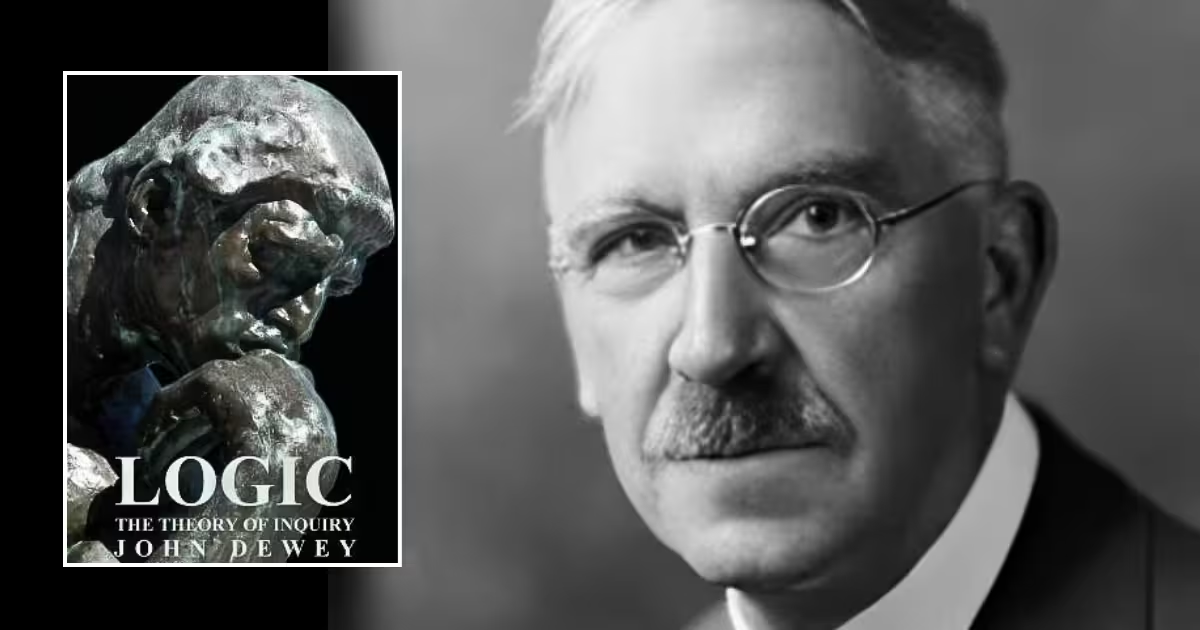

Do you ever feel like your thinking is stuck in quicksand—the more you struggle, the deeper you sink? John Dewey’s Logic: The Theory of Inquiry isn’t just another dusty philosophy textbook. It’s a 546-page intellectual bombshell that landed in 1938 and has been quietly reshaping how the world’s most innovative minds approach problem-solving ever since.
Overview
This isn’t a book about logic in the traditional sense—it’s a revolutionary manual for how to think when life throws you into confusion. Dewey argues that logical forms aren’t eternal truths handed down from on high, but tools that emerge during the process of solving real problems. Published when the world was teetering on the brink of World War II, it’s a guide for navigating uncertainty that feels more urgent today than ever.
Reader suitability
Logic: The Theory of Inquiry is highly suggested for educators, scientists, social scientists, policy-makers, critical thinkers, and anyone frustrated by their own inability to reason clearly through complex problems.
Logic: The Theory of Inquiry is suitable for those seeking quick fixes, math-phobes (Part III gets technical), or anyone who believes absolute truth is handed down from authority.
Table of Contents
Introduction
Title: Logic: The Theory of Inquiry
Author: John Dewey (1859–1952)
Publication: Henry Holt and Company, 1938 (546 pages)
The Later Works of John Dewey, Volume 12
Heralded as “the crowning work of a great career” by scholars, Logic: The Theory of Inquiry represents the culmination of over forty years of Dewey’s thinking about how we actually think. To Evander Bradley McGilvary, the work assured Dewey “a place among the world’s great logicians”.
Ernest Nagel called it “an impressive work”. Irwin Edman said of it: “Most philosophers write postscripts; Dewey has made a program. His Logic is a new charter for liberal intelligence”.
But here’s the thing that stopped me cold when I first opened this book: Dewey doesn’t think logic is about being “logical” in the way you were taught in school.
Background
John Dewey wasn’t just any philosopher. Born in Burlington, Vermont in 1859, he graduated from the University of Vermont in 1879, earned his doctorate from Johns Hopkins in 1884, and went on to become one of the founders of pragmatism, a pioneer in functional psychology, and a leader of the progressive movement in American education.
By 1938, he was 79 years old and had spent decades watching how people actually think—and how badly they do it.
Logic: The Theory of Inquiry emerged from ideas he first presented in Studies in Logical Theory (1903), expanded in Essays in Experimental Logic (1916), and briefly summarized for educators in How We Think (1910). But Logic: The Theory of Inquiry was something different entirely. As he writes in the preface:
“While basic ideas remain the same, there has naturally been considerable modification during the intervening years. While connection with the problematic is unchanged, express identification of reflective thought with objective inquiry makes possible, I think, a mode of statement less open to misapprehension than were the previous ones.”
Dewey was responding to a crisis. Traditional logic—the kind inherited from Aristotle—had become a dead language. It assumed a world of fixed substances, eternal essences, and unchanging truths. But science had moved on. Physics had embraced relativity. Biology had accepted evolution. The world was in flux, and logic was stuck in the past.
Dewey’s radical move? He decided that logic shouldn’t be about eternal forms. It should be about what works when you’re actually trying to figure something out.
Logic: The Theory of Inquiry Summary
Let me be honest: this isn’t an easy read. Dewey himself warned that readers “not particularly conversant with contemporary logical discussions may find portions of the text too technical, especially perhaps in Part III”.
He suggested a brilliantly practical approach: “interpret what is said by calling to mind what they themselves do, and the way they proceed in doing it, when they are confronted with some question or difficulty which they attempt to cope with in an intellectual way”.
Here’s what I learned when I took that advice.
1. Logic Is NOT About Being “Logical”
The biggest misconception Dewey demolishes is that logic is about following rules of thought. Traditional logic treats forms as “pure forms, forms that have independent subsistence”. In other words, logic was seen as a set of eternal patterns that thought must follow.
Dewey says: nonsense.
His central thesis is breathtakingly simple and revolutionary:
“All logical forms (with their characteristic properties) arise within the operation of inquiry and are concerned with control of inquiry so that it may yield warranted assertions.”
Did you catch that? Logical forms don’t exist “out there” in some perfect realm. They emerge during the process of figuring things out. They’re not imposed from above—they’re discovered from below, through the messy, frustrating, human process of trying to solve problems.
“The forms originate in operations of inquiry. To employ a convenient expression, it means that while inquiry into inquiry is the causa cognoscendi of logical forms, primary inquiry is itself causa essendi of the forms which inquiry into inquiry discloses.”
In other words: we discover logical forms by examining how we actually think when we’re trying to solve real problems. The forms come from inquiry, not the other way around.
2. Thinking Starts When You’re Stuck
Here’s where Dewey gets genuinely useful. He argues that all thinking—all genuine inquiry—begins with what he calls an “indeterminate situation”.
“Inquiry is the controlled or directed transformation of an indeterminate situation into one that is so determinate in its constituent distinctions and relations as to convert the elements of the original situation into a unified whole.”
Think about that for a moment. When was the last time you really thought about something? Not when you were comfortable. Not when everything was going smoothly. You think when you’re stuck. When things don’t make sense. When the situation is “indeterminate”—uncertain, confused, conflicted.
Dewey puts it bluntly:
“It is the situation that has these traits. We are doubtful because the situation is inherently doubtful. Personal states of doubt that are not evoked by and are not relative to some existential situation are pathological.”
This is revolutionary. Most philosophy treats doubt as a mental state—something happening inside your head. Dewey says: no. Doubt is in the situation. You’re not confused because you’re a bad thinker. You’re confused because the situation is confusing.
“The notion that in actual existence everything is completely determinate has been rendered questionable by the progress of physical science itself.”
3. The Pattern of All Inquiry
Dewey identifies a common pattern that underlies all successful inquiry—whether you’re a scientist in a lab, a detective at a crime scene, or just someone trying to figure out why your car won’t start.
Step 1: The Indeterminate Situation
Something’s wrong. You’re confused. The situation doesn’t make sense.
Step 2: The Problem
You figure out what the real problem is. Dewey emphasizes: “A problem well put is half-solved”.
Step 3: Observation and Ideas
You gather facts (observation) and generate possible solutions (ideas). These work together:
“Observation of facts and suggested meanings or ideas arise and develop in correspondence with each other. The more the facts of the case come to light in consequence of being subjected to observation, the clearer and more pertinent become the conceptions of the way the problem constituted by these facts is to be dealt with.”
Step 4: Reasoning
You develop your ideas through what Dewey calls “discourse” —working through the implications of different possibilities.
Step 5: Testing
You act on your ideas and see what happens. “The final test of the validity of conceptions formulated and developed in rational discourse was found to reside in their applicability to existential qualitative material”.
Step 6: Resolution
The situation becomes determinate—settled, unified, no longer confusing.
This pattern applies whether you’re doing quantum physics or deciding what to eat for dinner. The logic is the same. Only the subject matter changes.
4. Facts and Ideas Are Partners, Not Enemies
One of Dewey’s most brilliant insights is that facts and ideas aren’t opposites—they’re partners in the dance of inquiry.
“Perceptual and conceptual materials are instituted in functional correlativity with each other, in such a manner that the former locates and describes the problem while the latter represents a possible method of solution.”
This is why the old debate between “empiricists” (who worship facts) and “rationalists” (who worship ideas) is so stupid. You can’t have one without the other. Facts without ideas are blind—they don’t tell you anything. Ideas without facts are empty—they’re just castles in the air.
“Both are finally checked by their capacity to work together to introduce a resolved unified situation. As distinctions they represent logical divisions of labor.”
5. “Truth” Is a Moving Target
Here’s where Dewey gets really uncomfortable for traditionalists. He rejects the idea that truth is something fixed and eternal. Instead, he introduces the concept of “warranted assertibility” —a phrase that’s clunky but precise.
“Knowledge, as an abstract term, is a name for the product of competent inquiries. Apart from this relation, its meaning is so empty that any content or filling may be arbitrarily poured in.”
In other words: truth isn’t something you possess. It’s something you achieve through competent inquiry. And it’s always provisional:
“The ‘settlement’ of a particular situation by a particular inquiry is no guarantee that that settled conclusion will always remain settled. The attainment of settled beliefs is a progressive matter; there is no belief so settled as not to be exposed to further inquiry.”
This is what Charles Sanders Peirce called “fallibilism” —the recognition that we could always be wrong. Dewey takes it further:
“Because we live in a world in process, the future, although continuous with the past, is not its bare repetition.”
6. The Continuum of Inquiry
Dewey’s most original contribution—and he credits Peirce for noting it first—is the “principle of the continuum of inquiry”.
“Application of this principle enables an empirical account to be given of logical forms, whose necessity traditional empiricism overlooked or denied while at the same time it proves that the interpretation of them as a priori is unnecessary.”
What does this mean in plain English? Inquiry doesn’t happen in isolation. Every inquiry builds on previous inquiries and leads to future inquiries. The conclusions of one investigation become the tools of the next.
“The conclusions reached in one inquiry become means, material and procedural, of carrying on further inquiries.”
This is why science progresses. It’s not because scientists are smarter than everyone else. It’s because they build on what came before.
Logic: The Theory of Inquiry Analysis
The Pragmatic Revolution
Dewey avoids the word “pragmatism” in the text—he says it “lends itself to misconception”. But make no mistake: this is pragmatism’s crowning achievement.
“But in the proper interpretation of ‘pragmatic,’ namely the function of consequences as necessary tests of the validity of propositions, provided these consequences are operationally instituted and are such as to resolve the specific problem evoking the operations, the text that follows is thoroughly pragmatic.”
This is the heart of pragmatism: ideas are tested by their consequences. Not by how “logical” they seem. Not by how well they fit some abstract system. But by what happens when you act on them.
The German and American philosopher Herbert Marcuse, in his review of Logic: The Theory of Inquiry, recognized this as “the first systematic attempt at a pragmatistic logic (since the work of Peirce)”. Marcuse noted that the book “takes its subject matter far beyond the traditional works on logic. It is a material logic first in the sense that the matter of logic (the ‘objects’, that with which logical thought has to do) is thoroughly included in the cycle of investigation”.
Logic as a Social Enterprise
One of Dewey’s most profound insights is that logic isn’t a solo activity. It’s social.
“Man is naturally a being that lives in association with others in communities possessing language, and therefore enjoying a transmitted culture. Inquiry is a mode of activity that is socially conditioned and that has cultural consequences.”
This means thinking isn’t something you do alone in your head. Thinking is something we do together. The symbols we use, the concepts we employ, the very problems we think are important—all of these come from our culture.
“Neither inquiry nor the most abstractly formal set of symbols can escape from the cultural matrix in which they live, move and have their being.”
The Attack on Aristotle
Dewey has immense respect for Aristotle—but he’s also brutally honest about why Aristotelian logic is obsolete. He devotes an entire chapter (Chapter V) to explaining why the old logic can’t work anymore.
“The more adequate that logic was in its own day, the less fitted is it to form the framework of present logical theory.”
Why? Because Aristotle’s logic was built on a view of the universe that’s been completely demolished by modern science. Aristotle assumed fixed species, eternal essences, and a hierarchical universe. Modern science deals with change, probability, and functional relationships.
“When eternal essences and species are banished from scientific subject-matter, the forms that are appropriate to them have nothing left to which they apply; of necessity they are merely formal.”
Strengths and Weaknesses
What Makes Logic: The Theory of Inquiry Extraordinary
1. It’s Grounded in Reality
Dewey doesn’t spin theories about how people should think. He observes how people actually think when they’re doing their best work—scientists in labs, detectives solving cases, ordinary people solving everyday problems.
2. It’s Anti-Dualistic
Dewey refuses to accept the false dichotomies that plague philosophy: theory vs. practice, mind vs. body, facts vs. values, logic vs. experience. He shows how these apparent opposites are actually partners in inquiry.
3. It’s Practical
This isn’t just abstract philosophy. Dewey’s framework can be applied to education, politics, science, and everyday life. As William Gruen said: “No treatise on logic ever written has had as direct and vital an impact on social life as Dewey’s will have”.
4. It’s Humble
Dewey doesn’t claim to have the final answer. He explicitly says his work is “introductory” and that “the standpoint is so thoroughly sound that those who are willing to entertain it will in the coming years develop a theory of logic that is in thorough accord with all the best authenticated methods of attaining knowledge”.
What’s Problematic
1. It’s Dense
Let’s be real: this is not beach reading. Dewey’s prose is clear but demanding. Part III, which deals with propositions and terms, is particularly technical.
2. It Avoids Symbolic Logic
Dewey explicitly avoids symbolic formulation, which disappointed many readers:
“In the present state of logic, the absence of any attempt at symbolic formulation will doubtless cause serious objection in the minds of many readers.”
His defense: symbolic logic often “merely perpetuate[s] existing mistakes while strengthening them by seeming to give them scientific standing”. Fair point—but it does make the book harder to engage with for those trained in formal logic.
3. It’s Not For Everyone
Dewey himself suggests that readers “interpret what is said by calling to mind what they themselves do”. If you’re looking for a system of rules to follow mechanically, you’ll be disappointed. Dewey wants you to think, not follow instructions.
4. Limited Engagement with Critics
While Dewey engages deeply with the philosophical tradition, he doesn’t always address contemporary critics as directly as some might wish. The book assumes a certain familiarity with the debates of his time.
Comparison with Similar Works
Aristotle’s Organon
Dewey’s Logic: The Theory of Inquiry is in direct dialogue with Aristotle. While Dewey respects Aristotle’s achievement, he argues that the Organon is obsolete because its ontological assumptions no longer hold. Aristotle’s logic was a logic of being; Dewey’s is a logic of inquiry.
Kant’s Critique of Pure Reason
Kant asked: “What are the conditions for the possibility of knowledge?” Dewey asks: “What are the conditions for the success of inquiry?” Kant’s answer was a priori categories; Dewey’s answer is operational methods.
Mill’s System of Logic
Mill tried to create a logic for science but was hobbled by his empiricist assumptions. Dewey criticizes Mill for reducing experience to sensations and failing to recognize the role of concepts. Dewey’s logic is more sophisticated and more faithful to actual scientific practice.
Russell and Whitehead’s Principia Mathematica
Dewey’s approach couldn’t be more different from the formal logic of Russell and Whitehead. Where they sought to reduce logic to mathematics, Dewey seeks to ground logic in the process of inquiry. As one reviewer noted, Dewey’s “Logic is a new charter for liberal intelligence”.
Conclusion
Eighty-six years after its publication, Logic: The Theory of Inquiry remains one of the most important books about thinking ever written.
Paul Weiss called it “the source and inspiration of a new and powerful movement”. I think he was right.
Here’s why Logic: The Theory of Inquiry matters right now:
1. We’re drowning in information but starving for wisdom. Dewey’s framework gives us a way to think about what we know, not just accumulate more data.
2. We’re trapped in ideological echo chambers. Dewey’s emphasis on inquiry as a social, collaborative process offers a way out of the polarization that paralyzes us.
3. We’re facing problems that don’t have simple answers. Climate change, inequality, political dysfunction—these are “indeterminate situations” in Dewey’s sense. They require the kind of thoughtful, experimental, collaborative inquiry he describes.
4. We’ve forgotten how to think. In an age of hot takes and instant opinions, Dewey reminds us that real thinking is hard work. It requires doubt, exploration, testing, and revision.
Who should read Logic: The Theory of Inquiry?
- Educators who want to understand what genuine learning looks like
- Scientists who want to understand the philosophical foundations of their work
- Policy-makers who need to think clearly about complex problems
- Anyone who’s ever felt confused and wanted a better way to think through confusion
As Dewey himself wrote in the closing pages:
“Logic as the generalized account of the means by which sound beliefs on any subject are attained and tested has parted company with the actual practices by means of which such beliefs are established. Failure to institute a logic based inclusively and exclusively upon the operations of inquiry has enormous cultural consequences.”
That’s the challenge. And that’s why Logic: The Theory of Inquiry still matters.