
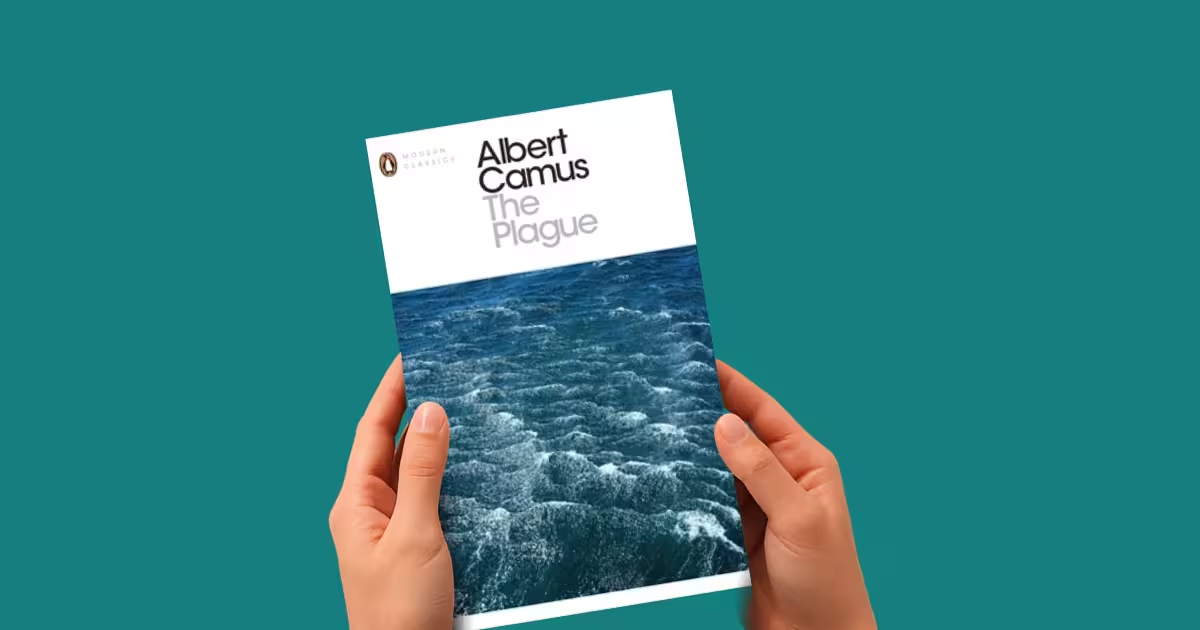

Why does a novel published nearly eighty years ago still feel like it was written for today’s world? That question stayed with me long after I finished The Plague. I expected a classic about disease. Instead, I found one of the most honest books I’ve read about fear, responsibility, loneliness, and what it means to remain human when everything familiar begins to disappear.
Overview
Albert Camus’ The Plague is much more than a novel about an epidemic. It is a profound reflection on human resilience, moral responsibility, isolation, and hope. Although set in the Algerian city of Oran during a deadly outbreak, its questions about how ordinary people respond to crisis remain strikingly relevant.
Readers who appreciate philosophical fiction with emotional depth will likely consider it one of the twentieth century’s essential novels.
The Plague is best for readers who appreciate philosophical fiction and historical allegories, but not good for those seeking fast-paced action thrillers or lighthearted escapism.
Table of Contents
1. Introduction
Published in 1947, The Plague (La Peste) is one of Albert Camus’ most celebrated novels. Written shortly after the Second World War, it tells the story of the Algerian city of Oran as it faces a devastating outbreak of bubonic plague.
Although the novel is firmly rooted in the experience of disease, it has long been interpreted as both a literal account of an epidemic and an allegory for the Nazi occupation of France and the broader human condition.
Camus, who later received the 1967 Nobel Prize in Literature, never reduces the novel to a simple political message. Instead, he asks a much larger question: How should decent people live when suffering cannot be avoided?
That question is why this novel continues to attract new readers generation after generation.
Background
The novel appeared just two years after World War II ended. Europe was still recovering from enormous destruction, millions had died, and many readers immediately recognized similarities between the fictional plague and authoritarian oppression.
Camus himself had participated in the French Resistance during the war and served as editor of the underground newspaper Combat. Because of this historical context, many literary scholars have interpreted the plague as representing fascism, occupation, and moral collapse. At the same time, Camus consistently resisted reducing the novel to a single interpretation. Instead, he presented the epidemic as a symbol of recurring human suffering.
The opening pages carefully establish Oran as an ordinary commercial city whose residents focus primarily on routine, business, and daily habits before those routines are shattered by the appearance of dying rats and a mysterious illness.
3. The Plague Summary
The Ominous Portents
Initially, it may seem like a completely normal year in the coastal town of Oran, Algeria. I noticed early on that the town itself is described as ugly, a place with a smug and placid air where people are primarily focused on doing business and getting rich.
A major trait of the townsfolk is their willful ignorance. The unusual events begin on April 16, when Dr. Bernard Rieux feels something soft under his foot on his landing, discovering a dead rat. Typically, the concierge, M. Michel, refuses to believe there are rats in the building, insisting someone must have planted it there as a prank.
But soon, thousands of rats are emerging from cellars and sewers to die bloody deaths in the streets. Consequently, public anxiety grows. The local Ransdoc Information Bureau announces that on April 25 alone, 6,231 rats were collected and burned.
By April 28, the number reaches 8,000. Just as the rat phenomenon abruptly ends, human beings begin to fall ill. M. Michel develops a high fever, painful swelling in his neck and armpits, and severe vomiting. Despite Dr. Rieux’s efforts, Michel dies in the ambulance, marking the beginning of the panic.
Administrative Denial and Quarantine
In contrast to the rising death toll, the local authorities are incredibly slow to react. Dr. Rieux and his older colleague, Dr. Castel, realize they are dealing with the bubonic plague. As noted earlier, humans have a habit of denying disasters. Rieux notes that townsfolk are humanists who disbelieve in pestilences because a pestilence is not made to man’s measure.
The Prefect and Dr. Richard, the chairman of the local Medical Association, initially refuse to use the word “plague” to avoid alarming the public. Due to insufficient evidence in their eyes, they issue only mild precautionary measures.
Once the mortality rate becomes undeniable, the government finally sends orders to declare a state of plague and close the town gates. Oran is entirely cut off from the outside world. Families are separated, including Dr. Rieux, whose wife had left for a mountain sanatorium just before the outbreak. The citizens are forced to endure a collective exile within their own city.
The Attrition of the Human Spirit
During the long months of summer, the disease ravages the town. I was struck by how different individuals cope with the quarantine. A journalist named Raymond Rambert, who was only visiting Oran for a report, desperately tries to arrange an illegal escape. Jean Tarrou, a mysterious visitor who keeps a detailed diary of the town’s eccentricities, organizes voluntary sanitary squads to help the overworked medical staff.
Joseph Grand, a humble municipal clerk, volunteers to keep the statistics for these squads.
Grand struggles with a personal project; he is writing a book but cannot get past the first sentence because he obsessively rewrites it, searching for the perfect words. On the other hand, Cottard, a man who attempted suicide before the plague began, finds himself thriving. Because of the chaos, the police stop investigating his past crimes, and he makes a fortune smuggling goods.
The disease forces the town to mechanical extremes. Funerals lose all dignity, eventually becoming mass burials in pits. Father Paneloux, a Jesuit priest, delivers a fiery sermon claiming the sickness is God’s punishment for the town’s sins.
The Turning Point and Agony
As the seasons change, the isolation wears down the citizens. Rambert finally gets the chance to escape, but at the last minute, he chooses to stay and fight the disease alongside Rieux and Tarrou, realizing that this is everyone’s business.
The most harrowing moment occurs when the young son of M. Othon, the police magistrate, contracts the disease. Dr. Castel has developed a new serum locally. They test it on the boy, but the child suffers a prolonged, agonizing death.
This horrific event profoundly shakes Father Paneloux. His second sermon is far more subdued, arguing that believers must simply accept the incomprehensible will of God. Shortly after, Paneloux falls ill and dies.
By winter, the situation seems hopeless. Grand falls ill and asks Rieux to burn his manuscript. Surprisingly, Grand makes a miraculous recovery. Around the same time, live rats begin to reappear in the streets, signaling that the epidemic is finally breaking.
The End of the Plague (Ending Explained)
The death rate plummets. However, the disease claims one last, tragic victim: Jean Tarrou. Despite Rieux’s desperate medical interventions, his friend dies just as the town prepares for liberation. Rieux then receives a telegram informing him that his wife has also passed away from her long illness in the sanatorium.
In February, the town gates are finally opened. Reunited families celebrate passionately in the streets. For Cottard, the end of the disaster means a return to his criminal paranoia.
He barricades himself in his apartment and begins shooting randomly at people until the police violently apprehend him. In the concluding pages, the narrator formally reveals his identity: it is Dr. Bernard Rieux. He explains that he wrote this chronicle to bear witness to the victims and to state that there are more things to admire in men than to despise.
Nevertheless, as he listens to the distant cheers, Rieux reflects that the plague bacillus never truly dies or vanishes. It simply lies dormant in furniture and linens, waiting for the day it will awaken its rats and send them to die in a happy city to teach humans a lesson.
4. The Plague Analysis
4.1 Characters
Dr. Bernard Rieux: He is the pragmatic core of the narrative. Rieux does not fight for grand religious or political ideals, but simply because it is his job as a doctor. His development is marked by a steady hardening against emotional exhaustion.
Jean Tarrou: A major trait of Tarrou is his philosophical exactness. He seeks peace of mind and believes that human beings unconsciously infect each other with destructive ideologies.
Raymond Rambert: Initially, it may seem that Rambert is entirely self-centered, desperate to return to his lover in Paris. His character development is highly significant; he transitions from an outsider trying to flee into an active participant in the town’s defense.
Joseph Grand: Typically, Grand appears as a completely insignificant municipal clerk. Yet, his quiet dedication to tracking the epidemic’s statistics makes him the true unsung hero of the story.
Cottard: He is the only character who benefits from the disaster. His final descent into violent madness illustrates what happens to individuals who isolate themselves from the common good.
Father Paneloux: He embodies the struggle of strict religious dogma when confronted with senseless suffering.
4.2 The Plague Themes and Symbolism
A comprehensive view of the issue cannot be formed without looking at the central theme: the Absurd. The illness symbolizes the unpredictable, irrational nature of death and suffering in a universe that does not care about human plans.
The citizens’ initial denial represents the human tendency to ignore our mortality.
Furthermore, the concept of collective resistance is central to the plot. The characters find meaning not in grand philosophical declarations, but in the simple, repetitive act of doing their jobs.
5. The Plague Evaluation
I feel that The Plague by Albert Camus is an extraordinarily poignant and urgent examination of human endurance.
Strengths: The novel’s greatest strength is its vivid, clinical description of administrative incompetence and the gradual, suffocating psychological weight of isolation.
Weaknesses: On the other hand, the pacing in the middle sections can feel deliberately slow and methodical, which might alienate readers looking for a more dynamic plot.
Impact: Undoubtedly, the book hits home deeply for me because it acts as a perfect mirror for any collective crisis, forcing the reader to question how they would behave under identical pressure.
Comparison with similar Works: It shares thematic similarities with José Saramago’s Blindness, which also uses a sudden epidemic to strip away societal norms, and Cormac McCarthy’s The Road.
6. Personal insight with contemporary educational relevance
When analyzing the text, I found the most important angle to be the danger of administrative denial and the necessity of individual responsibility. This directly relates to how modern societies handle global crises.
Lesson 1: Bureaucracies often prioritize public relations over public safety. As noted earlier, the authorities in the book delayed action to prevent panic, which only guaranteed a higher death toll. We see this mirrored repeatedly in modern governmental responses.
Lesson 2: Statistics can numb our empathy. Rieux notes that a hundred million corpses are just a puff of smoke in the imagination. We must actively work to remember the human lives behind daily data reports.
Lesson 3: True heroism is found in mundane duties. The book teaches that fighting a catastrophe is not about dramatic sacrifices, but about regular people doing their jobs with quiet competence.
Lesson 4: Disaster creates a dangerous opportunity for opportunists. Characters like Cottard serve as a warning about the predatory individuals who manipulate public fear for personal gain.
Lesson 5: The threat is never permanently defeated. The ending reminds us that the forces of authoritarianism and disease are cyclical. Constant vigilance and education are our only long-term defense mechanisms.
7. The Plague Quotes
“It is as reasonable to represent one kind of imprisonment by another, as it is to represent anything that really exists by that which exists not.”
“The town itself, let us admit, is ugly.”
“But what are a hundred million deaths? When one has served in a war, one hardly knows what a dead man is, after a while.”
“A pestilence isn’t a thing made to man’s measure; therefore we tell ourselves that pestilence is a mere bogy of the mind, a bad dream that will pass away.”
8. Conclusion
To put it in another way, this novel is a masterclass in observing human nature under extreme duress. I highly recommend it for fans of philosophical fiction, history enthusiasts, and anyone who wants to better understand the psychology of a society in lockdown.
Ultimately, Albert Camus leaves us with a message that is both sobering and deeply encouraging: while we can never permanently conquer the tragedies of existence, the act of fighting them together is what gives our lives meaning.