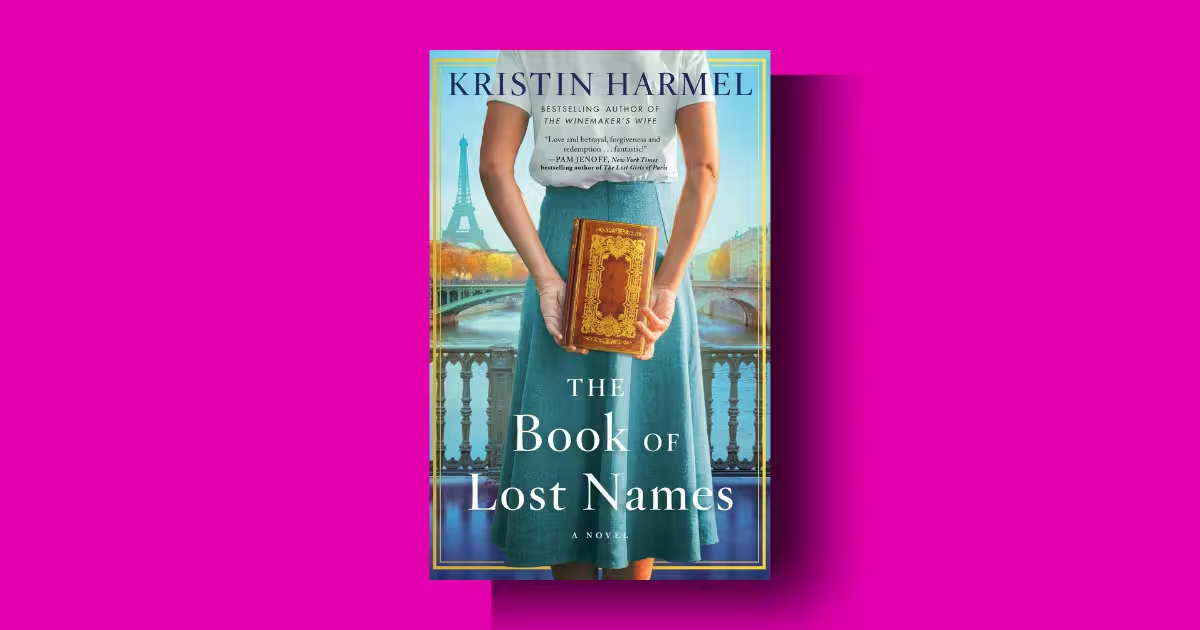
Did you know that an estimated 14,000 Jewish lives were saved by real-life forgers like Adolfo Kaminsky, who joined the French Resistance at just 17 years old? Kristin Harmel’s The Book of Lost Names draws inspiration from these astonishing true stories, weaving a tale that is as educational as it is emotionally gripping.
Published in 2020 by Gallery Books, this New York Times bestseller has been translated into more than 30 languages, a testament to its universal resonance.
Table of Contents
Overview
The Book of Lost Names is a historical fiction novel that alternates between 1942 France and 2005 Florida. It follows Eva Traube, a young Jewish woman who becomes a forger for the French Resistance, creating false identities for hundreds of Jewish children fleeing to Switzerland.
To ensure these children aren’t permanently erased, she and her fellow forger, Rémy, code their real names into an 18th-century religious text, creating the “Book of Lost Names”.
Decades later, as an elderly librarian, Eva must confront her past when she discovers the book has resurfaced in a Berlin library.
Reader recommendation
The Book of Lost Names is best for readers who love character-driven historical fiction with a focus on resistance, romance, and moral dilemmas. Fans of The Nightingale, The Alice Network, and Lilac Girls will find a kindred spirit here. It’s also a great choice for book clubs, as it offers rich themes for discussion.
The Book of Lost Names is not for readers seeking a fast-paced thriller or a strictly action-driven plot. Those sensitive to the emotional weight of Holocaust narratives may find certain sections difficult.
Additionally, if you prefer historical fiction that adheres strictly to documented facts, the novel’s fictionalized elements and romanticized ending might feel less satisfying.
Introduction
I’ll be honest: I’ve read my fair share of World War II novels. Some blend together, relying on familiar tropes and settings.
But The Book of Lost Names by Kristin Harmel stood out from the first page. It’s not just a story about survival; it’s a story about the very essence of identity and the lengths people will go to preserve it in the face of annihilation.
Harmel, a former reporter for People magazine who has been writing professionally since the age of 16, brings a journalist’s eye for detail to this narrative. The result is a novel that feels meticulously researched and deeply human.
The book opens in May 2005 with 86-year-old Eva Traube Abrams, a semi-retired librarian at the Winter Park Public Library in Florida. Her quiet life is shattered when she sees a photograph in the New York Times of a book she hasn’t laid eyes on in over six decades, an 18th-century religious text called Epitres et Evangiles.
This is the “Book of Lost Names,” a book she and her first love, Rémy, used to encode the real names of Jewish children they helped save during the war. The article explains that a German librarian, Otto Kühn, is trying to reunite looted books with their owners.
For Eva, this is a call to action, forcing her to confront a past she has tried to forget.
Background
To fully appreciate The Book of Lost Names, it helps to understand the historical context. The novel is set against the backdrop of World War II, specifically the German occupation of France. In July 1942, the French police, acting on Nazi orders, conducted the Vel’ d’Hiv Roundup in Paris, arresting over 13,000 Jews.
This event is a pivotal moment in the book and in French history. It was a brutal reminder that for Jews in occupied France, safety was an illusion.
Eva and her mother flee to the Free Zone, the unoccupied southern part of France administered by the Vichy government. It is here, in a small, fictional town called Aurignon, that Eva discovers her purpose.
The town is based on real places like Le Chambon-sur-Lignon, a village in the mountains that became a refuge for thousands of Jews. In these communities, ordinary people — pastors, farmers, teachers — risked their lives to hide and save others.
A key historical element Harmel explores is the work of document forgers. These were not professional spies but ordinary people with extraordinary skills. Adolfo Kaminsky, for instance, was a young Jewish man who joined the Resistance and became a master forger, saving an estimated 14,000 lives. Another, Oscar Rosowsky (who appears in the novel under the alias Jean-Claude Plunne), began forging documents at 18 and helped save over 3,500 people.
These real-life heroes inspired Eva’s journey.
The novel also touches on the Nazi looting of cultural property. During the war, the Nazis systematically stole millions of books from libraries, synagogues, and private collections across Europe.
Today, institutions like Berlin’s Zentral- und Landesbibliothek are still working to return these items to their rightful owners, a process that continues into the 2020s. This real-world effort provides the framework for the novel’s present-day storyline.
The Book of Lost Names Summary
Part 1: The Escape from Paris (July 1942)
The story begins with Eva Traube, a 23-year-old graduate student in English literature at the Sorbonne in Paris. She is living with her Polish-Jewish parents, Tatuś (Leo) and Mamusia (Faiga).
The atmosphere in Paris is tense. Eva is confronted by Joseph Pelletier, a handsome fellow student who is also Jewish. Joseph warns her of an impending roundup of foreign-born Jews. Eva is skeptical, but the warning proves prophetic.
On July 16, 1942, the French police come for the Traube family. Eva and her mother are luckily out of the apartment, watching over a neighbor’s children. They witness from a window as Tatuś is arrested and taken away. This traumatic event sets the course for the rest of their lives.
Eva, refusing to give up, seeks help from her father’s former boss, Monsieur Goujon.
He provides her with blank documents and art supplies, essentially forcing her to become a forger to save herself and her mother. Using her artistic talent, Eva forges identity cards and travel permits, transforming them into Sabine and Colette Fontain.
They flee Paris by train, heading south to the Free Zone. A kind but suspicious woman named Madame Barbier takes them in at her boardinghouse in the small town of Aurignon. However, their cover is almost immediately blown; Madame Barbier realizes their papers are forged.
Part 2: The Forger in Aurignon (July 1942 – Early 1943)
Eva is introduced to Père Clément, the local Catholic priest who is secretly a leader in the Resistance network. He sees her talent and asks for her help. He also introduces her to a young, brash, and handsome forger named Rémy Duchamp. Rémy is a chemist by training, and his skills with chemicals like lactic acid complement Eva’s artistic eye.
Eva and Rémy begin working together in a hidden library behind the church altar. They create false documents for Jewish children being smuggled to Switzerland. Eva is troubled by the thought that these children are losing their identities, and her mother’s words haunt her: “Who will remember us? Who will care?”
To solve this, Rémy devises a clever code using the Fibonacci sequence. They hide the children’s real names in an old religious book, Epitres et Evangiles, which they call the “Book of Lost Names.” Eva adds her own name and Rémy’s name to the book. Their relationship deepens as they work side-by-side.
But the war intrudes. They travel to Paris to try to save Eva’s father, only to discover he has already been deported to Auschwitz. This news devastates Eva and sends her mother into a deep depression, which only worsens their relationship.
Part 3: Betrayal and Loss (1943 – Early 1944)
By 1943, the Germans have occupied all of France. The forgery network in Aurignon is busier than ever. Rémy becomes more involved in the armed Resistance, using his chemistry knowledge to make explosives. He often disappears for weeks at a time.
Meanwhile, Joseph Pelletier re-enters Eva’s life. He is now a high-ranking member of the Resistance, going by the code name Gérard Faucon. He begins providing the forgers with high-quality paper from Algeria.
Eva and Rémy’s relationship is strained. He proposes marriage, but Eva, still haunted by her mother’s disapproval, hesitates. Her mother dies believing Eva has abandoned her faith. Shortly after, Rémy is arrested by the Nazis, but Père Clément manages to secure his release using forged documents. Rémy, now a marked man, cannot return to Aurignon and joins the maquisards (Resistance fighters) in the forests.
The situation becomes even more dangerous when Père Clément’s German informant warns of a betrayal. The network has been compromised. Geneviève, a new forger who joined the team, is betrayed and murdered by Joseph. Joseph is the traitor. He had been working for the Germans in exchange for his life.
Eva confronts Joseph in the church library. He is about to kill her when a German soldier named Erich, Père Clément’s informant who has been working for the Resistance, arrives and shoots Joseph. Erich knows his own cover is blown and sacrifices himself, allowing Eva to escape.
Part 4: After the War and Reunion (1945 – 2005)
Eva survives the war. She returns to Paris and, against all odds, is reunited with her father, Tatuś, who has survived Auschwitz. He encourages her to find happiness, but she cannot let go of Rémy. She waits for him for two years at the Mazarine Library, the place they promised to meet. He never comes.
Eva eventually moves to America with a kind man named Louis Abrams, a Jewish tourist she met in Paris. She has a son, Ben, and builds a new life, burying her past deep within her. She contacts Yad Vashem with the names she remembers, but refuses to be recognized for her heroism.
In 2005, the novel returns to the present. An 86-year-old Eva flies to Berlin to see the Book of Lost Names. She meets Otto Kühn, the librarian, and explains the code. As they begin to decode the names, a security guard announces that a man is outside claiming the book is his.
Eva goes outside and finds Rémy. He is alive. He had been gravely wounded in 1944 and was evacuated to England, only returning to France in 1947.
By then, Eva was gone. They share a tearful reunion and a kiss, and Rémy asks for her hand in marriage one last time. The book is finally returned to its rightful owner, and Eva and Rémy are reunited after more than 60 years.
The Book of Lost Names Analysis
Characters
Eva Traube Abrams is the heart of the novel. She is a complex and deeply human character. Initially, she is a bookish, somewhat naive student.
The war forces her to grow up quickly. She is resourceful, using her artistic talent to become a forger. She is also driven by a strong moral compass, determined to preserve the identities of the children she helps. Her guilt over her mother’s death and her lost love for Rémy stays with her for a lifetime.
Some readers find her constant guilt repetitive, but I found it realistic for someone who has experienced such profound loss.
Rémy Duchamp is the charismatic, “film star” handsome forger. He is Eva’s foil, confident and impulsive where she is cautious and reserved. His chemistry background is crucial to their forgery operation. His love for Eva is fierce and patient, but he is also a man of action, driven to fight the Nazis directly.
His decision to join the armed Resistance puts a strain on their relationship but also defines his character.
Mamusia (Faiga Traube) is a tragic figure. She is a devoted mother who is shattered by the loss of her husband. Her fear of losing her Jewish identity and her daughter to a Catholic man makes her bitter and angry. While she can be frustrating, her perspective is understandable. She represents the fear of cultural erasure that was so prevalent during the war.
Père Clément is the moral center of the novel. He is a Catholic priest who risks everything to save Jewish children. He is wise, kind, and unwavering in his faith. He provides Eva with not just a job but a purpose and a home. His faith in humanity, even in the darkest times, is inspiring.
Joseph Pelletier is the antagonist who is also a former friend. He is charming and manipulative. His betrayal is devastating because it comes from someone Eva trusted. He represents the moral decay that war can cause, as he chooses self-preservation over loyalty and humanity.
The Book of Lost Names Themes and Symbolism
Identity and Erasure: This is the central theme of the book. The Nazis tried to erase Jewish identity. The forgers, in turn, had to erase identities to save lives. Eva is haunted by this paradox. The Book of Lost Names is a powerful symbol of resistance against this erasure.
It is a physical record that says, “You existed. You mattered.” As Eva says, “We aren’t defined by the names we carry or the religion we practice, or the nation whose flag flies over our heads. We’re defined by who we are in our hearts, who we choose to be on this earth.”
Memory and Forgetting: The novel explores the importance of memory, both personal and historical. Eva tries to forget the war, but the past is always present. The act of recording the names is an act of memory. The novel also touches on the collective forgetting that happens when history is not preserved.
The Power of Books and Words: Eva is a librarian and a lifelong lover of books. Books are her refuge and her weapon. The Book of Lost Names is a book that saves lives and preserves history. The novel is a testament to the idea that words and stories have power.
Love and Sacrifice: Eva and Rémy’s love story is central. Their relationship is tested by war, distance, and moral dilemmas. Eva’s decision to not marry Rémy is a sacrifice she makes for her mother’s peace of mind. Rémy’s decision to fight is a sacrifice for his country.
The Fibonacci Sequence Code: The code itself is a brilliant symbol. It represents the order and logic Eva and Rémy try to impose on the chaos of war. It is a secret language that only they understand, a bond between them.
The Book of Lost Names Evaluation
Kristin Harmel has crafted a poignant and important novel. The Book of Lost Names is a moving tribute to the resilience of the human spirit and the unsung heroes of the Resistance.
Strengths
Compelling and Unique Premise: The focus on forgery as a form of resistance is fascinating and not often explored in popular fiction. The technical details of the forgery process, from using lactic acid to erase ink to duplicating stamps with a gel roller, are well-researched and add authenticity.
Emotional Depth: The novel is deeply emotional. The love story between Eva and Rémy is tender and heartbreaking. Eva’s guilt over her mother’s death and her lost love is palpable. The reunion at the end, while perhaps a bit too perfect for some, is emotionally satisfying.
Strong Female Protagonist: Eva is a relatable and inspiring heroine. She is not a soldier or a spy but an ordinary woman who discovers an extraordinary talent and uses it to fight evil.
Historical Context: Harmel weaves real historical events and figures into the narrative seamlessly. The inclusion of real-life forger Oscar Rosowsky (as Jean-Claude Plunne) is a nice touch.
Weaknesses
Pacing Issues: The middle section of the novel can feel a bit repetitive, with Eva and Rémy spending a lot of time forging documents. Some readers may find the pacing slow.
Predictable Plot Points: Some of the plot twists, such as the identity of the traitor, are somewhat predictable. The ending, while happy, also feels a bit too neat and convenient for some readers.
Flat Secondary Characters: Some critics have noted that characters like Eva’s mother and even Rémy can feel one-dimensional at times, serving more as plot devices than fully realized individuals.
Impact
Despite its weaknesses, The Book of Lost Names has a powerful emotional impact. It serves as a powerful reminder of the importance of preserving memory and fighting against injustice. The novel resonated deeply with me, prompting reflection on the moral complexities of war.
Comparison with Similar Works
The Book of Lost Names sits comfortably alongside other popular World War II historical fiction novels.
Similar to The Nightingale by Kristin Hannah: Both novels feature strong female protagonists in occupied France who engage in acts of resistance. However, The Nightingale is more focused on the direct dangers of the Resistance, while The Book of Lost Names focuses on the quieter, but equally vital, work of forgery.
Similar to The Alice Network by Kate Quinn: Both novels feature female spies and a dual-timeline structure. The Alice Network is more of a thriller, while The Book of Lost Names is a more introspective character study.
Similar to Lilac Girls by Martha Hall Kelly: Both novels are based on true stories and explore the experiences of women during the war. Lilac Girls has a broader scope, while The Book of Lost Names is more focused on a single protagonist.
Personal Insight: The Power of a Name
One of the most striking themes in The Book of Lost Names is the power of a name. The Nazis understood this power; they forced Jews to wear yellow stars and stripped them of their citizenship, effectively erasing them from society. The forgers understood it, too, by creating new names to protect the innocent. Eva’s mission to preserve the real names is a powerful act of defiance.
This theme is incredibly relevant today.
According to Yad Vashem, the World Holocaust Remembrance Center, they have documented the names of over 5 million Holocaust victims. But that means over 1 million victims remain nameless. The work of organizations like Yad Vashem is a direct parallel to Eva’s mission in the book. They are fighting against the erasure of history, one name at a time.
Furthermore, in our modern world, we see the power of names in other contexts. We see it in the fight for civil rights, where people reclaim names and identities that were stolen from them. We see it in the refugee crisis, where individuals fleeing war are often reduced to statistics. The Book of Lost Names reminds us that behind every name is a story, a life, a person who deserves to be remembered.
Five Lessons from The Book of Lost Names
- Courage Comes in Many Forms: You don’t have to be a soldier to be a hero. Eva, Rémy, and Père Clément saved countless lives with pens and paper.
- Identity is Worth Fighting For: In a world that tries to erase you, holding onto your identity is a revolutionary act.
- Memory is a Form of Resistance: Forgetting the past allows atrocities to be repeated. Remembering is a powerful act of defiance.
- Love Can Survive Anything: Even 60 years of separation and a world war couldn’t extinguish Eva and Rémy’s love.
- You Can’t Run from Your Past: Eva tried to bury her past, but it always caught up with her. We must all confront our history to find peace.
The Book of Lost Names Quotes
“We aren’t defined by the names we carry or the religion we practice, or the nation whose flag flies over our heads. I know that now. We’re defined by who we are in our hearts, who we choose to be on this earth.” This is the thesis of the entire novel.
“If we shrink from them, if we lose our goodness, we let them erase us. We cannot do that, Eva. We cannot.” Mamusia’s words, spoken before the war shattered her, encapsulate the moral of the story.
“I am my beloved’s, and my beloved is mine.” This Hebrew phrase from the Song of Songs becomes a private vow between Eva and Rémy, a promise that transcends time and distance.
“Someone has to take the fight to the Germans, Eva. No one is coming to save us.” Rémy’s realization that passive resistance is not enough is a turning point in the novel.
“Maybe the first identity to recover should be your own.” Otto Kühn’s words to Eva are a powerful call to action, urging her to reclaim her own story.
Conclusion
The Book of Lost Names is a beautifully written and deeply affecting novel. It is a story about love, loss, and the enduring power of hope. While it may not be perfect—some may find the pacing slow or the ending too convenient—its strengths far outweigh its weaknesses.
The novel’s exploration of identity, memory, and resistance is both timely and timeless. It serves as a powerful reminder of the horrors of the Holocaust and the bravery of those who fought against it. It is a celebration of the human spirit and a testament to the idea that even in the darkest of times, love and hope can survive.
I would highly recommend this book to:
- Fans of historical fiction, particularly World War II novels.
- Readers who enjoy stories with a strong romantic element.
- Book clubs looking for a thought-provoking and emotionally resonant read.
- Anyone interested in the lesser-known stories of the French Resistance.