Did you ever wonder what happens when the stories we tell about heroes and villains turn out to be completely wrong, and the person who knows the truth has been lying under your feet the whole time?
Téa Obreht’s Sunrise asks exactly that question, and the answer might just rearrange how you think about history, memory, and the people we choose to remember.
Table of Contents
Overview
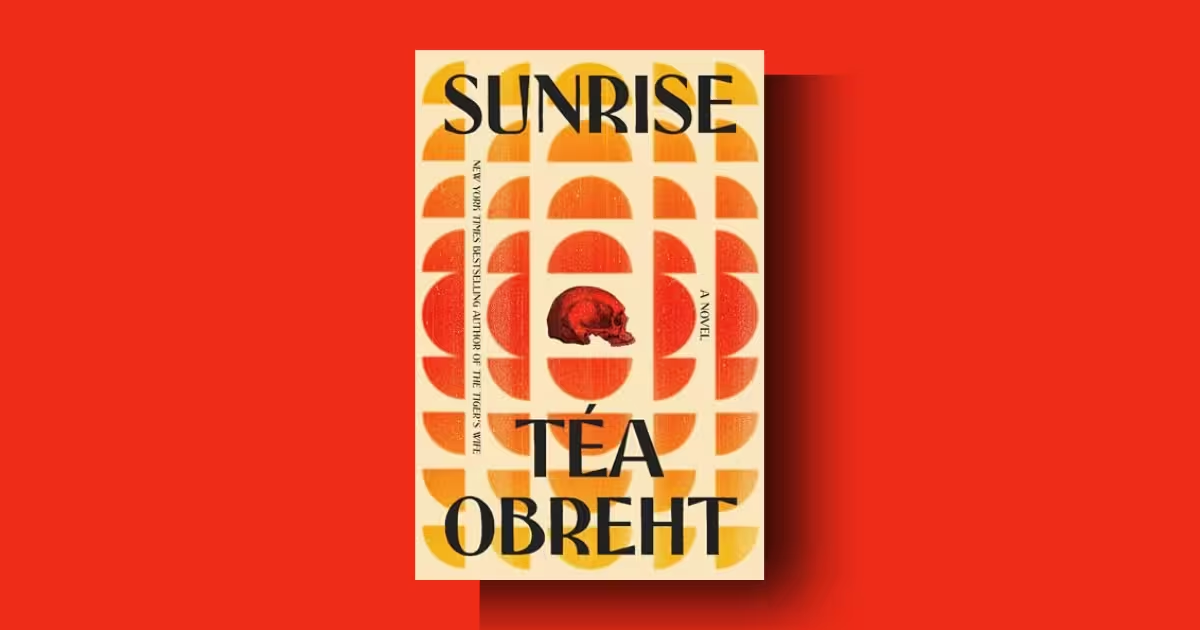
Sunrise is Téa Obreht’s fourth novel, published on August 11, 2026, by Random House. It runs 336 pages and weaves together three timelines: 2024 (a plane crash survivor named Nina finds a ghost town), 2003 (a local historian named Coll protects a legend), and 1902 (gunslinger Anton Vargas returns to Sunrise to confront his past).
The novel is structured as a story-within-a-story: Nina discovers a manuscript written by a woman named Louise Hawley, and that manuscript becomes the 1902 section we read. It challenges the myths we tell about the American West, about heroes, and about our own lives.
The New York Times called it a mashup of “Western gothic, murder mystery and survival saga”, while Kirkus praised it as “an adventurous, rewarding novel from a writer who just gets better and better”. As of this writing, it holds a 3.76 rating on Goodreads from over 135 ratings.
Reader recommendation for Sunrise
Sunrise is best for readers who love structurally ambitious literary fiction, fans of The Tiger’s Wife who want to see Obreht stretch into new territory, anyone fascinated by the mythology of the American West, and readers who enjoy novels-within-novels and unreliable narratives.
Sunrise is not for you if you prefer straightforward, linear storytelling or want clear answers to every mystery, this might frustrate you. The novel deliberately leaves some questions open, and the nested structure requires patience.
Introduction
Sunrise: A Novel is the fourth book from Téa Obreht, the Belgrade-born author who burst onto the literary scene with The Tiger’s Wife in 2011, winning the Orange Prize for Fiction at just 25 years old, making her the youngest winner in the prize’s history.
She was also a National Book Award finalist for that debut. Her subsequent novels include Inland (2019) and The Morningside (2024). Obreht now lives in Wyoming, and that state’s landscape deeply informs Sunrise. The novel was acquired by Random House in a deal with Seth Fishman at the Gernert Company and edited by Sara Birmingham.
Background
Historical Context
The novel is set against the backdrop of the American West’s mythmaking industry. The real Buffalo Bill’s Wild West show toured the United States and Europe from 1883 to 1916, turning Western outlaws and lawmen into celebrities. Obreht draws on this tradition: her character Anton Vargas becomes a dime-novel hero who eventually tours with a Wild West show, much like real figures such as Buffalo Bill Cody and Annie Oakley.
The novel also engages with the Fort Searles controversy. In the 1902 timeline, Preacher is outraged that the U.S. Army has reoccupied Fort Searles in violation of treaties from 1868 and 1851, a reference to the real Treaty of Fort Laramie and the U.S. government’s repeated violations of agreements with the Cheyenne and other Plains nations.
The 2003 timeline captures a moment of transition in rural Wyoming. The town of Salt Draw is small, insular, and wrestling with its own identity. The Matthew Shepard murder in 1998, just five years before Coll’s story, looms as an unspoken shadow. Coll’s father, Dr. Finch Yard, refers to a “Shepard boy” from Laramie, and the novel subtly suggests that the town’s attitudes toward outsiders and difference haven’t changed as much as people might like to believe.
Sunrise Summary
Part One: Nina (2024)
The novel opens with Nina Terzić, a 24-year-old nanny from Queens, falling out of a Cessna into Horsebone Lake in Wyoming. Her boyfriend Ben Robbins was piloting the plane when a bird strike disabled the engine. Nina survives the crash and swims to shore, but Ben is nowhere to be found. She’s armed with a few protein bars, a dying phone, and a growing terror that Ben might be dead.
She stumbles upon the ghost town of Sunrise, a place that looks abandoned but strangely well-maintained. The town is empty, but she finds shelter in a stable. There, she discovers a trapdoor and, beneath it, the body of a woman. The woman’s belongings include a satchel with a manuscript: an unfinished novel called “Sunrise,” written by L.T. Hawley.
Nina reads the manuscript, which tells the story of Anton Vargas, a legendary gunslinger from the 1902 timeline. Through the manuscript, Nina learns that the town she’s been sleeping in is Sunrise, and that Hemot City, a real town on her map, is only 25 miles away.
Over the course of several days in Sunrise, Nina battles hunger, cold, and her own deteriorating mental state. She hallucinates Ben’s presence. She eats the manuscript author’s pickled eggs. She carries the skull of L.T. Hawley with her when she finally decides to walk to Hemot City.
On the road, she encounters a pack of wolves killing an elk. She scavenges meat from the carcass, covering herself in blood. A truck driver finds her: it’s Coll Yard, the historian from the 2003 timeline, now older and scarred. In the truck, Nina notices bundles of wildflowers that match the ones she saw in Sunrise, and realizes Coll has been bringing them to L.T. Hawley’s grave all these years.
Ben appears on the road. He’s alive. Coll picks him up. But Nina, seeing Ben, experiences a complete physical collapse. Her heart stops. Ben performs CPR. Coll tells him she’s gone.
But Nina isn’t gone. She wakes up, steals Coll’s truck, and drives away, leaving both men behind.
Part Two: Louise and Coll (2003)
The 2003 timeline follows Coll Yard, a young historian in Salt Draw, Wyoming. Coll is the driving force behind the Old Sunrise Days reenactment, an annual celebration of the Greyrock Four, the legendary group that includes Anton Vargas.
Coll’s life is complicated. His sister Freenie is pregnant and volatile. His mother is struggling to finish a wedding cake. His father, Dr. Finch Yard, is a beloved but eccentric high school teacher. Coll himself is nursing a long-standing crush on Mira Greyfeather, the daughter of the local bar owner.
Into this world walks Louise Hawley, a would-be author from Denver. She’s written a book about Anton Vargas and wants Coll to take her to Sunrise. Coll reluctantly agrees. On the drive, Louise plays him a cassette tape, an interview with the real Fred Kipley, conducted in 1936 by Louise’s grandfather.
The interview upends everything Coll thought he knew. Kipley reveals that Vargas and Preacher (Dr. Maclean) were lovers. He suggests that Vargas abandoned Preacher before a planned attack on Fort Searles, leaving Preacher to face the consequences alone. He implies that Vargas’s death may not have been suicide, and that Preacher may have had a motive.
Coll is furious. He sees Louise’s book as a threat to the carefully constructed mythology of Anton Vargas, the hero he’s been playing in the reenactment for years. They argue. Coll tells Louise to leave Vargas alone.
Meanwhile, a darker story is unfolding in Salt Draw. Bob Fournier, a local man, brings a dead wolf’s body parts into the Cabin bar. People touch the wolf. Bob gets sick. Coll, in a moment of weakness, participates in the spectacle, holding the wolf’s paw like a microphone, singing along. He’s ashamed of himself. Mira, learning what happened, tells Coll she’s “mistaken” about him and won’t go out with him.
Bob Fournier dies of canine wasting disease. Coll, who touched the wolf, begins to show symptoms. He hallucinates Bob’s ghost in his kitchen. He gets a postcard that reads, “You’ll never be forgiven.”
The timeline ends with Coll in a state of physical and moral collapse. He’s sick. He’s been rejected. He’s lost his faith in the myth he’s been protecting.
Part Three: Anton Vargas (1902)
The 1902 timeline is the manuscript Louise Hawley wrote. It follows Anton Vargas as he returns to Sunrise after twenty years away. He’s dying of stomach cancer and has come to find Preacher, the man he betrayed.
Vargas is greeted by Fred Kipley, his old friend from the Greyrock days. Kipley is now a deputy marshal and newspaperman. Vargas learns that Sadie Wilkins, the woman he loved, has died. Her daughter Maura now runs the hotel.
Vargas is drawn into a mystery: a young boy named Jules Abadie has gone missing. The boy’s mother gives Vargas a broken arrow and tells him to return it to John Daisy, a wealthy rancher. Daisy claims the arrow is a priceless artifact from a Miniconjou buffalo hunt, but Vargas suspects Daisy’s story is self-serving.
Vargas tracks Jules to a dugout in the Warrens. He finds the boy hiding under a bed. But before he can bring him home, someone shoots Vargas in the shoulder. The shooter is Preacher.
Preacher is now a one-armed, one-eyed hermit living in the badlands. He’s been helping people escape the region, guiding them across the county line. Jules was one of them.
Vargas and Preacher have the confrontation Vargas has been dreading for twenty years. Vargas admits he abandoned Preacher before the Fort Searles attack. He says he thought if he didn’t go through with it, Preacher wouldn’t either. Preacher tells him he was wrong, and that he went through with it alone, losing an arm and an eye in the process.
Vargas gives Preacher a letter. The letter contains his confession and his apology. Preacher reads it. We don’t see what happens next.
The manuscript ends. Nina never learns how Vargas died.
The Ending (Full Spoilers)
The novel’s final section returns to Nina in Coll’s truck. She’s stolen the vehicle and is driving toward the highway. In the passenger seat, L.T. Hawley’s skull bounces around, grinning. Nina is heading somewhere, we don’t know where, but she’s driving toward the “wild blue yonder”.
The novel leaves several questions unanswered:
- How did Vargas die? The manuscript cuts off before Preacher’s response. Was it suicide? Murder? Mercy? The novel refuses to say.
- What happens to Nina? She’s alive, she’s driving, but we don’t know where she’s going or if she’ll survive.
- What happens to Coll? He’s sick, possibly dying of the same disease that killed Bob Fournier. But he’s also the one who’s been bringing flowers to L.T. Hawley’s grave all these years, suggesting he survived long enough to carry that guilt.
The novel’s final image, Nina driving toward the cottonwoods, the skull beside her, is deliberately ambiguous. It’s not a happy ending. It’s not a sad one. It’s an open road.
Sunrise Analysis
Sunrise Characters
Nina Terzić: Nina is the novel’s emotional core. She’s a survivor in the most literal sense, she falls out of a plane, swims to shore, and keeps herself alive for days on protein bars and willpower. But she’s also surviving a relationship with Ben, a man who’s verbally and physically abusive.
In the final moments of the plane crash, Nina hits Ben back for the first time, a small but significant act of defiance. By the end of the novel, she’s stolen a truck and driven away from him. She’s not just surviving anymore. She’s choosing to live on her own terms.
Ben Robbins: Ben is the kind of character you’re supposed to hate, and Obreht makes no effort to redeem him. He’s charming, manipulative, and physically abusive. He throws Nina out of the van on a highway in Nebraska.
He hits her. He gaslights her. In the plane, when Nina finally hits him back, it’s a moment of reckoning. Ben survives the crash, but the novel makes it clear that Nina’s survival is contingent on leaving him behind.
Coll Yard: Coll is the novel’s most tragic figure. He’s a small-town historian trying to preserve a myth he knows is false. He’s in love with Mira, who rejects him. He participates in Bob Fournier’s wolf spectacle out of fear, and the shame of that moment haunts him. He gets sick from touching the wolf. He hallucinates. He’s never forgiven, not by Mira, not by himself. By the end of the novel, he’s a broken man, still carrying flowers to a dead woman’s grave.
Louise Hawley: Louise is the novel’s writer figure, the author of the manuscript Nina finds. She’s persistent, idealistic, and ultimately right about Vargas and Preacher. But she’s also dead by the time Nina finds her work. Her body is under the stable floor. Her manuscript is unfinished. She never got to see her work completed.
Anton Vargas: Vargas is the novel’s central enigma. He’s a dime-novel hero who knows he’s a fraud. He’s dying of cancer and trying to make amends with the man he betrayed. He’s capable of great courage; he stands up to John Daisy, he protects the Abadie family, but he’s also capable of great cowardice.
He abandoned Preacher when it mattered most. His final scene with Preacher is unresolved. We never learn whether Preacher forgave him, killed him, or let him die.
Preacher (Dr. Maclean): Preacher is Vargas’s foil. He’s principled, uncompromising, and willing to die for what he believes in. He lost an arm and an eye trying to blow up Fort Searles. He’s been living in the Warrens, helping people escape. He’s still angry at Vargas, but he’s also still capable of love, or at least of reading Vargas’s letter.
Sunrise Themes and Symbolism (Full Spoilers)
The Myth of the American West: The novel is a sustained critique of Western mythology. Anton Vargas is a dime-novel hero, but the real Vargas is a dying, self-doubting man who betrayed the person he loved. Coll spends his life preserving Vargas’s legend, only to learn that the legend is a lie. Louise’s book, which tries to tell the truth, is rejected and unfinished.
The novel suggests that the stories we tell about the West are always partial, always self-serving, and always erasing the people who don’t fit the narrative.
The Violence of History: The novel is full of historical violence: the massacre at the Bradley cabin, the displacement of Indigenous peoples, the Fort Searles treaty violations, the hunting of wolves. But it also shows how that violence is perpetuated in small ways: Bob Fournier’s desecration of the wolf, Coll’s complicity in that desecration, the town’s willingness to look the other way. The novel suggests that history isn’t something that happened in the past, it’s something we’re still living with.
Survival and Agency: Nina’s survival story is the novel’s most literal thread, but every character is trying to survive something. Vargas is surviving cancer. Preacher is surviving his injuries and his exile. Coll is surviving the shame of his complicity. Louise is surviving the failure of her book. The novel asks: what does it mean to survive? And what does it cost?
The Power of Stories: The novel is a story about stories. Nina reads a manuscript about Vargas. Louise writes a book about Vargas. Coll performs a reenactment about Vargas. Kipley gives an interview about Vargas. Every version of Vargas is different. The novel suggests that stories are never neutral, they always serve someone’s interests. But it also suggests that stories can save us. Nina survives because she finds Louise’s manuscript. Louise’s story, even unfinished, keeps Nina alive.
Death and the Body: The novel is obsessed with bodies, dead bodies, dying bodies, bodies in pain. Vargas is dying of cancer. Preacher is missing an arm and an eye. Bob Fournier dies of canine wasting disease. Nina carries L.T. Hawley’s skull in her backpack. The novel refuses to look away from the physical reality of death. But it also suggests that death isn’t the end, that stories, memories, and even skulls can carry us forward.
Symbolism:
The Badger: In Vargas’s dreams, a badger leads him to Preacher. The badger is a guide, a symbol of the unconscious, of intuition, of the truths we can’t access when we’re awake.
The Arrow: The broken arrow that Jules Abadie steals is a symbol of contested history. John Daisy sees it as a priceless artifact. Jules’s mother sees it as a threat. Vargas sees it as a burden. The arrow means different things to different people, and none of those meanings is complete.
The Wolf: The dead wolf in the 2003 timeline is a symbol of desecration and consequence. Bob Fournier kills it, brings its body parts to the bar, and dies of a disease he caught from it. Coll touches it and gets sick. The wolf is also a symbol of the natural world that the town is destroying.
Sunrise Itself: The ghost town is a symbol of the past’s persistence. It’s abandoned, but it’s still there, still full of stories, still holding secrets, still waiting for someone to find them.
Evaluation
Sunrise is a virtuoso performance. Obreht has written a novel that’s simultaneously a survival thriller, a Western, a murder mystery, and a meditation on the nature of history. The nested structure could have been a gimmick, but Obreht makes it work, each timeline illuminates the others. The 1902 section is the novel’s strongest: Vargas is a deeply complicated character, and his relationship with Preacher is genuinely moving. The 2003 section is the weakest, Coll is a bit too passive, and the wolf storyline feels slightly disconnected from the rest. But the novel as a whole is ambitious, thought-provoking, and beautifully written.
Strengths
Vivid Descriptions: Obreht’s prose is extraordinary. She makes you feel the cold of Horsebone Lake, the dust of Sunrise, the heat of a Wyoming summer. The landscape is a character in its own right.
Structural Ambition: The three-timeline structure is daring, and Obreht pulls it off. Each section has its own voice, its own rhythm, its own concerns. But they all speak to each other.
Complex Characters: Vargas, Preacher, and Nina are all deeply flawed, deeply human figures. They make terrible decisions. They hurt the people they love. But they’re also trying, in their own ways, to do the right thing.
Thematic Depth: The novel isn’t just a story. It’s an argument about history, memory, and myth. It challenges the reader to think about whose stories get told, and who gets left out.
Weaknesses
Pacing Issues: The 2003 section drags in places. Coll’s domestic life, his mother’s cake, his sister’s pregnancy, feels like filler compared to the drama of the other two timelines.
Underdeveloped Supporting Characters: Some characters—Mira, Freenie, Louise—feel like they’re sketched rather than fully drawn. We never really understand what motivates them.
The Ending: The novel’s open ending will frustrate some readers. We never learn how Vargas died, or what happens to Nina, or whether Coll survives. Obreht is deliberately refusing to provide closure, and while that’s thematically appropriate, it’s also unsatisfying.
Impact and Controversy
The novel has been widely praised by critics. Kirkus gave it a starred review, calling it “adventurous” and “rewarding”. Publishers Weekly called it “spectacular”. BookPage said it was “one of the most unusual, thought-provoking books you’ll read this year”. The New York Times described it as “pure fun”.
But the novel has also sparked debate, particularly about its portrayal of Vargas and Preacher’s relationship. Some readers have praised Obreht for centering a queer relationship in a Western context. Others have criticized her for not making it more explicit.
The novel’s treatment of Indigenous history has also drawn scrutiny: the Shoshone and Cheyenne characters are mostly offstage, and the novel’s critique of colonialism feels somewhat abstract.
Comparison with Similar Works
Sunrise invites comparison to Cormac McCarthy’s Westerns, particularly All the Pretty Horses and No Country for Old Men. Like McCarthy, Obreht is interested in the violence of the West and the myths that sustain it. But Obreht is more interested in interiority than McCarthy: her characters think, feel, and doubt themselves in ways that McCarthy’s characters rarely do.
The novel also echoes Annie Proulx’s Close Range and Wallace Stegner’s Angle of Repose, both of which explore the tension between Western mythology and Western reality. Obreht’s use of a novel-within-a-novel structure is reminiscent of Italo Calvino’s If on a Winter’s Night a Traveler and David Mitchell’s Cloud Atlas.
Personal Insight with Contemporary Educational Relevance
Five Lessons from Sunrise
1. History is always incomplete.
“We don’t make assumptions about Vargas’s death, or about parts of his life we can’t access. It’s enough for us to know that he died here, close to home, and just accept the fact that we may never learn the whole story.”
This line from Coll (spoken to Louise) captures the novel’s central argument: history isn’t a settled record. It’s a series of interpretations, each one incomplete, each one serving someone’s interests. In an era of contested histories, from Confederate monuments to colonial legacies, Sunrise reminds us that the past is never really past.
2. The stories we tell about heroes are always lies.
“Magisterial and suspenseful, Téa Obreht’s novel challenges the myths we think we know: of heroes and villains, of the people and places to which we lay claim, and, most of all, of our own lives.”
Anton Vargas is a dime-novel hero, but the real Vargas is a dying man who betrayed the person he loved. Coll spends his life protecting Vargas’s legend, only to learn that the legend is a lie. The novel suggests that hero worship is always a form of self-deception, and that the people we admire are always more complicated than we want them to be.
3. Violence has consequences, even when we don’t see them.
Bob Fournier kills a wolf, brings its body parts to a bar, and dies of a disease he caught from it. Coll touches the wolf and gets sick. The novel makes clear that violence against the natural world doesn’t go unpunished, even if the punishment comes years later. This theme feels especially urgent in an era of climate crisis and species extinction.
4. Survival isn’t just about staying alive. It’s about leaving.
Nina survives the plane crash. She survives the cold, the hunger, the isolation. But her real survival comes when she leaves Ben behind. The novel suggests that sometimes the bravest thing you can do is walk away, even if it means being alone.
5. Love doesn’t always save us.
Vargas and Preacher love each other. But that love doesn’t prevent betrayal, injury, or death. Coll loves Mira, but she rejects him. Nina loves Ben, but he abuses her. The novel refuses to sentimentalize love. It’s not a solution to anything. It’s just another part of being human.
Sunrise Quotes
Here are some of the most memorable passages from the novel (spoilers included):
On survival and agency:
“Don’t panic. You’re an elephant seal. The ocean presses in around you. It pushes you down, down, down.”
This is Nina’s mantra, a reminder to slow her heart and endure. It’s one of the novel’s most powerful refrains.
On the power of stories:
“Sunrise’s many secrets are like gunpowder: quiet, contained, until they encounter a spark.”
This line, from the book’s jacket copy, captures the novel’s central metaphor.
On history and myth:
“We don’t make assumptions about Vargas’s death, or about parts of his life we can’t access. It’s enough for us to know that he died here, close to home, and just accept the fact that we may never learn the whole story.”
Coll’s defense of his reenactment, and his own limitations.
On Preacher and Vargas:
“You can always tell when there’s more between people. Even when they don’t admit it.”
Fred Kipley, in the 1936 interview, hinting at the truth about Vargas and Preacher.
On forgiveness:
“You’ll never be forgiven.”
The postcard Coll receives, a message that could be from anyone, but feels like it’s from everyone.
On the body:
“Nina has never fled anything the way she flees this. She is simply gone, the way wind is gone, or sound.”
After discovering L.T. Hawley’s body under the stable floor, Nina runs, and Obreht captures the physicality of terror.
On the ending:
“The cottonwoods are immense. She’s never seen them like this. Their orange crowns are swollen with light, full of wind. They are casting themselves up into the wild blue yonder.”
The novel’s final image, Nina driving toward the unknown, the skull beside her, the trees blazing.
Conclusion
Sunrise is a novel that refuses easy answers. It’s a survival story that’s also a love story. A Western that’s also a critique of the Western. A ghost story that’s also a meditation on history. Obreht has written a book that’s ambitious, beautiful, and deeply unsettling.
If you loved The Tiger’s Wife, you’ll find echoes of that novel’s magic realism and emotional depth here. If you’re new to Obreht, Sunrise is a perfect entry point, a novel that showcases her range, her ambition, and her extraordinary prose.
But be warned: this is not a book that will give you closure. It will leave you with questions. It will leave you unsettled. And that, I think, is exactly what Obreht intended.
Recommendation: If you enjoy literary fiction that challenges its own form, if you’re fascinated by the American West’s mythology, or if you just want to read a novel that will stay with you long after you’ve finished it, Sunrise is for you.