

Ever wonder why the smartest person in the room isn’t always the most successful one in life?
I’ve asked myself that question more times than I care to count. I’ve met people who could breeze through any standardized test you threw at them, yet struggled to navigate basic workplace politics, manage their finances, or adapt when life threw them a curveball. And I’ve met others who never cracked a 120 on an IQ test but seemed to have an almost supernatural ability to read situations, connect with people, and build extraordinary lives.
For years, I assumed this was just the difference between “book smarts” and “street smarts”, a neat but ultimately unsatisfying explanation that didn’t really explain anything.
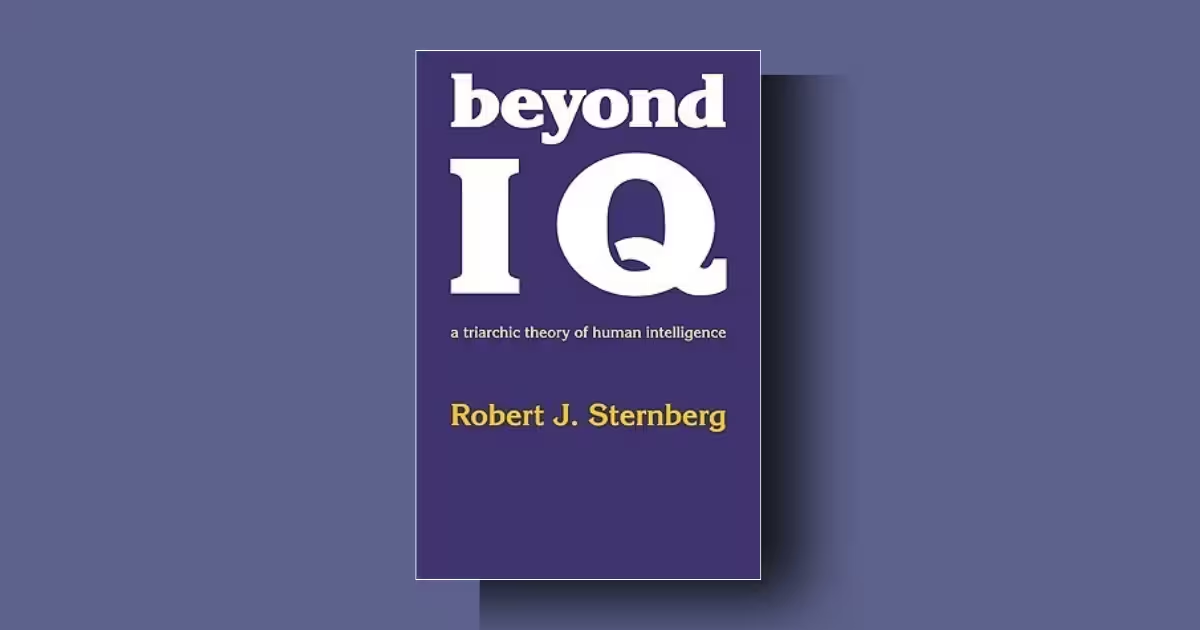
Then I picked up Robert J. Sternberg’s Beyond IQ: A Triarchic Theory of Human Intelligence, and everything I thought I knew about intelligence got turned upside down.
Overview
Sternberg’s central argument is deceptively simple yet profoundly disruptive: IQ tests measure only a fraction of what intelligence actually is. First published in 1985 by Cambridge University Press, this 411-page landmark work argues that human intelligence comprises three interconnected aspects, analytical, creative, and practical, and that conventional IQ tests capture only the first of these.
The book is dense, academic, and occasionally overwhelming. But if you’re willing to put in the work, it will fundamentally change how you think about intelligence, your own and everyone else’s.
Reader Recommendation: Who Will Actually Love This Book (and Who Should Bounce)
This book is for you if:
- You’ve ever felt like your IQ score doesn’t capture your actual abilities
- You’re an educator, psychologist, or parent trying to understand how children really learn and succeed
- You’re fascinated by cognitive psychology and want to understand the mechanisms behind intelligent behavior, not just the labels
- You’re willing to wrestle with technical material (this isn’t a breezy pop-psychology read)
You should probably skip this book if:
- You’re looking for practical self-help advice or quick tips to “boost your IQ”
- You have no patience for academic writing, research methodology, or statistical analysis
- You believe IQ tests are the be-all and end-all of measuring human potential
Let me be blunt: this book will challenge you. It’s not always an easy read. But if you stick with it, the payoff is enormous.
Table of Contents
Introduction
Title: Beyond IQ: A Triarchic Theory of Human Intelligence
Author: Robert J. Sternberg
Publication Details: Cambridge University Press, 1985 (hardcover) / 1985 (paperback)
Robert J. Sternberg is a towering figure in the field of intelligence research. At the time of writing, he was a professor of psychology at Yale University. He has since held positions at Tufts University and Cornell University, and his work has fundamentally reshaped how psychologists understand intellectual capacity.
The triarchic theory he presents in this book transformed the field’s study of intelligence from a purely psychometric approach to a more cognitive one.
Context: What This Book Is About
Beyond IQ is Sternberg’s comprehensive statement of his triarchic theory of human intelligence. It represents the culmination of years of research and represents a direct challenge to the conventional wisdom that intelligence can be reduced to a single number, your IQ score.
The book is organized around three subtheories, each addressing a different aspect of intelligence:
- The contextual subtheory, relating intelligence to the external world
- The experiential subtheory, relating intelligence to experience
- The componential subtheory, relating intelligence to the internal world
Purpose: The Central Thesis
Sternberg’s main argument is that intelligence is not a single, unitary trait but a complex interplay of multiple mental processes that operate in different contexts and at different levels of experience.
As he writes in the preface: “The general goal of this book is to present a new, ‘triarchic’ theory of human intelligence. I believe the theory goes beyond many previous theories in its scope and answers a broader array of questions about intelligence than has been answered in the past by most single theories.”
In other words, Sternberg isn’t just tweaking existing theories, he’s proposing a fundamentally different way of understanding what intelligence is and how it works.
Background
To understand why Beyond IQ was such a significant contribution, you need to understand the intellectual landscape Sternberg was stepping into.
By the early 1980s, intelligence research had largely been dominated by two approaches:
The psychometric approach (Spearman, Thurstone, Cattell, Guilford) treated intelligence as a set of factors or abilities that could be identified through factor analysis. The problem? These theories described the structure of intelligence but said almost nothing about the processes that produced intelligent behavior.
The cognitive approach (Hunt, Carroll, Newell & Simon) focused on the mental processes involved in intelligent performance. But this approach often relied on laboratory tasks of dubious relevance to real-world functioning.
Sternberg saw that both approaches were incomplete. The psychometric approach told us what intelligence looks like but not how it works. The cognitive approach told us how intelligence works in controlled laboratory settings but not what it looks like in the messy, unpredictable real world.
His solution? Combine them. As one Nature reviewer put it, “His approach is inclusive, and has become more so over the years”.
Beyond IQ Summary
Let me walk you through what I discovered in this book. I’ve organized this around the three subtheories that form the backbone of Sternberg’s framework.
Part 1: The Contextual Subtheory – Intelligence in the Real World
The contextual subtheory addresses a question that most intelligence theories had simply ignored: What behaviors actually count as “intelligent” in the real world?
Sternberg defines intelligent behavior as “mental activity directed toward purposive adaptation to, and selection and shaping of, real-world environments relevant to one’s life”.
This definition contains several critical elements:
1. Adaptation: This is what we normally think of as intelligence: adjusting to your environment. As Sternberg notes, “The normal course of intelligent functioning in the everyday world entails adaptation to the environment”.
2. Selection: Sometimes adaptation isn’t possible or desirable. In these cases, intelligent people select a new environment that better fits their skills, interests, and values. Think of someone who realizes they’re miserable in a corporate job and switches to freelance work. That’s not just a career change, it’s an intelligent act of environmental selection.
3. Shaping: When you can’t adapt and you can’t leave, intelligent people try to shape their environment to better fit them. A classic example: an employee who convinces their company to adopt a new workflow that plays to their strengths.
What makes this framework so powerful is that it recognizes that intelligence isn’t the same thing for everyone. As Sternberg puts it: “What is required for adaptation, selection, and shaping may differ across persons and groups, as well as across environments”.
This is a radical departure from the one-size-fits-all approach of traditional IQ tests.
A concrete example: Sternberg points out that “the advent of the computer in our society seems likely to change what constitutes intelligent performance in our society”. Fifty years ago, being able to do rapid mental arithmetic was a mark of intelligence. Today? You can pull out your phone. What’s adaptive has changed, and so has what we consider intelligent.
Part 2: The Experiential Subtheory – When Intelligence Shows Up
The experiential subtheory addresses another question that previous theories had largely ignored: When does a task actually measure intelligence?
Sternberg’s answer is elegant: tasks measure intelligence best when they involve either coping with novelty or automatizing information processing.
Coping with novelty means dealing with situations you haven’t encountered before. As Sternberg writes: “Intelligence is not so much a person’s ability to learn or think within conceptual systems that the person has already become familiar with as it is his or her ability to learn and think within new conceptual systems”.
Think about it: solving a problem you’ve solved a hundred times before doesn’t really demonstrate intelligence. It demonstrates familiarity. True intelligence shows up when you encounter something genuinely new and figure out how to handle it.
Automatization, on the other hand, is about becoming so skilled at something that it no longer requires conscious effort. As Sternberg explains: “The more intelligent person will be more rapidly and fully able to cope with the novel demands being made upon him or her”.
What’s fascinating is how these two processes interact. “Greater automatization of information processing frees additional processing resources for attending to novelty”. In other words, the more you automate routine tasks, the more mental energy you have available for dealing with genuinely new challenges.
This explains something I’d noticed but never quite understood: why some people seem to get better and better at handling complexity over time, while others plateau. The ones who improve are the ones who keep automating the routine stuff so they can focus their mental energy on what’s genuinely novel.
Part 3: The Componential Subtheory – How Intelligence Works
The componential subtheory is the most technical part of the book, and it’s where Sternberg gets into the actual mechanics of intelligent behavior. He proposes three kinds of mental processes:
1. Metacomponents – These are the executive processes that plan, monitor, and evaluate your performance. They’re the “CEO” of your cognitive system. When you’re deciding how to approach a problem, checking your progress, or adjusting your strategy, you’re using metacomponents.
Sternberg identifies seven metacomponents, including:
- Figuring out what problem you actually need to solve
- Deciding which lower-level processes to use
- Selecting a strategy for combining those processes
- Monitoring your progress
- Being sensitive to feedback
2. Performance components – These are the actual processes that execute the plans your metacomponents create. They’re the “workers” in your cognitive factory. In an analogy problem (LAWYER is to CLIENT as DOCTOR is to ?), the performance components include encoding the terms, inferring the relationship between the first two terms, mapping that relationship to the second half, and so on.
3. Knowledge-acquisition components: These are the processes that let you learn new things. Sternberg identifies three:
- Selective encoding: figuring out what information is relevant
- Selective combination: putting the relevant pieces together into a coherent whole
- Selective comparison: relating new information to what you already know
What’s crucial here is that these components aren’t just abstract theory, Sternberg and his colleagues actually tested them experimentally. In one study, they found that global planning scores correlated .43 with measured intelligence, while local planning scores correlated -.33.
Let me translate that: more intelligent people spent more time on high-level planning and less time on tactical details. They thought about the big picture before diving into the weeds. The less intelligent people did the opposite, they jumped into the details without adequate planning.
This is a pattern I’ve seen repeated in countless contexts. The most effective people I know don’t necessarily work faster; they work smarter by investing time upfront in understanding the problem before trying to solve it.
Putting It All Together: The Triarchic Framework
Sternberg’s genius lies in how he integrates these three subtheories. As he explains in the preface:
“The contextual subtheory relates intelligence to the external world of the individual. The experiential subtheory relates intelligence to both the internal and external worlds. The componential subtheory relates intelligence to the internal world of the individual.”
In other words:
- Context tells us what behaviors are intelligent in a given situation
- Experience tells us when those behaviors demonstrate intelligence (when they involve novelty or automatization)
- Components tell us how those behaviors are actually generated
A behavior is intelligent to the extent that it meets all three criteria: it’s contextually appropriate, it involves novelty or automatization, and it’s generated by effective componential processing.
This is a much richer, more nuanced view of intelligence than anything that can be captured by a single number.
Beyond IQ Analysis
So what do I actually think about this book?
It’s a masterpiece of cognitive psychology, and a tough slog.
Sternberg is brilliant, there’s no question about that. His grasp of the literature is encyclopedic, his experimental work is rigorous, and his theoretical framework is genuinely groundbreaking. The triarchic theory has influenced everything from educational practice to talent identification to our basic understanding of what it means to be intelligent.
But let’s be honest: this book is not an easy read.
The first few chapters, where Sternberg reviews the history of intelligence research, are accessible enough. But once you get into the componential subtheory and the experimental validation chapters, the material gets dense. Really dense. Sternberg is writing for fellow psychologists, not for a general audience.
That said, the effort is worth it. There’s something deeply satisfying about watching a master theorist work through his arguments, present his evidence, and build his case. Sternberg doesn’t just assert things, he shows his work.
The book also suffers from what I’d call the “academic blind spot”: an assumption that the reader cares as much about the experimental details as the author does. Do I really need to know the exact parameter estimates for every single component in every single experiment? Probably not. But for someone doing research in this area, that level of detail is invaluable.
Strengths and Weaknesses
What Worked for Me
1. The triarchic framework is genuinely illuminating. Once you see intelligence through Sternberg’s lens, you can’t unsee it. You start noticing the three dimensions everywhere, in how people solve problems, in how they succeed (or fail) in their careers, in how they navigate life.
2. The experimental grounding is impressive. This isn’t armchair theorizing. Sternberg and his colleagues actually tested their predictions across dozens of experiments with thousands of subjects. When he claims that a certain component takes a certain amount of time, he has the data to back it up.
3. The critique of IQ testing is devastating and necessary. Sternberg doesn’t just say IQ tests are incomplete, he shows why they’re incomplete and what they’re missing. As he writes: “IQ tests work only for some people some of the time. There has been an upper limit on the validity coefficients of IQ tests, generally around .5, that has not changed for many years”.
4. The practical implications are significant. This isn’t just academic theory. The triarchic framework has real-world implications for how we teach children, how we hire employees, and how we evaluate human potential.
What Didn’t Work for Me
1. The writing is often dry and technical. This is a book for specialists, not for general readers. If you’re looking for an accessible introduction to Sternberg’s ideas, you’d be better off starting with his later, more popular works.
2. Some sections feel like research reports rather than book chapters. The experimental validation chapters (Chapters 5-9) read like journal articles, detailed, data-heavy, and not always well-integrated into the broader narrative.
3. The book is dated in places. The research Sternberg cites is from the 1970s and early 1980s. While the theoretical framework remains relevant, some of the specific findings have been refined or challenged by subsequent research.
4. The treatment of practical intelligence feels underdeveloped. Sternberg acknowledges that practical intelligence is important, but the book focuses much more heavily on analytical intelligence. The practical intelligence research he presents is interesting but feels like an afterthought.
Comparison with Similar Works
Beyond IQ is often compared to Howard Gardner’s Frames of Mind: The Theory of Multiple Intelligences, which was published two years earlier (1983). Both books challenged the narrow, IQ-centric view of intelligence that had dominated psychology for decades.
But there are important differences.
Gardner argues for multiple independent intelligences (linguistic, logical-mathematical, musical, spatial, bodily-kinesthetic, interpersonal, intrapersonal), each operating somewhat autonomously. Sternberg, by contrast, argues for three interrelated aspects of intelligence (analytical, creative, practical) that work together within a unified cognitive system.
In practice, Gardner’s framework has been more popular with educators (it’s intuitively appealing to think of different “types” of smart), while Sternberg’s framework has been more influential in cognitive psychology (it’s more tightly grounded in experimental research).
Another point of comparison: Keith Stanovich’s What Intelligence Tests Miss: The Psychology of Rational Thought (2009) argues that IQ tests measure only one aspect of cognition (algorithmic efficiency) while missing others (rational thinking dispositions). This is a more recent, more focused version of the same basic critique Sternberg was making in 1985.
Conclusion
Beyond IQ is one of the most important books on intelligence published in the last fifty years. It fundamentally reshaped how psychologists think about intellectual ability and laid the groundwork for decades of subsequent research.
Is it an easy read? No. Is it for everyone? Definitely not. But if you’re willing to put in the work, you’ll come away with a far richer, more nuanced understanding of intelligence than you had before.
Who Should Read This Book
This book is essential reading for:
- Educators and educational psychologists who want to understand how children really learn and succeed
- Cognitive psychologists who want a comprehensive framework for understanding intelligent behavior
- Anyone involved in talent identification or personnel selection who wants to move beyond the limitations of IQ testing
- Serious students of psychology who want to understand one of the field’s most important theoretical contributions
Who Should Skip This Book
- Casual readers looking for a light, accessible introduction to intelligence research
- Self-help seekers hoping for quick tips to boost their IQ
- Anyone who’s not prepared for dense, technical, academic writing
What This Book Taught Me
Reading Beyond IQ changed how I think about intelligence, my own and everyone else’s.
I used to think of intelligence as a fixed trait, something you’re born with that determines your ceiling in life. Now I see it as a set of skills that can be developed, a set of processes that can be improved, and a set of strategies that can be learned.
I used to think IQ tests were imperfect but basically valid measures of intelligence. Now I understand just how much they miss, the creativity to generate novel solutions, the practical wisdom to navigate complex situations, the metacognitive skills to plan and monitor your own thinking.
I used to think the smartest people were the ones who could solve problems the fastest. Now I know that sometimes, the smartest people are the ones who spend more time understanding the problem before they try to solve it.
This book won’t make you smarter. But it will make you think more intelligently about intelligence. And that, I’ve come to believe, is worth more than any IQ score.