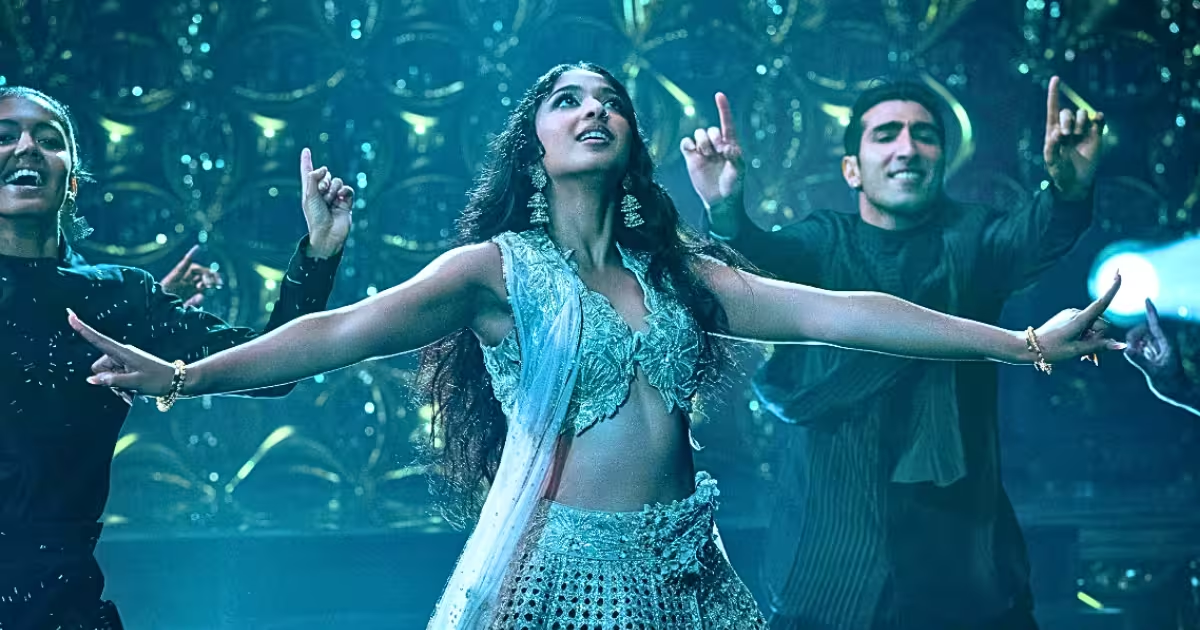

Best of the Best 2026 is a Netflix dance comedy that spends most of its 112 minutes doing exactly what you expect, and then ends with a heist for the Koh-i-Noor diamond that you almost certainly did not see coming. Released on 18 September 2026, the film follows two childhood best friends, Maya and Anjali, through their first year on UCLA’s Bollywood-fusion dance team.
Underneath the trophy chase sits a sharper question: what happens when the person who knows you best is also the person you are competing against?
I think the friendship story is stronger than the dance story, the script is weaker than the cast, and the finale is the reason to stay to the end. Spoilers are included below, so this is a review for people who have watched it, or who would rather know everything before they press play.
On paper, Best of the Best is a familiar package. Lena Khan directs. Hasan Minhaj and Prashanth Venkataramanujam wrote the script. Maitreyi Ramakrishnan, best known for Never Have I Ever, plays Maya opposite Priyanka Kedia as Anjali. Netflix rates it PG-13 and lists a running time of 1 hour 52 minutes.
The first reviews split in a way I found useful. The A.V. Club gave it a B+, while Roger Ebert’s site said the film misses a few steps. I land somewhere in between, and this Best of the Best review explains where and why.
Table of Contents
Is Best of the Best 2026 worth watching?
Yes, if you want a warm, funny Netflix dance comedy carried by two strong leads. No, if you need a fresh script. Best of the Best (2026) follows Maya and Anjali, who join UCLA’s dance team Agni and nearly lose their friendship on the road to a national championship.
The choreography, the chemistry between the leads and a Koh-i-Noor heist finale are the highlights. The plot is predictable, the editing chops up the dancing, and the male characters are forgiven far more easily than the women. My rating is 3.5 out of 5.
- Film: Best of the Best (2026), Netflix original, released 18 September 2026
- Director: Lena Khan
- Writers: Hasan Minhaj and Prashanth Venkataramanujam
- Stars: Maitreyi Ramakrishnan, Priyanka Kedia, Hasan Minhaj
- Runtime and rating: 1 hour 52 minutes, PG-13
- Ending in one line: UCLA Agni wins the national championship, and Maya and Anjali repair their friendship
- Best part: the museum heist finale set to a new A.R. Rahman song
- Weakest part: a formula script and editing that interrupts the dancing
Who should watch Best of the Best?
You will get the most out of this film if you fit one of these groups.
- Never Have I Ever fans. Ramakrishnan gets her first big follow-up to that series, and her comic timing is the main reason the film works.
- South Asian American viewers and second-generation families. The Student Association politics, the dance team cliques and the parent comparisons are drawn from real campus life.
- Anyone who misses cheerful dance comedies. If Pitch Perfect and Step Up were your comfort watches, this sits close to them.
- Friends and siblings watching together. The central relationship is a friendship, not a romance, which is still rare in this genre.
- Casual viewers. You do not need to know Bollywood to follow the story, although the references reward you if you do.
You may want to skip it if you are looking for formal risk, cultural depth or long uninterrupted dance shots. Parents should also note that the PG-13 rating covers strong language, sexual material, some teen drinking, drug material and brief smoking, according to Movie Insider.
What is Best of the Best about, and how did it get made?
Best of the Best is a coming-of-age comedy about college dance competitions, and it grew out of real memories. According to Netflix Tudum, Minhaj and Venkataramanujam finished their political comedy series Patriot Act in 2020 feeling worn out. They wanted to make something that brought joy, and they had long talked about a comedy on South Asian college kids.
Every road, they said, led back to the dance team.
Both had attended Bollywood-inspired dance competitions in college, and Minhaj has described the story as a set of painfully true events he saw firsthand. Reports differ on his campus. Netflix’s Tudum names UC Davis, while Ebert’s review cites a Drew Barrymore Show interview that refers to UC Santa Cruz.
I could not reconcile the two, so I will not pick one.
The tone came from an unexpected place. The writers say they watched To All the Boys I’ve Loved Before in Minhaj’s basement, meaning to see only the first 15 minutes, and ended up finishing it. They wanted the same tenderness. Khan, who previously directed Flora & Ulysses and The Tiger Hunter, points to Dope and Into the Spider-Verse as her visual reference points, and she describes the screenplay as a dance movie, a friendship movie and a big spectacle in a single story. She was aiming for a music-video look with editorial fashion.
The film was produced by Rideback and 186K Films for Netflix. Movie Insider notes that it entered post-production in January 2026 and was marked completed in June 2026.
It landed on Netflix on 18 September 2026, alongside 12 other films opening the same day, and Movie Insider expects a DVD and Blu-ray release in November 2026, though that date can change.
The choreography team includes Phillip Chbeeb, Makenzie Dustman and Joya Kazi, with Adam Carboni as cinematographer, and Daniel Rojas is credited with the score. The supporting cast includes Chaneil Kular as Arjun, Ankur Rathee as Ronak, Shreya Navile as Deepica, Becky Alex as Dimple, Nico Greetham as Harry, Lilly Singh as Sunny and Janina Gavankar.
What happens in Best of the Best? plot summary
Spoiler warning: everything below gives away the story and the ending. I have built this summary from Roger Ebert’s review, IndieWire, DMTalkies, the A.V. Club and interviews with the filmmakers. The second half of the film moves quickly and reviews describe the order slightly differently, so treat the sequence as my best reconstruction.
The setup. The film opens with a high school talent show.
Maya and Anjali perform a routine that blends classical Indian dance with modern jazz and hip-hop. It is a triumph until a drone mishap sends the clip viral for the wrong reasons, and Maya takes the worst of the embarrassment. Months later, the two girls are dropped off at UCLA to share a dorm.
Maya’s mother tells them to join the South Asian Student Association. Anjali’s mother reminds her that she must keep perfect grades to stay at the university, and then slaps her in full view of the dorm.
Maya jokes that the white students looked ready to call the police. It is one of the sharpest early gags, and it shows how differently the two families work. Maya is a computer science student on a full scholarship who seems to breathe code. Anjali, according to DMTalkies, was raised by a mother who did it alone and wants her daughter to depend on nobody, so she carries far more pressure.

Joining Agni. Early on, the two watch UCLA Agni, the university’s Bollywood-fusion dance team, perform on stage. Each drifts into a daydream. Anjali imagines a moonlit rooftop romance with the team’s captain Ronak, both dressed as if on their way to a wedding. Maya imagines herself leading the whole troupe, dancing in front of a row of mirrors in the style of Fred Astaire.
Still stung by the viral video, Maya tries out and talks Anjali into coming along. They make the team without trouble in a sequence set to Ghungroo, a song from the Hindi film War.
Ronak’s plan. Ronak is about to graduate and refuses to leave until he beats his ex-girlfriend and her rival squad at the national competition. He wants the team’s routine built around a Bollywood wedding. Maya laughs at the idea and is dressed down in front of everyone, a scene Ebert compares to the cerulean sweater speech in The Devil Wears Prada.
Her objection is not that a wedding is too grand but that it is stereotypical and boring. She wants a concept so specific to the team that nobody could copy it, and her thinking is that you cannot steal what already belongs to you.
The rift. Training takes over both girls’ lives.
A montage that feels like a single take shows the team rehearsing, and it balances spectacle with humour. Anjali’s grades slide and she ends up on academic probation.
Then the team votes to change the female lead in the championship routine from Maya to Anjali. Maya sees it happen and says nothing to her friend. The differences between them, Maya’s outspokenness and academic ease against Anjali’s beauty and agreeable nature, widen the gap. Ronak wrongs both girls without quite meaning to, and his eventual apology is a text message.
The boy trouble. Maya has a love interest of her own in Arjun, a chipper family friend played by Chaneil Kular. At a party, a video captures Maya and Ronak together. Arjun misreads it and storms off without hearing her side. Maya apologises anyway and even sends him a present, though she has done nothing wrong. He replies with an apology text of his own.
The low point. Once Anjali learns what happened to Maya, she quits the team. She turns to her studies, climbs off probation and also drops computer science, admitting it was never what she wanted to do. Maya walks away from Agni as well. Professor Latif, played by Minhaj, tells the two of them to bury the hatchet, because in fifteen years none of it will matter. A male teammate then finds Maya and talks her back into rejoining.
The finale. Maya and Anjali return as the team’s two leads, apparently because they are the only two who can learn a routine that fast. Maya’s concept is a heist.
Agni will perform a break-in at a British museum to retrieve the Koh-i-Noor, the diamond taken from India during colonial rule. What’s on Netflix stresses that the team retrieves the diamond, not steals it. Dancers hide behind moving walls, push statues, dress as paintings and change costumes mid-routine.
The music is a new song by A.R. Rahman called Aamaasee. Partway through, something outside the team’s control halts the performance, which Ebert calls an act of god, and the song stops and restarts. Reviews also mention an improvised routine inspired by kuthu, a Tamil street dance, and I read that as the same moment.
A duet between Maya and Anjali in the dark shows their friendship in its final form. In the closing beat, the team destroys the diamond instead of returning it, a choice Minhaj explained as reclaiming identity and creating something new.
The ending. UCLA Agni wins the national championship. Maya and Anjali reconcile, and the film does not pretend the fight never happened. Maya’s romance with Arjun is blossoming, and there is an unresolved spark between Anjali and Ronak, although Ronak’s time at UCLA is nearly over.
Both girls are still first-year students, which is why some outlets are already speculating about a sequel. I could not find an official announcement of one.
How good is Best of the Best as a film? Critical analysis
I enjoyed the film more than its structure deserves, and I think that gap explains most of the mixed reviews.
The script. The story follows the college dance formula closely.
Ebert’s review says it feels like a Disney Channel film and calls it the brown dance version of Pitch Perfect. IndieWire makes a similar comparison, pointing to Ronak’s play-it-safe approach as an echo of the upperclassmen in that film. In contrast, the A.V. Club argues that familiar arcs still ache when Maya and Anjali hurt each other.
I side with the A.V. Club on the emotional beats and with Ebert on the surprises, which mostly stop after the first act. JoySauce goes further and says setups are often forgotten or immediately resolved, and that the late reveals feel plucked from thin air. Some of that criticism is fair.
The viral video, for example, drives Maya to join Agni and then barely returns.
The humour. The jokes arrive quickly. JoySauce notes that many are delivered by minor characters off screen, in the rhythm of Minhaj’s stand-up, and that some lean on shorthand about the community rather than character.
I laughed most at the moments rooted in the two families, and less at the punchlines that only gesture at being in the know.
The editing. This is the most repeated complaint. Ebert argues that the cutting undercuts the choreography, with constant switches between wide shots and close-ups that make it hard to follow the rhythm and storytelling that Bollywood dance depends on.
That is frustrating because, as the same review says, the cast’s dancing is undeniable. JoySauce makes the opposite point, that the dance is so polished nobody ever seems to struggle, which drains it of stakes.
The two critics disagree about the cause and agree about the result: the dancing is excellent, but you do not always feel it.
The choreography and music. Joya Kazi’s choreography earns its praise. The A.V. Club lists Bollywood tributes with colourful outfits and wild props, high-energy kuthu and more classical dance, and says the cast handles all of it.
Khan told What’s on Netflix that a typical Bollywood dance takes about four days to shoot, while she had one, sometimes one and a half. She built the finale with peg dolls and a tiny camera ordered from Etsy, planning each move before the day.
The soundtrack mixes Hindi and Tamil music with pop, and What’s on Netflix lists BLACKPINK, ENHYPEN and Hanumankind among the artists. The Rahman song deserves its billing, though Ebert is right that the interruption stops it from landing as it should.
The gender problem. This is where Ebert’s review is sharpest. When Ronak wrongs the girls, he apologises with a two-second text. When Arjun misreads the party video, Maya is the one who apologises. When Maya needs persuading to return, a male teammate does it.
Ebert argues the bar for the male characters is low while the women’s reconciliation seems almost impossible, and asks why a story about brown women written by two men gets so little accountability outside the leads.
The review points to Polite Society, written and directed by Nida Manzoor, as a stronger example. I think this is a fair critique and the film’s clearest blind spot, even if I still enjoyed it.
How are the performances in Best of the Best?
The acting is the film’s strongest asset. Maitreyi Ramakrishnan plays Maya with the same fast, spiky charm that made her a star in Never Have I Ever.
Ebert says the film operates to a large degree on her charm alone, and the A.V. Club calls her a delight who finally gets a worthy follow-up to her four-season Netflix run.
Her weakness is not her doing. JoySauce argues that Maya’s selfish decisions are never given a source in her past or worldview, so the script asks Ramakrishnan to fill in a gap it never wrote.
Priyanka Kedia has the harder job. Anjali is the agreeable one, the easy character to overlook, and Kedia gives her a visible ache. FandomWire’s reviewer says she captures the experience of loving someone while feeling diminished beside them, and that this conflict is more compelling than the championship.
I agree. The scenes where Anjali holds her tongue say more than the scenes where she speaks.
Chemistry between the two is the film’s engine. The A.V. Club says their energy gives the film its beating heart, and both actors reportedly completed four months of intensive dance training, according to a Cosmopolitan report cited by FandomWire.
The supporting cast is uneven, mostly because the roles are thin. Chaneil Kular as Arjun is the standout for JoySauce, who calls him amusingly flirtatious. Nico Greetham steals scenes as Agni’s token white guy who knows more about South Asian culture than his brown teammates, according to Ebert.
Ankur Rathee plays Ronak as a heartthrob captain who is also controlling, and Minhaj appears as Professor Latif, delivering the film’s fifteen-year speech about letting grudges go. The A.V. Club also wishes the two mothers had more screen time.
What themes does Best of the Best deal with?
Friendship and jealousy. The real plot is the slow collision between two people who grew up sharing everything. Maya cannot see how her drive for recognition crowds out Anjali. Anjali cannot say how small she feels beside her friend. Minhaj told Netflix Tudum that the film is about sisterhood, friendship and self-acceptance.
Parental pressure and comparison. The A.V. Club says the film tackles tiger parenting and the habit of comparing children to one another through Maya and Anjali’s first taste of freedom.
Anjali’s mother sets an academic bar so high that dance competes directly with her studies. Maya, by contrast, has a scholarship and an easier path, which makes her hunger for the spotlight harder to sympathise with.
Being seen. Venkataramanujam says the film is about what it means to be seen. That runs through the dance team politics, the vote that sidelines Maya and the quiet moment where Anjali realises she never chose her degree. Latif’s advice to bury the hatchet lands because both girls need to be seen more than they need to win.
Culture, ownership and reclaiming. Maya’s argument that you cannot steal what is already yours becomes the film’s central idea. The finale turns a real historical grievance into a dance.
Venkataramanujam says the writers wanted the film to stop fixating on what was taken and ask where internal worth comes from. It is a bold way to end a college comedy, and I will come back to it in my personal take.
Diaspora identity. JoySauce notes that the leads are second-generation Americans, a shift from the first-generation stories that dominate South Asian American cinema, and argues that the writers’ concerns do not always fit that premise.
The A.V. Club takes the opposite view, saying the film shows characters whose culture is a major part of their lives without defining all of who they are. That disagreement is worth reading in full if you care about the subject.
How does Best of the Best compare with other dance and friendship comedies?
Pitch Perfect. This is the comparison every critic reaches for. Both films have a competitive ensemble, a controlling senior and an outsider who wants to change the routine.
Ebert’s verdict is that a film about a collegiate art form could do more than be the brown dance version of Pitch Perfect. I think the friendship at the centre makes Best of the Best warmer and less snarky, but Pitch Perfect is the sharper comedy.
Step Up. The A.V. Club says the cast is up to Step Up-esque demands, and that is accurate. The difference is that Step Up trades on romance and rivalry, while Best of the Best keeps its central relationship platonic and lets romance sit at the edges.
Booksmart and Lady Bird. The A.V. Club subhead says Bollywood meets Booksmart, which is a fair shorthand for the two best friends approaching a big life change. It also compares the mother-daughter angle to Lady Bird, though it wishes the film had focused on that relationship as sharply.
To All the Boys I’ve Loved Before. Minhaj and Venkataramanujam name this as their tonal model, and you can see it in the sweetness of the friendship scenes.
Polite Society. Ebert uses Nida Manzoor’s film as the standard for a story about brown sisters written by brown women. In contrast to that film’s ambition, Best of the Best plays it safer.
Khan’s earlier work. Movie Insider lists Flora & Ulysses and The Tiger Hunter among her previous films. Those are very different pictures, so I would not call this a natural continuation. What carries over is her willingness to build heart around spectacle.
What sets it apart from all of these is its finale. No other film in this genre that I know of ends with the leads breaking into a museum to retrieve a colonial diamond, then choosing to destroy it. It is not always subtle, but it is a swing.
How are audiences and critics reacting, and has Best of the Best won awards?
Best of the Best has been out for less than two days, so every number below is early and will move. At the time of writing, Rotten Tomatoes shows only five critic reviews and fewer than 50 audience ratings, and no Tomatometer score has been established yet.
Among the reviews I could read, the A.V. Club gave it a B+, Ready Steady Cut gave it 4 out of 5, and FandomWire gave it 8 out of 10.
TheWrap’s William Bibbiani wrote that the film is funny and involving enough to keep you alert even when sleep-deprived. On the other side, Ebert’s site and JoySauce are far more critical, with JoySauce calling it a scattered comedy-drama.
One early audience reviewer on Rotten Tomatoes described it as a comforting comedy that reminded them of Pitch Perfect.
What does Best of the Best teach us today? My personal take
Four things stayed with me after the credits.
The first is how ordinary the central problem is. Most of us have had a friend we grew up alongside and slowly stopped fitting next to. Nobody does anything monstrous.
One person gets a spotlight the other wanted, someone keeps a secret to avoid an awkward talk, and a small silence grows. Maya’s biggest mistake is not the ambition. It is watching the lead vote change and not telling Anjali.
If you take one practical lesson from the film, take that one. Say the uncomfortable thing early, while it is still a conversation and not a wound.
The second is about how we apologise. Ebert’s review is right that a two-second text from Ronak is a weak apology. Maya’s changed behaviour at the end is the stronger model, because she shows she has heard Anjali by doing something different. Try that in your own life.
Apologise with a change in action, not only words.
The third is the diamond. The Koh-i-Noor was recut in 1852 from about 186 old carats to roughly 105.6 carats, and it now sits in the Queen Mother’s crown at the Tower of London.
Britain says it obtained the stone legally under the 1849 Last Treaty of Lahore, signed by the 10-year-old Maharaja Duleep Singh, while India has asked for its return since 1947 and Pakistan, Iran and Afghanistan have made claims of their own.
The film does not settle that argument, and the writers say the debate is always bubbling in South Asian culture. Their answer is to point the characters toward their own worth, and that will appeal to some viewers and frustrate others who feel restitution deserves more than a dance number.
I think both reactions are reasonable, and the movie is at its best when it lets you feel both.
The fourth is the plain question of who tells these stories. I am glad the film exists, and I share Ebert’s wish that more stories about brown women are written by brown women. That is not an attack on Minhaj or Venkataramanujam. It is a reminder that representation is not finished when a cast is right.
For students, parents and anyone living between two cultures, the practical message is simple. Your worth does not depend on the trophy, the grade or the comparison your relatives make. Choose the work you love, tell your friends the truth early, and share the stage when it counts.
Pros and cons of Best of the Best
| Pros | Cons |
|---|---|
| Ramakrishnan and Kedia have real chemistry and carry the film | The plot follows the college dance formula closely |
| Excellent choreography across Bollywood, kuthu and classical styles | Editing chops up the dance numbers |
| A female friendship, not a romance, sits at the centre | Male characters are forgiven far too easily |
| The Koh-i-Noor museum heist is a bold and memorable finale | Some setups, such as the viral video, are dropped or forgotten |
| New A.R. Rahman song and a lively soundtrack | The Rahman number is interrupted at its peak |
| Rare mainstream focus on South Asian American campus life | Jokes sometimes rely on community shorthand |
Final verdict, should you watch Best of the Best?
Best of the Best (2026) is not the freshest dance comedy you will ever see, and it is not trying to be. It is a warm, quick, funny film with two excellent leads, a clear-eyed look at how friendship strains under ambition and a finale with more imagination than the rest of the script combined.
The flaws are real. The editing works against the dancing, and the male characters get an easy ride. Still, I found it easy to like, and the last twenty minutes are the reason I would recommend it.
My recommendation: a good watch for Never Have I Ever fans, dance movie lovers, families with older teens and anyone who has ever outgrown a friend. Skip it if you want radical originality. My rating is 3.5 out of 5.
FAQs
When did Best of the Best come out and where can I watch it?
It was released on Netflix on 18 September 2026. Movie Insider expects a DVD and Blu-ray release in November 2026, though that date may change.
Who is in the Best of the Best cast?
Maitreyi Ramakrishnan plays Maya and Priyanka Kedia plays Anjali. Hasan Minhaj appears as Professor Latif, with Chaneil Kular, Ankur Rathee, Shreya Navile, Becky Alex, Nihar Duvvuri, Nico Greetham, Amryn Khurana, Tanishq Joshi, Lilly Singh, Sasha Bhasin, Janina Gavankar, Saara Chaudry and Kavi Ramachandran, according to Netflix.
Does UCLA win at the end of Best of the Best?
Yes. UCLA Agni wins the national championship after the Koh-i-Noor heist routine, and Maya and Anjali repair their friendship.
Is Best of the Best based on a true story?
Not as a single true story. It is fiction, but it draws on the writers’ own college experiences and on real US collegiate Bollywood-fusion competitions, according to Netflix Tudum and the A.V. Club
Is Best of the Best suitable for kids?
It is rated PG-13 for strong language, sexual material, some teen drinking, drug material and brief smoking, according to Movie Insider. It suits older teens better than young children.
Will there be a Best of the Best 2?
I could not find an official announcement. Some outlets suggest a sequel could follow the unresolved Anjali and Ronak thread and the fact that both leads are still first-year students, but that is speculation.
Who should read this review?
Anyone deciding whether to watch the film, anyone who has finished it and wants the ending explained, and writers or students looking at how South Asian American stories are being told on streaming.