
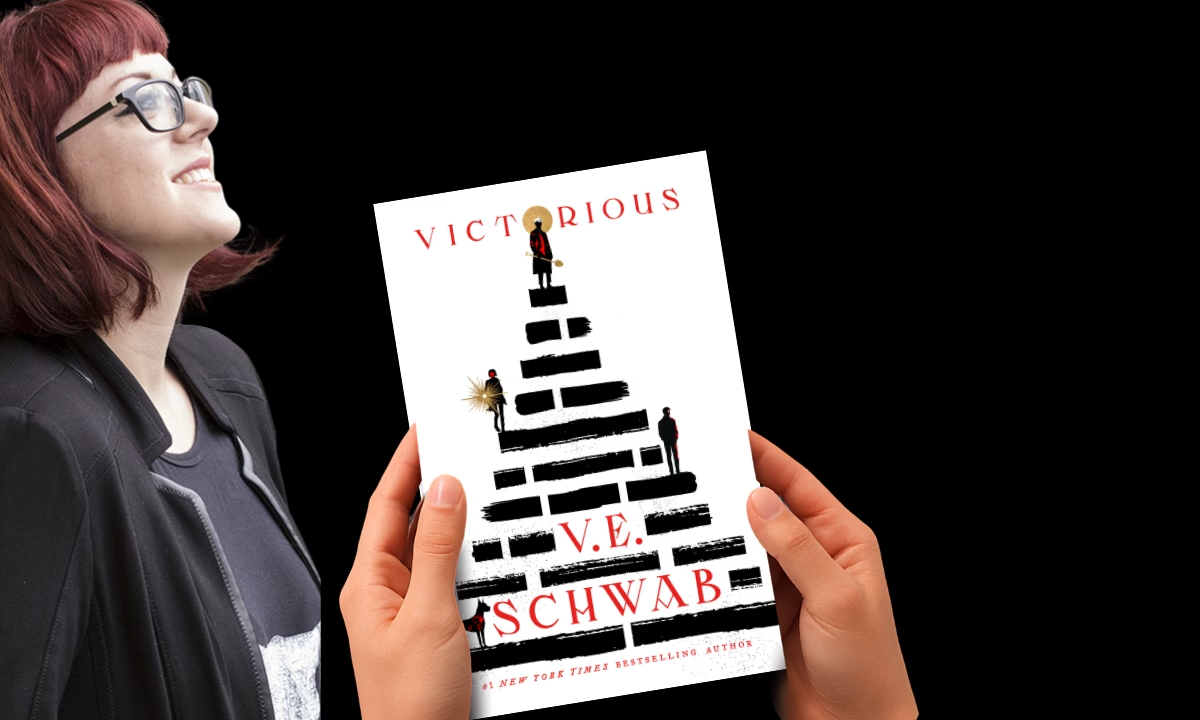

Victorious by V.E. Schwab is the final book of the Villains trilogy, and it is a finale about losing the thing you spent your whole life fighting for, then finding out the loss was the point.
I read it in two sittings, put it down, and sat in the quiet for a long while, because the title had been lying to me the entire time. Victor Vale wins. He also dies. And the person who could bring him back decides not to.
That last choice is why I wanted to write this review.
Most of what you will find online right now is either a spoiler-free “it was so good” reaction or a bare list of who lives and who dies. What I think gets missed is that this is a book about grief that refuses to end, told through a villain who is a therapist undone by his own grief.
Below you will get my full spoiler plot summary, the ending explained, character and theme analysis, short quotes cited by part and chapter, and a frank rating.
Table of Contents
Victorious at a Glance
Victorious is a dark superhero thriller that ends the Villains trilogy by asking what “winning” means for people who have already died once. Here is the short version for anyone (or any answer engine) skimming:
Book: Victorious (Villains #3) by V.E. Schwab, published October 6, 2026 by Tor Books in the US and Titan Books in the UK, according to Winter Is Coming’s cover-reveal report.
Length: 592 pages in the US hardcover and 544 in the UK edition, per the publisher listings cited in that same report. My copy runs 125 short chapters across seven parts plus a prologue.
The new villain: Dr. Gabriel Gray, a psychiatrist who can resurrect the dead and control whoever he brings back. He takes over EON, the agency that hunts ExtraOrdinaries (EOs).
The big turn: Sydney Clarke resurrects her sister Serena from three charred bones, and Serena comes back with a reality-warping dream power.
Who dies: Gabriel, Eli (for good), Serena, June, Noah, and finally Victor.
Ending in one line: Victor kills Gabriel, which unmakes everyone Gabriel raised, then dies quietly in the back of a pickup, and Sydney buries him instead of resurrecting him.
My rating: 4.5/5.
Recommended Readers for Victorious
Victorious will work best for readers who already care about Victor, Sydney and Mitch, and it will frustrate anyone hoping for a big, loud superhero war. I would split readers like this:
You will probably love it if you read Vicious and Vengeful and want an ending that actually ends; you like morally gray leads and found-family stories with sharp edges; you enjoy psychological villains more than physical ones; and if you do not mind short, punchy chapters that jump between “THEN” and “NOW.”
You might bounce if you have not read the first two books. This one assumes you know everyone; you wanted a final showdown between Victor and Eli that feels like the climax of Vicious; repeated dream sequences test your patience. There are a lot of them.
Victorious by V.E. Schwab
Victorious was written by Victoria “V.E.” Schwab and published by Tor Books (Macmillan) on October 6, 2026, closing a trilogy that began with Vicious in 2013. The ISBN for the US hardcover is 978-1-250-19223-3, as printed on the copyright page of the book.
Vicious is the first book to be published on September 24, 2013, and Vengeful on September 25, 2018. In her acknowledgments, Schwab calls it the finale of “a series thirteen years in the making,” and she dedicates the novel to her late father, noting this was the last book he read and that the Villains series was his favorite.
Quick Verdict
A brave, mournful finale that trades a superhero showdown for a story about control, grief and letting go. Recommended for fans of the first two books and of character-driven dark fantasy.
Should You Read It?
| Pros | Cons |
| Gabriel Gray is the most unsettling villain in the series | You need Vicious and Vengeful fresh in mind |
| Mitch and Sydney finally get the emotional spotlight | Dream sequences repeat the same trick several times |
| The countdown structure (“X hours before the end”) keeps pages turning | June’s and Noah’s deaths feel rushed |
| The ending has real courage and does not cheat | Eli’s final exit is quieter than many fans will expect |
| Short chapters make the 500+ pages move fast | Serena’s power upgrade can feel convenient |
What Is It About?
Three years after Eli’s death, Victor is kept alive by a drug that kills his powers, while Sydney and Mitch hide from EON in a small town. A psychiatrist named Gabriel Gray, who can raise the dead and control them, quietly takes over EON and starts collecting EOs, including a resurrected Eli.
When EON finally comes for Sydney, everyone converges on the agency’s headquarters for a last fight.
Rating: 4.5/5
Background
You need two books of context to follow Victorious, because Schwab spends almost no time recapping. Here is the backstory in brief.
In Vicious (2013), Lockland University seniors Victor Vale and Eli Cardale test a theory that near-death experiences can create ExtraOrdinaries. Both succeed.
Eli survives an ice bath and gains the power to heal from anything. Victor survives electrocution and gains control over pain. Their friendship collapses on the night their friend Angie dies, Victor spends ten years in prison (part of it sharing cell 1652 at Wrighton with Mitchell Turner), and he later teams up with Sydney Clarke, a girl Eli tried to execute.
Sydney, who fell through a frozen lake with her sister Serena, can resurrect the dead. Serena, who can command anyone with her voice, sides with Eli until Victor cuts her throat.
In Vengeful (2018), Victor’s resurrection starts glitching, so his own power keeps stopping his heart. Marcella Riggins, an EO set on starting a war between the ordinary and the ExtraOrdinary, enters the story alongside a shapeshifter named June, and EON, run by Director Stell, uses Eli as a hunter. As Victorious reminds us in its first chapter, it all ends on one night at the Merit gala: Victor kills Stell, Eli kills Marcella, and Sydney kills Eli.
There is also some real-world context worth knowing.
In fact, Entertainment Weekly’s interview with Schwab notes that Vicious was her first adult novel and that she planned the trilogy from the start but kept quiet after an earlier YA series of hers was cancelled at two books. In the same interview she names the TV series Hannibal as an inspiration and compares the book’s new reality-warping power to Wanda Maximoff’s in WandaVision.
Since then, Schwab has become one of the bigger names in fantasy. Wikipedia reports that The Invisible Life of Addie LaRue has sold over 2 million copies in the US.
Notably, there is one structural detail I loved and have not seen anyone mention: the seven parts of the novel are titled The Doctor Is In, Assessment, Treatment, Opposition, Exposure, Breakthrough and Termination. That reads like the arc of a course of therapy, and “termination” is the word therapists commonly use for the final phase of treatment, as Psychology Today explains.
For a book whose villain is a therapist, that is not an accident.
Victorious Plot Summary
Victorious is told in two braided timelines. The “THEN” chapters start three years before the end and walk forward; the “NOW” chapters cover the final week, then the final day, then the final hours, with headers that count down like a clock. I have retold it below in order, part by part, the way I would explain it to a friend who never plans to read it.
The Doctor Is In (Part 1)
The book opens moments before the end, with Victor standing at a metal door into EON, checking how much violet liquid is left in his inhaler. Then it rewinds three years.
Three weeks after the Merit gala, Victor is alone in a hotel bar, counting. He is alive only because he stole Dr. Haverty’s serum, the compound that once suppressed Eli’s healing. It stops Victor’s heart from short-circuiting, but it also shuts off his power, and he has roughly two months of it left. June finds him, wearing Mitch’s body, and instead of fighting she asks for a drink.
She hands him a deck of playing cards marked with the names and powers of EOs she has collected, and she slips him the jack of spades: Xavier Pascal, memory.
Meanwhile, in Merit, a precise, routine-loving psychiatrist named Dr. Gabriel Gray meets a patient named Paul Barnett, who believes his dreams become real. Under light sedation, snakes crawl out of Paul’s chest in Gabriel’s office. Gabriel sees it, feels a fang graze his arm, and then lies to Paul’s face, telling him it was only a bad dream, because he wants to study him.
Weeks later, Paul dreams of shattering glass and wakes to find his sister cut to pieces. He breaks into Gabriel’s office, the two struggle, Paul is knocked unconscious, and his dream brings the whole house down. Gabriel’s wife Iris and six-year-old son Ian die on the stairs.
Gabriel wakes from a nineteen-day coma. In the morgue, touching his wife’s body, he brings her back. Then his son. When a colleague, Dr. Walsh, walks in and reaches for the alarm, Gabriel cuts his throat with a scalpel and resurrects him too. Every person he raises obeys him completely.
Iris and Ian come home, but they are hollow; they will play music, cook, or shoot hoops only if told, and Iris can only mimic videos of her old self.
After about two months, Gabriel tells Iris he is sorry he brought her back, and she crumbles to ash under his hand. He does the same to Ian.
Back in the present, one week before the end, Mitch and Sydney are living in a red cabin outside the town of Herald (population 2,310, Mitch notes). Sydney is nearly twenty-one but still looks fourteen, and she secretly bikes to the library to watch Lockland University chemistry lectures by a Professor Daniela Dean.
In the past timeline, Mitch builds a program called Rainfall that plants Victor’s face in surveillance footage all over the country, so EON chases hundreds of fake leads. Victor, meanwhile, forces a chemist named George Ardley to recreate the serum, then kills him when Ardley tries to write the formula down.
Later he hires Xavi, whose touch erases memories, to wipe a second chemist after each batch. Xavi is captured by armored EON agents in a mall alley.
The new interim director of EON, Helena Roy, visits Gabriel about Paul and offers him a job.
Assessment (Part 2)
Gabriel tours EON, which holds nineteen EOs in isolated cells, and meets Agent Lilian Rios, an EO who can walk through walls and serves the agency by choice. He watches Xavi try to escape and get gassed.
June, still keeping her promise to dig into EON, kills three men in a penthouse for a client and then meets Rios in a dive bar wearing the face of Rios’s old friend. She exposes the trick, gives Rios a playing card with her number, and tells her EON is not on her side.
Gabriel discovers he is being followed by Helena’s bodyguard, Evanson, so he makes him coffee laced with rat poison, lets him die, and resurrects him as a loyal spy. Three months later, he drugs Helena’s espresso during a “check-in” and resurrects her as well.
In the present, Sydney raises a shot stag in the woods and almost gets caught by hunters. At the diner, a waitress tells Mitch a man came asking for him.
Back at the cabin, a blond man in sunglasses named Noah is waiting at the steps. He claims the cabin belonged to his late uncle, chats about his daughter Haley, and drives off. Mitch makes them pack immediately.
Still, in the past timeline, Victor hits bottom. Xavi has vanished, the chemist is dead, his serum is almost gone, and he sits with a gun and his inhaler on the coffee table, choosing. A hallucination of Eli tells him to give up. Instead, a near-fatal seizure snaps him awake, and he goes looking for a better chemist. One name stops him: Prof. Daniela Dean, at Lockland University.
Treatment and Opposition (Parts 3 and 4)
Using Helena as a puppet, Gabriel takes over EON.
He tells the board she is stepping down in his favor, then gasses a canteen full of guards and starts resurrecting them one by one until his nose bleeds and he collapses.
When a doctor named Andrews notices the converted staff freezing in place, Gabriel has Helena shoot him and then brings him back too.
Resurrecting EOs, however, turns out to be much harder. They come back with “glitches” in their powers and they fight his control. A captured EO named Jessica, who can freeze people with her stare, nearly crushes him before Evanson kills her. Gabriel needs one willing EO, so he picks the loyal soldier Noah Harris, whose power is camouflage.
Mid-conversation, Helena shoots Noah from behind, and Gabriel raises him. Noah returns devoted, with swirling, multicolored eyes.
Rios senses that the guards are dead behind the eyes, especially after a captured EO named Charlotte Tills, who sees deaths in mirrors, tells her the agents’ reflections “come back black.” She runs, calls June, and is caught by Noah in a parking garage. Gabriel converts her. When June arrives at the Iverly Hotel to help, Rios apologizes and draws her gun; June shoots her dead, fights off converted agents she cannot body-swap into, jumps six floors inside a borrowed body, and gets shot through the side in her real one. She stitches the exit wound in a motel bathroom, cauterizes the entry wound with a heated spoon, deletes Victor’s text and disappears.
In the present, Sydney packs her two secret possessions, a pistol and a red tin holding three charred bones from her sister Serena.
Six months before the end, Gabriel’s prize from the EON morgue wakes up: Eli Ever. Eli remembers dying and remembers nothing after it, which shakes his faith hard.
Gabriel’s control leaves him with a nightmare glitch: his healing now overcorrects, pushing out bone shards and leaving scars for the first time since he became an EO. Their therapy sessions are some of the best scenes in the book.
Gabriel probes Eli’s abusive preacher father and his faith, and Eli insists, “Because you’re not God” (Part 4, Chapter IV). Gabriel also shows Eli what he can do to a broken patient by turning Xavi, whose glitch has erased his ability to keep memories, into ash. And Eli, looking for an edge, tells Gabriel something he did not know: there is a girl named Sydney Clarke who can raise the dead too.
Exposure (Part 5)
Mitch and Sydney stop at a run-down motel in a dying town called Bethany. Sydney cannot sleep and sits by the empty pool with a library book, The Mind at Play, the Hands at Work by Martha and Alan Vale, Victor’s parents. She starts blacking it out the way Victor used to.
Noah and an EON team arrive, and Eli is with them.
Gabriel has armed him only with tranquilizer darts so he cannot kill Sydney. Eli catches her, pins her down and demands to know where Victor is.
Dol, the giant dog Sydney has raised from death twice, tears into Eli’s throat. Mitch is thrown down the stairs by the invisible Noah and darted. Cornered on the motel roof, Sydney jams her gun against the door and does the thing she has avoided for eight years. She reaches into her sister’s bones and pulls.
Serena comes back, and she comes back stronger. She lifts Sydney and walks away while four agents simply stroll off the roof as if it were not there. Serena’s voice command power is gone, replaced by a field of shared dreams. Anyone within roughly fifty meters is pulled into an illusion, usually a pleasant one, and only sharp pain breaks it. EON tracks the sisters to a shuttered theme park, Bethany Adventure Land.
Inside a ride called Madman’s Mansion, Serena has rebuilt their childhood home in Brighton Commons and is baking Sydney a birthday cake.
Eli walks into the dream holding daffodils instead of a gun. Meanwhile, Mitch wakes up cuffed in an EON van, burns the cuffs open on live camera wiring, and the van doors open on Victor.
Breakthrough (Part 6)
Now the past timeline catches up. Six months before the end, Victor reaches Dani Dean at Lockland.
She is a brilliant biochemist stuck teaching sophomores after insulting a powerful dean.
She warns him that Haverty’s serum is toxic and probably causing his hallucinations, then spends months building a new violet compound. It works: his powers come back without killing him, at the price of a ring of violet in his eyes. On the first night, though, he goes looking for trouble, takes on four car thieves for practice, gets slashed, and learns the hard way that years of dying have left his heart with real limits. “Pain is the body’s way of warning us to stop,” Dani tells him (Part 6, Chapter XIX).
He trains, gets stronger, and watches the world through a tracker he put in Dol’s fur years ago.
That tracker is how he knows something is wrong.
When Dol starts moving fast and far from Herald, Victor demands extra serum from Dani, takes her half-empty vial by force when she refuses, uses a clone of her phone he made months earlier to summon her pilot brother Jeremy, whom he forces at gunpoint to fly him west.
He finds the motel, the drugged dog and the dead agents, then follows the comm chatter to the park.
At the park, Victor sends Mitch up a roller coaster as a lookout and walks into Serena’s field, where he falls into a memory of senior year with Eli at Lockland.
He only escapes by cutting his hand on metal and keeping his own pain turned up. Converted agents keep getting up no matter how many times he drops them, and a voice comes over their comms: “My name is Dr. Gray.” Inside the Mansion, Sydney uses a splinter of wood to keep seeing the real room, Serena freezes Eli inside a block of dream ice for trying to stab her, and Sydney tricks her sister into letting her go upstairs.
Noah walks through his own dead squad in the dream and darts Serena, the illusion collapses, and Eli shoots Noah with a dart, chases Sydney down and drugs her just as she sees Victor across the park.
In the race back to EON, the convoy splits. June, answering Victor’s three-word text, “They have Syd,” blows up a yellow roadster in the road and kills the transport crew, only to find Serena in the van instead of Sydney.
Serena traps June in a dream of a diner and escapes. On the other road, Eli tears out his earpiece and sprints toward Victor through the woods, but Noah drags him down and hides them both with camouflage while a grenade goes off. Victor stares straight at the trees and sees nothing.
Driving toward EON, Victor works out that Gabriel is resurrecting people, which is why June could not wear the agents’ bodies.
Mitch, hacking from the back seat, realizes the system blocking him is not a program but an EO: Malcolm Olipett, a resurrected tech genius wired into EON’s servers. Mitch asks it a simple question. Is an EO automatically a threat? Yes. Are you an EO? Yes.
The contradiction frees Malcolm to hand him the keys.
At EON, Noah demands Eli be put down. Instead, Gabriel takes Eli to the morgue room, orders him to tie his own hands to a post with Gabriel’s belt and bare his scarred back, then unties the knot and says, “I forgive you” (Part 6, Chapter XXX). Eli’s resistance finally breaks. Serena, steering a stolen sports car, leaves a trail of crashed drivers all the way to the gates.
The Final Hours (End of Part 6 and Part 7) and the Ending Explained
Sydney wakes in Gabriel’s office.
He brings in a blank, obedient Eli to apologize to her, then orders Helena to crush a glass in her hand and turns her to ash to show Sydney what else he can do.
He wants Sydney to join his “program” and, as proof, to unmake her sister. When an alarm suddenly sounds, Sydney stabs Gabriel in the thigh with his own pencil, runs into Noah in the hall, hugs him, slides the gun from his holster, says “I’m not a kid” (Part 6, Chapter XXXIV), and empties the clip into his chest. Then Serena’s dream swallows the building.
Victor, Mitch and June walk into it. Victor relives the night on the Lockland roof before Eli’s ice bath, laughing with his friend under a starless sky, and chooses to turn his pain up and leave. He fights through two resurrected EOs, one who crushes the air around him and one who electrocutes him through the wall, and reaches Gabriel’s office, where Gabriel sends in Eli.
Their last fight is short and ugly.
Victor shoots Eli in the face; Eli heals wrong, with extra teeth and bone. Victor bets that Gabriel’s ego will bring him to the room in person, so he shoots out the camera and dares him. Gabriel arrives just as Eli raises a knife to Victor’s throat.
Victor uses his power to force Eli down out of the line of fire and puts his last bullet into Gabriel’s head. Because every resurrected body runs on Gabriel’s current, Eli turns to ash a few seconds after Gabriel dies.
So does every converted agent in the building. The knife hits the floor, and that is the end of Eli Ever.
Elsewhere, Sydney’s dream turns into the frozen lake where she and Serena first died. Mitch reaches her for real, and Serena shoots him in the chest. June, having shed her borrowed body for a second to use her own pain as a compass, attacks Serena with a knife. Serena impales her body with ice spikes, then stabs June’s true heart. June dies as herself, with auburn hair and green eyes.
Sydney raises Mitch, and he comes back as an EO who can duplicate himself, possibly thanks to the black dark-web pills he had been taking “in case.”
When Serena keeps killing his copies, Sydney takes her sister’s hand, tells her she wants to go home, finds the thread that ties them, and lets it go. Serena falls to ash.
They find Victor sitting against the green wall of Gabriel’s office. His inhaler cracked in the fight and leaked out. He jokes about his eyes, tells Mitch his new power proves the pills “weren’t bullshit after all,” and climbs into the back of the pickup next to Dol. When Mitch asks if he is okay, Victor says, “Better than ever.” He is lying. His heart slows, and for the first time, dying does not hurt, so he does not fight it. The darkness covers his vision “like a thick black marker, blotting out the end” (Part 7, Chapter XIV).
One night later, Sydney and four copies of Mitch carry Victor to his old grave in Merit Cemetery, the one they dug him out of eight years before, and put him back. Sydney wants to drag him back to life and chooses not to.
The epilogue jumps three years.
Mitch runs a diner called the Turn Around and lives in a yellow cabin. Sydney, now a sophomore at Lockland, calls him “Dad,” still quietly raises the odd cat hit by a car, and is excited about her new professor, Daniela Dean. Mitch recognizes the name from Victor’s chemist list and asks her to be careful. She promises.
The book ends with Mitch splitting wood under the stars, exactly where he wants to be.
So who really wins? Not Victor, at least not the way the title promises. Victor’s last act is to give up the fight he had been winning for eighteen years. The real winners are the two people who never had powers worth fearing at the start of the series, a girl who learns to let go and a man who learns to stay put.
Victorious Analysis and Critique
Victorious works best as a character study disguised as a superhero thriller. The action is fine, but what stayed with me were the quiet choices: who lets go, who refuses to, and who gets to decide.
Victorious Characters, Analyzed
Victor Vale. Victor is the most changed and the least changed character at once. He gets his powers back, gets physically stronger thanks to Dani’s insistence on diet and cardio, and still trusts no one. What moved me is how often the book shows him alone with ghosts.
The hallucinations of Eli, Sydney and Dol are side effects of the old serum, but they are also his conscience in the only form he will tolerate. When the phantom Eli toasts him with “Victor Vale. Victorious,” Victor answers, “It doesn’t feel like winning” (Part 2, Chapter X).
That exchange is the thesis of the whole novel. His death works because it is consistent: he overuses the serum against Dani’s warning, hides it from everyone, and finally chooses not to fight. He is not redeemed.
He just decides, for once, to stop controlling the outcome.
Sydney Clarke. In contrast to Victor, Sydney finally becomes the protagonist the series was building toward.
She is twenty, looks fourteen, and is sick of being treated as either. Her two big decisions, resurrecting Serena and then unmaking her, mirror each other, and both come from fear and love tangled together.
I also liked that her final strength is emotional honesty. The book’s last image of her, studying at Lockland and calling Mitch “Dad,” feels earned rather than tidy.
Mitchell Turner. Mitch is the heart of the book, and I say that as someone who always liked him but never expected him to carry a finale. His line to Victor, “Being ordinary doesn’t make me powerless” (Part 6, Chapter IV), is the closest thing the series has to a moral.
He is also the only character who refuses to kill until he has to, and the novel gives him the happiest ending: a diner, a cabin and a dog.
Dr. Gabriel Gray. Gabriel is the best villain Schwab has written in this series. He is calm, polite, and convinced he is helping.
Every horror he commits is phrased as care, and he is always rolling up his sleeves “to get to work.” His favorite trick is the pencil: he writes in pencil, he explains, because “the mind is always capable of change” (Part 1, Chapter III). It is a beautiful line from a man who uses the eraser on human beings.
My one complaint is that his origin, with the resurrected wife and son, is so strong that the later EON politics feel thinner by comparison. If the therapist-as-villain idea hooks you, Sopranu’s list of the 100 best psychology books of all time is a good antidote, full of what real therapy is supposed to look like.
Eli Ever. Initially, it may seem that Eli is just a weapon here, but he is the character fans will argue about most. He spends much of the book stripped of his certainty. He died and saw nothing, his healing now hurts him, and his faith is shaken.
His sessions with Gabriel are fascinating, and the belt scene, where Gabriel breaks him with forgiveness rather than pain, is the most disturbing chapter in the trilogy.
But the cost is that by the final fight he is barely himself, and his death comes as a side effect of Gabriel’s. I understood the choice. I still wanted one more real conversation between him and Victor. (His crisis of faith sent me back to my own review of Karen Armstrong’s A History of God.)
June. June gets one of the saddest arcs. She tries to live an ordinary life, cannot make it fit, and drifts back to killing because it feels like purpose.
Her death, in her own body, with her real face visible to Sydney for the first time, is devastating. It also happens fast, and I wish the book had slowed down for it.
Serena Clarke. Serena is less a person in this book than a weather system. Her new dream power is spectacular, and her line, “Now I make the world. And so, I make the rules” (Part 6, Chapter X), shows exactly how dangerous that is. She loves Sydney, but she wants a Sydney who never grows up.
Supporting cast. Noah Harris is a tragic soldier who confuses obedience for loyalty. Rios is a fine character who exits too early.
Malcolm Olipett, the resurrected EO wired into EON’s servers, gets one of the smartest chapters, where he obeys his orders to the letter while quietly helping Mitch beat them. Dani Dean is sharp and funny, and the epilogue clearly leaves her room for more.
Victorious Themes and Symbolism
1. Control dressed as care. The novel’s seven parts carry therapy titles, from The Doctor Is In to Termination, and that framing turns Gabriel’s takeover into a twisted course of treatment. His patients do not consent; they are killed and remade.
Even his “freedom” is fake. For instance, he tells Rios she is free to go, then explains that leaving means losing her badge and becoming a prisoner. The book is sharp about how coercion often sounds kind.
2. Refusing to let go. Above all, this is a book about grief. Every major disaster starts with someone who will not accept a death. Gabriel raises Iris and Ian and gets puppets. Sydney raises Serena and gets a god. Even Victor clings to a drug that is poisoning him.
The resolution is the opposite gesture: Sydney releasing Serena’s thread, and then deciding not to raise Victor. In the grave scene, she simply understands “it was time to let him go” (Part 7, Chapter XV).
3. Reality versus a pleasant illusion. The epigraph, credited to Erich Fromm, reads “An illusion shared by everyone becomes a reality.” Serena’s power puts that idea on the page. Her dreams are not nightmares; they are the happiest memories people own.
Eli gets Lockland and Angie, Noah gets his squad, June gets her little sister, Mitch gets the cabin, Sydney gets movie night with Victor. Pain is the only way out. As a result, comfort becomes the thing to fear, which I found quietly profound.
4. Blackout poetry and endings. Victor’s habit of blacking out his parents’ self-help books runs through the series, and here Sydney picks up the marker.
The final image of Victor’s death, the dark sliding across his vision “like a thick black marker” (Part 7, Chapter XIV), turns his whole life into a blacked-out page. What survives is what he chose to keep.
5. The pencil and the eraser. Gabriel’s pencil stands for revision: anyone can be changed. Sydney ends his control by driving that same pencil into his leg. It is a small, satisfying reversal, and it tells you how the book feels about people who believe they can rewrite others.
6. Ice, ash and the countdown. Ice marks every origin (the lake, Eli’s bath) and returns as Serena’s weapon. Ash marks every true ending. And the chapter headers count down, “1 week before the end,” “12 hours before the end,” until the final part simply says “The End.” Victor, who counted everything in the very first chapter, finally runs out of numbers.
Evaluation: My Honest Verdict on Victorious
Victorious is a brave, sorrowful and surprisingly gentle ending to one of the meanest series in modern fantasy, a book that understands the hardest thing a control freak can ever do is let go. I closed it feeling the way you feel after a long hospital vigil: wrung out, sad, and oddly relieved.
Strengths: What Works
Gabriel Gray. A villain who kills with kindness and an espresso cup is genuinely frightening.
Mitch and Sydney. The emotional center finally shifts to the two characters who earned it.
Structure. The braided THEN/NOW timeline and the countdown headers make 125 chapters fly.
The ending. It does not cheat. Nobody is resurrected in the last chapter, and that took nerve.
Small, sharp lines. Schwab’s sentences are blunt and clean here, which suits Victor’s voice.
Weaknesses: What Could Have Been Better
The dream device repeats. Victor, Eli, Noah, June, Mitch and Sydney each fall into a dream and use pain to escape. By the fourth time, I knew the beat.
Rushed deaths. June and Noah both deserved more space. Rios disappears almost as soon as she becomes interesting.
Eli’s ending. Killing Eli as a side effect of killing Gabriel is clever and thematically right, but it robs fans of a final clash on equal terms.
Serena’s upgrade. The explanation, that Sydney’s need shaped her power, is emotionally neat but logically thin.
The blunt style cuts both ways. Caitlin Lloyd at FanFiAddict called the writing “blunt compared to Schwab’s other books,” while arguing it suits the series. I agree, though a few action scenes read like summaries.
Nevertheless, the controversy will be about Eli. Some readers will feel cheated that the great rivalry ends with a pile of ash and a dropped knife. I understand that. But the trilogy was always about two men who could not stop needing each other, and Victor’s final move only works if he lets Eli go along with everything else.
Schwab herself admits in her acknowledgments that she knew the ending from the start. Early reader response seems warm: when I checked, Goodreads showed an average of 4.52 from roughly 900 early ratings, though that number changes daily.
I could not find full reviews from Kirkus, Publishers Weekly or major newspapers at the time of writing, so I cannot report a critical consensus yet.
Comparison With Similar Works
Vicious (2013) and Vengeful (2018). Vicious is still the tightest book in the trilogy. Vengeful is the most sprawling. Victorious sits between them: more focused than Vengeful, more emotional than Vicious.
Hannibal (TV). Schwab names the show as an inspiration in her EW interview, and you can feel it in Gabriel’s sessions with Eli: a psychiatrist who studies a killer while slowly remaking him.
WandaVision. Schwab compares the new reality-warping power to Wanda Maximoff’s in the same interview. Serena’s cozy suburban dream home is very much in that spirit.
Frankenstein by Mary Shelley. The oldest version of this story. Gabriel and Sydney are both creators who bring back the dead and must face what they made.
A found-family novel. If what you love here is Mitch and Sydney, I recently reviewed Stitched by Eli McCann on Sopranu, a very different book with the same instinct, The Quilting Novel That Redefined Found Family for Me.
Another dark fantasy series. My sister site Sopranu has a full summary and analysis of A Feast for Crows for readers who like dark fantasy that refuses easy comfort.
My Takeaway and Insights
Make no mistake, the single most important idea in Victorious, for me, is that refusing to grieve can do more damage than death itself, and that lesson feels very current.
In 2022 the American Psychiatric Association added prolonged grief disorder to the DSM-5-TR, describing grief symptoms that persist for at least 12 months after a loss (APA). A 2017 meta-analysis by Lundorff and colleagues put the pooled prevalence of prolonged grief among bereaved adults at 9.8% (Journal of Affective Disorders, via Europe PMC).
Furthermore, AI “griefbots” that imitate dead relatives are already on sale, and in May 2024 Cambridge researchers warned these services “run the risk of causing huge distress to people” (ScienceDaily).
Gabriel’s wife, copying videos of her old self, is basically a griefbot with a pulse.
Five lessons I took from the book:
- A copy is not a return. Iris could imitate every expression and still be empty. Tech that recreates a voice does not recreate a person.
- Consent matters even after death. Nobody asks Eli, Noah or Serena whether they want to come back. One of the Cambridge scenarios involves exactly that, a grandmother recreated without her consent.
- Comfort can be a cage. Serena’s dreams are kind, and that is what makes them dangerous. A soothing illusion can keep you from living.
- Pain carries information. Every character escapes the dream through pain. Grief hurts because it is true, and that truth is what lets you move.
- Letting go is an act of love, not defeat. Sydney does not stop loving Serena or Victor when she releases them. She simply stops making them serve her fear.
Victorious Quotes: The Best Lines From the Book
All quotes below are from the Tor first edition (2026), cited by part and chapter. I have kept them short.
- “How ironic, thought Victor Vale, that in the end, he’d chosen to be a hero.” (Prologue, “Moments Before the End”)
- “Victor Vale. Victorious.” (the phantom Eli, Part 2, Chapter X)
- “It doesn’t feel like winning.” (Victor, Part 2, Chapter X)
- “And the mind is always capable of change.” (Gabriel, Part 1, Chapter III)
- “Blank as paper, waiting to be written on.” (on the resurrected Iris, Part 1, Chapter XIV)
- “A person dies, and what comes back is not a person anymore.” (Eli, Part 4, Chapter VI)
- “Because you’re not God.” (Eli to Gabriel, Part 4, Chapter IV)
- “Most people are convinced fake fear is the only kind they’ll ever know.” (Victor, remembered, Part 5, Chapter XIV)
- “I don’t need to get inside your head when I can hold you inside mine.” (Serena, Part 6, Chapter VIII)
- “Being ordinary doesn’t make me powerless.” (Mitch, Part 6, Chapter IV)
- “Never underestimate the power of a God complex.” (Victor’s lesson from his parents’ books, Part 7, Chapter XII)
- “Dying hurt. But not as much as she expected.” (June, Part 7, Chapter X)
- “And had still managed to be hers.” (Sydney on Victor, Part 7, Chapter XV)
- “…he was right where he wanted to be.” (Mitch, the final line, Part 7, Chapter XVI)
Conclusion: Is Victorious Worth Reading?
Yes, if you have read the first two books, Victorious is absolutely worth reading, and it is the ending this series deserved even if it is not the one many fans wanted. It replaces the Victor-versus-Eli war with something sadder and smarter: a story about control, grief and the courage to stop fighting death.
I would recommend it to fans of morally gray antiheroes, found-family stories, psychological villains in the style of Hannibal, and anyone who likes their fantasy dark but humane. If you love superhero stories mostly for the fights, you may find the dream-heavy middle slow and the final duel too brief. If you have not read Vicious, start there.
Thirteen years after that book began with two arrogant students and a bathtub full of ice, Victorious ends with a man splitting wood and a girl who learned to put down the shovel. That is a strange kind of victory, and I think it is the right one.
FAQs About Victorious
Does Victor die in Victorious? Yes. His inhaler cracks during the fight at EON, his damaged heart gives out in the back of the pickup, and Sydney chooses not to resurrect him.
Does Eli die for good? Yes. Eli was resurrected by Gabriel Gray, so when Victor kills Gabriel, Eli turns to ash.
Who survives Victorious? Sydney, Mitch (now an EO who can duplicate himself), Dol and Dani Dean survive. Gabriel, Eli, Serena, June, Noah and Victor do not.
Is Victorious the last Villains book? It is marketed as the final book of the trilogy, and Schwab writes in the acknowledgments that she always planned three. The epilogue hints at Sydney’s future with Dani Dean, but nothing further has been announced that I could find.
Is there a bonus epilogue? Barnes & Noble’s signed exclusive edition was announced with an extra epilogue, according to Winter Is Coming. I have not read it, so it is not covered here.
Victorious
Victorious by V.E. Schwab is the final book of the Villains trilogy, and it is a finale about losing the thing you spent your whole life fighting for, then finding out the loss was the point.
URL: https://www.sopranu.com/victorious-ve-schwab-review-ending-explained/
Author: V.E. Schwab
4.5
Pros
- Gabriel Gray is the most unsettling villain in the series, a therapist who does harm while calling it care.
- Mitch and Sydney finally take the emotional lead, and both get endings they’ve earned.
- The countdown structure (“1 week before the end,” “12 hours before the end”) keeps the pages turning.
- Short chapters make more than 500 pages move fast.
- The ending has real courage. Nobody is brought back to life in the last chapter.
- Schwab’s blunt, clean sentences suit Victor’s voice.
Cons
- You need Vicious and Vengeful fresh in your mind, because there’s almost no recap.
- The dream scenes repeat the same trick, where pain breaks the illusion, several times.
- June’s and Noah’s deaths feel rushed, and Rios leaves the story too early.
- Eli’s final exit is quieter than many fans will expect, with no last showdown against Victor.
- Serena’s power upgrade can feel convenient.
- A few action scenes read more like summaries than scenes.





