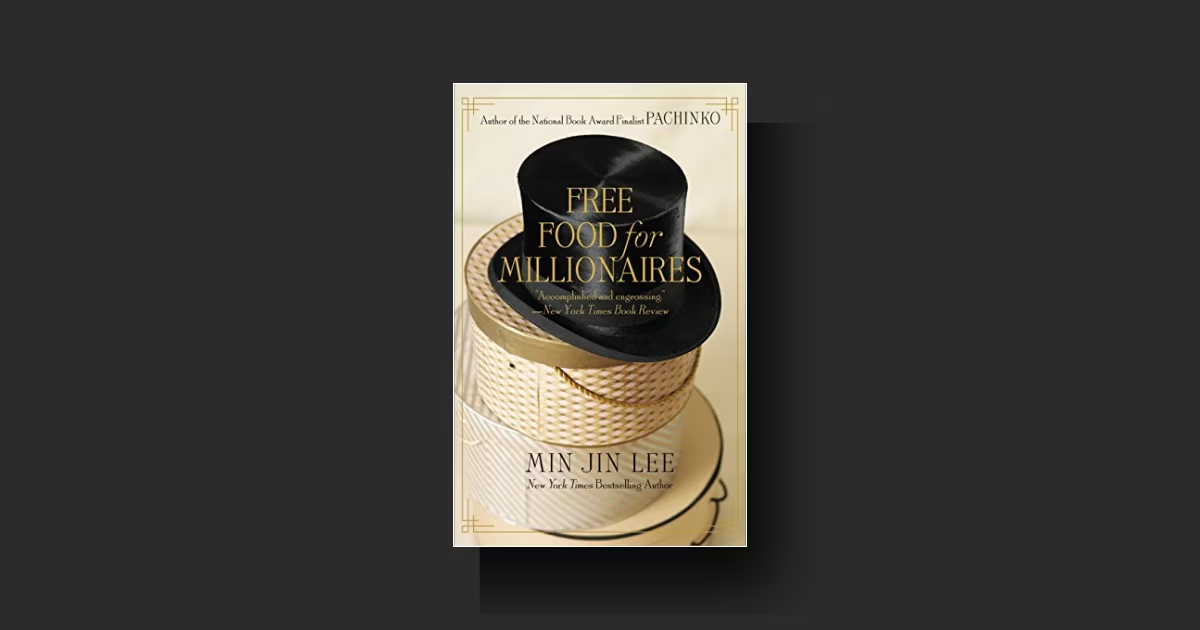

Free Food for Millionaires by Min Jin Lee is a 2007 novel about a Korean American Princeton graduate who cannot afford the life her education taught her to want, and it is the most honest book about money, pride, and borrowed time that I have read in years. Most reviews call it a coming-of-age story.
I think that undersells it. Read the chapter titles and you will see what Lee was really doing: the first part of the book is built out of finance words like Options, Credit, Deficit and Default, the second out of travel words, and the third out of sewing and hat-making words like Block, Seam, Baste and Crown. The novel moves, quite literally, from a ledger to a workbench.
That shift is the whole story, and it is why the ending lands the way it does.
Table of Contents
Quick Summary
What is Free Food for Millionaires about? It follows Casey Han, 22, the daughter of Korean immigrants who manage a Manhattan dry cleaner, from her 1993 Princeton graduation through roughly four years of bad jobs, good friends, credit card debt, broken engagements and a slowly growing religious faith she can’t explain.
Author and year: Min Jin Lee, published in 2007 by Warner Books (now part of Hachette). A 10th anniversary edition followed in 2017.
Setting: Queens and Manhattan, 1993 to 1997, from Elmhurst walk-ups to Park Avenue penthouses and a Wall Street trading floor.
Big theme: What people owe each other, in dollars and in loyalty, and whether you can ever pay it off.
How it ends: Casey earns a permanent investment banking offer, then realizes she doesn’t want it. She decides not to return to business school, reconnects cautiously with her ex, Unu, and the final image is the two of them drawing chalk flowers on a patio. It is an open, hopeful ending, not a tidy one.
Length: Long. 500 plus pages, and Free Food for Millionaires follows at least eight major characters.
Adaptation: Netflix announced a series in development in January 2021, written by Lee with Alan Yang as executive producer. I could not confirm any release date or cast as of this writing.
My verdict: A big, generous, flawed novel. Too long in the middle, but Casey Han is one of the most believable young women in American fiction.
Reader Recommendation for Free Food for Millionaires
You will probably love it if:
- You have ever been the first person in your family to go to a “good” school and then felt like a fraud once you got there.
- You liked Pachinko and want to see where Min Jin Lee’s interest in money, faith and family began.
- You enjoy big, multi-character Victorian-style novels. Casey rereads Middlemarch throughout Free Food for Millionaires, and Lee clearly wants you to notice.
- You carry debt, or you grew up watching your parents carry it. The money details in this book are specific and uncomfortably accurate.
- You care about Korean American or wider Asian American stories that aren’t about tragedy or triumph but about ordinary, messy living.
You may bounce if:
- You want a fast plot. This novel wanders, often for chapters, into side characters’ heads.
- You need a likable heroine. Casey is proud, impulsive, occasionally cruel, and she makes the same financial mistake about five times.
- You dislike explicit sex. There is a lot of it, and some of it is disturbing, including a sexual assault in Book III.
- You want a romance with a clear endpoint. The love story is deliberately unresolved.
Introduction
Free Food for Millionaires was Min Jin Lee’s debut novel, first published in 2007 by Warner Books, an imprint that later became part of Hachette Book Group. The ebook edition I read was released in June 2007. A 10th anniversary edition came out in 2017, the same year her second novel, Pachinko, became a finalist for the National Book Award for fiction.
Free Food for Millionaires did well on arrival. According to Lee’s biographical record, The Times of London named it one of its Top 10 Novels of the Year, it made year-end lists from NPR’s Fresh Air and USA Today, and The New York Times made it an Editor’s Choice. It was also a No. 1 Book Sense pick.
Background
A little history helps. Casey’s father, Joseph, was sixteen in late 1950 when his wealthy family near Pyongyang sent him south to avoid conscription. The peninsula split, and he never saw them again. That wound sits at every dinner table in Free Food for Millionaires. As Lee writes in the first chapter, Casey was in Queens in 1993, “But at the table it was 1953, and the Korean War refused to end.”
The Hans emigrated in 1976, the year of the American bicentennial, and settled into a rent-controlled two-bedroom on Van Kleeck Street in Elmhurst. Joseph and Leah run a dry-cleaning drop shop on First Avenue for a Korean owner, Mr. Kang, who has sixteen locations. Lee gives the actual pay: Joseph earns a thousand dollars a week, and Leah, who works as both cashier and seamstress, earns half that. No health insurance.
No vacations.
Lee herself was born in Seoul in 1968, came to the United States at seven in 1976, went to Yale, then Georgetown Law, and worked as a corporate lawyer in New York from 1993 to 1995.
In other words, she was living inside the exact world Casey wants to enter, in the exact years the novel takes place. You can feel that knowledge in every detail, from the rolltop desks of the analysts to the smell of street cart coffee on the trading floor.
Free Food for Millionaires Summary
Book I: Works (June 1993 to about 1995)
Free Food for Millionaires opens with a line that works like a thesis: “Competence can be a curse.” Casey Han has a magna cum laude economics degree from Princeton, a white boyfriend her parents don’t know about, a smoking habit, and no job. She was rejected by the one investment bank she applied to, Kearn Davis, after showing up in a yellow silk suit and making a Nancy Reagan joke. She has deferred her admission to Columbia Law.
A week after graduation, at the first family dinner in months, her father needles her about drinking too much water. It escalates fast. Casey screams at him about what it cost her to survive Princeton as the dry cleaner’s daughter. She tells him, “You won the sweepstakes with kids like us.” Joseph hits her, several times, and finally throws her out.
She takes the train to her boyfriend Jay Currie’s apartment and walks in on him having sex with two sorority girls from Louisiana State who picked him up on a dare. Bruised and humiliated, she checks into the Carlyle Hotel, pretending to be a friend’s aristocratic grandmother.
The next morning she maxes out her brand new credit card on about $4,300 worth of designer work clothes at a department store called Bayard Toll.
There she runs into Ella Shim, a beautiful, shy girl from her parents’ church whom Casey has resented since childhood. Ella’s widowed father, Dr. Douglas Shim, is an eye surgeon. Ella is twenty-one and engaged to Ted Kim, a thirty-year-old Harvard graduate (twice over) from an Alaskan cannery family. Ella insists Casey move into her spare room, and Casey, broke and out of options, agrees.
Ted can’t stand Casey, but Ella pushes him, and he gets her an interview on the Asian equities sales desk at Kearn Davis, through his business school friend Walter Chin. The desk head, Kevin Jennings, is gruff. The senior salesman, Hugh Underhill, is handsome and flirty. Walter is kind. During the interview there is a catered lunch for the department, and Walter explains the ritual that gives the book its name: the desk that closes a deal buys lunch for everyone, and the richest men always grab first. “You have to take what’s offered,” Walter tells her.
Casey gets the job, a sales assistant post paying $35,000 a year, well below what her degree could command. She also meets Delia Shannon, a sexy, sharp, long-serving assistant from Staten Island.
Meanwhile, Casey is starving, literally. She loses eleven pounds living on ramen and Ella’s leftovers. She runs into Jay’s mother, Mary Ellen, a librarian who has spent eight years on a biography of Emily Dickinson and who loves Casey like a daughter. Weeks later, Jay turns up outside Ella’s church. Casey punches him in the nose, then goes home with him and ends up moving in.
Lee then turns to the parents. At Christmas, Dr. Shim tells Leah that Casey is working at Kearn Davis and will be Ella’s bridesmaid. Leah hasn’t seen her daughter in six months. She visits Ella, carrying $2,400 she received from her church women’s savings pool, and Ella finally gives her Casey’s address. Leah arrives at Jay’s apartment, discovers her daughter is living with a white man, refuses to shake his hand, and leaves.
Casey starts millinery classes at the Fashion Institute of Technology and finds something she loves. Her old boss Sabine Gottesman, a Korean-born department store owner, and Sabine’s much older husband, real estate mogul Isaac, offer to host Casey and Jay’s wedding in their penthouse. Casey feels only one thing: she has parents of her own.
At Ella and Ted’s wedding in a Flushing banquet hall, Jay forces an introduction to Joseph. Joseph shoves him and walks out. That night on the roof, Casey tells Jay she can’t marry him. Her reason sounds absurd. Since childhood she has seen “pictures” in her head that predict her life, and she has never seen one of the two of them married.
Book II: Plans (about 1995 to 1996)
Eighteen months pass. Casey, nearly twenty-five, lives in a Battery Park studio, still works as a sales assistant, sells hats at Sabine’s on weekends, and owes $12,000 on her credit cards. Sabine lectures her over lunch (“Every minute matters. Every damn second.”), offers to pay for business school, and even floats the idea of eventually selling Casey her store. Casey applies to four business schools. Sabine gives her a Rolex.
Ella, eight months pregnant and suffering from preeclampsia, learns she has genital herpes. She has only ever slept with Ted. Ted confesses he had an affair with Delia. Ella shows up at Sabine’s store in a daze, and Casey leaves her post to take her home. Sabine docks her pay for it, which cracks something between them. The baby, Irene, is born healthy.
Tina, now in medical school, announces her engagement to Chul, her MIT boyfriend. She also reports that Joseph’s only investment, a small commercial building in Edgewater, New Jersey, bought with his retirement savings, has burned down.
On a company golf trip to Florida, Casey plays brilliantly and meets Unu Shim, Ella’s cousin, a divorced buy-side analyst from Dallas. They start dating. He asks her to move in so she can pay down her debts. She confesses that she now owes $23,000. He confesses he owes his bookie. They move in anyway.
Ella goes back to work at St. Christopher’s, the boys’ school where her old boss, David Greene, a poet who teaches writing in a prison, has been quietly in love with her for years. Ted, meanwhile, runs into Delia again and falls back into the affair, this time for real.
At Tina’s rehearsal dinner, the Hans spend about $6,000 from their retirement savings on gifts for the groom’s wealthy family. The Baeks respond with cheap department store presents.
Tina says the line I underlined twice: being snubbed like that “Makes you feel rich to not behave that way.” At the wedding, Casey overhears Ted on the phone telling Delia he loves her.
Then she learns that Ted and Delia were caught on a Kearn Davis security camera having sex on the trading floor and forced to resign. Ella, dazed at the reception, collapses from an overdose of codeine pills and has her stomach pumped.
Casey starts at NYU’s Stern School of Business, borrowing nearly $40,000. Unu loses his job in February and doesn’t look very hard for another. Virginia, Casey’s college roommate now living in Italy, writes that Jay is engaged to a wealthy Japanese classmate, Keiko Uchida.
In a parallel storyline, Leah’s church choir gets a new director, Dr. Charles Hong, a forty-eight-year-old Juilliard-trained composer from a rich Seoul family, twice divorced. He is instantly taken by Leah’s extraordinary voice and cruelly impatient with her modesty.
Casey stumbles into a rare-book shop and befriends its owner, Joseph McReed, an elderly widower who has been watching her read on the bus. She buys a first American edition of Jane Eyre from him for $1,500 she doesn’t have. Then she swallows her pride, calls Hugh, and gets a late interview for a summer banking internship at Kearn Davis.
Book III: Grace (1997)
Ted, now living with Delia and working at a rival bank, asks for joint custody of Irene. Ella’s lawyer tells her Ted will use custody as a weapon. David confesses his love, breaks off his own engagement, and later, when Ella tells him about the herpes, asks her to marry him.
Leah and Dr. Shim visit Charles Hong when he has chicken pox. Leah cleans his filthy house all afternoon, and for the first time in her life she feels necessary to someone outside her family. Weeks later, after a late rehearsal, she drives Charles to a diner because he hasn’t eaten. Afterward, parked outside a subway station, he pushes her into the back seat and has sex with her while she repeatedly says no. He believes they made love. Leah believes she has committed adultery and deserves to die.
Casey’s internship is brutal. On a weekend golf trip to Vermont, right after Unu tells her he gave his car and watch to his bookie, she sleeps with Hugh. She confesses to Unu, and he throws her out. She moves into Sabine’s guest room.
Ted’s father dies in Anchorage. His mother, who adores Ella, refuses to forgive him. Back in New York, in the middle of a custody meeting, Ted suddenly loses vision in his right eye.
Dr. Shim diagnoses central serous retinopathy, often linked to stress. Soon after, Ted drops his demand for joint custody and lets Ella keep the house.
At church one Sunday, Leah hemorrhages in the choir loft. She has miscarried. Joseph had a vasectomy after Tina was born, so Casey quickly works out the truth. Leah tells her everything. Casey tells her mother it was not her fault, that what happened wasn’t consent, and makes her promise never to tell Joseph. The whole choir comes to the hospital to sing.
Unu, evicted and broke, shows up at Ella’s door at midnight. Ella and David take him in. He starts attending Gamblers Anonymous, and David finds him a job teaching statistics at St. Christopher’s.
Joseph McReed dies. His family tells Casey he left her his late wife Hazel’s collection of more than a hundred hats. Casey sleeps with Hugh once more, finds a pornographic video in his closet that echoes something he said to her in bed, and walks out.
Then comes the scene I didn’t see coming. Early one morning Casey goes to Charles Hong’s house in Brooklyn. Leah’s friend Kyung-ah, a married choir soprano, is coming down his stairs half dressed. Casey tells her exactly what Charles did to her mother, orders him to quit the choir and stay away, and when he runs upstairs after Kyung-ah, she takes the handwritten score of his song cycle from the piano. At the office, she feeds it into the shredder.
That same morning, Kearn Davis offers her a permanent job. She asks for a week to decide.
The Ending of Free Food for Millionaires Explained
The last chapter is called “Sketch,” and it’s quiet. Casey drives to Litchfield with Joseph McReed’s sister-in-law, Lucy Griswold, and spends a whole day opening hatboxes.
She talks the reluctant, self-conscious Lucy into trying on one of Hazel’s hats and gets her to look at herself in the mirror. Back in the city, Casey finishes a new summer hat and names it “Hazel.” There is no one to show it to.
After church, Ella, now engaged to David, invites her to lunch. Unu is living there. In the backyard, among Irene’s toys, Casey tells him she got the offer. He asks if she’ll take it, “Because you hate it there.” She admits she won’t. Then she says something she didn’t know until she said it: she isn’t going back to business school either. Unu tells her to make hats. She says there’s no money in it. He asks, “Since when did you want money?”
He kisses her, and tells her, “Casey, you lack nothing.” She gently pulls her hand away. Then the two of them kneel on the patio and draw with Irene’s sidewalk chalk: she draws tulips, he draws grass and then a tree.
So what does it mean? Three things, I think.
First, Casey finally stops paying for other people’s approval. The Wall Street offer was the one thing her father, Sabine and her classmates all understood. Turning it down is the first choice in Free Food for Millionaires she makes without looking over her shoulder.
Second, the romance is left open on purpose. She pulls her hand back, then they draw together. Lee isn’t giving us a wedding. She is giving us two broke people living in other people’s guest rooms, starting from zero, side by side.
Third, the chalk drawing matters. Chalk washes away. It costs almost nothing. After four hundred pages of tallying the price of everything, from the $6 side of rice at a steakhouse to the interest on a $50,000 loan, Casey ends up making something beautiful that has no resale value at all. That’s the ending’s quiet argument: a life can be worth something even when it isn’t worth much.
Free Food for Millionaires Analysis
Characters
Casey Han. She’s proud, funny, observant and self-destructive in the exact same breath. What makes her work is that Lee never lets her off the hook.
Casey knows her shopping is a sickness; she hides her credit cards in a Ziploc bag in the freezer, then pays for a $1,500 rare book because an old man needed a sale. She reads the Bible every morning and doesn’t know if she believes it. Her real gift, as Lee puts it, is attention: she can make anyone feel seen.
Her tragedy is that she almost never turns that attention on herself. By the end, she does.
Leah Han. The quiet heart of the book, and to me the most painful character. Married at seventeen to a man nineteen years older, gray-haired before forty, gifted with a voice that makes a Juilliard-trained composer rank her above Callas and Te Kanawa, Leah has spent her whole life shrinking.
Her assault by Charles Hong is written with deliberate discomfort because she can’t even name it. Casey names it for her. That hospital scene reverses the parent-child roles in a way I haven’t forgotten.
Joseph Han. A war refugee who lost everyone, a man who hits his daughter and also returns a customer’s gold cuff links every single week. Lee refuses to make him a monster or a saint. The moment at the hospital where he pats Casey’s back, and she stiffens, then relaxes, is the closest the two of them come to peace, and it is enough.
Ella Shim. At first she reads as the perfect, boring rich girl. Lee slowly shows her as the loneliest person in the book: motherless, married too young to a man who treats her like a trophy.
Her arc, from overdose to a job she chose and a man who is kind, is the most conventionally satisfying one in Free Food for Millionaires. Casey’s late, uncharitable thought that Ella is “a poor person in a rich person’s disguise” is also, I think, true.
Ted Kim. A self-made climber from an Alaskan cannery family, and possibly the most interesting man Lee writes. He is arrogant, sexist and a liar, and yet the Anchorage funeral chapter, where his mother tells him how his dying father defended him, makes him almost unbearably human. His stress-induced eye condition is a little on the nose as symbolism, but it works.
Unu Shim. A kind man with a gambling problem. Unu is a “true believer” in his stock calls and in love, and he gambles when the world stops rewarding belief. His collapse and recovery mirror Casey’s debt, which is why their ending together makes sense.
Sabine Gottesman. The fairy godmother who keeps the receipts. She’s generous to the point of control, and she’ll dock your pay the same day she hands you a Rolex. Her confession late in the book, “It’s just that I don’t know how to love. Without taking over,” is one of the most honest lines anyone says to Casey.
Charles Hong. A gifted, self-pitying artist who believes his talent excuses him. He is the book’s clearest villain, and Lee gives him interior chapters that make you understand him without ever excusing him.
Supporting cast worth noting: Delia, the “perma-assistant” who wants a baby more than a husband; Hugh, charming and emotionally empty; Tina, the “good” daughter who secretly feels trapped by motherhood; Isaac, whose story about his Uncle Irv (told to become a silver engraver so he wouldn’t worship his work) is a small parable in the middle of the book; and Joseph McReed, the bookseller who sees Casey more clearly than anyone.
Free Food for Millionaires Themes and Symbolism
Debt, in every sense. This is the spine of Free Food for Millionaires. Casey carries credit card debt, then student debt, then emotional debt to Sabine, then moral debt to Unu. Leah carries a debt she thinks she owes God. Ted literally tries to pay his parents back with monthly checks, and his mother mails the last one back.
The Lord’s Prayer line Casey struggles with at church, “Forgive us our debts as we forgive our debtors,” is the book’s secret thesis. Lee asks whether a debt of love can ever be settled, and her answer seems to be no, and that’s fine.
Free food. Walter’s line about millionaires grabbing free lunch is funny, but it’s also a rule of the world Casey is entering: the people who already have plenty take the most, fastest, with the least shame. Casey, raised to believe there’s no such thing as a free lunch, can’t do it. Even when she’s starving, she takes a samosa and a spoonful of rice at her interview to look ladylike. Her father’s voice lives in her stomach.
Clothing and hats. “Clothing was magic,” Casey believes, and Lee means it both ways. Clothes let Casey pass as an Andover girl or a banker. They also bury her in debt. Hats are different. She makes them. She names them after heroines of her favorite books. The book’s movement from buying clothes to making hats is its movement from consumption to creation.
The chapter titles. Book I uses finance terms (Options, Credit, Net, Deficit, Bond, Default). Book II uses travel terms (Compass, Luggage, Passport, Customs). Book III uses sewing and millinery terms (Block, Seam, Baste, Lining, Crown, Sketch). Casey’s life literally moves from the balance sheet to the journey to the craft.
The third book is called “Grace,” which in Christian terms means a gift you can’t earn or repay. After three hundred pages about paying people back, that title is a quiet rebuke.
Faith. Casey’s daily Bible verse habit, learned from a Princeton professor who died, is one of the most original things in the book. Lee doesn’t write a conversion story. Casey keeps sinning, keeps reading, keeps doubting. Her faith grows, as she puts it, like a gangly tree cracking through concrete. For a secular literary novel, that is unusually respectful of belief without preaching it.
Class and race. Lee is sharp about how class and race stack. Casey gets mistaken for a nanny or a mail-order bride in fancy shops, so she overdresses. Ted resents Korean women who date white men. Jay, well-meaning and sunny, bullies his way toward her parents precisely because, as Casey eventually realizes, they don’t count for anything socially in his eyes. None of this is lectured. It just happens, the way it does.
The symbol I keep thinking about: roofs. Casey smokes on roofs. She plays a game of guessing strangers’ lives from their windows. Jay used to find her on the roof at parties. Roofs are where she goes to be alone and to see. It is fitting that the novel ends at ground level, on her knees on a patio, drawing.
Evaluation: My Verdict on Free Food for Millionaires
Free Food for Millionaires is a sprawling, stubborn, deeply humane novel, and though it is not as controlled as Pachinko, it may be the braver book, because it dares to make its heroine’s biggest problem something as unglamorous as a credit card balance.
Strengths
Casey Han. She’s the reason to read it. Lee writes her with real affection and zero sentimentality.
The money detail. Rents, salaries, commissions, the $250-a-head wedding, the $6 side of rice. Every number makes the world more solid.
Leah’s storyline. Quietly devastating. The hospital scene with the choir singing is one of the best set pieces in any debut I know.
Fairness to everyone. Even Ted and Hugh get their moments of dignity. Lee rarely stacks the deck.
An ending that trusts the reader.
Weaknesses
Length and sprawl. Book II sags. Some side chapters, like the doorman George’s interior monologue, feel like detours.
The omniscient voice. Lee hops between heads mid-scene. Kirkus complained that the narration enters “dozens of characters, often unpersuasively,” and in a few places I agree.
Repetition. Casey’s cycle of shame, spending and more shame repeats often enough that I got impatient, which may be partly the point.
Casey’s “pictures.” The psychic visions she uses to decide her life are the one element I never believed.
Impact and Controversy
The controversy, such as it is, comes from the sexual content and from Casey’s likability. Some readers online find her selfish and exhausting. I understand. But I’d argue that a young woman who makes real, repeated mistakes is exactly what makes this feel like life rather than a lesson.
The one piece I’d flag for sensitive readers is Leah’s assault, which Charles narrates in his own head as romance. Lee writes it that way on purpose, to show how easily a man can rewrite what happened.
Critics split along similar lines. Kirkus called Casey “an appealing heroine” but the book “fitfully entertaining but not extraordinary.” A decade later, reviewing the anniversary edition for the South China Morning Post, James Kidd called it “a modern-day Middlemarch but more fun” and gave it four stars. I land closer to Kidd.
Comparison with Similar Works
Middlemarch by George Eliot. The obvious model, and Casey rereads it constantly. Like Dorothea Brooke, Casey is a principled young woman whose ideals collide with money and marriage. Lee even has Casey argue about Dorothea’s foolishness with Joseph McReed.
Pachinko by Min Jin Lee. Lee’s 2017 follow-up is tighter, more historical and more tragic. Free Food for Millionaires is its restless, contemporary younger sibling. If you’ve read our Pachinko review and ending explained, you’ll recognize the same obsession with money and faith.
The Great Gatsby by F. Scott Fitzgerald. Joseph McReed literally calls Casey “Daisy Buchanan” because of her flapper dress. Both books are about people trying to buy their way into a class that will never fully admit them. Our Great Gatsby review covers that theme from the Jazz Age side.
The Age of Innocence by Edith Wharton. For the sense of New York money as a system of manners and quiet exclusion. See our piece on The Age of Innocence.
The Bonfire of the Vanities by Tom Wolfe. For the Wall Street setting; Kirkus made this comparison directly.
Flashlight by Susan Choi. Another novel about a Korean family, secrets and the cost of silence between generations. Our Flashlight review is worth reading alongside this one.
Personal Take: What Casey Han Teaches About Debt, Pride and Class Today
The angle that feels most current to me is the one hiding in the chapter titles: the idea that a young person can be well educated and still financially trapped, and that pride can make it worse.
The numbers are bigger now than in Casey’s 1990s. According to the Federal Reserve Bank of New York, Americans held $1.263 trillion in credit card debt and $1.651 trillion in student loans in the second quarter of 2026. And the “model minority” image Casey runs from hides real division. A Pew Research Center analysis found that income inequality among Asian Americans rose faster than in any other major group, with the ratio of top to bottom earners climbing from 6.1 in 1970 to 10.7 in 2016. Casey and Ella sit on opposite ends of that gap while sitting in the same church pew.
Five lessons I took from Free Food for Millionaires:
A credential is a door, not a salary. Princeton got Casey noticed; it didn’t pay her rent. Lee shows how the name on your degree matters far more than any of us like to admit, and how that stings when you choose the “lesser” school.
Pride is expensive. Casey refuses Sabine’s tuition offer and Isaac’s phone call to Columbia, then borrows nearly $90,000 across two years. Independence is worth something, but it’s worth pricing with open eyes.
Spending can be a substitute for grief. Casey shops after every blow. Unu gambles. Ella eats ice cream in secret. The book treats all three as the same hunger.
Not all debts are financial, and some shouldn’t be repaid. Leah believes she owes God her death. Casey’s refusal to let her carry that debt is the most loving act in the book.
Walking away is a real decision. Turning down a Wall Street offer in a debt-heavy life sounds reckless. Lee frames it as the first time Casey spends her own time on purpose, which is exactly what Sabine told her to do.
Free Food for Millionaires Quotes
I’ve kept these short and noted where each appears (by book and chapter, since page numbers vary by edition).
- “Competence can be a curse.” (Book I, “Options”)
- “You won the sweepstakes with kids like us.” Casey to her father. (Book I, “Options”)
- “With love, you have to march into the possibility of losing.” Casey to Tina. (Book I, “Credit”)
- “I want love, Tina. I want that. I’ll pay.” (Book I, “Credit”)
- “Anyone could be in your situation.” Ella, refusing to let Casey be proud. (Book I, “Deficit”)
- “Clothing was magic.” (Book I, “Deficit”)
- “You have to take what’s offered.” Walter, over the free lunch. (Book I, “Worth”)
- “The loss was real because the love was real.” Mary Ellen’s thought about Casey and Jay. (Book I, “Derivative”)
- “Life was just guesswork even if you were an eyewitness.” (Book I, “Derivative”)
- “Every minute matters. Every damn second.” Sabine. (Book II, “Compass”)
- “Makes you feel rich to not behave that way.” Tina, after the gift snub. (Book II, “Wonders”)
- “You are the pearl of great price.” Reverend Lim at Tina’s wedding. (Book II, “Wonders”)
- “People and promises are not like jobs.” Ted’s mother. (Book III, “Model”)
- “Never bluff in love.” Ella’s lawyer, thinking. (Book III, “Adjustment”)
- “Love is respect, Casey.” Sabine. (Book III, “Adjustment”)
- “You’re a true person, Casey. You are your own.” Tina, accepting the cuffs. (Book III, “Seam”)
- “There are no winners or losers, Unu.” Ella. (Book III, “Gift”)
- “Casey, you lack nothing.” Unu, in the final chapter. (Book III, “Sketch”)
Conclusion
Free Food for Millionaires is not a perfect novel, and it doesn’t want to be. It is long, it wanders, and its heroine makes you want to shake her. But it tells the truth about something most literary fiction avoids: what it’s like to be smart, broke, proud and trying to figure out what your life is for while the interest keeps compounding.
By the last page, Casey hasn’t won anything. She has just stopped keeping score. I found that more moving than any triumphant ending could have been.
Who should read it: first-generation college graduates, children of immigrants, readers who loved Pachinko or Middlemarch, anyone who has worked in finance or retail and felt out of place in both, and book clubs looking for a novel that will start real arguments about money, faith and sex.
Who might skip it: readers who want tight plotting, a romance with a bow on top, or a heroine who learns her lesson the first time.
Why it still matters almost two decades later: because the gap between what an education promises and what it pays has only widened, and because Min Jin Lee wrote a young Korean American woman as fully flawed and fully human long before publishing made much room for that.