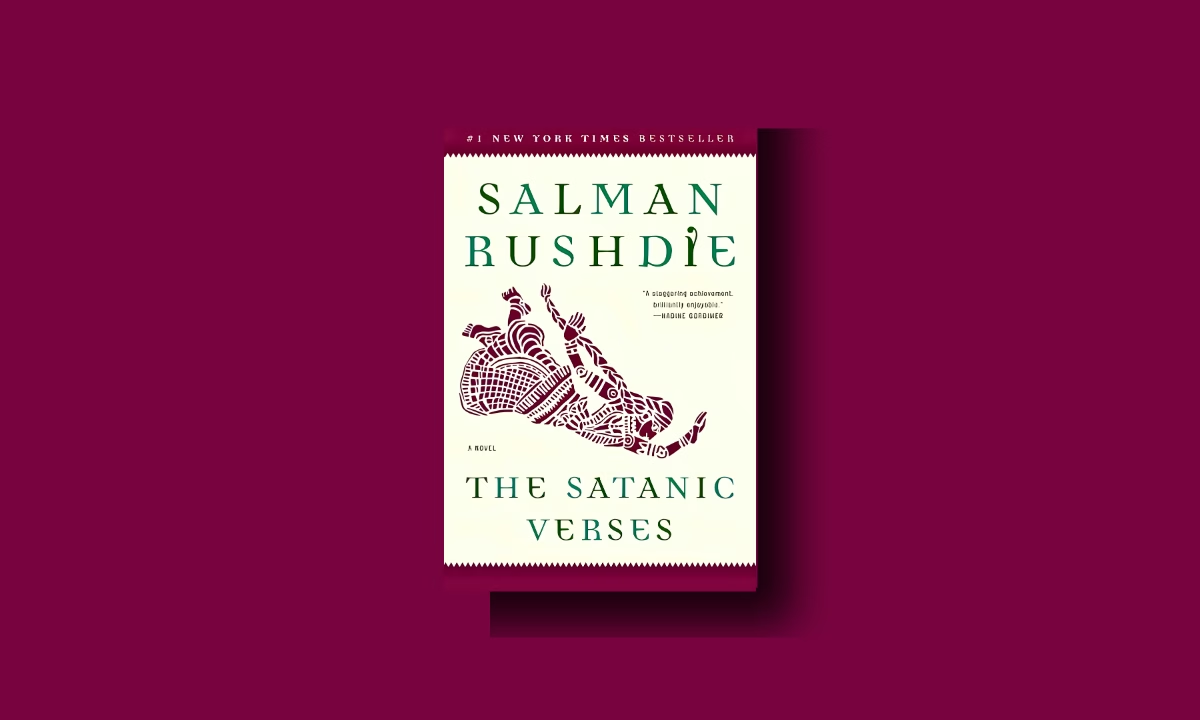

The Satanic Verses was banned because many Muslims read its dream chapters as an insult to the Prophet Muhammad, his wives and his companions, and governments from India to Venezuela moved to keep it out. That is the textbook answer, and it is true.
But after reading the novel cover to cover, I think the full answer to “why was The Satanic Verses banned” has a second half that almost nobody quotes: a 4,000-word section about a Khomeini-like Imam in exile, the one part of the book that pointed straight at the man who later signed Rushdie’s death sentence.
Table of Contents
Why was The Satanic Verses banned
The blasphemy charge: Gibreel’s dreams show a prophet-figure named “Mahound” (an old insult for Muhammad) who briefly accepts three pagan goddesses, a scribe who secretly rewrites revelation, and a brothel whose twelve prostitutes take the names of the prophet’s wives.
The speed of the bans: India banned imports on 5 October 1988, nine days after UK publication. Pakistan and South Africa followed on 24 November, and well over a dozen countries joined by June 1989.
The fatwa: Ayatollah Khomeini called for Rushdie’s death on 14 February 1989, which by my count was 141 days after the book came out.
The overlooked part: One section, about 2.1% of the novel by my word count, satirises an exiled, clock-smashing Imam who leads his followers into machine-gun fire and then swallows them. Several commentators, including Hussein Ibish, argue this personal caricature mattered more to Khomeini than the theology.
My view: The hurt many believers felt was real. The violence that followed was a political choice, and it was largely made by people who had not read the book.
What Exactly in The Satanic Verses Offended Muslim Readers?
Muslim critics objected to specific choices, not to the novel’s general existence. When I went back to the text with the published complaints in hand, I found every one of them on the page. Here is what they are, where they appear, and who says them in the story. That last detail matters, because the defenders’ main argument rests on it.
1. The name “Mahound.” The prophet-figure in Gibreel’s dreams is called Mahound, a medieval European slur for Muhammad. Rushdie’s narrator says the character has adopted “the demon-tag” outsiders hung on him, much as other groups reclaimed names “given in scorn” (Part II). Critics saw no reclaiming at all, only the slur.
2. The “satanic verses” episode itself. Mahound accepts the three goddesses Lat, Uzza and Manat as “exalted birds, and their intercession is desired indeed,” then withdraws the verses as the Devil’s work (Part II).
The story comes from early Islamic sources such as al-Tabari, but most Muslim scholars since the medieval period have rejected it. Turning it into fiction, and having the dreaming Gibreel admit he spoke both versions, struck many readers as a direct attack on the Quran’s divine origin.
3. Salman the scribe. In Part VI, a Persian scribe confesses that he secretly altered the revelations as he wrote them down: “He said Christian, I wrote down Jew.” The prophet does not notice. For a believer, that idea goes to the heart of the faith.
4. The brothel. Also in Part VI, the twelve women of a Jahilia brothel called The Curtain take the names of the prophet’s twelve wives, whom Muslims honour as Mothers of the Believers. This is the passage I have seen cited most often in protest literature, and I understand why.
5. Mocking the revelations. Salman complains of “rules about every damn thing” (Part VI), and the prophet’s wife Ayesha is reported as saying, “Your God certainly jumps to it when you need him.” A vision of God appears to Gibreel as a balding man with dandruff and glasses (Part V). Even the patriarch Ibrahim is called “the bastard” for abandoning Hagar in the desert (Part II).
Who says these things? Nearly every hostile line comes from a character the novel itself treats as compromised: Baal, a satirist hired by the city’s ruler; Salman, a bitter drunk; and above all Gibreel, a man losing his mind who dreams the entire Jahilia story.
Rushdie’s defence rests on that frame. Critics answered that a frame does not change what readers actually read, and a group of thirteen Muslim barristers even tried to bring a blasphemous libel case in Britain. I think both sides are describing something real.
Which Countries Banned The Satanic Verses, and When?
India banned it first, and by mid-1989 it was banned or penalised across much of the Muslim world and beyond. This timeline follows Wikipedia’s record of the controversy, which is itself inconsistent in places, so treat the exact months as approximate.
| Date | Country or event |
|---|---|
| 26 Sep 1988 | Published in the UK by Viking Penguin |
| 5 Oct 1988 | India bans imports after MP Syed Shahabuddin’s petition |
| 24 Nov 1988 | Pakistan and South Africa ban it |
| Nov 1988 | Bangladesh and Sudan ban it |
| Late 1988 | Saudi Arabia, Egypt, Somalia and Qatar follow within weeks |
| Dec 1988 | Sri Lanka bans it |
| 14 Jan 1989 | Copies burned in Bradford, England |
| 12 Feb 1989 | Six killed outside the American Cultural Center, Islamabad |
| 14 Feb 1989 | Khomeini’s fatwa |
| Mar 1989 | Kenya, Thailand, Tanzania, Indonesia and Singapore ban it |
| Jun 1989 | Venezuela becomes the last country to ban it |
| Jan 2002 | South Africa lifts its ban |
| 5 Nov 2024 | Delhi High Court presumes India’s 1988 ban notification does not exist |
Interestingly, Wikipedia’s account notes that Turkey was the only predominantly Muslim country where the book stayed legal.
Then there is the human cost. Adding up only the incidents in that same record, I count at least 57 deaths: 6 in Islamabad, 1 in Srinagar, 12 in Bombay, the Japanese translator Hitoshi Igarashi in 1991, and 37 in the 1993 Sivas hotel fire in Turkey. That is my own tally from one source, so the real number may be higher.
Why Did the Fatwa Come Five Months Later?
The fatwa arrived 141 days after publication, and that gap is the best clue that the book alone does not explain it. If Khomeini had been outraged by the theology, he had five months to say so.
Look instead at what was happening in Iran. On 17 July 1988, Iran accepted the UN ceasefire that ended its eight-year war with Iraq, a decision Khomeini compared to drinking from a poisoned chalice.
That summer his officials carried out mass executions of political prisoners, with estimates ranging from 1,000 to 30,000 dead. My reading is that by early 1989 the revolution needed a cause.
Then, on 12 February, six protesters died in Islamabad, and the book became the most famous symbol of Muslim anger in the world. The fatwa came two days later. Khomeini himself died on 3 June 1989, aged 89, but the fatwa outlived him and Iranian officials have since reaffirmed it.
None of this proves the fatwa was cynical. It does show that it landed at a politically convenient moment.
Who Is the Imam in The Satanic Verses?
The Imam is an unnamed, exiled cleric in Part IV, “Ayesha,” and I believe he is the key to the whole affair. Rushdie never calls him Khomeini. He did not need to.
Here is what the novel shows. The Imam lives in a rented flat in Kensington, waiting for “a dream of glorious return.” He “is the enemy of images” and the pictures literally slide off his walls. He drinks a glass of purified water every five minutes and has written a monograph on water. He hates history, calling it “the intoxicant.”
His spokesman broadcasts to the homeland, Desh, against the Empress Ayesha, who drinks wine and blood. His slogan is “Burn the books and trust the Book.”
Then comes the satire that would sting any revolutionary leader. Gibreel carries the Imam home through the sky. Below them, the people march seventy abreast up the avenue into the Empress’s machine-guns, the bodies piling into a hill, while mothers push their sons forward to die.
The Imam calls it love. Gibreel, weeping, calls it hate. As the march goes on, the Imam promises that after the revolution “there will be no clocks.” When the Empress falls, Gibreel watches him grow monstrous, lying in the palace forecourt as “the people march through the gates,” and he swallows them whole.
Compare that with the record. Khomeini spent most of his exile in Najaf, Iraq, then moved to Neauphle-le-Château outside Paris on 6 October 1978, and flew home on 1 February 1979 to a crowd reported at up to five million.
Rushdie moves the exile to London, but the long wait abroad, the hatred of Western images, and the triumphant return are all there.
So did this caricature trigger the fatwa? Here is what I could verify:
- The author John Crowley believed it was the most likely trigger, noting that Rushdie publicly read this section while promoting the book (as reported in Wikipedia’s account of the controversy).
- In 2022, the analyst Hussein Ibish argued in The National and on his blog that the fatwa was “above all, about the wounded ego” of Iran’s supreme leader.
- Khaled Diab, writing in New Lines Magazine, reported that Khomeini’s son told an American reporter in the early 1990s that his father had not read the book before issuing the fatwa.
The other side deserves a fair hearing too. The fatwa itself treated the book as blasphemy against Islam, and Iranian officials claimed the book did not insult Iran or its leaders.
Many Muslims who had no loyalty to Khomeini at all were genuinely hurt by the Mahound chapters. So I cannot tell you the Imam caused the fatwa, and nobody honestly can.
What I can say is that the section covers about 4,000 words, roughly 2.1% of the novel by my count, and that it is almost never mentioned in the “why was it banned” explainers I found online.
Was The Satanic Verses Banned for Blasphemy or for Politics?
My honest answer is both, in layers. The first layer was religious hurt, and it was real. Reading the book, I could see exactly which pages would wound a believer. The brothel scene is not subtle.
The second layer was local politics. The Indian ban came from a petition by an opposition MP, Syed Shahabuddin, not from any court ruling on the text, and Hussein Ibish argues that the protests were more about local communal politics than the novel, noting that “Few, if any, protesters had actually read the book.”
The third layer was Tehran. Iran turned a book dispute into a state death warrant and attached a bounty from the 15 Khordad Foundation: $1 million, or $3 million for an Iranian killer.
Where I come down is simple. Offence can be a fair reason to criticise a book, to argue with it, or even to never open it. It is never a reason to kill a translator in Tokyo or set a hotel on fire in Sivas. And the strangest thing I found is how little of the novel the bans were really about. The two Mahound chapters make up about 13.7% of the book; the Imam section, 2.1%.
Everything else is a story about two migrant actors in London and Bombay.
Rushdie’s own position kept shifting under pressure. In December 1990 he signed a declaration affirming his Islamic faith and asked that the paperback not be published.
By 1998, when Iran’s government said it would “neither support nor hinder” attempts on his life, he said he was “not, in fact, religious.”
Is The Satanic Verses Still Banned Today?
The Satanic Verses is no longer banned everywhere it once was, but the picture is patchy. South Africa lifted its ban in January 2002. In India, on 5 November 2024, after officials said the 1988 ban order could not be traced, the Delhi High Court said it had “no other option except to presume that no such notification exists,” which effectively let the book back in.
The fatwa itself has never been formally withdrawn. On 12 August 2022, Hadi Matar stabbed Rushdie on stage in Chautauqua, New York, costing him the sight in his right eye and the use of one hand.
Diab reports that Matar admitted to reading only a couple of pages of the novel. Matar was sentenced to 25 years in May 2025. The book’s sales jumped in the week after the attack, and it climbed to number 26 on Amazon‘s overall chart.
Frequently Asked Questions
Did Khomeini read The Satanic Verses?
Probably not. According to Khaled Diab in New Lines Magazine, Khomeini’s son told an American reporter in the early 1990s that his father had not read it. I could not find a direct primary source for that interview, so treat it as reported, not proven.
What are the “satanic verses”?
They are a disputed early Islamic report of verses praising the goddesses al-Lat, al-‘Uzza and Manat, said to have been recited and then withdrawn as Satan’s insertion. The English phrase is attributed to the scholar William Muir in 1858.
Is The Satanic Verses anti-Islam?
Readers disagree. Critics point to Mahound, the brothel and the rewritten revelations. Defenders note that these scenes are the dreams of a mentally ill character who has lost his faith, and that most of the novel is about migration. Rushdie said he wrote about migration, metamorphosis, divided selves, love, death, London and Bombay.
Is it illegal to own The Satanic Verses?
That depends on the country. It was not banned in the UK or the US, and since November 2024 it can legally be imported into India. For most of the other 1988 and 1989 bans, I could not find a clear record of formal repeal, so check local law before assuming either way.
Who is the Imam in The Satanic Verses?
An unnamed exiled cleric in Part IV who plots against the Empress Ayesha of a country called Desh. Many readers and critics see him as a satire of Ayatollah Khomeini.
Conclusion
So why was The Satanic Verses banned? Because a small part of a long novel told a sacred story in the most provocative way possible, because politicians in several countries saw gain in banning it, and because a dying revolutionary leader, who had arguably been mocked in its pages, turned outrage into a death sentence.
If you want to judge for yourself, read Part II, Part IV and Part VI. Then read the rest, which is the part almost nobody talks about.