
Leo Tolstoy married Sophia Behrs on 23 September 1862. He was 34 and she was 18. They stayed married for 48 years and had 13 children, eight of whom survived childhood.
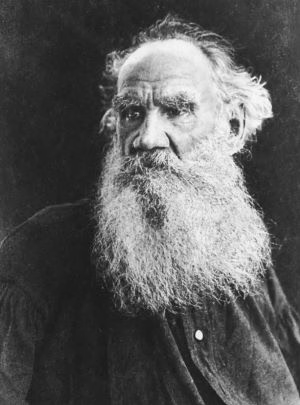
Then, in 1910, at 82, Tolstoy abruptly left home. About ten days later he died at Astapovo railway station.
That is exactly why Tolstoy on marriage is worth reading. He was not a guru with a perfect home. He was a man who saw clearly on the page what he often failed to manage in his own house. Here are eight things his fiction understood about marriage that modern couples, with all our advice columns and apps, still forget.
Table of Contents
Tolstoy on Marriage: 8 Lessons Modern Couples Forget
1. Happy marriages are built from ordinary things
Anna Karenina opens with its famous line: “Happy families are all alike; every unhappy family is unhappy in its own way.”
The very next sentence is less quoted: “Everything was in confusion in the Oblonskys’ house.” Stiva has had an affair with the former governess. Within three days the cook walks out, the children run wild, and the servants give notice.
My reading of that opening: happiness in a marriage is undramatic. It lives in meals, routines and trust, which is why it makes no story. Unhappiness is always specific. So stop measuring your marriage against other couples. Look hard at your own particular friction, because that is where yours will break or heal.
2. The romance ends, and that can be where marriage begins
In 1859, three years before his own wedding, Tolstoy published the novella Family Happiness. Masha, 17, marries Sergey Mikhaylych, a family friend of 36. Their early bliss gives way to boredom in the country, then to the glitter of Petersburg society, then to distance.
After children arrive, Masha asks why their intense love disappeared. Her husband’s answer settles her. In one English translation she says simply: “That day ended the romance of our marriage.” The old feeling becomes a treasured memory. A new love, for her children and their father, becomes the ground of a different kind of happiness.
Readers still argue whether this ending is wisdom or resignation. Either way, Tolstoy refuses the modern assumption that fading passion is a verdict on the marriage. For him it is a change of season.
3. Marriage is not what you imagined, and that is not failure
Before his wedding, Levin looked down on other couples’ petty quarrels. He believed family life should be nothing but love and happiness.
Three months in, Tolstoy writes: “He was happy, but not at all in the way he had expected to be. At every step he found his former dreams disappointed, and new, unexpected surprises of happiness.”
Then comes one of the best images in the novel. Levin feels like a man who admired a little boat gliding smoothly across a lake, and then got into it himself. Watching a marriage and living inside one are different experiences. The disappointment is real, but so are the surprises, and Tolstoy insists on both.
4. A quarrel can show you how joined you are
Levin and Kitty’s first quarrel is almost comically small. He goes out to a new farmhouse, tries a short cut home, gets lost, and returns half an hour late. Kitty meets him with: “You’ve been enjoying yourself.”
In that moment Levin understands something he missed on their wedding day: “He felt now that he was not simply close to her, but that he did not know where he ended and she began.” He is offended for an instant, then realises he cannot be offended by her, because she is himself. Kitty, knowing she was wrong but not saying so, grows tenderer, and their happiness doubles.
Modern couples often argue to win. Tolstoy suggests a fight with your spouse hurts like hurting yourself, because in a sense it is. You cannot win against yourself, so the only real goal is to come back together.
5. Honesty is a gift only when the other person can carry it
On the eve of their wedding, Tolstoy handed 18-year-old Sophia his diaries. They detailed his sexual past, including the fact that a serf on his estate had borne him a son. He gave Levin the same scene in Anna Karenina: Levin asks Kitty to read his diaries before they marry.
Tolstoy seems to have wanted a marriage without secrets. What Sophia received, by the accounts drawn from her own diaries, was a shock that left her devastated and disgusted.
The lesson is not to hide the truth. It is to ask why you are telling it, and when. Are you sharing it so your partner can know you, or so you can be relieved of carrying it alone? Tolstoy’s confession was honest. It was also, in part, a burden passed to someone very young the night before her wedding.
6. Someone is doing work you do not see
In the chapter on Levin’s early marriage, Tolstoy slips in a sharp line: “But, like all men, he forgot that she too would want work.” Kitty throws herself into running the house, managing servants and arranging rooms, and Levin barely registers it.
Tolstoy’s own household ran the same way. Sophia acted as his secretary, editor and financial manager. She copied out the War and Peace manuscript seven times from beginning to end, according to most accounts, at night by candlelight after the children and servants were asleep.
History.com puts the number of full copies at eight. She did this while bearing and raising their children and running the estate.
The work that holds a household together is nearly invisible to whoever is not doing it. Ask your spouse what they carry that you never see. Then actually look.
7. When goodwill goes, small things become evidence
Anna returns to Petersburg after her first meeting with Vronsky. Her husband is waiting on the platform, and her first thought is: “why do his ears look like that?” She meets his weary glance with an unpleasant, familiar feeling, which Tolstoy compares to a consciousness of hypocrisy.
Karenin’s ears have not changed. Anna’s way of looking at him has. Her brother Stiva shows the same decay from the other side: after his affair, Tolstoy tells us, he does not repent the affair itself, only that he failed to hide it better from his wife.
In a marriage turning cold, irritation at trivial things, such as a habit, a phrase, the way someone chews, is usually a symptom rather than the cause. If you notice yourself collecting small evidence against your spouse, ask what larger feeling it is standing in for.
8. Differences in values do not stay quiet forever
After a moral and spiritual crisis in the 1870s, Tolstoy’s beliefs grew steadily more radical. He sought to give up his inherited and earned wealth, including the copyrights on his earlier works. He came to oppose private property and even the institution of marriage.
Sophia feared for their children’s future and pushed for control of his publishing royalties. His disciple Vladimir Chertkov became a rival for his trust. The biographer A. N. Wilson described their later life together as one of the unhappiest in literary history.
In 1910, at 82, Tolstoy abruptly left Sophia, accompanied by their daughter Alexandra and his doctor. He died of pneumonia at Astapovo station on 20 November 1910. According to accounts of those days, Sophia was kept away from him.
The man who wrote Levin and Kitty’s reconciliation could not reconcile with his own wife at the end. Big differences, about money, faith and how to live, need to be talked through while there is still goodwill to carry the conversation.
What Tolstoy on marriage still teaches us
Go back to Dolly, the betrayed wife in the first chapters of Anna Karenina. She keeps telling herself she will leave Stiva. She cannot, Tolstoy writes, “because she could not get out of the habit of regarding him as her husband and loving him.” Then she sends for milk, settles the children’s dinner, and drowns her grief in the duties of the day.
That is not a romantic picture. It is a true one. The marriages that survive in Tolstoy’s fiction do not run on feeling alone. They run on attention, ordinary work and repeated forgiveness, the very things Tolstoy described so well and found so hard to practise.
Note on sources: quotations from Anna Karenina use Constance Garnett’s public-domain translation. Dates follow the modern (Gregorian) calendar.
Tolstoy on marriage: frequently asked questions
What did Tolstoy say about marriage?
His best-known line on the subject opens Anna Karenina: “Happy families are all alike; every unhappy family is unhappy in its own way.” His fiction treats marriage as something different from what lovers imagine, built on ordinary work and forgiveness. In later life his views hardened, and he came to oppose the institution of marriage itself.
Who was Tolstoy’s wife?
Sophia Andreyevna Tolstaya, born Behrs. She married Tolstoy in 1862 at 18 and later became known as a diarist. She also acted as his copyist, secretary and financial manager.
How long was Tolstoy married?
48 years, from 1862 until his death in 1910. The couple had 13 children, eight of whom survived childhood.
Was Tolstoy’s marriage happy?
The early years were largely happy and productive, the period in which he wrote War and Peace and Anna Karenina. The later years were bitter, driven by conflicts over his religious views, property and copyrights. Biographer A. N. Wilson called it one of the unhappiest marriages in literary history.
Which Tolstoy books are about marriage?
Family Happiness (1859) follows a marriage from courtship to its settled middle. Anna Karenina contrasts three marriages: Anna and Karenin, Dolly and Stiva, and Levin and Kitty. The Kreutzer Sonata (1889) gives a much darker view of marriage and jealousy.