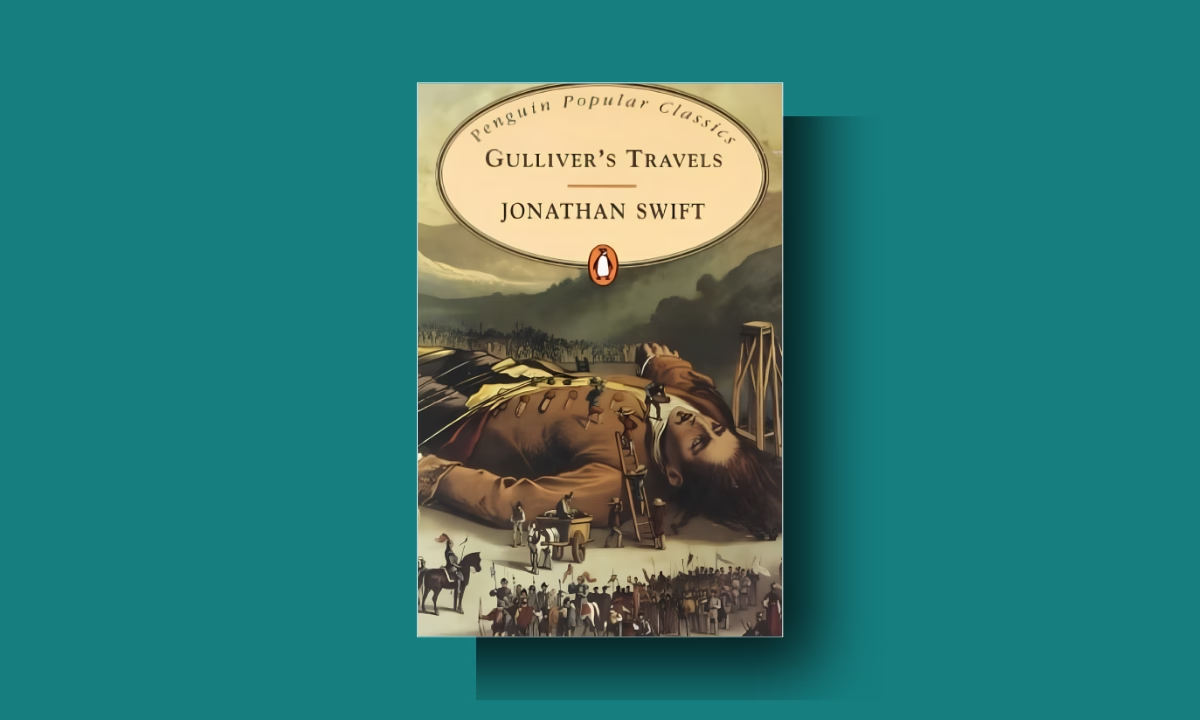
Gulliver’s Travels ends with a ship’s surgeon who cannot bear to sit at the same table as his own wife, because he would rather spend his evenings talking to horses. That is the ending in one sentence, and it is far darker than any cartoon, children’s edition or Jack Black comedy lets on.
Jonathan Swift’s four-part satire, first published on 28 October 1726, sold out its first printing within a week, and I think it still earns a place on your shelf at 300 years old, as long as you go in expecting a joke with a knife inside it rather than a tale about tiny people.
Gulliver’s Travels at a Glance
- What it is: a 1726 satire in four voyages, narrated by the ship’s surgeon Lemuel Gulliver, that parodies the travellers’ tale while satirising the errors, follies and frailties of human beings.
- The four voyages: Lilliput (tiny people), Brobdingnag (giants), Laputa and its neighbours (misguided scientists, ghosts, immortals), and the land of the Houyhnhnms (rational horses and brutish Yahoos).
- The ending: Gulliver returns to England in December 1715 convinced that humans are Yahoos, cannot stand the smell of his family, and buys two horses to talk to.
- The big idea: the book does not praise reason over humanity. It shows what happens to a man who confuses the two.
- Who it suits: readers of satire, fans of Orwell and Voltaire, and anyone who only knows the Lilliput episode.
- Verdict: 4.5 out of 5.
Quick Verdict
A savage, funny and still unsettling satire whose final voyage turns the joke back on the reader. Recommended for anyone who enjoys being made uncomfortable by their own species.
Should You Read Gulliver’s Travels in 2026?
Yes, if you can accept that two of its four voyages are slower and more political than the famous first two. Here is how the scales tip for me.
| Pros | Cons |
|---|---|
| Part II and Part IV are some of the sharpest satire in English, and they still sting | Part III wanders, and some Whig and Tory jokes need footnotes |
| The deadpan narrator gives every outrageous scene a believable surface | Gulliver barely changes in a conventional sense, so character arcs are thin |
| Short, self-contained voyages make it easy to read in pieces | The Yahoo passages are crude and the women in the book are mostly sketches |
| The ending is ambiguous enough to argue about for days | Swift’s contempt can feel hard to bear for readers who want some warmth |
| It gave English words such as Lilliputian and Yahoo, and gave computing the terms big-endian and little-endian | Eighteenth-century prose takes a few chapters to settle into |
What Is Gulliver’s Travels About?
It follows Lemuel Gulliver, an English ship’s surgeon, through four voyages that each leave him stranded in a society that mirrors some failing of his own.
In Lilliput he is a giant among petty courtiers. In Brobdingnag he is a toy among giants who find European pride laughable. In the third voyage he meets thinkers who cannot govern and men who cannot die. In the fourth he meets talking horses who live by reason alone, and he is broken by them.
Rating
4.5 / 5.
I take half a point off for Part III’s uneven shape and for how long the Yahoo disgust runs. Everything else is close to perfect.
Why Was Gulliver’s Travels Written, and Who Was Swift Aiming At?
Swift was an Anglo-Irish clergyman and satirist, known as Dean Swift, who also wrote A Tale of a Tub and A Modest Proposal (1729). He arranged the book’s publication under a pseudonym with help from Alexander Pope, and the publisher Benjamin Motte used five printing houses to speed production and avoid piracy.
The result was a hit: ten thousand copies sold in three weeks, and the playwright John Gay said it was read from the cabinet council to the nursery, a line the Spectator repeated in its 300th anniversary piece.
Swift himself said he wrote it to vex the world rather than divert it. He was also furious about what Motte did to the text. Motte’s political caution led him to change the book without Swift’s knowledge, and Swift later complained that he hardly knew his own work.
The Dublin printer George Faulkner restored the text in 1735, and Cambridge University Press’s scholarly edition notes that Faulkner’s version dropped a 1726 passage in Part IV praising Queen Anne, which implicitly criticised George I.
One practical note from my own reading: the free PDF I worked from begins straight at Part I. It leaves out the opening letter from Gulliver to his cousin Sympson, so you will not meet that fictional framing unless you pick up a fuller edition.
Gulliver’s Travels Plot Summary
This summary retells all four voyages and the ending in the order Swift tells them, so you can follow the book without opening it.
Before the voyages
Lemuel Gulliver is the third of five sons of a Nottinghamshire gentleman. He goes to Emmanuel College, Cambridge, at fourteen, is apprenticed to a London surgeon named James Bates, then studies medicine at Leyden. He serves as a ship’s surgeon, settles in London and marries Mary Burton.
When Bates dies, Gulliver’s practice fails because his conscience will not let him copy the bad habits of other doctors, so he goes back to sea. On 4 May 1699 he sails from Bristol on the Antelope for the South Seas.
Part I: A Voyage to Lilliput
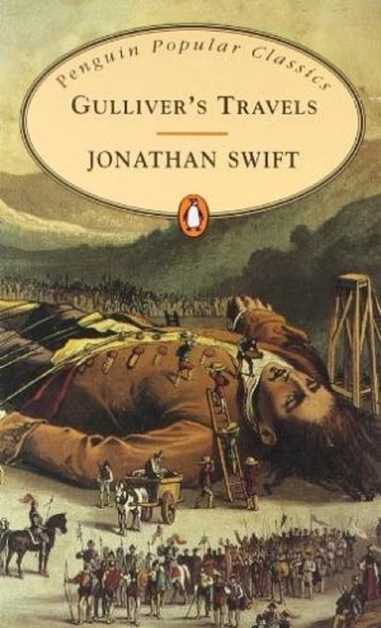
A storm wrecks the ship. Gulliver swims to shore, collapses asleep, and wakes pinned to the ground by hundreds of fine threads. The captors are people less than six inches tall.
They feed him enormous quantities of meat and drink, then haul him on a vast wheeled platform to an abandoned temple near their capital, where he is chained by the left leg. Officials search his pockets and list every item, including his watch, his pistols and his handkerchief. The Lilliputians call him the Man-Mountain, Quinbus Flestrin.
Gulliver wins his freedom by being gentle and obliging, and the emperor lets him go on conditions set out in a list of articles. He may not leave the empire without permission, must keep to the main roads, must not trample subjects, and must help in the emperor’s wars. At court he sees officials win their posts by dancing on a rope and by jumping over or creeping under a stick.
The treasurer, Flimnap, is a rope-dancer of note. Reldresal, the principal secretary for private affairs, becomes a friend, and the high admiral, Skyresh Bolgolam, becomes a sworn enemy.
Reldresal explains the politics. Lilliput is split between two parties distinguished by the heels of their shoes, and it is at war with the neighbouring island of Blefuscu over a religious quarrel about which end of a boiled egg to break. The present emperor’s grandfather cut his finger breaking an egg at the big end, so his father ordered everyone to break eggs at the small end.
The people rebelled, six rebellions followed, and the book says eleven thousand people have died rather than break their eggs at the smaller end. The Big-endian exiles now shelter in Blefuscu.
Gulliver ends the war in a single morning. He wades across the channel, ties cables to fifty Blefuscudian warships with hooks and drags the whole fleet home. The emperor makes him a nardac, the highest honour in the realm, but then asks him to destroy Blefuscu entirely and make it a Lilliputian province. Gulliver refuses to help enslave a free people, and that refusal is never forgiven.
The court’s hostility explodes after a fire breaks out in the empress’s apartments. Gulliver, with no water at hand, puts the fire out by urinating on it. He saves the palace, but the act is a capital offence, and the empress is revolted.
A friend in high office warns him privately that articles of impeachment are drawn up. The charges include treason for urinating within the palace, for refusing to finish off Blefuscu, and for being kind to Blefuscudian ambassadors. The council enters a sentence of blinding on its books, and a secret plan to starve him by degrees stands behind it.
The emperor, true to form, will announce the blinding as an act of mercy. Gulliver slips across to Blefuscu, finds an overturned ship’s boat drifting offshore, repairs it and sails out.
An English ship under Captain John Biddel picks him up, and he reaches the Downs on 13 April 1702, bringing home tiny cattle and sheep as proof.
Part II: A Voyage to Brobdingnag
Barely two months later Gulliver is off again, sailing in the Adventure on 20 June 1702. After a storm the crew find land and send a boat ashore for water. Gulliver walks inland and sees the sailors fleeing from a giant. He is left behind, trapped in grass the height of trees and then seized by a farmer who looks about as tall as a church spire.
The farmer takes him home, where his small daughter, a nine-year-old girl, becomes his nurse. Gulliver calls her Glumdalclitch and she calls him Grildrig, which means a manikin.
The farmer discovers that this tiny creature can talk, so he carries him in a box from town to town, charging admission. When Gulliver is exhausted, close to death, the farmer sells him to the queen of Brobdingnag.
The queen keeps Glumdalclitch as his guardian and has a travelling box made for him. For years Gulliver lives as the court’s pet, and Swift uses that smallness to make everything ordinary ugly. Gulliver sees the pores on a maid’s skin, the lice on a beggar and the hairs on a woman’s breast.
He is attacked by wasps, nearly drowned in a bowl of cream and carried onto a roof by a kitchen monkey that tries to feed him like a baby.
The heart of the voyage is his conversations with the king. Gulliver describes England, its government, courts, wars and church with patriotic pride. The king, who is wise and reasonable, asks plain questions, and the account collapses.
After several audiences the king sums up what he has heard. He concludes that the people of England are the most pernicious race of little odious vermin that nature ever allowed to crawl on the earth. Gulliver then makes things worse by offering the king the secret of gunpowder, so that he could blow up armies and rule absolutely.
The king recoils with horror and tells him never to mention it again. Gulliver, in the narration, blames the king’s narrow mind.
The end comes by accident. During a royal journey to the coast, Gulliver’s box is left on the beach with a page who wanders off. An eagle seizes the box and carries it out over the sea. Gulliver supposes other eagles attacked the first, which let go, and the box splashes into the sea.
Sailors from an English ship hear him shouting, hook the box and haul it aboard. When he reaches home on 3 June 1706, he is so used to giants that he stoops below his wife’s knees so she can reach his mouth, looks down on his servants as if they were pigmies, and tells his wife she has starved herself to nothing.
His family decides he has lost his wits.
Part III: A Voyage to Laputa, Balnibarbi, Luggnagg, Glubbdubdrib and Japan
Gulliver has been home for only ten days when Captain William Robinson of the Hopewell offers him a job as ship’s surgeon on a voyage to the East Indies. He leaves on 5 August 1706. Two pirate ships attack, one commanded by a Japanese captain, and a Dutchman among the raiders shows Gulliver the pettiest malice of the whole book.
The pirates set him adrift in a small canoe with a little food. He rows to a barren rock, and from there he sees an enormous floating island overhead, which is Laputa. The islanders spot him, lower a chair on a chain and haul him up.
Laputa is a flying island about four and a half miles across, kept aloft by a giant loadstone. Its people are so lost in mathematics and music that they hardly notice the world around them.
Each wealthy Laputan keeps a servant called a flapper, who taps his master’s mouth and ears with an inflated bladder to remind him to speak and to listen. Their clothes are cut in geometric patterns and fit badly. Their houses are crooked, their meals are served in the shape of triangles and violins, and their wives, bored and neglected, slip off to the mainland below to find lovers.
They live in constant fear that the sun will go out or a comet will hit the earth.
The island also rules the land beneath it, called Balnibarbi. When a town rebels, the king can hover the island above it to cut off sun and rain, or lower the island and crush the town. One city, Lindalino, defies him, and the king in the end decides it is too risky to drop the island, partly because the diamond-like base might crack. Gulliver, bored and ignored, asks to go down.
He is passed to a lord named Munodi in the city of Lagado. On the way he sees fields and houses in ruins. Munodi explains that some years earlier a group of men visited Laputa, came back full of mathematical schemes, and set up an academy to improve farming and building from scratch. Every project failed, but nobody dares stop them.
Munodi’s own estate is the single prosperous one for miles, because he kept to the old methods, and his neighbours scorn him for it.
He takes Gulliver to the Grand Academy of Lagado, which is a sequence of houses full of crack-brained schemes. One man spends eight years trying to extract sunbeams from cucumbers. Another tries to turn ice into gunpowder. Another builds houses from the roof down, trains pigs to plough fields by scattering acorns, spins webs with spiders, tries to soften marble for pillows, and proposes abolishing words so that people carry the things they want to talk about on their backs.
In the school of political projectors, professors work out how to find plots by decoding the excrement of suspects and by treating letters as anagrams.
Gulliver then travels to Maldonada and sails to Glubbdubdrib, the island of sorcerers, whose governor can call up the dead. Gulliver meets Alexander, Hannibal, Caesar and Brutus, and he asks to see Homer and Aristotle at the head of their commentators. Aristotle is out of patience with the commentators who have mangled his work.
He meets the ghosts of modern English noblemen and finds a disgraceful family history behind every proud name. The governor makes clear how much of recorded history is false.
Next is Luggnagg, where Gulliver must crawl on his belly and lick the floor to be admitted to the king. Here he learns of the Struldbrugs, children born with a red circular spot on the forehead, which marks them as immortal. Gulliver is thrilled.
He imagines wisdom piling up over centuries, and he plans what he would do with endless life. Then he meets some of them. They are not immortal in youth, only in decay. By thirty they are melancholy, by eighty they are legally dead, and by two hundred they are toothless, forgetful, jealous and unable even to talk with each other because the language has changed. Gulliver loses his wish for eternity.
He sails on to Japan, is excused from the ritual of trampling the crucifix after a private plea to the emperor, and reaches the Downs in April 1710.
Part IV: A Voyage to the Country of the Houyhnhnms
After barely five months at home, Gulliver sails again, this time as captain of his own merchant ship, leaving Portsmouth on 7 August 1710. Sickness kills several of his crew, so he takes on replacements in Barbados and the Leeward Islands. Most turn out to be former buccaneers.
They persuade the rest of the crew to mutiny, tie him up in his cabin and keep him confined for months. They eventually dump him on an unknown shore.
Gulliver walks inland and meets a pack of filthy, hairy, ape-like creatures who climb trees, throw excrement and attack him.
They are the Yahoos.
Then two horses appear, and he watches them talk to each other in what seems like a language. One horse, a grey, takes him home. The horses call themselves Houyhnhnms, a word that, as the book glosses it, means a horse and, by its roots, the perfection of nature. Gulliver is horrified to realise that the Yahoos are exactly like him in shape.
Under the grey horse’s care, Gulliver learns the language and becomes a household servant. He finds that the Houyhnhnms have no word for lying, and his master struggles to see why anyone would say what is false. Gulliver describes England in detail: its wars, its lawyers, its doctors, its use of money, its fashions, and the ministers who rule by corruption.
His master draws a quiet conclusion. Humans are Yahoos with a little reason that makes their vices worse, and he points out that the Yahoos of his own country dig up shining stones and fight over them, which sounds uncomfortably like European money.
Gulliver comes to see himself as a Yahoo. He is mortified when a young female Yahoo throws herself at him while he bathes. He begins to prize the Houyhnhnms’ way of life: no lies, no greed, no passion for individuals, marriages arranged by breeding, children educated in modest habits, and a calm acceptance of death that Gulliver translates as a return “to his first mother.” Near the end of his stay, a general assembly debates whether the Yahoos should be exterminated.
A milder idea is to castrate the young males. Then the assembly turns its attention to Gulliver. They tell his master that it is unwise to keep a creature who might lead the local Yahoos into revolt, so the master must either treat him as a Yahoo or order him to leave.
His master does not want to, but he obeys. Gulliver faints with grief.
He builds a canoe with the help of the sorrel nag, a fellow servant, and covers it with Yahoo skins. He leaves on 15 February 1714 by the old calendar (1715 by ours). He lands on the coast of New Holland, is hit by a native’s arrow, and is then carried off by force onto a Portuguese ship.
Its captain, Pedro de Mendez, treats him with great courtesy. Gulliver is repelled to be among humans again. He sneaks to the ship’s side to leap into the sea rather than stay among Yahoos, and he is chained to his cabin for it.
When he tells Mendez his story and asks whether it is the custom in Portugal to say the thing which was not, Mendez slowly decides to trust him, and he is determined to bring Gulliver home. They reach Lisbon on 5 November 1715, and Gulliver lands in the Downs on 5 December.
The ending explained
At home, the sight of his family fills Gulliver with hatred, disgust and contempt.
When his wife kisses him, he faints. He is sickened to think that, by fathering children with her, he has produced more Yahoos. For the first year he cannot stand his family in his presence, and he writes, five years after returning, that they still dare not touch his bread or his cup.
The first money he spends goes on two young stallions, which he keeps in a good stable. He admits that the groom is his greatest favourite after the horses, because the smell the man picks up in the stable revives his spirits, and he talks to his horses for at least four hours a day.
The closing pages complain about travel writers who lie and about colonial projects that seize land by force. Gulliver then says that he can forgive Yahoos for their ordinary vices, such as being lawyers, pickpockets or fools, but not for being smitten with pride. Swift never says whether Gulliver has found the truth or lost his mind.
The joke, to my reading, is that a man who has decided reason can replace every human feeling has ended up behaving in the least reasonable way imaginable: bowing to horses, shunning his children and sniffing a groom.
Who Is Lemuel Gulliver, and Does He Ever Really Change?
He changes, but only into a worse version of the same man. Gulliver begins as a decent, curious, slightly vain English surgeon, and Swift gives him one great talent: he adapts. He picks up languages quickly and watches customs closely, which makes him a perfect witness and a poor judge.
In Lilliput he behaves with a sort of honest courtesy, and he refuses to flatten Blefuscu even though it costs him his career. In Brobdingnag he swallows his pride a little.
By Part IV he has swung to the opposite pole, the convert who has found a religion of reason and cannot see that it is making him cruel to the people who love him.
What I find striking, having read it straight through, is how little Gulliver understands himself at each stage. He is proud of being a giant in Lilliput, and proud of being England’s spokesman in Brobdingnag. Even in Part IV he is proud, in a new way, of how humble he has become before the horses. Swift never lets us settle on whether the narrator is a fool or a prophet.
Glumdalclitch is the warmest figure in the book, and she gets surprisingly little credit. The farmer’s nine-year-old daughter cares for him, defends him at court and fights for him to the very end. When the eagle carries his box away, Gulliver imagines the girl’s grief, and he writes of her with something close to love. After he returns home, he never mentions her again. That silence says a lot.
The Lilliputian court is a cast of types rather than people. Flimnap the treasurer, who jealously suspects Gulliver of flirting with his wife, and Skyresh Bolgolam, the admiral who hates him for no reason, show how courts run on spite.
Reldresal, the secretary who softens the sentence to blinding, is a more interesting portrait of the well-meaning official who thinks he has saved a friend by arranging a cruel compromise.
The King of Brobdingnag is the most sympathetic ruler in the book, a man who asks plain questions. His horror at gunpowder is the moral high point of Part II, and it makes Gulliver’s offer of that secret one of the most chilling acts of the narrator.
Lord Munodi is the sane conservative in the madhouse of Balnibarbi, and his prosperous old estate makes him a target for every neighbour who has adopted the new schemes.
The Houyhnhnm master deserves a close look. He is calm, fair and honest, and he cannot lie. Yet when the assembly orders Gulliver out, he obeys, though with regret. Swift gives his ideal beings no capacity to resist a decision made by consensus, which is quietly chilling.
Don Pedro de Mendez, the Portuguese captain, is easy to miss. He is generous, patient and fair to a man who treats him with contempt. To my reading, he is Swift’s argument that humans are not all Yahoos, and Gulliver is too far gone to see it.
Mary Gulliver and the children hardly speak. A wife who has waited years for her husband, only to be treated as unclean when he comes home, is the book’s quietest tragedy.
What Do the Themes and Symbols in Gulliver’s Travels Mean?
The central theme is human pride, and every voyage attacks it from a different angle. Swift lays out his target in the closing chapter, where Gulliver says he can forgive a lawyer or a pickpocket as natural vices, but not a creature smitten with pride (the passage is in Part IV, chapter 12).
Scale and perspective. Size is the book’s main device. When Gulliver is huge, the Lilliputians’ politics look absurd. When he is tiny, European pride looks ridiculous to giants. The trick is that nothing about human behaviour changes.
Only the viewpoint does. Swift uses each society as a distorted mirror, and we spend the book trying to work out which version is the accurate one.
Party politics and trivial quarrels. The high and low heels of the Tramecksan and Slamecksan, and the egg war between the Big-endians and the Little-endians, are among the most famous jokes in English. The point is not that religion or party is silly, but that the quarrel is out of all proportion to the cause. Eleven thousand people die rather than break an egg at the smaller end.
Science without sense. Laputa and the Academy of Lagado attack theory that has lost touch with the world. The Laputans know the stars and cannot build a straight wall. The Academy’s inventors spend years on sunbeams from cucumbers while the fields go to ruin.
Swift’s target is not learning, but learning that rewards itself. Notably, the book’s most useful idea comes from the King of Brobdingnag: whoever makes two ears of corn grow where one grew before deserves better of mankind than all the politicians put together (Part II, chapter 7).
Mortality. The Struldbrugs reverse the wish for eternal life. Gulliver imagines that endless years would bring wisdom, and the reality is decay without a way out. For a book so concerned with human limits, it is a fitting episode.
Reason versus feeling. The Houyhnhnms are the book’s hardest puzzle. They are honest, calm, fair and free of greed, and Gulliver worships them. Yet they feel no passion, arrange marriages by breeding, and debate exterminating the Yahoos. They are not a model for human life. They are a trap, and Gulliver walks into it.
Truth and lies. Gulliver attacks travel writers who lie, then tells a story so fantastical that his rescuer thinks he is mad. Part IV is a long reflection on honesty, in which a society that cannot lie finds it hard to understand a society that lives on lies.
Empire. The final chapter dismantles colonial ambition with dry irony, as Gulliver describes how a shipload of pirates can claim a land and its people in the name of a crown.
Symbols. The eggs stand for the pettiness of doctrinal war. The flying island is power ruling from above, with the loadstone as its hidden mechanism.
The urine that puts out the palace fire is the book’s crudest and best joke: the one useful act in Lilliput is also the one that gets him condemned.
The Yahoos are the human animal stripped of clothing and manners. The stable is the final symbol, because it shows what happens to a man who tries to leave humanity and ends up smelling like a groom.
Evaluation: Is Gulliver’s Travels Still Worth Reading?
Gulliver’s Travels is a mean, wildly funny and quietly tragic book, a satire so well aimed that its target has spent three hundred years trying to step out of the way and keeps failing.
Strengths
The prose is clear and deadpan, which is why the absurd scenes work. The structure, four short voyages, lets you read in pieces. The best set-pieces, the fire in Lilliput, the king’s horror at gunpowder, the Struldbrugs and the stable, are unforgettable. And the ending leaves a question open for the reader to answer.
Weaknesses
Part III is the least coherent section, a travelogue stitched together from side trips. Some political jokes in Part I only make sense with notes on Whig and Tory rivalry.
Gulliver’s disgust at the Yahoo body can wear thin, and with few exceptions the women in the book are minor or rendered with distaste. Readers who need character growth in the usual sense will find little.
Impact and controversy
The book was a success on publication and a headache to its author. Swift was furious about Motte’s changes, and a corrected text appeared only with Faulkner’s 1735 Dublin edition. Its influence is large. The Spectator’s anniversary piece credits it with shaping children’s books from Lewis Carroll’s Alice to Mary Norton’s Borrowers and with giving English the insults Lilliputian and yahoo.
In computing, it also gave us a pair of terms: in 1980 the scientist Danny Cohen borrowed big-endian and little-endian for byte order in a paper called “On Holy Wars and a Plea for Peace”, because the quarrel over data order reminded him of Swift’s egg war.
The lasting controversy is Part IV. Readers still argue whether Swift endorses the Houyhnhnms or mocks Gulliver for worshipping them. I side with mockery, because the horses are too cold and Gulliver too absurd at the end. I accept that other readers see real misanthropy there. Swift never clears it up.
Comparison with similar works
Gulliver’s Travels belongs to a tradition of invented-world satire. Critic Oliver Tearle notes that More’s Utopia (1516) was probably an influence, and that like Defoe’s Robinson Crusoe, which appeared seven years earlier, Swift’s book presents itself as a real traveller’s account.
Where Utopia is a puzzle about what its author really thinks, Swift is harsher and funnier.
If you liked the animal politics of Orwell’s Animal Farm or the dystopian satire of Huxley’s Brave New World, you will find their ancestor here. Voltaire’s Candide is the closest in tone, a travel story in which a naive hero is knocked about by a world that refuses to match his philosophy.
Adaptation: book versus screen
Most screen versions only touch the first voyage, and that is where the trouble begins. A 1939 animated film from Fleischer Studios, the company behind Popeye, adapted the first voyage as a cartoon feature.
The 1996 NBC miniseries, directed by Charles Sturridge and starring Ted Danson, is the serious attempt. Sturridge said at the time that Swift’s book had never before been filmed in its entirety, and the production reportedly cost $28 million.
It won five Emmys, including Outstanding Miniseries, from eleven nominations. It also frames the story as a recollection by Gulliver after his return, a device the book does not use. I have not rewatched it for this review, so my comparison rests on published descriptions and I cannot say how closely its ending follows Swift’s.
The 2010 comedy with Jack Black is the other extreme. Critics’ consensus on Rotten Tomatoes says it largely fails to do justice to its source material and leans on juvenile humour and effects.
At the box office it took in about $237 million worldwide on a $112 million budget, but only $42.8 million of that came from the United States and Canada, and its opening weekend was $6.3 million. Commercially it limped; as Swift, it vanished.
The book’s real power, the final voyage, has no screen equivalent that has become popular, and I think that is no accident. An audience wants to be comforted, and this ending refuses.
What Can Gulliver’s Travels Teach Us in 2026?
The sharpest lesson for me is Swift’s egg war, because it describes how we now argue. Pew Research found in 2022 that 72% of Republicans and 63% of Democrats said the other party’s members were more immoral than other Americans, up from 47% and 35% in 2016. The pattern matches what Swift mocked: a gap that grows in importance as the sides spend more energy hating than reasoning.
Here are five lessons I take from it:
- Small differences become identities. When a quarrel gets a flag, it stops being about eggs.
- Ask who benefits from the split. In Lilliput, the court’s rivalries keep the courtiers in power.
- Change the scale. Look at your own dispute as a Brobdingnagian would, and see how small it is.
- Distrust the perfect remedy. Whoever offers pure reason, pure markets or pure virtue is a Houyhnhnm waiting to cull the Yahoos.
- Keep a Don Pedro. Stay close to at least one decent person who disagrees with you, because Gulliver’s tragedy is that he could no longer see one.
Quotable Lines From Gulliver’s Travels
These are short extracts from the text, with the part and chapter in brackets. The full book is free to read on Project Gutenberg.
- “the most pernicious race of little odious vermin” (Part II, chapter 6). The King of Brobdingnag’s verdict on England, and the book’s most quoted insult.
- “whoever could make two ears of corn” grow where one grew before “would deserve better of mankind” (Part II, chapter 7). The king’s idea of real service, set against all politicians.
- “They look upon fraud as a greater crime than theft” (Part I, chapter 6). A Lilliputian law Swift clearly prefers to the English one.
- “a project for extracting sunbeams out of cucumbers” (Part III, chapter 5). The whole Academy in a phrase.
- “poor nations are hungry, and rich nations are proud” (Part IV, chapter 5). Gulliver’s account of why countries go to war.
- “to say the thing which was not” (Part IV, chapter 11). Gulliver’s scornful question to Don Pedro, after years among horses who cannot lie.
- “I am not in the least provoked at the sight of a lawyer” (Part IV, chapter 12). He forgives every vice except pride.
- “deformity and diseases, both in body and mind, smitten with pride” (Part IV, chapter 12). Swift’s actual target.
- “My horses understand me tolerably well” (Part IV, chapter 12). The last joke, and the saddest.
Conclusion: Should You Read It?
I recommend Gulliver’s Travels to readers of satire, to anyone who loved Animal Farm or Candide, and above all to people who think they know the book because they remember a giant tied down by tiny ropes. Read the first two voyages for the comedy, skim the third if the notes lose you, and give the fourth your full attention.
The final pages are among the strangest in English fiction, and they are worth the walk.
Swift wrote it to vex the world rather than divert it, and after three hundred years the world is still easy to vex.
My rating is 4.5 out of 5.
Gulliver's Travels
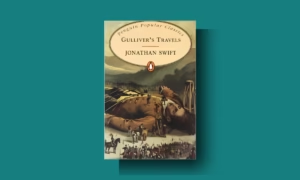
Gulliver's Travels ends with a ship's surgeon who cannot bear to sit at the same table as his own wife, because he would rather spend his evenings talking to horses. That is the ending in one sentence, and it is far darker than any cartoon, children's edition or Jack Black comedy lets on.
URL: https://www.sopranu.com/gullivers-travels-ending-explained-review/
Author: Jonathan Swift
4.5