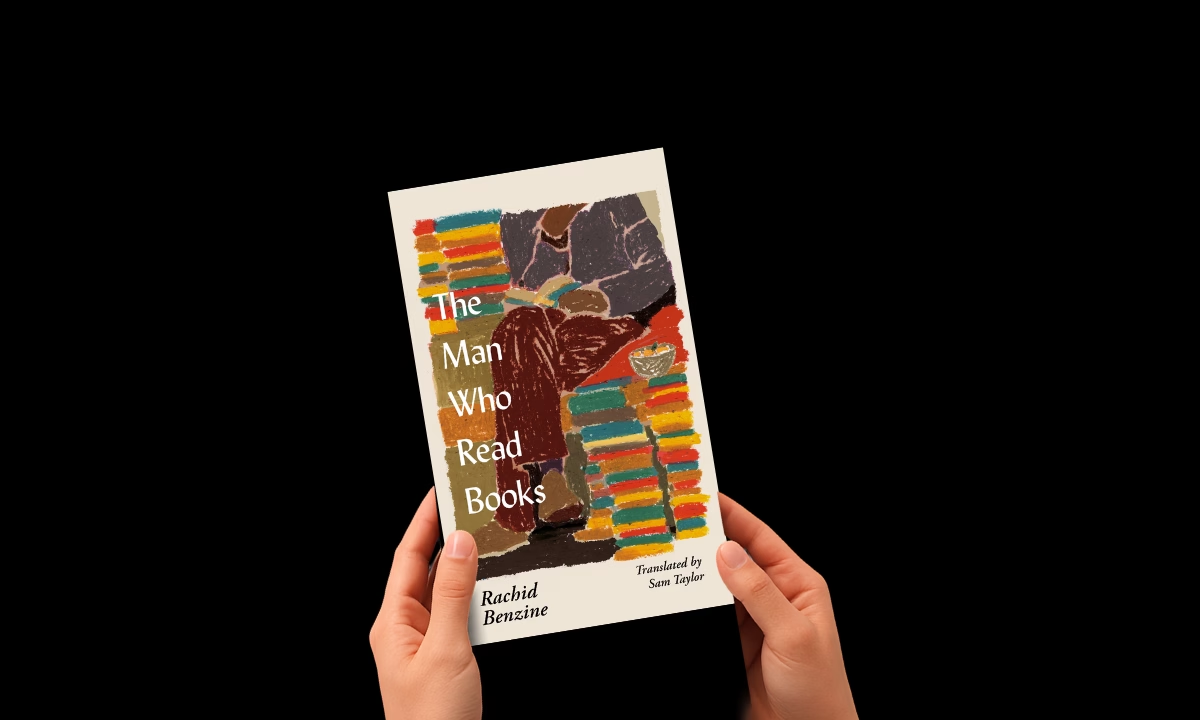
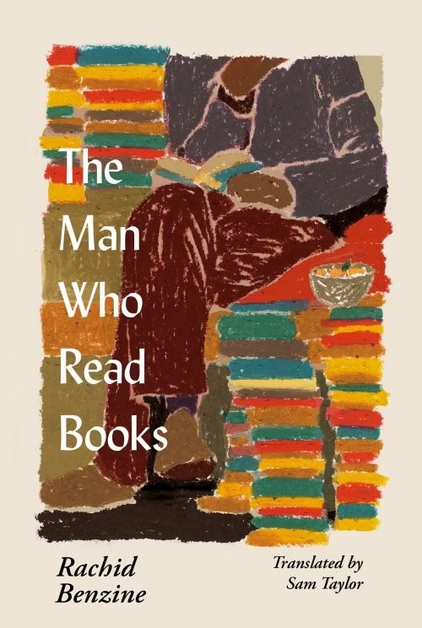
The Man Who Read Books is a 144-page novel in which a French photographer asks a Gazan bookseller for a portrait and walks away with a whole life story, handed over one book at a time (page count per the Canongate listing). Rachid Benzine wrote it in French as L’homme qui lisait des livres, published by Julliard, and Sam Taylor’s English translation arrives in the UK from Canongate and in the US from Cardinal, with a listed on-sale date of 10 November 2026.
My short answer on whether to read it: yes, if you can handle grief told gently. Below I cover what happens, how the ending works, where the book is weaker than its reputation, and who should pick it up.
Quick Verdict
- Verdict: A short, humane novel that turns a bookshop doorstep into a witness stand. It is moving and sometimes overbuilt, and I finished it wanting to read the poets it names.
- Rating: 4/5
- Best for: Readers of literary fiction in translation, people who like books about books, and anyone tired of seeing Gaza only through headlines.
- Main strength: The structure. Ten chapters are named after ten books, so the novel reads like a life told through a reading list.
- Main weakness: Nabil’s life passes through almost every major event from 1948 to 2025, and the losses pile up so thickly that the story occasionally feels assembled rather than lived.
At a glance
The novel is a frame story. A young French photographer named Julien Desmanges meets Nabil Al Jaber, born on 1 January 1948, who sells and gives away books in Gaza. Over a few days Nabil tells him about the Nakba, the camps, a university in Cairo, a son lost in the first Intifada, nearly twenty years in prison, and a wife killed in 2009.
The turning point comes in the chapter “If This Is a Man,” where the Six-Day War kills Nabil’s grandparents and his brother, and the brother’s last request shapes everything afterwards: keep reading.
The ending is not a twist. It is a return to the ruins in February 2025, where the photographer learns the bookseller is gone and a child hands him a few torn pages of a Darwish poem.
The Man Who Read Books is a tribute to reading as a way of staying human, and it is honest that reading does not stop a bomb.
What Is The Man Who Read Books About?
The Man Who Read Books is about a chance meeting between a French photojournalist and an elderly bookseller in Gaza, and about the life story the bookseller insists on telling before he will allow a picture. During a ceasefire the photographer wanders away from his hotel, finds Nabil reading outside his shop, and is told that a photograph is “no small thing” unless the man behind it is known first.
Each of Nabil’s memories is anchored to a book: Darwish’s poetry, Hamlet, Primo Levi, the Book of Job, Mohammed Dib, Mourid Barghouti and others.
Background worth knowing. The Man Who Read Books opens in the second person, so “you” are the photographer. Benzine is a Franco-Moroccan writer and scholar, born in Morocco in 1971 and raised in France from the age of seven. In an AFP interview from August 2025, he said that after 7 October he asked himself what a good man looks like in wartime, and he described the book as a fictional life of a French-speaking Gaza bookseller born in 1948.
One detail I found useful as a reader: according to a French summary of the prize selection, nothing indicates that such a bookshop actually exists in Gaza, and the seed of the character was a photograph of a bookseller in Morocco. So Nabil is invented.
The history around him is not.
The French edition was reported as the winner of the 2026 Prix du livre de la Liberté intérieure.
Is The Man Who Read Books Worth Reading? Spoiler-Free Review
Yes, it is worth reading, particularly because it is short enough to finish in a sitting or two and generous enough to stay with you afterwards. What follows avoids the ending.
Writing Style and Narrative Voice
Two voices alternate. The framing sections, in second person present tense, describe Gaza through a photographer’s eye: colour, dust, smell, the sound of carts on cobblestones. Nabil’s sections are long spoken monologues in first person, often addressed directly to “Julien.”
The second person is the book’s best formal decision.
Because “you” are the one holding the camera, the story keeps asking what a person owes the subject of a photograph. In the opening chapter the photographer already has the shot framed and cannot take it, and Nabil’s response is to ask for time, tea and a conversation first.
That small refusal is the moral engine of the whole novel.
The prose is rich, sometimes too rich. Benzine piles similes on ruined buildings (ribcages, gutted animals, dead snakes made of cable), and in the first chapter I felt the imagery was working harder than the scene needed. Nabil’s own voice is calmer and, to my ear, more convincing. I read in English, so I cannot say how much of the ornament belongs to the French and how much to the translation. Sam Taylor has translated over 70 books from French, and the English reads smoothly.
Characters and Pacing
Nabil is warm, ironic and a little theatrical, a man who hands over books the way a doctor hands over medicine, and who refuses money for them. Hiam, his wife, appears first as Ophelia in a refugee-camp production and later as a doctor and a children’s theatre director.
Hafez, his closest friend, is a journalist turned politician turned scribe. Julien, the photographer, barely speaks. He is a listening device, and that is both the point and a limitation.
Pacing is uneven in a way I mostly forgave. The first third, with the village massacre, the exodus and the camps, moves like a chronicle. The middle slows pleasantly for theatre, university and love. Then the final third speeds up and darkens quickly, with a son’s death, prison, parents’ deaths and the 2009 bombardment all arriving within a few chapters.
Pros and Cons
Pros
- A compact structure: ten of the chapters are named after books Nabil gives or recalls.
- The photographer-and-subject frame treats listening as an ethical act, not a literary trick.
- Warm and funny in unexpected places, including a short joke about a Palestinian and an owl.
- Gives a long historical span (1948 to 2025) a single human voice.
- Closes with restraint instead of a speech.
Cons
- Nabil’s life touches nearly every major event, so it can feel like a guided tour of history.
- Losses stack up quickly in the last third, which risks melodrama.
- Heavy simile in the descriptive passages.
- Israeli characters mostly appear as soldiers, so The Man Who Read Books argues for human sympathy more than it dramatises both sides, despite a line in the prison chapter that says decent people exist on both sides.
- The monologue format sometimes sounds more like an essay than speech.
Who Should Read It?
Read it if you like literary fiction in translation, enjoy novels that talk about other books, or want a Palestinian life told from inside rather than summarised from outside. Skip it, or come to it later, if you want a plot-driven page-turner or a political analysis with several competing voices. It is a lament and a tribute, and it knows it.
Spoiler warning: The following sections reveal major plot developments and the ending. Skip to Section 8 for the spoiler-free recommendation.
The Man Who Read Books Plot Summary and Ending Explained
I am retelling this in order, using The Man Who Read Books‘ own chapter titles, and attributing historical statements to the book where I have not verified them.
The Beginning
The Meeting. A French photojournalist arrives in Gaza during a ceasefire after two strikes the day before killed four children playing football on a beach. His agency made him stay in a hotel for journalists. He wants to photograph ordinary life, but his editors want crying children and rubble.
He walks through a market and then through a devastated neighbourhood, which the novel describes in long, painful detail: ripped façades, burned cars, a teddy bear spilling its stuffing, a family drinking tea in front of half a house.
Between a bakery and a shoemaker’s he finds an old man, thin, bespectacled, glasses mended with tape, reading in front of a shop crammed with books.
The photographer kneels and watches for several minutes, afraid of breaking the spell. When he finally prepares to shoot, his shadow falls across the old man’s page. The man smiles, answers him in precise, slightly old-fashioned French, and declines the photograph for now. He says a portrait is richer when you know what is behind it, and he invites the photographer to share tea and a story.
Inside the shop the books are arranged by secret affinities rather than alphabet. The bookseller presses three books on the visitor and refuses payment for each: Man’s Fate by André Malraux, a collection of poems by Mahmoud Darwish, and a third that he calls a mystery some people love and some hate. He tells him that books choose their readers too.
The Earth Is Too Narrow for Us (Balad al-Sheikh). The next morning the photographer shoots a Hamas rally for his Paris editors, aware that this is the image the West expects and that it misrepresents daily life. Three alleys away, he finds the bookshop again. The bookseller introduces himself as Nabil Al Jaber and the photographer gives his name, Julien Desmanges.
Nabil explains that he learned French from classes, from books and in prison, and he asks Julien to wait for the story. Over coffee and dates he begins.
Nabil was born on 1 January 1948 in the village of Balad al-Sheikh, outside Haifa. His mother, Safa Zahalka, was Muslim, and his father, Elias Al Jaber, a Christian day labourer at the British oil refinery in Haifa. His older brother Moussa was born in 1944.
According to Nabil, the Palmach attacked the village on the night of 31 December 1947, killed about sixty people, mostly men, and shot his mother in the back hours before she gave birth to him. He frames the killings as part of a chain of reprisals that started at the refinery.
Fact check. The broad outline is documented. A Jewish Telegraph Agency report from 31 December 1947 describes the lynching of Jewish workers at the refinery after an Irgun bombing killed six Arab workers, and Zochrot’s village page records a massacre at Balad al-Shaykh on 31 December 1947.
I did not find an agreed death toll. Sources I saw give widely different numbers, so I would treat the book’s “about sixty” as the narrator’s figure, not a settled one.
The family leaves on 7 January 1948 with about thirty other families, carrying a blanket, a saucepan, a bag of flour. Irgun fighters stop them in the night, and a young soldier tears the grandfather’s thobe off his shoulder. The grandfather will wear the torn garment every year on the anniversary of the Nakba and forbid his wife to mend it.
They stay two months in Nazareth, then go to the Aqabat Jaber refugee camp near Jericho. Nabil’s mother keeps three things from the exodus: the bullet in her flesh, a bent spine and the key to her house.
The Legend of the Ages (Aqabat Jaber). Nabil grows up in the camp, among tents later replaced by tin and mud brick. He tells of Israel’s declaration of independence on 14 May 1948, when his grandfather lets a handful of soil from Balad al-Sheikh run through his fingers. His sister Maryam is born in 1951. His brother Moussa, who remembers the village, becomes the camp’s most promising student. He studies by lamplight and dreams of becoming a doctor, a lawyer or a professor. Then his hope runs out.
He abandons books, talks of vengeance, marries at twenty-two in 1965 and becomes, in Nabil’s words, a spectre in a prison without walls.
Nabil is the quiet one. He grows up between two religions, learning psalms from a nun and suras from an imam, and mixing them in his private prayers. He considers himself a smuggler of stories. In March 1966 their father, helped by a communist friend named Mahfoud Adnan, announces that the family is moving to Gaza, where he has found work as a fisherman.
Nabil, eighteen, is the only one in the family who mourns the camp they are leaving.
Hamlet (Jabalia). In the Jabalia camp, under Egyptian administration and fed by the UN relief agency, Nabil joins a theatre class run by a French writer. The class stages Hamlet in an Arabic translation, with Nabil as Hamlet and a girl from Gaza named Hiam as Ophelia.
Rehearsing together, they fall in love. The performance is a triumph, and Nabil sees that illiterate audience members still grasp the play, and that children in the crowd want to attack the king. He realises that the wall between fiction and life is thinner than it looks.
If This Is a Man (Jabalia). In June 1967 war arrives. After false hopes of liberation, the Israeli army wins in six days, then enters the camp with air strikes and tanks. Nabil’s grandparents are crushed by a tank. Moussa runs to them and is shot in the chest.
Dying, he strokes Nabil’s hair and tells him to read until he cannot read any more. Nabil says that Primo Levi’s book probably saved his life, that he still wakes reaching for his brother, and that he eventually managed to forgive, though it took a very long time.
The Middle
The Book of Job (Jabalia). Nabil takes Julien for a walk and introduces him to Hafez, who runs a tiny tea stall in the ruins. Hafez, an orphan whose parents were killed in front of him, became like family to the Al Jabers.
Nabil describes how Israeli military rule made Gaza a place where people got used to the unbearable. A French nun, Sister Mathilde, gives him the Book of Job. He sees himself in Job’s suffering, but he is furious when Job submits at the end, and for the first time he refuses to accept. What he keeps from Job is the need to understand why.
A camp professor, Abu Khalil, lends him books, among them Homer and Fanon’s The Wretched of the Earth, which tells him revolt can be justified.
Nabil reads the Iliad and the Odyssey aloud to Hiam every night. With his sister Maryam and Abu Khalil he starts a small library, and Abu Khalil tells him he is no longer just a reader but a bearer of knowledge.
The Fire (Cairo). Nabil’s father rises from fisherman to boat owner and insists his children study. Thanks to Abu Khalil and the UN relief agency, Nabil, Hiam, Hafez and Maryam win places at a university in Cairo in 1968, and Nabil spends the summer before as an interpreter, an experience that leaves him proud and guilty in equal parts.
Cairo treats the Palestinian students with a mix of admiration, pity and contempt. Maryam graduates top of her class and settles in the United States. Hafez becomes a journalist for a clandestine newspaper and, through him, the group reads Mohammed Dib’s novel The Fire, about a strike in an Algerian village crushed after a colonial farm burns. Nabil says reading it was like seeing his own story told in another country.
He also gives a detailed description of Israeli Military Order No. 50, which he says banned unauthorised Palestinian newspapers; I did not independently verify the order’s date or its penalties.
The House of Return (Gaza). Their favourite professor in Cairo is Mourid Barghouti, an exile poet. Nabil recites a long poem from Barghouti’s collection about a house, a threshold and a fig tree, and then shows Julien the worn notebook where he copies quotations.
The next day, in a downpour, he continues. The three friends return to Gaza in 1973. Hiam works at a refugee clinic, Nabil teaches, and Hafez drifts into the PLO’s communications work and eventually moves to Lebanon. Nabil and Hiam have a son in 1976 and name him Mourid, after the poet.
Prisoner of Love (Gaza). This short chapter is a pause. Hiam, who has always laughed at Nabil for talking too much, founds a children’s theatre troupe in the camps and stages Shakespeare, Brecht, Ionesco and Soyinka.
Nabil, speaking of her in the past tense, reads out the list he keeps in his notebook of what she was: a blue cotton dress, a scar on her thumb, a quick walk, the smell of olive oil soap, a Sabreen song hummed in the kitchen. He says she has become an absence that fills everything, and that so long as he speaks of her she will not disappear.
The Ending Explained
Wild Thorns (Gaza). In December 1987 the first Intifada begins. Mourid, eleven, slips out to join the stone-throwing children and is shot through the chest. Hiam cries until she has no tears left.
On the third day of the uprising Nabil goes out into the street with a weapon, blind with grief. He is arrested and spends almost twenty years in prison, separated from Hiam and his daughter.
He says he has not forgiven, but that righteous people exist on both sides and that the impossibility of peace is their shared wound. In prison, where Palestinian inmates keep a lending library, he reads Solzhenitsyn, Foucault, Kundera, Eco, Lessing, Calvino and the Quran.
One Hundred Years of Solitude (Israel, Prison). A boy comes into the shop looking for a story about space, and Nabil gives him The Little Prince, on the condition that he returns.
Then Nabil continues. After the failure of Oslo and the second Intifada, Hafez gives up politics, writes notebook after notebook about ordinary Gazan life without trying to publish them, and earns money as a public letter-writer. The two friends write to each other through the prison years. Nabil’s parents die in 2002 while he is locked up.
His father goes first, after weeks of decline, and his mother follows months later. Nabil describes each parent at length, and credits Hafez with preserving details he never saw himself.
The Photograph. Released in 2006, Nabil spends three years relearning life with Hiam, Hafez and their daughter. Hamas has replaced the Palestinian Authority and Israel has imposed a blockade. In early 2009, at the start of Operation Cast Lead, Nabil and Hafez are fishing in his father’s old boat when the bombardment begins.
They row back and find their building destroyed. Hafez’s wife survives, but his granddaughter and Nabil’s wife do not. Hafez never writes another word and eventually opens a tea stall; Nabil opens his bookshop. He says he wanted to stand on the threshold of reality without adding to the world’s ugliness.
His daughter now lives in Rafah with her husband and three children. When he finishes, he tells Julien he can take the photograph now.
Epilogue. The photograph is published in a few papers, one with a short summary of Nabil’s life. From 2014, Julien stays in touch with Nabil and Hafez, visits them, meets Hafez’s children and grandchildren. After 7 October 2023 he hears nothing. In February 2025 he is one of the few Western journalists permitted into Gaza.
Hafez’s home is rubble, his children’s home a crater, and Nabil’s bookshop a heap of ruins. Neighbours tell him bluntly that Nabil, Hafez and Hafez’s family were killed very early in the Israeli reprisals. A barefoot boy brings him a few pages of a trilingual book.
They carry a Mahmoud Darwish poem Nabil once read to him. Julien presses the pages to his face, hands them back and wipes away his tears.
The Ramadan Table. A one-paragraph coda. On 1 March 2025 the world saw a photograph of a very long table, set with a red cloth between wrecked buildings, with people sharing the Ramadan meal. News outlets confirm that day’s mass iftar: AFP described a table stretching several hundred metres through rubble in southern Gaza, and reports placed gatherings in Rafah and Jabalia.
The Man Who Read Books ends by saying that near this banquet you can still hear the laughter of Nabil and Hafez and the rustle of their books.
What the ending means. The photograph Julien finally takes cannot hold what the reader now knows, and that is the point of the frame. A portrait of an old man among books would be a sentimental image. The Man Who Read Books turns it into a portrait plus a full biography, and then it removes the subject.
What remains is the pages, the memory and the reader’s responsibility to keep telling the story, which is exactly what Nabil’s dying brother asked of him.
The final image of a boy holding up torn poem pages like a trophy is hopeful and unbearable at once. Books cannot protect a bookshop from a bomb, but a child can still pick up a page.
One timing note, based on my own reading: Nabil says the struggle has lasted sixty-six years, which points to about 2014, and the epilogue says Julien’s regular contact began that year. So the long conversation takes place roughly a decade before the final visit, a gap that makes the silence after 7 October 2023 feel longer.
Characters, Themes, and Symbolism
Main Characters and Their Development
Nabil Al Jaber starts as a gentle bookseller and is revealed to be a former fighter, prisoner and bereaved father. His development is a series of refusals: refusing to accept Job’s surrender, refusing to take money for books, refusing to hate even after taking up arms once.
Julien Desmanges hardly develops on the surface, but he changes from a man who wants the photograph to a man who accepts the story first. The second-person narration keeps him close to the reader.
Hafez is Nabil’s mirror: the friend who wanted to bear witness and ends up writing down tiny, ordinary things.
Relationships and Motivations
The central relationships are brotherhood and friendship. Moussa’s last words give Nabil a mission, Hafez keeps Nabil’s parents alive in notebooks, and Hiam gives him a gentler idea of art. The photographer and the bookseller form the book’s present-tense relationship, built on a trade: a story for a portrait.
Central Themes
Reading as refuge and responsibility. Nabil does not say that books fix anything. He says words may save us only “in silence,” that our minds take flight while reality stays the same. That honesty is more interesting than the usual claim that literature heals.
Consent and the ethics of looking. This is the thematic angle I found least discussed in the reviews I skimmed. The Man Who Read Books starts with a photographer who is about to take a picture without asking, and Nabil’s first move is to refuse until he is known. In that sense the whole book is a case against decontextualised images of suffering, a point the narrator reinforces when he photographs a Hamas rally only because editors want that picture.
A book that works like a reading list. Ten chapters take their titles from books: Darwish, Victor Hugo, Hamlet, Primo Levi, the Book of Job, Mohammed Dib, Mourid Barghouti, Jean Genet’s Prisoner of Love, Sahar Khalifeh’s Wild Thorns and García Márquez. They are not all discussed equally. “One Hundred Years of Solitude” mentions its namesake only briefly, and “Prisoner of Love” is mostly about Hiam. I read the titles as emotional signposts instead of literary analysis.
Mixed inheritance. Nabil’s mother is Muslim and his father Christian. He grows up between church and mosque, mixing psalms and suras in private prayer, and later gets help from a French nun and a Muslim friend. In a book about a conflict often described in religious terms, that mixed upbringing is a deliberate counterweight.
Symbols and Their Meaning
- The torn thobe. The grandfather’s ripped garment, worn each year on the Nakba anniversary and never mended, is a physical wound kept open.
- The key and the handful of soil. Both are things carried out of Balad al-Sheikh. The key stays with Nabil’s mother, while the soil runs through the grandfather’s fingers on the day Israel is declared.
- The notebook. Nabil’s cracked leather notebook is a collection of other people’s sentences in many inks. It stands for a life assembled from borrowed words.
- The shop’s logic. Books are shelved by secret affinity. It is a small image of the novel’s belief that stories speak to each other across languages and centuries.
- The scrap of Darwish. Pages in a child’s hands at the end are the book’s last symbol: survival of the word, not of the shop.
Critical Evaluation
Overall Critical Judgement
The Man Who Read Books succeeds because it stays small. It does not try to argue Gaza’s politics point by point. It gives one long conversation, a handful of loves and losses, and a consistent moral question. Where it struggles is the density of its history.
Strengths: What Works Best
The frame is excellent. The second-person narration, the tea, the dates, the way Nabil gives away books instead of selling them, all make the reader feel like a guest. The chapter about Hiam’s list is the most affecting in the book for me, partly because it is so quiet.
Weaknesses: What Could Be Better
I felt the book’s biggest flaw in the last third. Every public event of the Palestinian past, from the Nakba through 1967, 1973, the first Intifada, Oslo, the second Intifada, Hamas and 2009, finds its way into one family. The effect is moving, but it also feels schematic.
The simile-heavy descriptive passages, particularly in the first chapter, can overstate what the scene already shows. And because Israelis appear mainly as soldiers, the book’s plea for shared humanity is more convincing when Nabil says it than when the story shows it.
Emotional and Intellectual Impact
Emotionally, I felt the loss of Nabil more as a loss of a reader than of a character, which is a strange thing to say. The impact is cumulative. Intellectually, the book sent me looking up Barghouti and Dib, which is probably what it wants.
Comparison with Similar Books
The nearest comparison I can make is to the books it names. Barghouti’s poetry anchors the middle section, and Dib’s The Fire is a lesser-known classic that mirrors Nabil’s story of a strike crushed and blamed on its leaders.
Primo Levi’s If This Is a Man is the novel’s moral parent, a book about bearing witness. For a non-fiction counterpart about a bookseller under pressure, readers sometimes mention Åsne Seierstad’s The Bookseller of Kabul, but I have not rechecked its details for this review, so take that suggestion as a lead and not a verified comparison.
What Does The Man Who Read Books Reveal About Cultural Loss in Gaza?
It shows that war destroys memory as well as buildings, and that the shelves matter as much as the walls. The novel’s last chapters are about a bookshop reduced to a ruin, which echoes real reporting on libraries and archives.
Researchers and advocacy groups have documented damage.
A tally reported by Truthout puts the number of public libraries and archives partly or fully destroyed at more than 87, and an earlier report by Librarians and Archivists with Palestine said openly that it was incomplete because verification during bombardment was so difficult. In June 2025 a UN commission of inquiry said attacks on schools, religious and cultural sites amounted to war crimes; Israel rejected the commission as biased.
After the October 2025 ceasefire, individuals have started rescuing what remains: Al Jazeera profiled Omar Hamad, who says his team has recovered about 3,000 books.
Five Specific Lessons from the Book
- Ask before you photograph. The first chapter is a lesson in consent and context.
- Reading is not rescue. Nabil admits words save us “in silence,” not from the bombs.
- Inheritance is not destiny. Nabil and Moussa grow up in the same camp and diverge.
- Give things away. Nabil’s refusal to take money is his form of resistance to cruelty.
- Keep telling the story. The ending makes memory the reader’s job.
Selected Quotes and Why They Matter
I am not reproducing passages from the book. The publisher’s copyright page reserves the text, so instead of quotation I give chapter references and paraphrase, and you can pull the exact wording from your own copy. According to the edition’s Sources page, Darwish’s poem sits on page 21, the Hamlet lines on page 62, the Primo Levi passage on page 63, and the Barghouti poem on pages 96 to 100. Page numbers for the other passages were not available to me.
- “The Meeting,” the photograph refusal. Nabil says a portrait is richer when you know what is behind it. This sets the book’s ethics: a face is not a story.
- “The Meeting,” books choose readers. He says you can choose a book, but books also choose their readers. It explains why he gives them away.
- “If This Is a Man,” Moussa’s last request (about page 63 onward). The dying brother tells Nabil to keep reading. It turns reading from a pastime into an obligation.
- “The Book of Job.” Nabil recognises himself in Job but refuses Job’s acceptance. It is the clearest statement of the book’s quarrel with passive suffering.
- “The Book of Job,” on whether words can save us. Nabil says perhaps they save us in silence. It is the book’s most honest line about literature.
- “One Hundred Years of Solitude,” on rereading. He says the books we love are the ones we have not fully understood. It explains why he rereads.
- “The Ramadan Table.” The closing paragraph, with laughter and rustling pages, is the book’s most hopeful note.
Final Recommendation
Read The Man Who Read Books if you want a short novel that treats listening as a moral act and gives Palestinian history a single, gentle human voice.
It suits readers who like literature in translation, books about books, and stories that move slowly before they hurt.
If you prefer fast plots, balanced multi-voice politics or restrained prose, you may find it too lyrical and too one-sided in its sympathies. For me it earns four stars: a few overbuilt passages, but a durable central idea and an ending that I kept turning over for days.
FAQs
Who wrote The Man Who Read Books?
Rachid Benzine, a Franco-Moroccan writer and scholar. The English translation is by Sam Taylor, published by Canongate in the UK.
Is The Man Who Read Books a true story?
No. It is fiction. According to a French summary of the prize selection, nothing indicates such a bookshop exists, and the idea came from a photograph of a bookseller in Morocco. The historical events it refers to are real.
How long is it?
144 pages, per the publisher listing.
What is the original French title?
L’homme qui lisait des livres, published by Julliard. Spanish and other editions use titles that translate as “The Bookseller of Gaza.”
Does Nabil die?
Yes. The epilogue reports that Nabil and Hafez were killed early in the Israeli reprisals after 7 October 2023, according to neighbours Julien questions in February 2025.
What books does Nabil mention?
Among others: Malraux’s Man’s Fate, Darwish’s poetry, Hamlet, Primo Levi, the Book of Job, Fanon, Mohammed Dib’s The Fire, Barghouti’s poetry, Sahar Khalifeh’s Wild Thorns, and The Little Prince.
Is it a good book for a book club?
I think so. It is short, and it raises questions about testimony, photography and what reading can and cannot do. Be ready for a heavy conversation.
Is it one-sided?
It is told from one Palestinian character’s viewpoint, so it is a perspective, not an overview. It does include a line saying righteous people exist on both sides.
The Man Who Read Books
The Man Who Read Books is a 144-page novel in which a French photographer asks a Gazan bookseller for a portrait and walks away with a whole life story, handed over one book at a time (page count per the Canongate listing). Rachid Benzine wrote it in French as L'homme qui lisait des livres, published by Julliard, and Sam Taylor's English translation arrives in the UK from Canongate and in the US from Cardinal, with a listed on-sale date of 10 November 2026.
URL: https://www.sopranu.com/the-man-who-read-books-rachid-benzine-review/
Author: Rachid Benzine
4