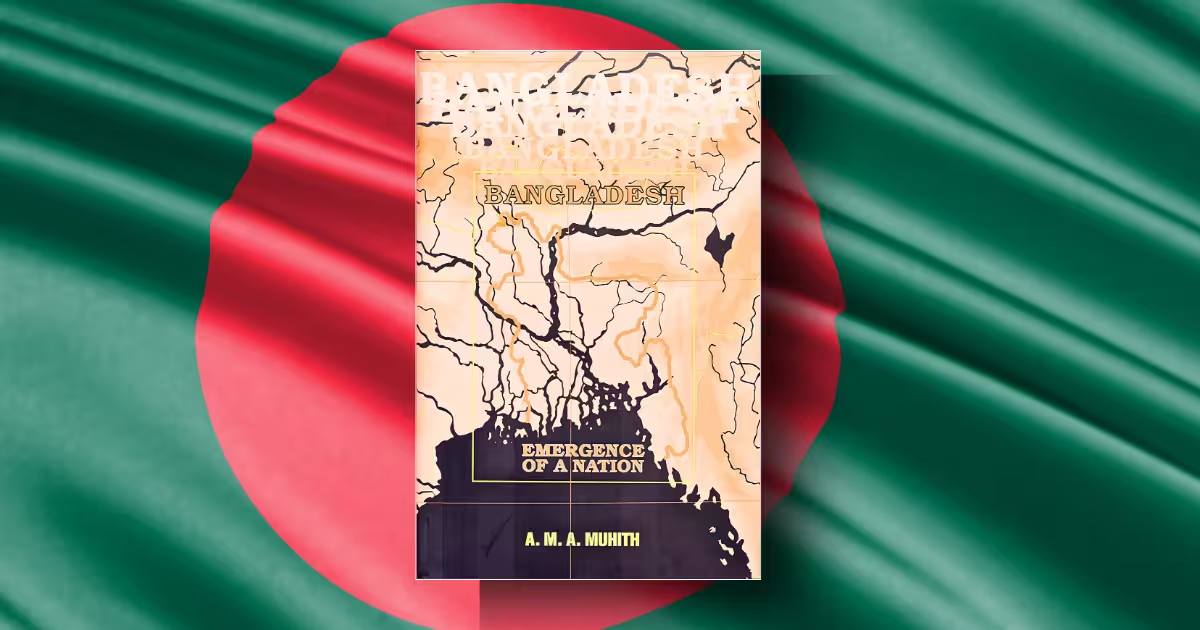

You know that feeling when you’re reading a history book and suddenly realize you’re not just learning about the past, you’re understanding why your present looks the way it does? That’s exactly what happened to me with A. M. A. Muhith’s Bangladesh: Emergence of a Nation.
This isn’t some dry academic textbook gathering dust on a library shelf. It’s a first-hand account from someone who was actually there, a civil servant who watched the machinery of state grind Bengalis down, a participant who later became Bangladesh’s longest-serving Finance Minister.
When Muhith writes about the economic exploitation of East Pakistan, he’s not just citing statistics; he’s describing what he witnessed in government meetings.
When he recounts the Agartala Conspiracy Case, he’s telling you about events that shaped his own career and his country’s destiny.
What struck me most while reading was how Muhith manages to be both deeply personal and rigorously analytical.
The book’s subtitle, “Emergence of a Nation”, captures something essential. This isn’t just a story about independence; it’s about how a nation emerges from the wreckage of colonial rule, from the failure of one political union, and from the ashes of a brutal war.
Table of Contents
Overview
Bangladesh: Emergence of a Nation (first published 1978, revised 1992) is the definitive insider account of how East Pakistan became Bangladesh. Written by A. M. A. Muhith, a former Pakistani civil servant who later became Bangladesh’s longest-serving Finance Minister, the book argues that Bangladesh’s independence wasn’t an accident but the inevitable outcome of systematic exploitation, political exclusion, and cultural suppression by West Pakistan’s ruling elite.
Muhith makes his case across fifteen chapters, covering everything from ancient Bengal’s history through British colonial rule, the 1947 Partition, and twenty-three years of Pakistani domination.
The book’s core message is devastatingly simple: East Pakistan earned the foreign exchange, paid the taxes, and provided the captive market, while West Pakistan got the investment, the aid, the military, and the political power.
The economic chapters are particularly damning, Muhith provides hard statistics showing that Bangladesh contributed roughly 33% of central revenues but received only about 20% of current expenditure and 23% of foreign aid. Even though it earned 54.7% of Pakistan’s export receipts, it received just 31% of imports.
Politically, the book traces how Bengali demands for autonomy, culminating in Sheikh Mujibur Rahman’s Six Point Programme of 1966, were met not with negotiation but with repression, culminating in the fabricated Agartala Conspiracy Case, Ayub Khan’s fall, Yahya Khan’s broken promises, and the 1970 election landslide that gave the Awami League an absolute majority.
When West Pakistan refused to honor that democratic mandate, the military crackdown on 25 March 1971 made independence the only path forward.
What makes this book unique isn’t just the analysis, it’s the author’s access. Muhith was a serving civil servant during the events he describes, attended cabinet-level meetings, kept personal notes, and spoke directly with key figures like Tajuddin Ahmad and General Osmany. His account reads less like academic history and more like a witness statement.
Reader recommendation for Bangladesh: Emergence of a Nation:
This book will genuinely reward you if you fall into any of these categories:
Students of South Asian history looking for the most comprehensive single-volume account of Bangladesh’s emergence, it covers everything from the 1947 partition to the 1971 war with a level of detail you won’t find elsewhere.
Anyone trying to understand why Pakistan failed as a nation-state, Muhith doesn’t just describe events; he explains the systematic economic, political, and cultural forces that made separation inevitable.
Readers who appreciate insider accounts, the author was a civil servant during the Ayub and Yahya years, later a diplomat, and finally a minister. He had access to documents and conversations that no outsider could have.
People who want the facts, not just the narrative, the book is packed with tables, statistics, and documentary evidence. If you like your history with numbers, this is for you.
Who might bounce off it:
If you’re looking for a quick, light read, this isn’t it. The book runs over 400 pages and doesn’t shy away from economic analysis.
If you prefer narrative history without the bureaucratic and economic detail, some chapters (especially the ones on development planning) might feel dense.
If you’re completely new to South Asian history, you might want to start with a broader overview first, this book assumes some familiarity with the basic timeline of the subcontinent.
Introduction
Title: Bangladesh: Emergence of a Nation
Author: Abul Maal Abdul Muhith (A. M. A. Muhith)
First Published: 1978
Second Revised Edition: 1992
Publisher: The University Press Limited, Dhaka
The book runs to 431 pages in its second edition, with fifteen chapters covering the historical, political, and economic background of Bangladesh’s emergence. As the publisher’s description notes, it was “then the most authentic and comprehensive study” when first published in 1978.
Context of Bangladesh: Emergence of a Nation
The book is a work of contemporary history, Muhith was writing about events he had lived through. He served as a civil servant in Pakistan from 1956 onward, worked as Deputy Secretary to the Governor of East Pakistan, and later became a diplomat.
After Bangladesh’s independence, he served in various capacities, eventually becoming Finance Minister from 2009 to 2019. This gives the book an unusual authority: Muhith isn’t reconstructing events from archives alone; he’s drawing on personal notes, conversations, and documents he saw firsthand.
The book covers the period from the land’s ancient history through the British colonial period, the Pakistan years (1947-1971), and concludes with the emergence of Bangladesh. It was revised in 1992 to incorporate new information that became available after 1975.
Purpose o Bangladesh: Emergence of a Nation
Muhith’s central argument is that Bangladesh’s emergence was not an accident or the result of a conspiracy, it was the inevitable outcome of systematic exploitation and denial of rights by West Pakistan’s ruling elite. He writes:
“Pakistan’s dominance in the political, economic and administrative decision-making processes gave her wide latitude to distribute the total wealth of the country to the advantage of West Pakistan alone. Bangladesh, in fact, was squeezed severely to transfer substantial resources to West Pakistan.”
The book argues that the failure was not just economic but political and cultural. Bengalis were denied participation in power, their language was suppressed, and their legitimate demands for autonomy were met with repression.
The Six Point Programme, which Muhith discusses in detail, represented a last attempt at a negotiated solution within Pakistan. When that failed, the military crackdown of March 1971 made independence the only option.
Background
To understand why this book matters, you need to know who A. M. A. Muhith was.
Born in Sylhet on 25 January 1934, Muhith came from a politically active family. He joined the Pakistan Civil Service in 1956 and served in various capacities, including as Deputy Secretary to the Governor of East Pakistan during General Azam Khan’s tenure. This gave him an insider’s view of the relationship between the central government and the province.
After Bangladesh’s independence, Muhith returned from Washington, where he had been working, and became deeply involved in reconstruction efforts. He later served as Bangladesh’s Ambassador to the United States and, from 2009 to 2019, as Finance Minister. He authored nearly 30 books on various subjects, including the liberation war and economic development.
What makes his perspective unique is that he was both a participant in events and a chronicler of them. In the introduction, he writes about his role as a “clandestine lobbyist on the Capitol Hill” from April 1971, and later as a registered lobbyist for Bangladesh.
He spoke with key figures, Tajuddin Ahmad, General Osmany, M. M. Ahmad, and gathered information from the Mujibnagar government while it was still in exile.
Bangladesh: Emergence of a Nation Summary
Reading Muhith’s book feels like sitting through a masterclass on how a nation can be systematically impoverished by its own government.
The book is divided into fifteen chapters, each building on the previous one to create an overwhelming case for why Bangladesh had to separate.
Chapter 1: The Land and the People
Muhith opens with geography and demography, and even here, the political implications are clear. Bangladesh is a deltaic region of 55,600 square miles, formed by the Ganges and Brahmaputra rivers. The population in 1951 was 44 million; by 1991 it had reached 115 million. The density is mind-boggling: over 2,000 inhabitants per square mile.
He describes the six seasons, the annual floods, and the cyclones that periodically devastate the coast. This isn’t just background color, it’s essential context for understanding why economic development in East Pakistan was so difficult and why the central government’s neglect was so damaging.
The people of Bangladesh, Muhith notes, are an ethnic mixture, Dravido-Mongoloid, Aryan, and others, but remarkably homogeneous. The language is Bengali, which “has a long history, it belongs to the Indo-European family of languages”. By 1981, 86.7% of the population were Muslim, 12% Hindu.
Chapter 2: Towards Pakistan
This chapter traces Muslim politics in British India from the first century of British rule through the establishment of Pakistan. Muhith describes how the Muslim community suffered under the British: “Under the British rule, the Muslim community suffered in every walk of life”.
He documents the rise of Muslim modernism, the establishment of the All India Congress and Muslim League, and the eventual demand for Pakistan. The Pakistan Resolution of 1940, moved by Bengali leader A. K. Fazlul Huq, originally called for “Independent states” in the northwestern and eastern zones, not one Pakistan. The concept of a single Pakistan developed later, as a matter of convenience.
Muhith makes an important observation about Bengal’s role:
“In retrospect it is interesting to assess the role of Bengal in the Muslim struggle for independence in India. Muslim modernism began in Bengal and central India. Pakistan movement was spearheaded by these same elements. From the birth of the Muslim League through the adoption of Pakistan concept, Bengali leaders had to shape the movement and guide it.”
But West Pakistan’s commitment to Pakistan was always weaker. “It was the lack of commitment in West Pakistan to the concept of Pakistan that prevented sacrifices on their part for the sake of the nationhood of Pakistan”.
Chapter 3: The Twins Never Met
This chapter examines political relations between the two wings of Pakistan. Muhith argues that Pakistan started with a very weak political base: “The level of politicisation in the country as a whole was very low and the quality of indigenous political leadership was similarly very poor”.
He documents the systematic exclusion of Bengalis from power. Though East Bengal had 56% of the population, the capital was located in West Pakistan, as were all military headquarters and the State Bank.
Bengalis made generous gestures in the hope of fostering nationhood, they elected West Pakistanis to the Constituent Assembly from East Bengal constituencies, and accepted a cabinet where only two of seven ministers were Bengali.
But the sacrifices were one-sided. The constitution-making process was repeatedly sabotaged by West Pakistani interests. The Interim Report of the Basic Principles Committee (September 1950) would have rendered East Bengal a minor partner.
When Nazimuddin’s cabinet produced a more balanced report in December 1952, it was rejected. In April 1953, Governor-General Ghulam Mohammed dismissed Nazimuddin despite his holding the confidence of parliament, an act that “marked the beginning of direct bureaucratic rule in Pakistan”.
The pattern repeated itself: elections in East Bengal (1954) gave a massive victory to the United Front, but the government was dismissed within two months. The Constituent Assembly was dissolved in October 1954. Martial law was declared in 1958.
Chapter 4: Evolution of a Colony
This is the heart of Muhith’s economic argument, and it’s devastating. He writes:
“West Pakistan’s dominance in the political, economic and administrative decision-making processes gave her wide latitude to distribute the total wealth of the country to the advantage of West Pakistan alone. Bangladesh, in fact, was squeezed severely to transfer substantial resources to West Pakistan.”
The evidence he presents is detailed:
- Revenue and expenditure: Bangladesh contributed approximately 33% of central revenues but received only about 20% of current expenditure.
- Foreign assistance: In twenty-three years, Bangladesh received only 23% of total foreign aid committed to Pakistan. On the basis of population, it should have received 56%.
- Export earnings: Bangladesh earned 54.7% of Pakistan’s total export receipts but received only 31.1% of merchandise imports.
- Development expenditure: Between 1950 and 1970, Bangladesh received only about 27% of total development expenditure.
- Inter-wing trade: West Pakistan had a favorable balance of trade with Bangladesh of about Rs. 7.5 billion (approximately $1.6 billion) between 1947 and 1969.
Muhith concludes:
“Through a system of tight control over trade, a colonial relationship was established between the two regions. The policy of industrialization followed in West Pakistan demanded heavy import of capital goods, spares and industrial raw materials. Foreign aid as well as export earnings of the country were utilized to meet these demands. The products of these industries were marketed in Bangladesh under heavy protective cover.”
Chapter 5: Live and Let Live
This chapter traces the demand for provincial autonomy, culminating in Sheikh Mujibur Rahman’s Six Point Programme of February 1966.
Muhith explains that the Six Points were not a secessionist document but a last attempt to make Pakistan work:
“The best option was, therefore, a policy of ‘live and let live.’ In return for a payment for the upkeep of West Pakistani military and for the pursuit of a common foreign policy, Bangladesh should be master of her own house with complete economic autonomy. By eliminating areas of friction it was piously wished that stronger bonds of nationhood could be forged over a period of time.”
The Six Points were:
- Federal parliamentary government based on direct adult franchise
- Federal responsibility only for defense and foreign affairs
- Two currencies (or one with safeguards against capital flight)
- Fiscal policy and taxation with federating units
- Separate foreign exchange accounts and control of foreign trade
- Separate military or paramilitary forces for each wing
President Ayub Khan’s response was immediate and vicious. In March 1966, during a visit to East Pakistan, he termed the Programme “a disruptionist ruse” and threatened civil war. He warned that “an independent East Bengal could not survive”.
Chapter 6: From Stability to Chaos
This chapter covers Ayub’s martial law regime and the Agartala Conspiracy Case. Muhith describes how the case was fabricated: on 6 January 1968, the government announced that a conspiracy by some Bengali officials in collusion with Indian military officials had been unearthed. Sheikh Mujib was implicated while already in detention.
The case backfired spectacularly. As the trial proceeded, “it became obvious that the mainstay of the case was fabricated documents and supporting evidence of approvers”.
The accused persons’ statements “graphically described the systematic policy of discrimination followed against Bengalis in all walks of life”. Instead of discrediting the Awami League, “Sheikh Mujibur Rahman became more of a hero and the Six Point Programme became the slogan of East Pakistan”.
The mass uprising of 1968-69 forced Ayub to release Mujib on 22 February 1969 and withdraw the case. On 25 March, Yahya Khan took over.
Chapters 7-8: Yahya’s Regime and the 1970 Elections
Yahya promised a return to democracy. He announced elections would be held on 7 December 1970. The Legal Framework Order of March 1970 dissolved West Pakistan’s One Unit and provided for elections based on “one man one vote”.
The results were a landslide. The Awami League won 167 out of 169 East Pakistan seats in the National Assembly, an absolute majority. The PPP won 81 seats in West Pakistan.
Muhith describes the fear this created in West Pakistan:
“The intense parochialism of West Pakistan would not stand for such a compromise. The entire bureaucracy, military top-brass, political leadership and the intellectual community of West Pakistan were nearly unanimous in their disapproval of regional autonomy and Bengali majority in the national parliament.”
Chapter 9: Those Twenty-Five Days of March
The civil disobedience movement began on 1 March 1971 when Yahya postponed the National Assembly session. Sheikh Mujib called for non-cooperation, and East Pakistan effectively came under Awami League control.
Negotiations between Yahya and Mujib took place from 16 to 25 March. They failed because Yahya demanded that Mujib accept a federal system with limited autonomy, while Mujib insisted on the Six Points.
On the night of 25 March, the Pakistani army launched Operation Searchlight. Mujib was arrested and flown to West Pakistan. The army began a systematic massacre that would claim hundreds of thousands of lives.
Bangladesh: Emergence of a Nation Analysis
Muhith’s book is remarkable for its combination of insider perspective and analytical rigor. He doesn’t just assert that East Pakistan was exploited, he shows you the numbers. The tables on revenue collection, foreign aid distribution, and development expenditure are damning. They make it impossible to dismiss the exploitation as mere perception.
What I found most compelling was Muhith’s treatment of the Six Point Programme. He presents it not as a secessionist plot but as a reasonable attempt to make Pakistan work.
The Programme’s demands, federalism, parliamentary democracy, control over one’s own resources, are standard features of any functioning federation. The fact that they were treated as treason tells you everything about Pakistan’s ruling elite.
The book also succeeds in showing how cultural suppression was intertwined with economic exploitation. The language movement of 1952 wasn’t just about language, it was about whether Bengalis would be treated as equal citizens. The ban on Tagore’s songs wasn’t just about culture, it was about denying Bengalis their identity.
Strengths and Weaknesses
Strengths:
- Insider access: Muhith’s position as a civil servant gave him access to documents and meetings that no outsider could have seen. His account of cabinet discussions and bureaucratic maneuvering has an authenticity that secondary sources can’t match.
- Comprehensive coverage: The book covers everything from ancient history through the 1971 war. It’s a one-volume reference that genuinely earns its subtitle.
- Economic analysis: The chapters on economic exploitation are exceptionally detailed. Muhith doesn’t just make claims, he backs them up with tables and statistics.
- Balanced perspective: Despite being a participant in events, Muhith maintains a scholarly tone. He doesn’t demonize all West Pakistanis, he notes, for example, that General Azam Khan was a humane governor who “instilled among Bengali bureaucrats and elite the courage for dissent and a great measure of self-confidence”.
Weaknesses:
- Density: Some chapters, especially the economic ones, are heavy going. If you’re not interested in development finance, you might find yourself skimming.
- Limited coverage of post-1971 period: The book essentially ends with independence. Muhith revised it in 1992 but didn’t add chapters on post-liberation developments.
- Some factual errors noted: Critics have pointed out factual errors and inconsistencies. Professor Anisuzzaman noted that Muhith “tried to link up Bangladesh’s history, civilisation and politics with pre-historic times of Indian civilisation” but “should have described it more elaborately”. Professor Abdul Momin Chowdhury “pointed out some factual errors and inconsistencies”.
Comparison with Similar Works
Compared to other books on Bangladesh’s emergence, Muhith’s stands out for its insider perspective and economic detail.
Rounaq Jahan’s Pakistan: Failure in National Integration (1972) covers similar ground but from a more academic perspective. Jahan’s book is shorter and more focused on the political dynamics of the 1960s.
Choudhury Mohammed Ali’s The Emergence of Pakistan (1967) covers the 1947 partition from the perspective of a senior civil servant. But it ends before the Bangladesh crisis.
Z. A. Bhutto’s The Great Tragedy (1971) is a polemic by a participant on the other side. It’s valuable as a document of West Pakistani attitudes but doesn’t have Muhith’s analytical depth.
Anam Zakaria’s 1971: A People’s History from Bangladesh, Pakistan and India (2019) is a more recent work that draws on oral histories from all three countries. It’s more accessible but less detailed on the economic dimensions.
Muhith’s book remains the most comprehensive single-volume account of Bangladesh’s emergence. It’s not the easiest read, but it’s the most thorough.
Conclusion
Bangladesh: Emergence of a Nation is a remarkable book, part memoir, part economic analysis, part political history. Muhith’s unique position as a civil servant who witnessed the exploitation of East Pakistan from inside the system gives his account an authority that few other writers can match.
The book makes a compelling case that Bangladesh’s independence was not an accident but the inevitable outcome of systematic exploitation and denial of rights. The economic data is damning: East Pakistan earned the foreign exchange, paid the taxes, and provided the market, while West Pakistan got the investment, the aid, and the power.
What struck me most was the tragedy of it all. Pakistan could have worked.
The Six Point Programme was a reasonable attempt to create a federal system that would have preserved the country’s unity. But West Pakistan’s ruling elite couldn’t accept equality with Bengalis. They preferred repression to sharing power.
Who should read this book:
- Students and scholars of South Asian history
- Anyone trying to understand why Pakistan failed
- Readers who appreciate detailed, evidence-based history
- People interested in the economic dimensions of decolonization
Who might want to look elsewhere:
- Casual readers looking for a light introduction
- Those who prefer narrative history without economic detail
As Professor Sonia Nishat put it, the book is “a wonderful handbook on Bangladesh history, civilisation and politics” despite some shortcomings. For anyone who wants to understand how Bangladesh emerged, this is the place to start.
Related Works
- Rounaq Jahan, Pakistan: Failure in National Integration (1972)
- Choudhury Mohammed Ali, The Emergence of Pakistan (1967)
- Z. A. Bhutto, The Great Tragedy (1971)
- Anam Zakaria, 1971: A People’s History from Bangladesh, Pakistan and India (2019)
- Kamal Hossain, Bangladesh: Quest for Freedom and Justice (2013)
- Moudud Ahmed, Bangladesh: Constitutional Quest for Autonomy (1979)