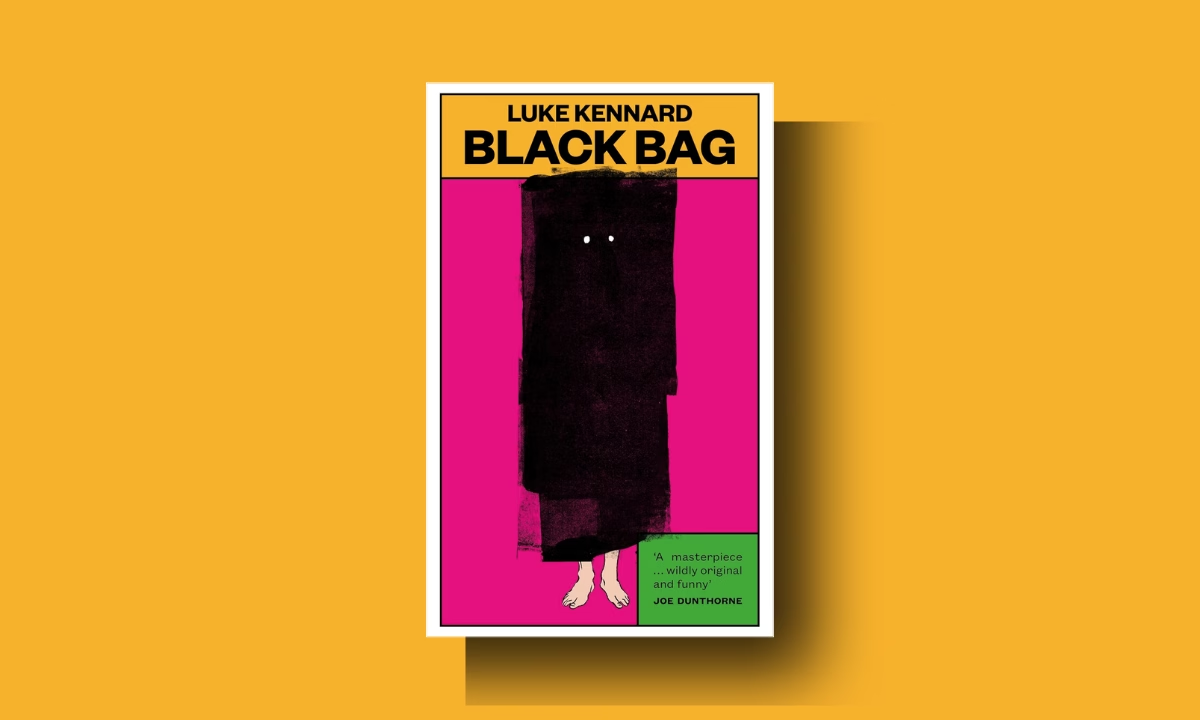

Black Bag by Luke Kennard is the novel everyone on the Booker Prize 2026 shortlist conversation keeps circling back to, because its question is so simple and so uncomfortable: what if a man only felt free once nobody could see him? An out-of-work actor is paid to sit in university lectures zipped inside a black leather bag, and slowly the bag stops being a costume and becomes a way of life.
Then other men start wearing bags too. I came to this book as a reader who loves philosophy and films about people performing themselves, and I left it thinking about every man I know who goes quiet when life gets hard.
Below you will find a full spoiler summary, the ending explained, what the silent men in bags really mean, and an honest verdict on whether this Booker-shortlisted novel lives up to its premise.
Table of Contents
Quick Summary
Black Bag is a comic campus novel about an unnamed, broke, 37-year-old English actor who takes a three-month job as a living psychology experiment. Dr. Paul Blend is re-running a 1967 study of the “mere-exposure effect,” the idea that people grow fond of things simply by seeing them again and again.
So the actor sits silent and faceless in Blend’s lectures and seminars, twice a week, while the students go from repulsed to curious to warm.
Along the way, a married English professor called Justine Pearce falls for him on the strict condition that he never leaves the bag; his childhood friend Claudio, a gaming streamer, turns “black bag” into shares, NFTs and a coin; and a secret brotherhood of penitent men begins wearing identical bags. The book ends with a standing ovation and an unfinished sentence.
It was published by John Murray in the UK on 12 March 2026 and longlisted for the Booker in July, then shortlisted on 22 September 2026. My rating: 4/5, a brilliant, hilarious, slightly overstuffed novel with a real wound at its centre.
Who Will Love the Book, and Who Will Quit Halfway?
You will probably love Black Bag if you enjoy a narrator who talks too much, overthinks everything and is funniest when he is most miserable. Readers who like the cringe comedy of Peep Show, the playful philosophy of Spike Jonze films such as Being John Malkovich, or classic campus satire will feel looked after.
It is also, quietly, a book for anyone who has ever felt like a failure at 30-something, or who has watched a close friend sink into the internet and wondered how to pull him back.
On the other hand, if you need a fast plot with tidy answers, you may give up somewhere around the middle, where the story pauses for long digressions about AI films, a talking dog and an imaginary Swedish village. The explicit sex scenes, which are important to the story, will not suit every reader either.
And if you arrived looking for the 2025 spy movie with Cate Blanchett, you are in the wrong place, though I explain the mix-up below.
Book Details: Title, Author and Publication
- Book: Black Bag
- Author: Luke Kennard, British poet and novelist, Professor of Creative Writing at the University of Birmingham
- UK edition: John Murray (Hachette), 12 March 2026, hardback £18.99
- US edition: Zando, 17 March 2026, 352 pages in hardcover
- Genre: Literary fiction, satire, campus comedy
- Awards: Booker Prize 2026 longlist (13 books chosen from 163 submissions) and shortlist (six books)
The other five shortlisted novels, according to the official Booker announcement, are The End of Everything by M. John Harrison, The Disappearers by Marlon James, May We Feed the King by Rebecca Perry, The Things We Never Say by Elizabeth Strout and John of John by Douglas Stuart.
The judging panel is chaired by Mary Beard, with Raymond Antrobus, Jarvis Cocker, Rebecca Liu and Patricia Lockwood.
Quick Verdict: A sad, very funny novel about a man who can only be loved once he disappears. Recommended for fans of satire, literary comedy and fiction about modern masculinity.
Should You Read It?
| What works | What doesn’t |
|---|---|
| Genuinely funny, line by line | Too many subplots in the second half |
| A premise taken from real psychology | The men’s movement is explained rather than shown |
| The friendship with Claudio is beautiful | The narrator’s snobbery can wear you down |
| Honest about male shame and loneliness | Justine stays an enigma, perhaps too much |
| One of the boldest endings of the year | Graphic sex scenes will not suit everyone |
What Is It About? A struggling actor is hired to sit, silent and faceless, inside a black bag in university lectures for a psychology experiment. The longer he wears it, the less he wants to come out, and the more other people try to own, love or copy what he has become.
Rating: 4/5
Where Did Kennard Get the Idea? The Real 1967 “Bag” Student
Kennard did not invent the bag. In the novel’s acknowledgments, he explains that the original experiment was conducted by Charles Goetzinger at Oregon State University in 1967 to test Robert Zajonc’s theory of mere exposure.
He found it by accident while researching a poem, and he says he was immediately and obsessively interested in the person inside the bag rather than in the results.
The real story is wonderfully odd. According to the OSU Foundation, a student in Goetzinger’s speech persuasion class, which had about 20 students, attended in a large black bag during winter 1967, the student newspaper broke the story on 3 February, and national media followed.
Nobody ever learned who he was. Zajonc’s 1968 paper, “Attitudinal Effects of Mere Exposure,” cited the case, and the summary on Wikipedia notes that the class’s feelings moved from hostility to curiosity and then to friendship.
Kennard, speaking to NPR after the shortlist, described the effect as “the idea that we become fond of things just by encountering them over and over again even if we dislike them at first,” as reported by KUOW.
Accordingly, the whole novel can be read as an answer to one question the 1967 class never asked: did the young man in the bag feel loved, or only tolerated?
Black Bag Full Plot Summary
Act One: A Man Hired to Disappear
We meet our narrator, who stays nameless for the whole book, trying to cross a road to get a free falafel wrap. He is an English character actor of 37, small, slight, proud of looking younger than his age, and broke.
He has to find £1,400 every month for his rent and bills, and his last paid job was a murder-mystery dinner three months earlier.
His closest friend since the age of seven is Claudio, a gaming streamer who is now well off, and who keeps offering to be his “patron.” The narrator refuses, as a matter of pride.
His career is a series of small disasters. At an audition for a devised play about climate change, he sings one long note instead of announcing a flood, then tells the director the project is “beneath contempt,” and is rejected anyway, which makes him cry.
A last-minute murder-mystery job with the unpleasant Howard reunites him with his old stage friend Samantha, until the hotel catches fire mid-show and nobody is paid.
Then he spots a strange advert. A psychologist, Dr. Paul Blend, needs a short, slight male actor for a silent three-to-four-month role. In a cramped office, Blend fits him into a tailored black leather bag that reaches his upper calves and explains the study: people come to like what they meet repeatedly, even if it repels them at first. The actor is barefoot, voiceless and featureless.
He is told not to wiggle his toes. Later Blend snips two little eyeholes so he can walk to campus in it.
Act Two: Loved as an Absence
The first lecture is grim. Students mutter “Is that a dead body?” and “It’s horrible.” In the small seminar group, a student named Sophie complains that the bag is distracting, and the others agree to call it “it.” Blend pays him in cash from his own pocket, and Claudio lets him change and sleep at his penthouse near campus during the week.
Strangely, the actor flourishes. He starts wearing the bag at weekends, at the park, in a coffee shop, even at home with a drink. He builds secret pockets inside it from gaffer tape.
When lectures bore him, he drifts into a fantasy life in a remote Swedish town, where he has lost a hand in a sawmill and is mothered by an old woman called Birgitta. At his parents’ house (he refuses to describe them, so they appear only as two “pillars” of stone), he holds sardonic conversations with their border collie puppy, Elliott.
Then Professor Justine Pearce enters his life, literally by dragging him off a radiator in the English department. She is 47, brilliant, impatient and very direct.
She wants to know what he is, and he breaks his vow of silence to tell her. She gives him an app called One-Way, through which only she can start a conversation, and proposes a relationship that is sexual and affectionate but has one rule: he must remain inside the bag. Their meetings, first on her office floor, later in her stone cottage, are odd and intimate, and he falls hard. She mentions, casually, a husband.
Meanwhile his ordinary life cracks. A dinner with Samantha goes wrong when she brings up his ex, Angelique, whom he is convinced once planned to murder him, and he responds by tipping out Samantha’s handbag and pulling it over his own head in the restaurant.
Act Three: Sold, Copied, Replaced
Claudio has a business idea. He calls black bag “live art,” gets his friend to sign a long contract, and splits ownership: 20 percent each, 60 percent sold to investors.
A week later he says the stake is worth £150,000. A tracker on the bag turns the actor’s wandering routes into digital “codes”; pin badges and T-shirts go to investors; a “Bag Coin” appears. Claudio spreads mysterious backstories online to keep people guessing.
When the actor falls ill, he asks Claudio to stand in for one lecture. Claudio sits through it silently and collects Blend’s praise and cash, but on the way out Justine leads “black bag” to her office and starts to take her clothes off, believing he is her lover. Claudio, in a moral panic, freezes until a colleague’s knock saves everyone.
This is the moment, for me, when the book’s comedy turns into a real question about consent and identity.
The actor’s world keeps widening. At a tech boat party arranged by Claudio, he meets Mason Long, an American founder developing Paterfamilias, an app in which fathers speak to an AI-aged version of their child 65 years in the future.
Mason calls the bag “an allegory” and becomes its investor. Justine takes the actor to see a film reportedly made entirely by AI, and then phones him from a wedding and from Paris with explicit stories about a giant of a man, stories he can never verify.
Claudio warns him that loving a married woman will break him. So, with a heavy heart, the actor tells Justine it is over. She calmly refuses to accept it. He deletes the app and drinks alone.
Act Four: The Congregation of Bags
Immediately afterward, everything goes strange. Claudio disappears: no streams, no replies. A caller who claims to be Justine’s husband speaks through a glitching voice changer, slips into chatbot phrasing, and tells the actor he must “see this through.”
At a supermarket the actor, in ordinary clothes, sees another person in an identical bag and chases him across town; it turns out to be a frightened archaeology student who will only say that the bags meet on Saturdays and that membership is by invitation.
On campus, Blend has vanished, replaced by a young temporary lecturer, Dr. Mazower, who has never heard of any experiment. A parcel arrives for “BLACK BAG” at Claudio’s address. Inside is a powder, and the actor, half hoping it will bring him closer to his friend, takes it and has a long, overwhelming vision of machine-like cathedrals in which voices tell him to go and find Claudio.
Using a screenshot from Claudio’s last stream, he tracks the meeting place to a derelict warehouse on a canal.
The journey there is an epic of humiliation.
A drunk man throws him in the canal, where he nearly drowns inside the bag. A stranger rescues him. He walks on, breaks into a boathouse and pedals a cracked swan pedalo for miles.
In the warehouse, 27 identical bags sit in rows before a soft-spoken Scottish leader, chanting a creed of male guilt and droning together. The leader says no saviour is coming and that healing will take generations.
Our narrator hates it, slips away and pedals back into the dark, until Mason, who has been following his signal, flags him down and drives him home.
Curtain: The Ending of Black Bag Explained
The last stretch moves quickly. Justine messages to say they never broke up, and gives him Blend’s address. At Blend’s tidy, lonely house, the old psychologist reveals that he has repeated the bag experiment for some thirty years, that earlier actors always ruined it, and that since around 2009 the bags tended to disappear before the final session.
He fears he spent his career making students comfortable with meaninglessness. The actor visits his parents, finds an old photo of himself playing Ariel in The Tempest at 16, and quietly cries. Elliott the dog tells him to extend some grace to himself.
Then Claudio turns up at the door. He had followed the bags, mugged one of them for a bag of his own, and been flown to a “Center for Advanced Studies in Masculinity” in Copenhagen, where silent men in bags live simply. He has struck a deal: the movement takes 4.5 percent and the money scheme continues, with Mason holding a controlling stake. Claudio says they will each make several hundred thousand pounds, enough for the actor to start the theatre company he has always dreamed of. Asked why, Claudio says he loves him.
Out of the bag, waiting for coffee, the actor sees Justine with dyed blonde hair and a strip of hessian on her lapel. She looks right at him and does not recognise him. “I’m a big fan of your work,” he says, and she thanks him.
In the final lecture, Blend returns in academic robes and invites black bag to the stage. Every student stands and cheers. The narrator walks down the steps toward the applause and begins to ask himself why something he always wanted feels so… and the book ends mid-sentence.
My reading of the ending: The 1967 hypothesis is proved.
The students love black bag. Yet the person they love has no face, no voice and no name, and the woman who loved him cannot see him without it. That missing final word is the hollow at the centre of fame, of masculinity, perhaps of acting itself.
I also read Justine’s hessian lapel (sackcloth, the old fabric of penance) as a sign that she is connected to the bag movement, which would explain her husband’s call and her line that “This is just starting… it’s bigger than you.” Kennard never confirms it, so this is my interpretation, not a fact.
Black Bag Characters: A Critical Look
The Narrator: A Man Who Is Only Free in Hiding
He is vain, kind, snobbish, frightened and very funny, often in the same sentence. His defining wish, stated early, is “a level of success that I can be disingenuously modest about.” What makes him complex is that the bag gives him the one thing he never had as a man: permission to stop competing.
By chapter 34 he says that without the bag he is “some pitiful and unremarkable man going around, doing things.” That line hurt to read, because I have heard versions of it from real friends.
Claudio: The Friend Who Keeps Showing Up
Claudio is a satire of influencer capitalism (sponsored energy drinks with scratch cards, NFTs, a coin), and yet he is the most loyal person in the book.
He has known the narrator for 30 years, gives him a place to stay, covers for him when he is ill, refuses to take advantage of Justine, and says “I love you” at the end without a joke attached. Readers who liked our piece on why maintaining adult friendships is so hard will find a lot to think about here.
Justine Pearce: Love on Her Terms
Justine is the novel’s riddle. She is clever and seductive, but she also treats her lover as an experiment and controls every channel of contact. Her claim that “it is the role of women to cover up the truth of mortality” is one of the strangest and most quotable ideas in the book.
Whether she is a liberator or a collector of men is left open.
Dr. Blend, Mason and the Rest
Blend is a lonely, decent man being shuffled out of academia; his final tea with the narrator is one of the book’s saddest scenes.
Mason is the friendly face of tech power, a man who boasts about a room full of weeping fathers and then shrugs when his app is linked to a death. Samantha, Howard, the vulnerable student in the supermarket and the imaginary Birgitta round out a cast that feels lived-in.
Elliott the dog, who speaks only in the narrator’s head, gets some of the best lines. The New York Times, as quoted by Zando, admitted, “I often agreed with the dog.”
Themes and Symbolism
Why men hide. This is the novel’s big subject. The narrator’s “Compensatory Model” in chapter 44 lists what a man without strength, money or confidence is expected to offer in return (intelligence, kindness, good humour, compassion) and admits that, in the end, he was offering “precisely nothing.” Claudio names the undercurrent “the Great River of Shame.”
The bag is the raft. In contrast, the warehouse cult turns shame into ritual, which Kennard clearly distrusts. The Booker judges predicted “a lot of discussion about what the novel has to say about the state of modern masculinity,” and they were right.
Being liked versus being known. Mere exposure works: everybody ends up fond of the bag. Yet nobody who loves it knows the man inside, not the students, not Justine, not the investors. That gap is the book’s quiet tragedy.
Performance and selfhood. As an actor, the narrator must be “absolutely not myself. A whirling void.” The bag is the purest role he has ever had because nobody knows it is him. Similarly, Claudio once confessed that he tones down his personality a little more with every episode he streams.
Money and art. Claudio sells shares in a silence; Mason tells the narrator that art is just “a kind of pus” left by suffering; an AI makes a terrible film that everyone wants to see. Kennard asks, with real feeling, whether human art still matters, and the narrator, to his credit, answers yes.
Symbols. The bag (coffin, cocoon, confessional, sackcloth), the swan pedalo (an absurd vehicle for a hero’s quest), the new curtains (a small act of dignity bought with his first wages) and the hessian lapel at the end all carry weight without ever feeling forced.
My Evaluation of Book
Black Bag is a tender, absurd and heartbreaking comedy, and I think it is the most honest novel about male loneliness I have read in a long time, even when it is making me laugh at a man stuck inside a handbag.
What I Loved
The jokes land constantly, and they are usually jokes with a bruise underneath. The prose has the precision you would expect from a poet; the New York Times noted that “Kennard is a poet by trade and it shows,” according to Penguin Random House.
The friendship between the narrator and Claudio is the finest thing in the book, and the swan pedalo voyage made me laugh and then, oddly, made me want to cry. Writer Will Ashon put it perfectly in a blurb for John Murray: it made him “worry about a man on a swan pedalo.”
What Didn’t Work for Me
However, the second half carries too many passengers. The talking dog, the Swedish daydream, Justine’s phone stories, Mason’s app and the AI film each have charm, yet together they slow the book down.
The men’s movement, potentially the most powerful idea, is mostly reported second-hand by Claudio. I am not the only one: a reviewer on The Reader’s Room Booker panel said it needed about 50 fewer pages, while the same panel still ranked it third of the nine longlisted books they had read.
How It Affected Me
Surprisingly, what stayed with me was not the satire but the loneliness. Our narrator cannot accept a loan from his best friend, cannot describe his own parents, cannot say what he wants at a coffee counter once he leaves the bag. That last scene, where his voice simply seizes up, felt painfully real.
Some critics have read the book as a light answer to the “manosphere”; the Standard called it “comic relief,” per John Murray. I would say it is both relief and diagnosis.
Similar Books and Films
Anton Chekhov’s The Man in a Case (1898): A schoolteacher who wraps himself, literally and morally, in protective cases. The narrator is his comic, modern heir.
Franz Kafka’s The Metamorphosis (1915): A man transformed into something his family cannot look at. Kennard’s version is voluntary, which makes it stranger.
Kingsley Amis’s Lucky Jim (1954): The template for the British campus comedy of failure.
Tom McCarthy’s Remainder (2005): The Sunday Times called Black Bag “as surreal and ambitious” as McCarthy’s novel.
Spike Jonze’s Being John Malkovich (1999): Author Ben Purkert described Black Bag as “part SNL sketch, part Spike Jonze film,” and the comparison fits a story about crawling inside an identity.
If the actor’s money panic and age anxiety hit home, you may also like our honest look at a career crisis at 30, the hidden habits that growing up poor leaves behind, and our review of Kyle MacLachlan’s memoir about an actor’s flops, Fictional Selves. For a classic of comic, deluded questing, try our Don Quixote review.
Adaptation: Is There a Black Bag Movie?
Not of this novel, as far as I can find. Based on the available data as of October 2026, no film or series adaptation of Kennard’s Black Bag has been announced, and I could not verify any report of screen rights being sold.
The film most people find when they search “Black Bag” is Steven Soderbergh’s 2025 spy thriller with Cate Blanchett and Michael Fassbender, written by David Koepp.
It has nothing to do with the book. According to Wikipedia, it was released in the US on 14 March 2025, cost a reported $50 to 60 million and grossed roughly $43 million worldwide (the page gives slightly different totals).
Even the Booker Prize felt the need to say the novel is not to be confused with the movie. So, for now, there is no box office and no book-versus-film comparison for Kennard’s novel.
Why Men Hide: Five Lessons From Black Bag for Today
The theme that matters most in Black Bag, to me, is male withdrawal: men who would rather vanish than be seen failing. It is not only a literary idea. A Gallup report from May 2025 found that 25 percent of US men aged 15 to 34 said they felt lonely a lot of the previous day, compared with 18 percent of all US adults.
Here are five lessons I took away.
- Silence is not the same as peace. The narrator feels calm in the bag, yet his voice fails him the moment he leaves it. Withdrawal can feel like healing while it quietly erodes us.
- Shame grows in the dark. The warehouse men chant about their guilt but never speak to one another. Shame shared in a creed is still shame kept private.
- Pride can block help. He will not take money from Claudio because “it messes things up,” and he nearly drowns, literally and financially, as a result. Accepting help is a skill, not a weakness.
- Hustle culture eats friendships. Claudio’s love is real, but so is his urge to monetise everything, including his best friend. Notice when someone you love has become content.
- Being seen requires risk. The final applause is for a mask. The book suggests that the only recognition worth having is the kind we earn by showing our faces, even when they are not impressive.
Quotes and Passages
- “I’m an actor. That’s just something I wanted to get out of the way at the beginning.” (chapter 1)
- “I will speak to you in present tense. The silliest tense.” (chapter 1)
- “We are testing life itself… We are testing God’s thoughts.” Dr. Blend (chapter 6)
- “We all make someone uncomfortable.” (chapter 10)
- “Your dealer is never your friend.” (chapter 15)
- “As an actor I must be absolutely not myself. A whirling void.” (chapter 16)
- Justine: “I’m forty-seven. I’m just attractive and very good at my job.” (chapter 24)
- Justine: “I am a person. You are an absence.” (chapter 30)
- “I’ve never felt comfortable anywhere.” (chapter 36)
- “I’m in here… It’s me.” said aloud against a train window as an unknowing Justine walks away (chapter 44)
- Claudio: “And black bag is the life raft.” (chapter 56)
- “I’m more myself than ever.” (chapter 65)
- Dr. Blend: “Retirement feels rather similar to being expelled from a cult.” (chapter 84)
- Claudio, asked why he did it all: “Because… I love you.” (chapter 87)
- To Justine, unrecognised: “I’m a big fan of your work, that’s all.” (chapter 88)
Final Thoughts: Should You the Book?
Black Bag is a funny novel about a sad truth: many men would sooner disappear than risk being seen as ordinary. Luke Kennard wraps that truth in a perfect absurd premise borrowed from a real 1967 experiment, then fills it with jokes, heartbreak, crypto nonsense and one unforgettable swan pedalo.
It is overstuffed in places, and some of its biggest twists happen off-stage, but the voice is so alive and the friendship at its core so warm that I forgave it almost everything.
I recommend it to readers of literary comedy and campus satire, to anyone interested in modern masculinity, to actors and artists who know the gap between talent and income, and to every man who has ever gone quiet instead of asking for help.
Whether or not it takes the Booker on 9 November, it is a book I expect people to keep arguing about, and that is the best kind.
Black Bag
Black Bag by Luke Kennard is the novel everyone on the Booker Prize 2026 shortlist conversation keeps circling back to, because its question is so simple and so uncomfortable: what if a man only felt free once nobody could see him? An out-of-work actor is paid to sit in university lectures zipped inside a black leather bag, and slowly the bag stops being a costume and becomes a way of life.
URL: https://www.sopranu.com/black-bag-luke-kennard-summary-ending-explained/
Author: Luke Kennard
4
Pros
- Jokes that hide real heartbreak
- An honest look at male loneliness and shame
- Claudio is one of the most loyal friends in recent fiction
- Poet’s prose, precise and quotable
- The swan pedalo voyage is an unforgettable set piece
- It leaves you plenty to argue about
Cons
- Too many subplots crowd the second half
- The men’s movement is told second-hand, not shown
- The narrator’s snobbery can wear thin
- Justine stays a riddle, maybe too much of one
- Explicit scenes may put off some readers