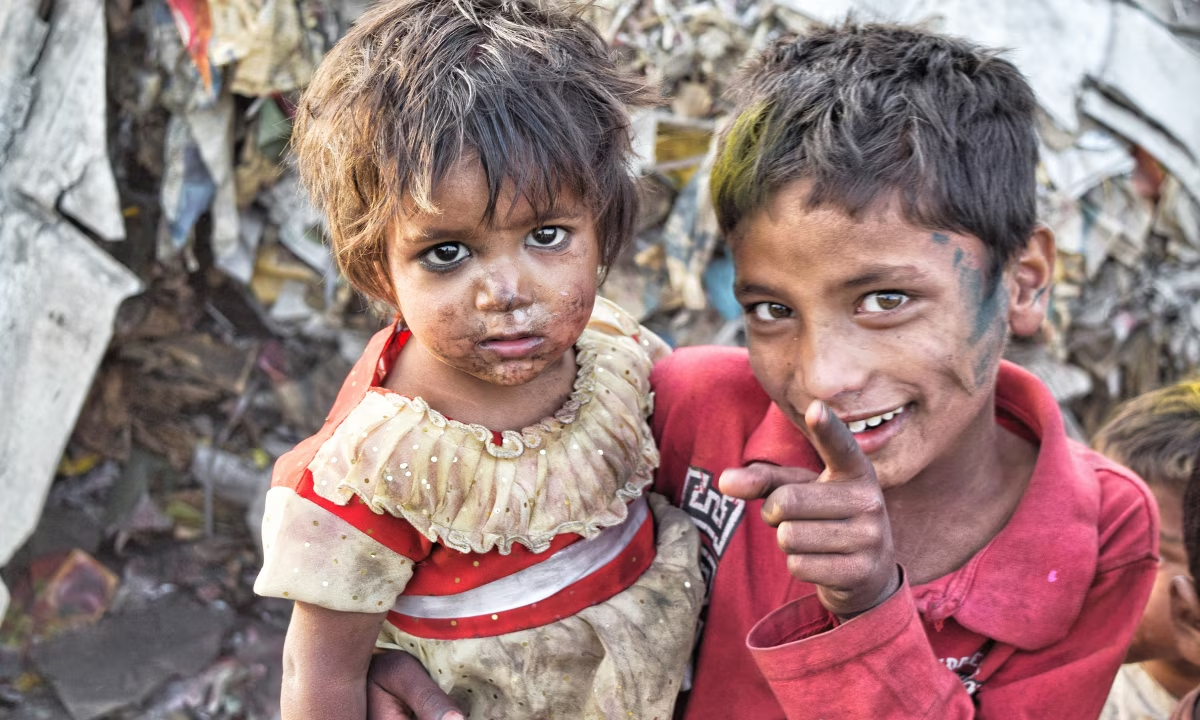

Growing up poor leaves marks that often outlast the poverty itself. You might earn a decent salary now, pay your bills on time and have some savings, and still find yourself scraping the last grain of rice from the pot, checking your bank balance three times a day, or feeling a jolt of guilt when you buy something just because you like it. These habits can feel irrational to people who never went without.
They make complete sense once you remember where they came from. Some of them protected you as a child. A few still serve you well. Others quietly cost you money, peace or relationships.
In this article, I go through seven habits people who grew up poor often carry into adulthood, what research says about why they form, and how to keep the strengths while loosening the ones that no longer fit your life.
Table of Contents
At a Glance
Growing up poor can shape adult behaviour around money, food, risk, rest and trust, even after income improves.
Research explains many of these habits. A 2013 study in Science by Anandi Mani, Sendhil Mullainathan, Eldar Shafir and Jiaying Zhao found that financial worry reduced cognitive performance by an amount comparable to losing a full night’s sleep or about 13 IQ points.
Childhood environment shapes decisions under stress. University of Minnesota research (Griskevicius and colleagues, 2013; Mittal and Griskevicius, 2014) found adults who grew up poorer became more impulsive and felt less in control when economic hardship was made salient.
The 7 habits: never wasting food, constant money anxiety, spending quickly when money arrives, refusing help, guilt about rest and spending on yourself, short-term thinking, and hiding your background.
These habits are adaptations, not character flaws. Many come with real strengths: resourcefulness, empathy, gratitude and resilience.
How Does Growing Up Poor Affect You as an Adult?
Growing up poor affects you as an adult mainly by shaping the habits and instincts you learned for surviving scarcity, which often stay active long after the scarcity has ended.
Children are excellent learners. When money is unpredictable, food runs short at the end of the month, or a single unexpected bill can throw the family into crisis, children learn rules for survival. Eat what’s in front of you. Don’t ask for things. Spend money before it disappears.
Don’t trust promises. Never waste anything. These rules are sensible in a harsh environment.
The problem is that they don’t automatically switch off when your circumstances change.
Researchers have studied several parts of this. A 2013 Psychological Science study led by Vladas Griskevicius at the University of Minnesota drew on life history theory, the idea that people raised in unpredictable, harsh conditions tend to adopt a “fast” strategy focused on immediate gains, while people raised in predictable, comfortable conditions adopt a “slow” strategy focused on future payoffs.
According to ScienceDaily’s summary of the paper, the researchers stressed that neither strategy is good or bad in itself. Impulsiveness can be the smart choice when the future is uncertain.
That framing helped me a lot. Habits from a poor childhood aren’t evidence that you’re bad with money or weak-willed. They are evidence that you adapted.
How Many People Grow Up Poor?
The number of people who grow up poor is large, though it varies widely by country and by how poverty is measured.
In Bangladesh, the Bangladesh Bureau of Statistics’ Household Income and Expenditure Survey 2022 found that 18.7% of the population lived below the poverty line, down from 24.3% in 2016, and that extreme poverty fell from 12.9% to 5.6%, according to The Daily Star.
That decline is real progress.
It also means that millions of Bangladeshi adults today grew up in households that were poor even if they themselves no longer are. Many of the habits in this article are, in that sense, a quiet inheritance shared by a large part of the population, including many people in the middle class.
7 Habits People Who Grew Up Poor Often Carry
1. Never Wasting Food, Even When It Doesn’t Make Sense
The first habit many people carry from growing up poor is a deep discomfort with wasting food. You finish everything on your plate, even when you’re full. You eat leftovers that are past their best. You keep three half-empty jars of the same sauce. You can’t throw away bread, even stale bread.
This habit usually comes from real experiences of not having enough, or from parents who drilled into you that food was precious. In many South Asian homes, religious and cultural teachings against wasting rice and food are common too, which reinforces the instinct.
The strength: You’re resourceful. You can make a meal from almost nothing, and you waste far less than many people.
The cost: Eating past fullness out of guilt, or eating spoiled food, can harm your health.
What to try: Keep the respect for food, but change the tool. Cook smaller portions, freeze leftovers quickly, and give yourself permission to stop eating when you’re full. Wasting a little food is not the same as being wasteful.
2. Constant Money Anxiety, Even When You’re Fine
Constant money anxiety is one of the most common habits of people who grew up poor. You check your account balance obsessively. You run the same calculations over and over. A small unexpected expense, like a broken phone screen, triggers a wave of panic far bigger than the cost.
Research shows how heavy this kind of worry can be. In August 2013, Science published a study titled “Poverty impedes cognitive function” by Anandi Mani, Sendhil Mullainathan, Eldar Shafir and Jiaying Zhao. According to Princeton University’s report on the study, the researchers ran experiments with about 400 shoppers at a New Jersey mall and with 464 sugarcane farmers in India.
When lower-income participants thought about a difficult financial problem, their performance on cognitive tests dropped, while wealthier participants were unaffected.
The Indian farmers performed better after harvest, when they had money, than before it. The researchers estimated that the effect was comparable to a 13-point drop in IQ or losing a full night’s sleep.
In other words, money worry isn’t just unpleasant. It takes up mental space you need for everything else.
What to try: Replace constant checking with a scheduled check, such as once a week. Build a small emergency fund, even a modest one, specifically to calm this anxiety. Knowing that a broken phone won’t become a crisis frees up a surprising amount of mental bandwidth.
3. Spending Money Quickly When It Arrives
Spending money quickly when it arrives can seem like the opposite of the previous habit, but many people who grew up poor have both. When money comes in, part of you wants to use it immediately before something takes it away: a bill, a relative’s request, an emergency.
The research on “fast” strategies helps explain this. In the 2013 Griskevicius study, when participants were primed with cues about a recession, those who grew up poorer became riskier, more impulsive, and quicker to approach luxury goods, while those who grew up wealthier became more cautious. The pattern stayed mostly dormant in good times and appeared under stress.
There’s also a famous experiment that shows the logic. In 2012, Celeste Kidd, Holly Palmeri and Richard Aslin at the University of Rochester published a variation of the classic “marshmallow test” in the journal Cognition.
According to the University of Rochester, they split 28 children aged three to five into two groups of 14. One group saw an adult keep small promises before the test, while the other experienced broken promises.
In the unreliable condition, children waited an average of about 3 minutes and only 1 of 14 waited the full 15 minutes. In the reliable condition, children waited about 12 minutes on average, and 9 of 14 waited the full 15 minutes.
The lesson is simple: when the world is unreliable, taking what you can now is rational, not impulsive.
What to try: Automate your future self’s share. Set up an automatic transfer to savings on payday, before you can see the money. That way, the “spend it now” instinct only has access to what’s left.
4. Refusing Help, Even When You Need It
Refusing help is a habit many people who grew up poor carry quietly. You’d rather struggle alone than ask a friend for a loan, a colleague for advice, or a family member for support. Accepting help feels like owing something, and owing something feels dangerous.
This hyper-independence often comes from childhood experiences where help came with strings attached, judgement, or public shame. Some children watched their parents being humiliated when they asked relatives for money. They learned early never to put themselves in that position.
The strength: You’re self-reliant and resilient. You’ve figured out how to solve problems on your own.
The cost: You may miss opportunities, mentorship and support that others take for granted. Many careers and businesses grow through networks and favours, and refusing help can quietly limit you.
What to try: Start with low-stakes requests. Ask a colleague to review your CV. Ask a friend for a book recommendation. Notice that most people enjoy helping. Then build up to bigger asks.
5. Guilt About Rest and Spending on Yourself
Guilt about rest and self-spending is a habit that can follow people who grew up poor for decades. Buying a nice shirt, booking a holiday, taking a day off, or ordering food instead of cooking all trigger the same thought: “Who do you think you are?”
Part of this comes from watching parents work exhausting hours just to survive. Rest can feel like a luxury you haven’t earned. Part of it comes from a sense that comfort is fragile and could be taken away at any moment.
Research from the University of Minnesota connects this to a sense of control. In a 2014 study in the Journal of Personality and Social Psychology, Chiraag Mittal and Vladas Griskevicius found that adults who grew up poor were more likely to see difficult economic conditions as beyond their control, even when their current income was similar to people who grew up wealthier.
According to ScienceDaily, when reminded of economic hardship, participants from poorer backgrounds also gave up on an unsolvable puzzle about 25% sooner. Encouragingly, the researchers found that recalling a time when they had been fully in control reduced impulsive choices, even for those who grew up poor.
What to try: Budget for joy on purpose. Set aside a small, fixed amount each month that you are required to spend on yourself, guilt-free. Making it a rule removes the moral debate.
6. Short-Term Thinking and Distrust of Long Plans
Short-term thinking is a habit that often gets misread as irresponsibility. People who grew up poor may find it hard to plan five or ten years ahead, invest for retirement, or delay rewards for a distant future. “Who knows what will happen?” feels like an honest answer, because in childhood, it often was.
This habit connects directly to the marshmallow research. For decades, the original marshmallow studies were interpreted as showing that children who could wait were destined for success.
However, a 2018 replication by Tyler Watts, Greg Duncan and Haonan Quan, involving more than 900 children, told a more complicated story.
According to BusinessTech’s report on the research, the link between waiting and later achievement was about half the size of the original findings, and controlling for family background and the home environment reduced it by about two-thirds. In other words, a lot of what looked like self-control was really about circumstances.
What to try: Make the future feel concrete. Instead of “save for retirement,” set a specific, near goal: “Build three months of expenses by next December.” Small, visible wins make long-term planning feel trustworthy.
7. Hiding Your Background and Feeling Like an Impostor
Hiding your background is a habit that can follow people who grew up poor into offices, universities and middle-class social circles. You change how you talk. You avoid mentioning where you grew up. You feel uneasy at expensive restaurants or when colleagues casually discuss holidays abroad. You worry someone will “find you out.”
This feeling of being an outsider in comfortable spaces is common among people who move between social classes. It can push you to work harder than everyone else, which can be useful. It can also make you lonely, because part of you is always performing.
Memoirs often capture this better than research. Jeannette Walls’s The Glass Castle and Trevor Noah’s Born a Crime both describe growing up with very little and later moving through worlds that didn’t understand where they came from. Our reviews of The Glass Castle and Born a Crime go deeper into how each writer handled that tension.
What to try: Share your story selectively, with people who’ve earned your trust. Many people discover that colleagues and friends respect their background more than they expected. Your history is part of your competence, not a secret flaw.
Are There Advantages to Growing Up Poor?
Yes, growing up poor can leave real advantages, though they never justify the hardship itself.
People who grew up with little often develop:
- Resourcefulness: You know how to stretch money, fix things and improvise.
- Empathy: You understand struggle from the inside and are often less quick to judge others.
- Gratitude: Ordinary comforts like a full fridge, a reliable roof and a paid bill rarely feel ordinary to you.
- Work ethic: You know how to keep going when things are hard.
- Perspective: Many minor problems simply don’t frighten you, because you’ve seen worse.
The aim isn’t to erase the habits of growing up poor. It’s to keep the strengths and loosen the reflexes that now cost you more than they protect you.
How Do You Unlearn the Habits of Growing Up Poor?
You unlearn the habits of growing up poor by noticing them without shame, building financial safety nets that calm your nervous system, and practising new behaviours in small, safe steps.
Here’s a simple plan:
| Habit | Small step to try this month |
|---|---|
| Money anxiety | Check your account once a week at a fixed time, not daily |
| Spending when money arrives | Automate a savings transfer on payday |
| Never wasting food | Cook smaller portions and freeze leftovers quickly |
| Refusing help | Ask one person for advice on something low-stakes |
| Guilt about rest | Schedule one fully free evening and protect it |
| Short-term thinking | Set one concrete savings goal with a deadline under a year |
| Hiding your background | Share one honest story about your childhood with someone you trust |
If you want to understand the psychology of money more deeply, our list of the best books on the psychology of money is a good place to start.
For the structural side of poverty, our reviews of Nickel and Dimed and Poverty, by America explain why poverty is so hard to escape, and George Orwell’s first-hand account in Down and Out in Paris and London still feels uncomfortably current.
What I’ve Learned About Carrying a Poor Childhood Into Adult Life
The most important thing I’ve learned is that these habits are not proof that something is wrong with you. They are proof that you learned well. A child who grew up with unpredictable money and unpredictable promises would be foolish to act as if the world were safe and generous.
You did what made sense.
What I’ve also learned is that you’re allowed to update the rules. The world you live in now may be different from the one you grew up in. You can keep your resourcefulness, your empathy and your gratitude, and still let yourself rest, accept help, plan for the future and enjoy a nice meal without apologising.
That process is slow. Some days the old instincts win. That’s fine. The goal isn’t to become someone who never grew up poor. It’s to become someone who grew up poor and now gets to choose which lessons to keep.
FAQs About Growing Up Poor
How does growing up poor affect your brain and decisions?
Research suggests financial worry uses up mental bandwidth. A 2013 study in Science found that thinking about difficult money problems lowered cognitive performance among lower-income people by an amount comparable to losing a full night’s sleep.
Why do people who grew up poor spend money quickly?
When the future feels uncertain, using resources immediately can be a rational choice. University of Minnesota research found that adults who grew up poorer became more impulsive under economic stress, and Rochester’s marshmallow study variation showed children waited far less when adults were unreliable.
Is it normal to feel guilty spending money after growing up poor?
Yes. Many people who grew up with little feel guilt or anxiety when spending on themselves, even when they can afford it. Setting a fixed, guilt-free spending allowance can help.
Does growing up poor make you better with money?
It can go either way. Some people become extremely careful savers. Others swing between anxiety and impulsive spending. Many develop strong resourcefulness. Awareness of your own pattern matters more than your background.
Is the marshmallow test proof of self-control?
Not on its own. A 2018 replication with more than 900 children found the link between waiting and later achievement shrank sharply once family background and the home environment were taken into account.
Can you fully change habits learned from childhood poverty?
You can change many of them, especially with financial security, practice and sometimes support from a therapist or financial counsellor. Some instincts may stay, but they can become choices rather than automatic reactions.
Final Thoughts
Growing up poor teaches lessons that last: never waste food, watch every taka or dollar, spend before it disappears, don’t ask for help, don’t rest, don’t trust long plans, and don’t let people see where you came from. Each of those lessons made sense once. Research from Princeton, Rochester and Minnesota helps show why they formed and why they can resurface under stress.
You don’t have to throw them all away. Keep the resourcefulness, empathy and grit. Gently retire the anxiety, the guilt and the secrecy. You survived a childhood that asked a lot of you. You’re allowed an adulthood that asks a little less.