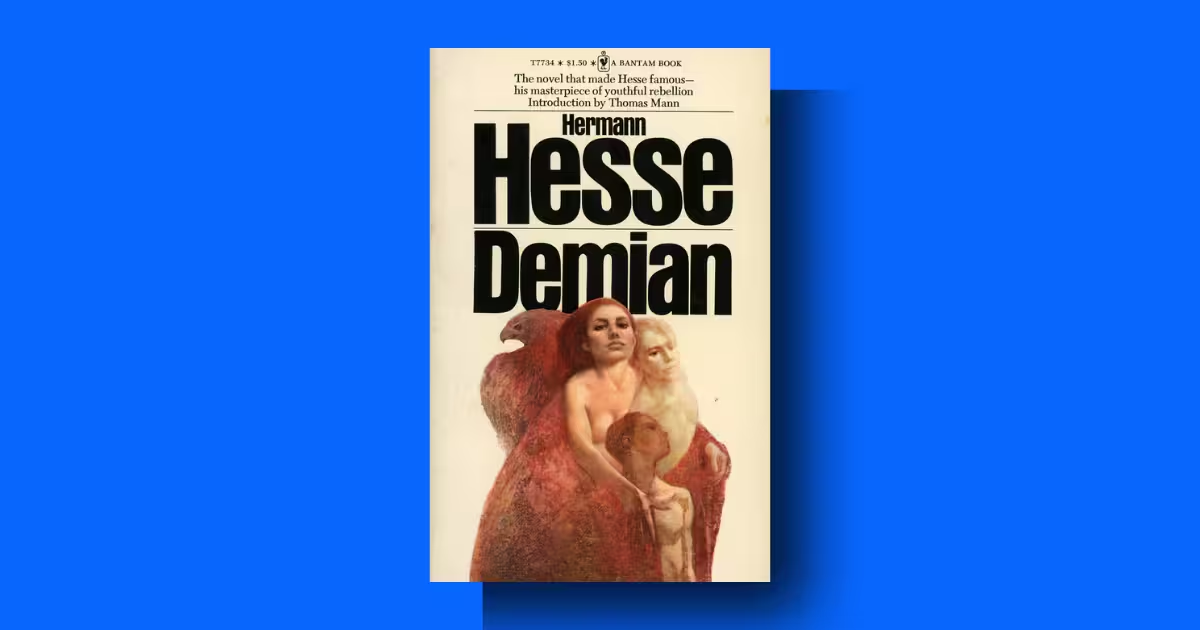
Do you remember the first time you realized the world wasn’t as simple as your parents said it was?
I do.
It wasn’t a dramatic moment—just a quiet crack in the foundation of everything I believed. And that’s exactly what Hermann Hesse’s Demian captures better than any book I’ve ever read.
Published in 1919, this novel sold over 100 million copies worldwide across all of Hesse’s works. But numbers don’t tell you why it still matters. Over a century later, Demian remains one of the most powerful novels about what it actually feels like to grow up—not the sanitized version, but the ugly, confusing, terrifying version where you don’t know who you are and no one can tell you.
Overview
Demian is the story of Emil Sinclair, a boy trapped between two worlds: the safe, “bright” world of his parents and the forbidden, “dark” world of everything else. A charismatic older student named Max Demian rescues him from a bully and becomes his mentor, teaching him to question morality, religion, and the very idea of good and evil.
Sinclair’s journey takes him through drinking, despair, mystical visions, and eventually to Demian’s mother, Eve, who represents the ultimate union of opposites.
The novel ends with World War I, where Sinclair is wounded and Demian dies—but not before revealing that he has always been inside Sinclair. It’s a book about finding yourself by losing everything else.
Reader recommendation
Demian is best for anyone who’s ever felt like they don’t belong—especially teenagers and young adults questioning authority, religion, or their own identity. Readers who love philosophical fiction, Jungian psychology, or books that make you feel understood rather than entertained.
Demian is not suggested for people looking for fast-paced plots, simple answers, or traditional happy endings. If you prefer clear morals and likable protagonists, this will frustrate you. Also not for readers uncomfortable with homoerotic undertones, religious skepticism, or ambiguous spirituality.
Table of Contents
Demian summary
The Two Worlds
The novel opens with ten-year-old Emil Sinclair describing his childhood. He lives in a small German town, and his world is split cleanly in half. There’s the “bright” world—his parents’ home, full of cleanliness, prayer, order, and love. Then there’s the “dark” world—servants, criminals, drunks, and everything forbidden.
Here’s the thing Hesse gets right: these worlds aren’t separate. They exist right next to each other. The maid who prays with the family in the evening tells ghost stories in the kitchen. And Sinclair lives in both, even though he’s supposed to belong only to the first.
“Two worlds intermingled there; from two opposite poles came the day and the night.”
The Fall
One afternoon, Sinclair is hanging out with some neighborhood boys when Franz Kromer shows up—a thirteen-year-old tailor’s son, already hardened and dangerous. To impress them, Sinclair makes up a story about stealing apples from an orchard.
Kromer immediately blackmails him. He threatens to report Sinclair to the orchard owner unless he pays two marks. Sinclair has no money. So begins a nightmare that lasts weeks.
Kromer forces Sinclair to steal from his own family, bringing him small coins and enduring endless humiliation. Sinclair becomes physically ill from the stress. He dreams of Kromer kneeling on him, forcing him to commit obscenities. In one nightmare, Kromer makes him murder his father.
This section is brutal precisely because it’s so believable. Hesse doesn’t romanticize childhood suffering. He shows how one bad decision can spiral into something that feels inescapable.
The Rescue
A new student arrives at Sinclair’s school: Max Demian. He’s older, more mature, and utterly different from everyone else. He carries himself like an adult, speaks with strange confidence, and seems to see right through people.
One day, Demian walks Sinclair home and points out the faded coat of arms above Sinclair’s door—a sparrow hawk. Then he drops a bombshell: the story of Cain and Abel, he says, has been misinterpreted. Cain wasn’t evil; he was just stronger, more independent. The “mark of Cain” wasn’t a punishment—it was a badge of honor that frightened weaker people.
“Cain was a fine fellow, and they told this story about him because they were scared of him.”
Sinclair is shocked but fascinated. More importantly, Demian somehow knows about Kromer. He confronts Sinclair, reads his mind (or so it seems), and promises to handle it. Within days, Kromer disappears. He literally flees from Sinclair in the street.
Demian saved him—but Sinclair can’t accept it. He runs back to his parents, confesses everything, and is welcomed back like the prodigal son. He deliberately forgets Demian because Demian belongs to the “dark” world he’s trying to escape.
Adolescence and Despair
Years pass. Sinclair goes to boarding school and spirals into drinking and wild behavior. He becomes a ringleader among the worst students, cynical and self-destructive.
But he’s miserable. He’s trying to escape himself through alcohol and rebellion, and it’s not working. He feels utterly alone.
Then he sees a girl in a park. He calls her Beatrice (after Dante’s beloved) and falls into worshipful, distant love. He starts painting her portrait—but the face that emerges isn’t hers. It’s Demian’s.
This is a crucial moment. Sinclair has been running from Demian for years, but Demian is inside him. The painting reveals that his “friend” is actually part of himself.
The Bird and Abraxas
Sinclair paints another picture: a sparrow hawk breaking out of a globe—an egg. He sends it to Demian without knowing where he lives.
Months later, he finds a note in his schoolbook:
“The bird fights its way out of the egg. The egg is the world. Whoever wants to be born must destroy a world. The bird flies to god. The god is called Abraxas.”
Sinclair doesn’t know what Abraxas means—until a teacher mentions it in class. Abraxas, he explains, is a deity that unites the divine and the satanic.
This is the core of the novel. The old division between good and evil is a lie. True wholeness requires embracing both.
Pistorius
Sinclair meets Pistorius, an organist who lives in a dark old house with his father, a respected pastor. Pistorius is an outsider—a failed theology student who plays Bach and studies forgotten religions.
He becomes Sinclair’s new mentor. They lie in front of fires, discuss dreams, and explore the idea that every person must find their own path. Pistorius teaches Sinclair that his sexual dreams aren’t shameful—they’re sacred. That the “dark” urges inside him are part of his wholeness.
“We cannot fear anything or treat anything our soul desires as forbidden.”
But eventually Sinclair outgrows Pistorius. He realizes his mentor is stuck in the past, collecting ancient myths instead of living his own life. Their relationship ends quietly, painfully—with Sinclair saying something cruel and Pistorius accepting it without defense.
Sinclair writes on a piece of paper: “A guide has left me. I am in total darkness. I cannot take a single step alone. Help me!”
Eve
Sinclair enrolls at university and, by chance, finds Demian again. Demian takes him home—and Sinclair meets his mother, Eve.
She is everything Sinclair has been dreaming about: powerful, maternal, sensual, wise. She looks exactly like the figure in his paintings.
“It was her: the large, almost masculine figure, resembling her son; the signs of maternal love, strictness, and deep passion in her features; beautiful and enticing, beautiful and unapproachable, daemon and mother, fate and lover.”
Sinclair falls deeply in love with her. She becomes his everything—mother, lover, goddess, destiny. She teaches him that love isn’t about pleading or wishing; it’s about being so certain of your desire that reality bends to meet it.
“Love cannot ask or plead. Love must have the strength to reach certainty from within.”
The War and the End
World War I breaks out. Demian becomes a lieutenant and goes to the front. Sinclair follows.
On the battlefield, Sinclair has a vision: a giant city in the clouds, a goddess with Eve’s face, stars bursting from her forehead. One star screams toward him and explodes.
He wakes in a field hospital, wounded. Next to him lies Demian, dying.
Demian looks at him and whispers: “The next time you call me, I won’t come so obviously on horseback or by train. You will have to listen inside yourself, and then you’ll realize I’m in you.”
He kisses Sinclair—Eve’s kiss—and dies.
When Sinclair wakes, Demian’s bed is occupied by a stranger. But when Sinclair looks into himself, he sees his own face… and it has become Demian’s.
“I need only bend down over the black mirror and I see my own image, which now looks exactly like Him, Him, my friend and my guide.”
Demian Analysis
Characters
Emil Sinclair is one of the most honest portrayals of adolescence I’ve ever encountered. He’s not heroic. He lies, drinks, feels superior, and wallows in self-pity.
But he’s also deeply searching, capable of profound growth, and willing to question everything. His name itself is symbolic: “Sin” and “clair” (light)—darkness and brightness combined.
Max Demian is more a symbol than a person. He represents Sinclair’s own potential, his anima, his higher self. Demian doesn’t really “develop”—he’s always already complete. That’s because he’s not real; he’s an archetype. The homoerotic undertones between him and Sinclair are unmistakable, but they serve a purpose: Sinclair’s love for Demian is really love for his own hidden self.
Franz Kromer is the dark world in human form. He’s not complex; he’s pure cruelty. But he’s necessary. Without Kromer, Sinclair would never need Demian. Without the fall, there’s no redemption.
Beatrice is a brief, beautiful illusion. Sinclair worships her from afar, but when he paints her, she transforms into Demian. She’s a stepping stone—a safe, non-threatening way to experience love before he’s ready for Eve.
Pistorius is the most tragic figure in the book. He’s a failed prophet, a man who knows all the answers but can’t live them. He guides Sinclair to self-knowledge but can’t achieve it himself. Their breakup is heartbreaking because Pistorius knows it’s coming and accepts it.
Eve is the culmination. She’s the mother of all, the feminine principle, the unity of opposites. She’s both sacred and sexual, nurturing and dangerous. Sinclair’s love for her is incestuous in its intensity, but that’s the point: to become whole, he has to integrate everything, including his deepest taboos.
Demian Themes and Symbolism
The Two Worlds is the novel’s central metaphor. Sinclair’s childhood home is the “bright” world of order and morality. Everything else is “dark.” But Hesse shows that this division is false—the worlds interpenetrate, and trying to stay in only one is impossible.
The Mark of Cain is the novel’s most famous symbol. Demian reinterprets Cain’s mark as a sign of strength, not sin. People with the mark are those who refuse to follow the herd. They’re frightening to others because they’re free. By the end, Sinclair bears this mark too—not literally, but in his refusal to conform.
Abraxas is the god who unites good and evil. He represents the idea that wholeness requires embracing everything, not just the approved parts. This is Hesse’s answer to the problem of dualism: you don’t choose between light and dark; you integrate both.
The Sparrow Hawk is Sinclair’s personal symbol. It appears on his family’s coat of arms, in his paintings, and in his dreams. It represents his true self breaking free from the constraints of the world.
Fire and the Organ represent Pistorius’s approach to spirituality: intense, focused, transformative. Watching fire or listening to Bach isn’t passive entertainment—it’s a form of meditation that connects you to something deeper.
Dreams and Painting are Sinclair’s tools for self-discovery. He doesn’t understand his dreams intellectually; he paints them. Art becomes a way of accessing the unconscious.
Demian Evaluation
What Works
The first half of Demian is genuinely brilliant. Hesse captures the texture of childhood terror—the blackmail, the shame, the feeling of being trapped—with uncomfortable accuracy. The Kromer section alone is worth the price of admission.
The philosophical ideas are provocative and timely. In an era of moral certainty, Hesse argues that certainty is the enemy of growth. The book’s insistence that we must find our own path, not follow someone else’s, feels more relevant than ever.
The prose is beautiful. Hesse writes with a kind of hypnotic simplicity. Even in translation, the sentences have weight. They feel like someone telling you a secret.
The ending is powerful. Demian’s death and transformation into Sinclair’s inner self is a brilliant resolution—not happy, but true.
What Doesn’t
The second half loses momentum. Once Sinclair leaves school, the novel becomes more abstract. Pistorius and Eve are interesting, but they lack the concrete reality of Kromer and the early Demian.
The novel is heavily indebted to Jungian psychology, which can feel dated. The dream sequences, the archetypes, the emphasis on individuation—it all reads like a therapy session sometimes.
Sinclair is passive for much of the book. Things happen to him; he rarely makes things happen. This is realistic (adolescence often feels like that), but it can be frustrating.
The treatment of women is problematic. Beatrice is an ideal, Eve is a goddess—neither is a fully realized person. They exist for Sinclair’s development, not for themselves.
Impact and Controversy
Demian was a sensation when it appeared. Published under the pseudonym “Emil Sinclair,” it won the Fontane Prize as a first novel—even though Hesse was already established. When the truth came out, Hesse had to return the prize.
The book spoke directly to post-WWI youth who felt betrayed by their elders. Its message—that the old morality was bankrupt, that individuals had to find their own way—resonated deeply. In the 1960s, it became a counterculture classic, selling nearly 1.5 million copies in the U.S. alone.
Today, Demian remains controversial. Some see it as profound; others as pretentious. Critics have called its philosophy “errant nonsense” and its mysticism “too rich and too strange”. But even its detractors acknowledge its power.
Comparison with Similar Works
Demian belongs to the bildungsroman tradition—novels of education and formation. It’s often compared to Goethe’s Wilhelm Meister and Joyce’s Portrait of the Artist as a Young Man.
It’s also part of a specifically German tradition of psychological fiction, alongside Musil’s Young Törless and Mann’s Magic Mountain. All these novels examine the inner life of young men against the backdrop of a collapsing world.
In English, Catcher in the Rye is the closest analogue. Both novels are about alienated young men who can’t fit into society. But Salinger’s Holden is ironic and defensive; Hesse’s Sinclair is earnest and searching. Demian is more philosophical, less funny.
Personal Insight
Why This Book Still Matters
I read Demian in my twenties, and I wish I’d read it earlier. Not because it gives answers—it doesn’t. But because it validates the questions.
Here’s what I mean: growing up, I was taught that there was a right way to live. Go to school, get a job, be a good person. But I always felt like something was missing. Like the “bright” world my parents believed in wasn’t the whole story. And I felt guilty for thinking that.
Demian told me that guilt was misplaced. That questioning authority, doubting morality, even feeling drawn to the “dark” side—these aren’t signs of failure. They’re signs of growth.
The novel’s central idea is deceptively simple: you have to become yourself. Not the self your parents want, not the self society expects, not even the self you think you should be. Your actual self, the one that exists beneath all the conditioning.
This is terrifying. Because your actual self might be a poet or a criminal, a saint or a monster. You don’t get to choose. You only get to discover.
“Every person’s true calling was only to arrive at himself. He might end up a poet or a madman, a prophet or a criminal—that was no concern of his; in the end it was meaningless. His concern was to find his own fate, not a random one, and to live it out, full and complete.”
Five Lessons from Demian
1. The world isn’t divided into good and evil. That’s a comforting fiction. Reality is more complicated. The sooner you accept that, the sooner you can stop judging yourself for being human.
2. Your dark urges aren’t your enemy. They’re part of you. Suppressing them makes them stronger. Integrating them makes you whole.
3. No one can save you but yourself. Demian rescues Sinclair, but only temporarily. True liberation comes from within. Guides can point the way, but you have to walk it alone.
4. Conformity is a kind of death. Safety is tempting. The herd is warm. But if you never risk being different, you never become who you actually are.
5. The path to yourself is lonely—and worth it. Pistorius says it best: “He whose only desire it is to work out his own destiny has no kith or kin, but stands alone and has only the cold world space around him”. That’s terrifying. But it’s also the only way to truly live.
Demian Quotes
“I have been and still am a seeker, but I have ceased to question stars and books; I have begun to listen to the teaching my blood whispers to me.”
“If you hate a person, you hate something in him that is part of yourself. What isn’t part of ourselves doesn’t disturb us.”
“The bird fights its way out of the egg. The egg is the world. Whoever wants to be born must destroy a world.”
“Love cannot ask or plead. Love must have the strength to reach certainty from within.”
“No one ever arrives home. But when the paths of friends meet, the whole world looks like home for a while.”
“We who bore the mark might well be considered by the rest of the world as strange, even as insane and dangerous. We had awoken.”
“Nothing in the world is more repugnant to a man than following the path that leads him to himself!”
Conclusion
Demian is not a perfect book. Its second half is weaker than its first. Its philosophy sometimes feels like a lecture. Its women are symbols, not people.
But it’s also a book that understands something essential: that growing up is painful, confusing, and lonely—and that’s okay. That the questions matter more than the answers. That the only real failure is never asking at all.
If you’re young and lost, Demian will make you feel seen. If you’re older and settled, it will remind you of what you gave up to get there. Either way, it’s a book that stays with you.
I’ll leave you with this: Hesse wrote Demian during his own psychological crisis, after his marriage fell apart and World War I shattered Europe. He was trying to save himself. And he did—by writing a book that has saved countless others.
That’s not a small thing.