
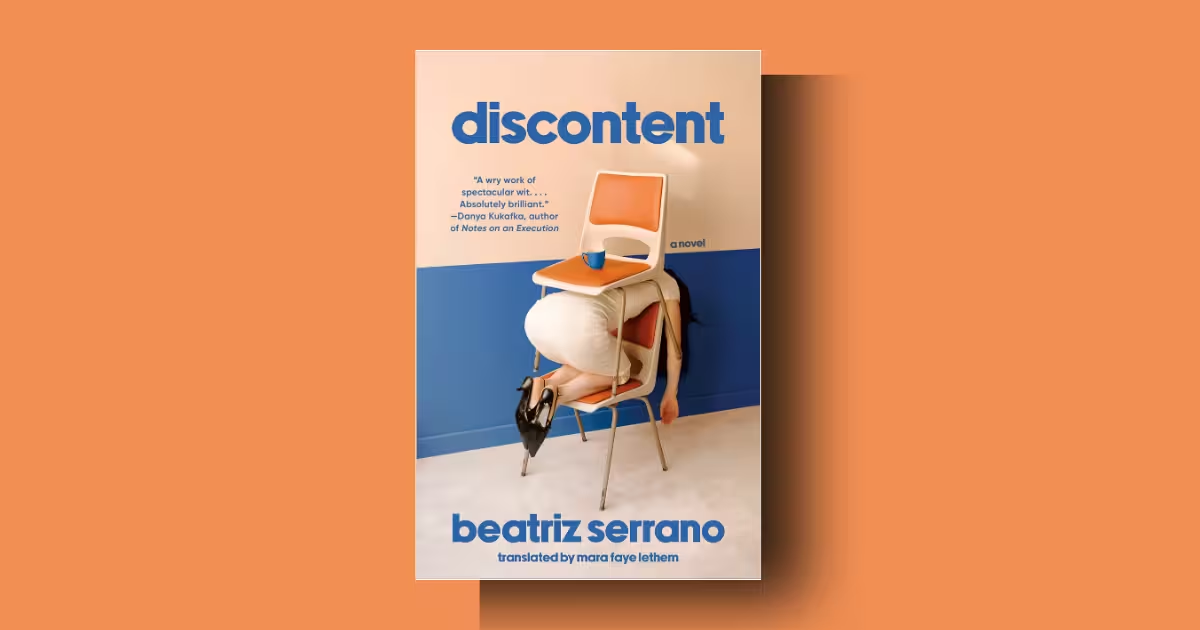

Are you secretly counting down the minutes until you can leave work and do literally anything else? If that question hit a little too close to home, Beatriz Serrano’s Discontent might be the most relatable book you’ll read this year.
Serrano has written something that feels less like fiction and more like a confession from someone who’s been there, done that, and bought the overpriced office coffee.
Here’s the thing about Discontent: it’s not just a book about hating your job. It’s about the quiet, creeping realization that you’ve built a life around something that’s slowly draining the life out of you. And it’s funny as hell while doing it.
Overview
Discontent follows Marisa, a 32-year-old creative strategist at a Madrid advertising agency who has mastered the art of doing as little as possible while appearing indispensable. She spends her days watching YouTube, popping Ativan, stealing ideas from her students, and fantasizing about getting hit by a car on her way to work, not because she wants to die, but because a workplace accident would mean paid leave.
The novel charts her slow unraveling across the dog days of August, culminating in a company retreat where her carefully constructed facade finally, spectacularly, collapses.
Reader recommendation: If you’ve ever sat through a meeting thinking I’d rather be literally anywhere else, this book is for you. If you’ve ever googled “how to be creative” while pretending to work, this book is you.
However, if you’re looking for a plot-heavy thriller or a feel-good redemption arc, you might find Marisa’s relentless cynicism exhausting rather than cathartic.
Table of Contents
Background
Beatriz Serrano is a Spanish journalist and writer born in Madrid in 1989. She has written for BuzzFeed, Vanity Fair, GQ, Harper’s Bazaar, S Moda, and Vogue, and currently works for El País. Along with writer Guillermo Alonso, she co-directs the podcast Arsénico Caviar, which won the Ondas Prize for best conversational podcast.
Discontent (originally published in Spanish as El descontento in 2023) is her first novel. The book became a significant commercial success in Spain, sold rights to multiple international markets including the UK, US, Germany, Italy, and Hungary, and was named a New York Times Book Review Editors’ Choice. Serrano was also nominated as a revelation author at the 2024 Openbank Vanity Fair Literature Awards.
The novel’s English translation by Mara Faye Lethem, herself an award-winning translator and a 2025 National Endowment for the Arts Translation Fellow, has been praised for preserving Serrano’s sharp, caustic tone.
Discontent Plot Summary
Part One: Looking Inside Is Dangerous
The novel opens in late August, with Marisa drawing a parallel between herself and Marina Joyce, a British YouTuber whose followers once suspected she was being held captive because of subtle changes in her behavior. Marisa notes that if someone examined her own meetings closely, they’d notice the same signs: the same woman who used to seem engaged now looks sleepy, dazed, even drugged.
Marisa is a 32-year-old creative strategist who has spent eight years in advertising, the last four at her current agency. She’s risen to middle management through what she calls “the office game” rather than genuine skill. She knows her job is essentially selling snake oil: red lipstick as the promise of being unforgettable, perfume as the guarantee of not being boring, vacuum cleaners as the key to a Instagram-worthy home.
She knows the world would be better off without jobs like hers. Yet she still believes, despite herself, that buying a dress might transform her into a happier person.
To avoid actually working on the Christmas campaign, Marisa emails her master’s students a fake assignment, planning to steal their best ideas. She delegates research to Natalia, her eager-to-please subordinate.
When she’s not hiding in her glass-walled office watching YouTube videos, she escapes to the Prado Museum, where she takes Ativan (a prescription tranquilizer) and stares at Hieronymus Bosch’s Garden of Earthly Delights. She interprets the central panel not as a condemnation of sin but as a vision of everything desirable that life could offer, and avoids looking at the hell panel because she already spends too much time there.
We learn about Marisa’s history with anxiety through her friendship with Rita, a quiet graphic designer who was her only real friend at the agency.
Rita recognized Marisa’s anxiety symptoms during a panic attack in the office cafeteria and urged her to see a doctor. Marisa was prescribed tranquilizers and recommended therapy. She quit therapy after concluding that her problem wasn’t her job tasks but the fundamental requirement of going to work at all, and continued getting the tranquilizers by fabricating a story of childhood sexual abuse. She and Rita bonded over bringing books to lunch as shields against small talk; talking to Rita made the workday bearable.
Rita, however, was deeply unpopular at the office. She never worked beyond her contract, never joined after-work socializing, and once told someone in sales that her incompetence wasn’t Rita’s emergency.
One Monday, she didn’t show up. On the third day, HR announced her death by email. Rumors circulated that Rita had died by suicide, though no one could confirm it because no one knew her life outside work. She was quickly replaced by Lorena, a friendly, diligent employee everyone liked better. Marisa took Rita’s box of belongings home and stored it unopened in her closet.
A chance encounter at a Japanese restaurant reunites Marisa with Elena, her best friend from university. Elena has changed dramatically, she’s had extensive cosmetic surgery and now works as what she describes not as a prostitute but as someone who has relationships with wealthy men who support her financially. Despite her changed appearance, Elena’s sharp wit and deep understanding of Marisa remain intact. They drink three bottles of wine and reconnect in a way Marisa hasn’t experienced in years.
That night, drunk and emotionally raw, Marisa finally opens Rita’s box. Inside, she finds a pashmina shawl, a mug with the inscription “Your incompetency is not my emergency,” and a black notebook.
The notebook contains meeting notes, deadlines, and small caricatures of coworkers. Among them is a drawing of Marisa herself, holding a cell phone and a pill box, with the speech bubble: “The day doesn’t start until I take my first Ativan”.
Part Two: OOTO (Out of Office)
A company email announces a mandatory team-building retreat at a five-star hotel in Segovia. Marisa is filled with dread. Her boss Ramón asks her to lead a creativity exercise at the retreat and mentions that HR has arranged a minute of silence for Rita. The name triggers a dissociative episode.
At the retreat, the absurdity peaks. The group is taken paintballing, minutes after a performative minute of silence for Rita. Marisa smokes a joint and hides in the forest, experiencing a panic attack. When she returns to the hotel, she’s kissed by Emilio, a young activities monitor.
The evening features a series of corporate speakers, including a “divinity coach” who was once a priest and now applies Christian values to business. Marisa is told she’s speaking next, and she has nothing prepared.
In a moment of desperate, drug-fueled inspiration, Marisa crushes MDMA and pills into pitchers of pineapple juice and has them served to all the attendees. She then delivers a TED Talk-style presentation on creativity, complete with dancing, laughter exercises, and a video of fat people falling. The drugged audience eats it up.
The night ends with a concert by José Carlos Ruiz, a reality show finalist singing “Happy Little Heart”. Marisa falls asleep outside and wakes up covered in Maika’s shawl.
Part Three: In Itinere
The novel’s final section is presented through a series of increasingly frantic company emails. The divinity coach went to the hospital after the retreat and tested positive for illegal substances. An internal investigation is launched. Employees are being asked to submit to drug tests. Maika demands answers. Ramón is confused. Someone suggests removing Marisa from the email thread because her out-of-office auto-reply keeps flooding the chain.
Meanwhile, Marisa is on vacation in Fuerteventura, blissfully unaware, or deliberately ignoring, the chaos she’s left behind.
On her first day back in Madrid, walking to work on a hot September morning, Marisa is hit by a delivery cyclist. The accident is described in vivid, almost cinematic detail: the deliveryman thrown eight meters, the bicycle embedded in a store window, four pizzas scattered on the crosswalk.
She wakes up in the hospital after emergency surgery. The damage: dislocated right shoulder, two broken ribs, bruises everywhere, broken right wrist, cracked hip, and lost index, middle, and ring fingers on her right hand.
Pablo visits. Elena visits. Her parents visit. Her coworkers visit with flowers. Ramón kisses her forehead and promises to handle the paperwork. Marisa holds up her mutilated hand and tells him she doesn’t know if she can return to work.
Elena brings tomatoes and tells Marisa she’s consulted a lawyer: between the delivery company and the driver who ran her over, Marisa could get a substantial settlement. Combined with the medical leave from her in itinere workplace accident, she could be “set for life”.
The novel ends with Marisa eating a slice of tomato. She thinks: “I’ve figured it out. In the end, all we need in life is someone who loves us, a bed with nice big pillows, a few cans of cold beer, and tomatoes that still taste like something”.
Discontent Analysis
Characters
Marisa is the novel’s beating heart, and its most confounding puzzle. She’s deeply unlikeable in many ways: she steals from her students, manipulates her subordinates, lies to her doctor, and drugs her coworkers. Yet she’s also undeniably sympathetic.
Her relentless self-awareness about her own failings, “I’m a professional fake, a master of deceit”, makes her impossible to dismiss. She knows her job is meaningless and damaging, yet she can’t imagine another way to live.
She’s trapped not by circumstance but by inertia, by the slow erosion of ambition that comes from years of doing something you hate. Serrano’s genius is in making us recognize ourselves in Marisa’s worst qualities, our own quiet-quitting, our own performative busyness, our own desperate scrolling through YouTube to avoid facing the emptiness of our days.
Rita functions as Marisa’s ghost, both literally and figuratively. She’s the colleague Marisa actually liked, the only person who made the office bearable.
Rita’s death (implied suicide) hangs over the entire novel, a constant reminder of what happens when you can’t sustain the performance anymore. Rita was unpopular precisely because she refused to perform, she didn’t work beyond her contract, didn’t join after-work drinks, didn’t pretend to care. Her refusal to play the office game made her a pariah. And yet she was the only one Marisa could be real with.
Rita’s notebook, with its cruel but accurate caricature of Marisa, suggests that even their friendship was more complicated than Marisa wanted to believe.
Pablo is Marisa’s neighbor and occasional lover. Their relationship is a study in convenience: they sleep together when they’re both single, they talk on the terrace, they know where each other keeps the wineglasses.
Marisa describes love as “a scowl suddenly relaxing” and notes that with Pablo, her facial muscles ease, but they always return to tension when he leaves. Pablo represents the possibility of something comfortable, something that doesn’t require performance. But he’s also a reminder that comfort isn’t the same as fulfillment.
Elena is Marisa’s foil: she’s embraced the performance of femininity so thoroughly that she’s become a kind of performance artist. She’s had extensive cosmetic surgery; she’s with wealthy men who support her; she’s honest about it all. Elena tells Marisa she’s “filled with plastic. … I’m the Atlantic Ocean”.
Yet Elena is also the person who makes Marisa feel seen, who understands the fundamental performance of modern life. Their reunion, drunk, honest, deep, is one of the few moments of genuine connection in the novel.
Natalia represents the alternative path: the employee who genuinely loves her job, who believes in the company culture, who will sacrifice her evenings and weekends for a pat on the back. Marisa both pities and envies her. Natalia’s enthusiasm for work is almost incomprehensible to Marisa, and yet there’s something enviable about not having to pretend.
Natalia’s tragedy is that she’s working for a company that will never truly value her; she’s the one who will be burned out and replaced in a decade.
Ramon is the well-meaning boss who thinks he’s a father figure. He offers tangerines and motivational phrases; he avoids conflict, he genuinely believes in his employees. He’s also utterly useless; he can’t give raises, he can’t solve problems, he can’t even remember Natalia’s name. Ramon represents the kind of corporate kindness that’s actually just incompetence dressed up as empathy.
Discontent Themes and Symbolism
Work as Performance is the novel’s central theme. Marisa has built her entire career on pretending to be competent, pretending to care, pretending to be busy. “Fake it until people leave you alone,” she says.
The office is a stage, and everyone is acting, some better than others. The novel’s title is a pun on “content” (the things we consume online) and “discontent” (the dissatisfaction we feel). We’re all producing content, consuming content, performing content, and none of it makes us happy.
Escape and Entrapment run through every page. Marisa dreams of being hit by a car, not because she wants to die, but because she wants to stop. She fantasizes about a Nazi’s hidden house in Fuerteventura, a place so remote there are no roads. She stares at Bosch’s paintings and imagines the central panel not as hell but as paradise.
But she can never quite escape. The system is too strong, her inertia too powerful. Even when she finally does get hit by a car, the thing she’s been fantasizing about, she’s not escaping; she’s just been injured. She’s still in the system, but now she has a way out. The irony is palpable.
Consumerism and Self-Delusion are dissected with surgical precision. Marisa sells the promise of transformation: buy this lipstick and you’ll be beautiful; buy this perfume, and you’ll be memorable; buy this dress and you’ll be happy. She knows it’s all lies, and she still falls for it herself. “I still believe that dress will turn me into a different woman,” she admits.
The novel suggests that we’re all trapped in the same cycle: we know the system is broken, we know the products are empty, and we buy them anyway because the alternative, facing the emptiness directly, is too terrifying.
Hieronymus Bosch serves as the novel’s symbolic anchor. Marisa visits the Prado to look at his work, interpreting the Garden of Earthly Delights not as a warning against sin but as a vision of everything desirable.
Bosch understood something about human nature: we’re pulled between pleasure and guilt, between desire and damnation. Marisa sees herself in Bosch’s world, the garden of earthly delights is the life she wishes she could live, the hell panel is the one she’s already in.
Loneliness and Connection pulse beneath the satire. Marisa is surrounded by people, coworkers, Pablo, Elena, her parents, and yet she feels profoundly alone. The novel’s most poignant moments are when she connects with someone: Elena in the restaurant, Pablo on the terrace, Rita before she died. These moments are brief, fragile, and precious.
The novel suggests that connection is the only real antidote to discontent, but it’s not always available, and it’s not always enough.
Discontent Evaluation
Discontent is a sharp, darkly funny, and surprisingly tender debut that captures the existential exhaustion of modern work with more precision than most novels twice its length. Serrano has written something that feels both of the moment and timeless, a satire of corporate culture that could have been set in any city, any agency, any open-plan office.
Strengths
The novel’s greatest strength is its voice. Marisa’s narration is cynical, self-aware, and frequently hilarious. Serrano has a gift for the perfect, cutting observation: “Offices are like hunting, the more you move, the less chance you have of being shot”. The translation by Mara Faye Lethem preserves this sharpness; nothing is lost in the transition from Spanish to English.
The book’s structure is also remarkably efficient. At under 200 pages, Discontent moves quickly, alternating between Marisa’s internal monologue, her interactions with others, and the slow build toward the retreat’s chaotic climax. The email section at the end is a brilliant touch, a formal innovation that captures the absurdity of corporate communication while advancing the plot.
The novel’s treatment of mental health is nuanced and unsentimental. Marisa’s anxiety isn’t romanticized or solved; it’s just there, a constant companion. She takes Ativan because she needs to function, not because it’s a plot device. The novel doesn’t offer easy answers about how to escape the cycle of work and dread, which is, in itself, a kind of honesty.
Weaknesses
The novel’s slightness is also its limitation. At 192 pages, Discontent moves so quickly that some characters, particularly Rita, feel underdeveloped.
We learn about Rita primarily through Marisa’s memories and her notebook, never quite getting a full sense of who she was. This might be intentional (Rita is unknowable because she was unknown), but it also means her death doesn’t land with the emotional weight it should.
Some readers may find Marisa’s relentless cynicism exhausting rather than cathartic. She’s not a character who grows or changes in any conventional sense; she remains, for most of the novel, trapped in her own patterns of avoidance and self-medication. The ending, in which she’s literally run over and given a financial lifeline, feels like a deus ex machina. Marisa doesn’t have to change; the universe simply delivers what she’s been fantasizing about. It’s satisfying in a darkly comic way, but it’s not exactly earned.
Impact and Controversy
Discontent has been a phenomenon in Spain and is gaining traction internationally. It was named a New York Times Book Review Editors’ Choice and included in the paper’s “Favorite Hidden Gem Books of 2025”. It was also selected as Jezebel’s November Book Club pick.
The novel has drawn comparisons to Ottessa Moshfegh’s My Year of Rest and Relaxation, and reviewers have noted its resonance with the “quiet quitting” phenomenon. It speaks to a generation that has been told to follow their dreams and found themselves in open-plan offices, staring at spreadsheets, wondering where it all went wrong.
The book has also generated some controversy. Some readers have criticized Marisa’s actions, particularly drugging her coworkers, as crossing a line that the novel doesn’t adequately address. Others have questioned whether a book about a relatively privileged woman complaining about her job is really the radical critique it presents itself as.
These are fair criticisms, though they arguably miss the point: Discontent isn’t a call to revolution, it’s a portrait of someone who can’t even imagine one.
Comparison with Similar Works
Discontent is most frequently compared to Ottessa Moshfegh’s My Year of Rest and Relaxation. Both novels feature young women who have achieved conventional success and are deeply, existentially unhappy.
Both use dark humor to explore mental illness and disconnection. But where Moshfegh’s narrator is almost sociopathic in her detachment, Marisa is more relatable, her unhappiness feels grounded in recognizable experience rather than extreme pathology.
The novel also echoes Convenience Store Woman by Sayaka Murata in its critique of work and social expectations, and Eleanor Oliphant Is Completely Fine in its portrayal of a lonely woman hiding behind a carefully constructed facade.
But Discontent is less sentimental than either of those novels; it refuses to offer Marisa an easy redemption arc.
In Spanish literature, Discontent has been compared to the work of authors like Elvira Navarro and Mercedes Cebrián, who also explore the textures of contemporary urban life with a critical, often satirical eye.
Personal Insight: Why Discontent Matters Right Now
The most striking thing about Discontent is how it captures something that feels both personal and collective: the sense that we’re all just pretending to be OK, pretending to be busy, pretending to care.
According to a 2023 Gallup report, employee engagement in the U.S. has been declining, with only about 23% of employees feeling engaged at work. In Europe, the figures are similar. The pandemic accelerated a trend that was already underway: people are less willing to sacrifice their lives for jobs that don’t fulfill them.
Discontent is a novel for this exact moment. It doesn’t offer easy answers, there’s no scene where Marisa quits her job and starts a pottery business. Instead, it offers recognition. It says: I see you. I see you sitting in that meeting, pretending to care about the quarterly results. I see you scrolling through LinkedIn, wondering how everyone else seems to have it figured out. I see you taking that little pill in the bathroom just to get through the day.
The novel’s dedication is to “everyone who wakes up, every day, with no desire to go to work”. That’s a lot of people. According to a 2022 study by the ADP Research Institute, only about 15% of workers worldwide feel engaged in their jobs. The other 85% are just getting through the day.
Marisa’s story is extreme, most of us don’t drug our coworkers or fantasize about getting run over, but the feeling behind it isn’t. The exhaustion, the performance, the slow erosion of self: these are common experiences, even if we don’t talk about them.
What makes Discontent valuable isn’t its solutions, it has none. It’s the permission it gives us to admit that we’re not OK, that work isn’t fulfilling, that we’re all just trying to get through the day. Sometimes that’s enough.
5 Lessons from Discontent
1. The performance of competence is exhausting, and it’s a trap. Marisa has built her career on appearing competent without actually being competent. She’s mastered “the office game”, knowing the right things to say, the right expressions to make, the right way to seem busy. But the performance is draining, and it’s not sustainable. Eventually, you either burn out, get caught, or both.
2. Work isn’t going to fill the void. Marisa keeps hoping that the next project, the next campaign, the next promotion will make her feel something. They never do. She knows this intellectually: “I know the world would be a better place if jobs like mine didn’t exist”, but she keeps hoping anyway. The novel suggests that work can’t give us meaning. It can give us money, and status, and something to do with our days. But meaning comes from somewhere else.
3. Connection is the only real antidote to alienation. The moments when Marisa feels most alive are when she’s connecting with someone: talking to Rita, drinking with Elena, sitting on the terrace with Pablo.
These moments are brief and fragile, but they matter. They’re what makes life bearable. The tragedy is that Marisa often fails to sustain these connections, she pushes people away, she retreats into YouTube, she numbs herself with drugs.
4. You can’t escape by running away. Marisa fantasizes about escape, about being hit by a car, about moving to a remote island, about disappearing. When escape finally comes (in the form of an accident), it’s not a solution; it’s just a different kind of trap. She’s still in the system, just injured. Real escape would require something harder: changing her life from the inside.
5. Sometimes the best we can hope for is small pleasures. The novel’s final image, Marisa eating a tomato, thinking about cold beer and someone who loves her, is deliberately modest. It’s not a grand redemption. It’s not a revolution. It’s just a moment of peace. Serrano seems to be saying: this is what we can hope for. Not happiness, but moments of it. Not meaning, but connection. Not escape, but rest.
Discontent Quotes
“The truth is I don’t know how to do anything and I don’t know how I got here. I suppose it was by perfecting the office game until everybody believed I was a great professional.”
“My job is to be nice and sell snake oil.”
“Offices are like hunting, the more you move, the less chance you have of being shot.”
“I think it was Julian Barnes, or maybe some other British guy, who had a pretty dead-on definition of love being like a scowl suddenly relaxing. When I’m with Pablo, I feel my facial muscles easing, but when I say goodbye and close the door, they always go back to their natural state of tension.”
“Vacations are like putting a Band-Aid on an axe wound.”
“Fake it until people leave you alone. You can’t change the world; you can only try to keep the world from changing you.”
“The day doesn’t start until I take my first Ativan.”
“I’ve figured it out. In the end, all we need in life is someone who loves us, a bed with nice big pillows, a few cans of cold beer, and tomatoes that still taste like something.”
Conclusion
Discontent is a remarkably assured debut, funny, sharp, and surprisingly moving. It’s a novel about work that isn’t really about work; it’s about the quiet desperation of modern life, the performance we all sustain, and the small moments of connection that make it bearable.
Marisa is not a hero. She’s not even particularly likeable. But she’s recognizable. She’s the person we might become if we keep going through the motions, if we keep pretending to be OK, if we keep hoping that someday things will be different without actually doing anything to make them different.
The novel doesn’t offer easy answers. It doesn’t suggest that quitting your job will solve everything, or that finding the right relationship will fix you, or that a holiday in Fuerteventura will reset your life. What it offers is something more valuable: recognition. I see you, it says. I see how hard you’re trying. I see how tired you are. I see the small ways you cope.
If you’ve ever sat through a meeting thinking I’d rather be anywhere else, if you’ve ever counted the minutes until you can leave, if you’ve ever taken a longer route home just to delay going back to your apartment: this book is for you.