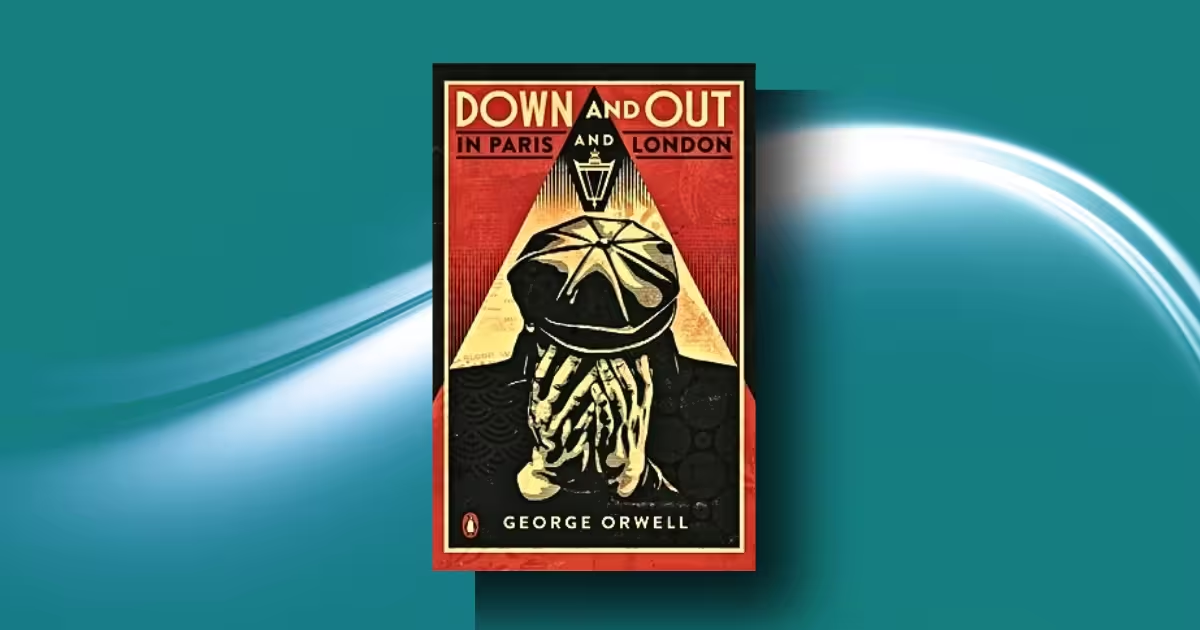

Do you ever wonder what it truly feels like to be hungry—not just skipping a meal, but genuinely, desperately hungry for days on end? George Orwell’s Down and Out in Paris and London doesn’t just tell you; it makes you feel it.
This isn’t a book about poverty written from a comfortable armchair. It’s a visceral, unflinching descent into the underworld of two great cities, written by a man who chose to live among the destitute so he could tell their story with authenticity and authority.
Published in 1933, when Orwell was just a struggling writer in his twenties, this groundbreaking memoir gave a human face to the statistics of poverty for the first time—and in doing so, found his voice as a writer.
Down and Out in Paris and London is best for readers who crave unvarnished truth and social commentary; fans of immersive, character-driven nonfiction; anyone curious about the hidden worlds of hotel kitchens and tramp lodging-houses; those who appreciate Orwell’s sharp, lucid prose and dry wit.
Not for readers seeking a traditional plot or uplifting narrative; those who prefer their social critique sugar-coated; anyone easily disturbed by graphic depictions of filth, hunger, and human degradation; individuals who believe poverty is simply a matter of personal failing.
Table of Contents
Introduction
Author: George Orwell (the pen name of Eric Arthur Blair)
Publication Date: 9 January 1933
Publisher: Victor Gollancz (London)
Genre: Memoir / Social Documentary
Pages: 230
Down and Out in Paris and London is George Orwell’s first full-length work, a semi-autobiographical account of his experiences living in near-extreme poverty in Paris and as a homeless tramp in London.
Down and Out in Paris and London is divided into two distinct parts: the first chronicles Orwell’s time as a dishwasher (plongeur) in the bowels of a Parisian hotel, while the second documents his life on the road among the tramps and casual wards of England.
Orwell’s central thesis is simple yet profound: poverty is not a moral failing but a trap—a system that grinds people down physically and spiritually, robbing them of dignity, energy, and hope.
He set out to expose the “shocking, previously-hidden world” of the destitute, not from a position of superiority, but from alongside them. The book’s target audience was the middle and upper classes—those who were more likely to be well-educated—and it pulls no punches in revealing the squalor, injustice, and sheer pointlessness of the lives led by the down and out.
Background
To understand Down and Out in Paris and London, one must understand the man. After resigning from his post as a policeman in Burma in 1927 to become a writer, Orwell—then still Eric Blair—moved to rooms in Portobello Road, London. He was 24 years old and determined to write about the lives of the poor, but he knew that to do so credibly, he had to experience their world firsthand.
In London, he undertook investigative tramping expeditions, collecting material for what would become the second half of Down and Out. In the spring of 1928, he moved to Paris, living at 6 Rue du Pot de Fer in the Latin Quarter.
There, he worked as a dishwasher in a grand hotel—an experience that would form the book’s explosive first half. The book was initially rejected by both Jonathan Cape and Faber and Faber before finally being picked up by the fledgling Victor Gollancz.
It was published on 9 January 1933 under the pen name “George Orwell,” which he would use for all his major works thereafter.
Down and Out in Paris and London Summary
Part I: Paris—The Hotel Inferno
Orwell opens in the rue du Coq d’Or, a “fairly rackety place” in a Parisian slum, where he lived for about a year and a half. The street is a “ravine of tall, leprous houses,” home to a floating population of Poles, Arabs, Italians, and other foreigners. His hotel, the Hôtel des Trois Moineaux, is a “dark, rickety warren” of forty rooms, infested with bugs that “marched all day like columns of soldiers”.
When Orwell’s money runs out, he is left with just forty-seven francs—about seven shillings and tenpence. He must now live on about six francs a day—the equivalent of a shilling. This is where his “first contact with poverty” truly begins.
“It is altogether curious, your first contact with poverty. You have thought so much about poverty—it is the thing you have feared all your life, the thing you knew would happen to you sooner or later; and it is all so utterly and prosaically different. You thought it would be quite simple; it is extraordinarily complicated. You thought it would be terrible; it is merely squalid and boring. It is the peculiar LOWNESS of poverty that you discover first; the shifts that it puts you to, the complicated meanness, the crust-wiping.”
Orwell vividly captures the petty humiliations of poverty: the secrecy, the lies, the constant fear of being found out. He describes the “extreme precariousness” of six francs a day, the boredom, and the gnawing hunger. A man who has gone even a week on bread and margarine, he writes, “is not a man any longer, only a belly with a few accessory organs”.
Desperate for work, Orwell turns to his friend Boris, a Russian ex-captain turned waiter. Together, they embark on a futile search for jobs, walking “fourteen kilometres over pavement”. They pawn clothes, survive on stolen food, and face constant rejection. Boris, despite his optimism, is reduced to sleeping on the floor of a Jew’s attic.
Their luck finally changes when Boris gets a job at the Hotel X, a “vast, grandiose place” near the Place de la Concorde.
Orwell joins him as a plongeur—a dishwasher.
The Hotel X section is a tour de force of social observation. Orwell describes the “elaborate caste system” of the hotel, where waiters despise plongeurs, cooks despise waiters, and everyone fears the manager. The work is brutal: seventeen and a half hours a day in a stifling, underground cellar, with temperatures reaching 110 degrees Fahrenheit. The filth is revolting:
“It is not a figure of speech, it is a mere statement of fact to say that a French cook will spit in the soup—that is, if he is not going to drink it himself.”
Orwell exposes the hypocrisy of the “smart” hotel, where customers pay exorbitant prices for food that has been handled by greasy, sweaty hands. The staff, he notes, are “proud of their efficiency,” but their work is ultimately “beastly and silly”. The plongeur, he concludes, is a “slave,” and a “wasted slave, doing stupid and largely unnecessary work”.
Part II: London—The Tramp’s World
The second half of the book shifts to London, where Orwell, having returned to England, finds himself penniless once more. He exchanges his good suit for a set of filthy rags and enters the world of the tramp. This is a different kind of poverty—less frantic than Paris, but more degrading and hopeless.
“It gives one a very strange feeling to be wearing such clothes. I had worn bad enough things before, but nothing at all like these; they were not merely dirty and shapeless, they had—how is one to express it?—a gracelessness, a patina of antique filth, quite different from mere shabbiness.”
Orwell describes the “spike”—the casual ward of the workhouse—where tramps are herded like cattle, searched for money and tobacco, and forced to sleep on bare floors or in cramped, verminous cells.
He details the “extraordinarily repulsive” scene in the bathroom, where “fifty dirty, stark-naked men” elbow each other for space. The food is barely edible, the boredom is crushing, and the entire system seems designed to humiliate and break the spirit.
He introduces us to a cast of unforgettable characters: Paddy, a “whimpering, self-pitying” Irish tramp whose “ignorance was limitless and appalling”; Bozo, a screever (pavement artist) with a mangled leg who refuses to let poverty destroy his mind; and Bill the moocher, a “genuine sturdy beggar of the old breed” who boasts of his ability to get a job and then get sacked.
Orwell’s analysis of the tramp’s life is scathing. He identifies three great evils: hunger, which is the “almost general fate” of tramps; sexual starvation, as tramps are “entirely cut off from contact with women”; and enforced idleness, which rots the soul. He points out the sheer pointlessness of the tramp’s existence:
“Each day they expend innumerable foot-pounds of energy—enough to plough thousands of acres, build miles of road, put up dozens of houses—in mere, useless walking. Each day they waste between them possibly ten years of time in staring at cell walls. They cost the country at least a pound a week a man, and give nothing in return for it.”
The book ends with Orwell leaving the tramp’s life, but not before he has learned some indelible lessons:
“I shall never again think that all tramps are drunken scoundrels, nor expect a beggar to be grateful when I give him a penny, nor be surprised if men out of work lack energy, nor subscribe to the Salvation Army, nor pawn my clothes, nor refuse a handbill, nor enjoy a meal at a smart restaurant. That is a beginning.”
Down and Out in Paris and London Analysis
Reading Down and Out in Paris and London nearly a century after its publication, what strikes me most is its startling contemporaneity. The problems Orwell describes—the precarity of low-wage work, the dehumanization of the poor, the hypocrisy of “charity,” the sheer waste of human potential—are as relevant today as they were in 1933.
Orwell’s genius lies in his refusal to sentimentalize poverty. He doesn’t portray the poor as noble victims or romantic rebels; he shows them as they are: tired, hungry, often petty, sometimes mean, but always recognizably human. He is clear-eyed about the psychological effects of destitution. As he notes, poverty “annihilates the future”.
When you have only three francs, you cannot think beyond tomorrow. This is not laziness; it’s survival.
The book is also a masterclass in immersive journalism. Orwell doesn’t just observe from a distance; he gets his hands dirty. He scrubs dishes, sleeps on bare floors, and goes days without food. This gives his account an authority that no amount of second-hand research could provide. He gives a human face to the statistics of poverty.
One of the most powerful themes is the “peculiar LOWNESS” of poverty. It’s not the grand tragedy you might imagine; it’s the “complicated meanness” of everyday survival—the crust-wiping, the lies, the petty humiliations. This is what makes the book so devastating. It’s not about epic suffering; it’s about the slow, grinding erosion of the self.
Orwell also exposes the hypocrisy of the “smart” world. The Hotel X, with its “spotless table-cloths, bowls of flowers, mirrors and gilt cornices,” is just a few feet away from a scullery where waiters wash their faces in the dishwater.
The customers pay a fortune for food that has been fingered, dropped on the floor, and sweated over. The “luxury” they are buying is a sham, sustained by the brutal exploitation of a hidden workforce.
Perhaps the book’s most radical argument is that poverty is unnecessary. Orwell devotes a whole chapter to this idea, arguing that the plongeur’s work is “more or less useless,” kept going by “fear of the mob” and the “instinct to perpetuate useless work”. The rich, he suggests, keep the poor busy and miserable because they are afraid of what they might do with leisure.
This is a devastating indictment of the social order.
The book is not without its flaws. Some critics have questioned whether Orwell was ever truly “down and out”—whether his experiences were, in fact, a kind of “slumming”. Cyril Connolly later dismissed it as “agreeable journalism”.
There is some truth to this. Orwell was never trapped in poverty in the way that Paddy or Bozo were. He always had the option of returning to his middle-class life. But this does not invalidate his observations. His privilege gave him the ability to see the system from both sides, and he used it to powerful effect.
Strengths and Weaknesses
Strengths
Vivid, unflinching prose: Orwell’s writing is lucid, precise, and utterly immersive. He makes you feel the hunger, the cold, the exhaustion.
Deep empathy: He treats his subjects as fully human, never condescending or sentimental.
Sharp social critique: The book is a powerful indictment of poverty, inequality, and the hypocrisy of the “smart” world.
Unforgettable characters: From the loquacious Charlie to the stoic Bozo, the people Orwell meets are vividly drawn.
Historical significance: As Orwell’s first book, it marks the beginning of a literary career that would change the world.
Weaknesses
Pacing issues: The London section, while insightful, can feel slower and more repetitive than the Paris section.
Limited perspective: Orwell’s account is filtered through his own middle-class lens, which some critics have found limiting.
Dated in some respects: The specific conditions of the 1930s are not identical to those of today, though the broader themes remain relevant.
Comparison with Similar Works
Down and Out in Paris and London belongs to a rich tradition of poverty literature and social documentary. It can be compared to:
Jack London’s The People of the Abyss (1903): London’s account of life in the East End of London is a clear precursor to Orwell’s work, though Orwell’s is more personal and less overtly political.
Henry Mayhew’s London Labour and the London Poor (1851): A monumental work of Victorian social investigation, though Mayhew’s approach is more journalistic and less immersive than Orwell’s.
Barbara Ehrenreich’s Nickel and Dimed (2001): A modern American counterpart, in which Ehrenreich goes undercover to experience low-wage work. Like Orwell, she finds that poverty is a trap from which it is almost impossible to escape.
Orwell’s own later works: The Road to Wigan Pier (1937) continues his exploration of poverty in the north of England, while Homage to Catalonia (1938) applies his sharp eye to the Spanish Civil War.
Conclusion
Down and Out in Paris and London is not a comfortable read. It is a book that will make you angry, sad, and profoundly grateful for the small mercies of your own life. But it is also a book that will open your eyes. It will make you think twice about the next meal you eat in a restaurant, the next beggar you pass on the street, the next time you hear someone dismiss the poor as “lazy.”
Who should read this book? Anyone who wants to understand the reality of poverty, not as an abstract concept, but as a lived experience. Anyone who appreciates great writing and sharp social observation. Anyone who believes that literature can change the world.
“I can at least say, Here is the world that awaits you if you are ever penniless.”
Orwell’s warning is as urgent today as it was in 1933. In an age of widening inequality, precarious work, and growing homelessness, this book is not just a historical document; it is a call to action. Read it. And then, as Orwell did, do something about it.