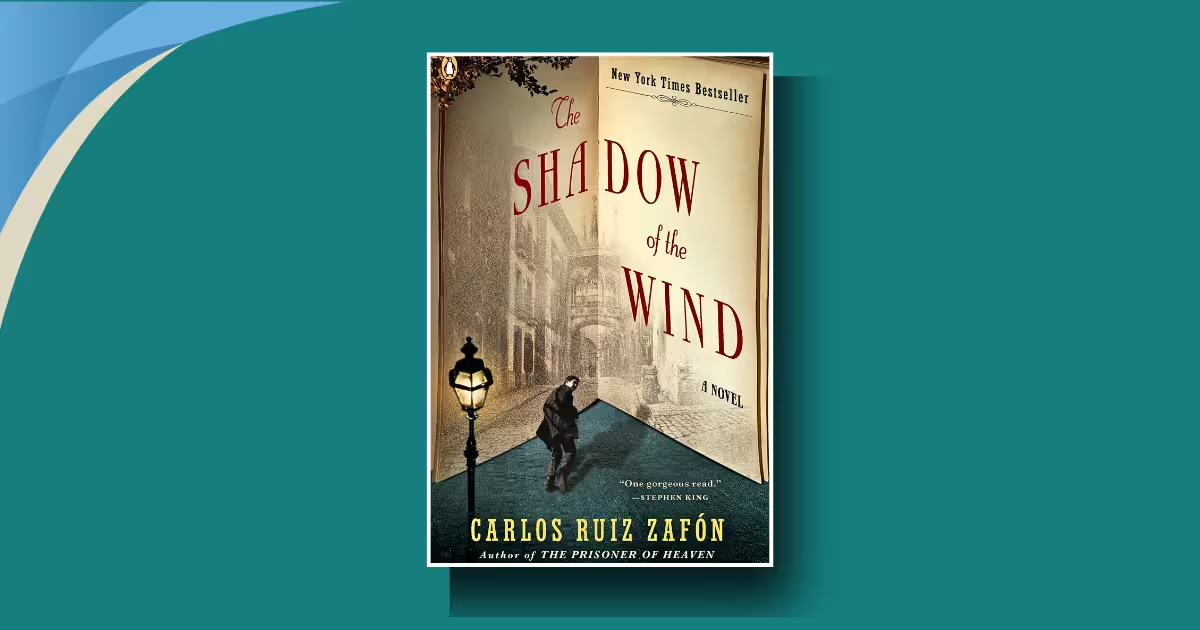
Do you ever wonder why some stories feel like they were written just for you, whispering secrets about your own life from the dusty shelves of memory? In The Shadow of the Wind, where a young boy in post-war Barcelona uncovers a forgotten book that leads him into a labyrinth of murder, doomed love, and a dark history that mirrors his own life, gives you clues to the queries like that.
The Shadow of the Wind is best for lovers of atmospheric gothic mysteries, bibliophiles who believe books have souls, and anyone enchanted by the foggy, gas-lit streets of 1940s Barcelona. Not for readers who prefer fast-paced, linear thrillers without descriptive prose or those who dislike complex, multi-generational flashbacks.
Table of Contents
1. Introduction
The Shadow of the Wind (Original Spanish: La Sombra del Viento)
Author: Carlos Ruiz Zafón
Publication: Originally published in Spain in 2001; translated into English by Lucia Graves in 2004.
The Shadow of the Wind is not merely a novel; it is a love letter to literature itself. Written by the late Spanish author Carlos Ruiz Zafón, this modern classic became a global phenomenon, captivating millions with its lush prose and intricate plotting.
It serves as the opening volume to the Cemetery of Forgotten Books tetralogy, a series that cements Zafón’s legacy as one of the most significant European writers of the 21st century.
2. Background
The story is set against the brooding backdrop of Barcelona in 1945, a city still licking its wounds from the Spanish Civil War (1936–1939).
The shadow of General Franco’s dictatorship looms large over the narrative, creating an atmosphere of repression, secrecy, and fear. It is a time when people speak in whispers, where the past is a dangerous country, and where “silence” is the primary language of survival.
Zafón masterfully weaves this historical reality into the fabric of a gothic mystery. The city of Barcelona is not just a setting but a living, breathing character—a place of “ashen skies” and “liquid copper” dawns, where the scars of war are visible on both the buildings and the souls of its inhabitants.
The Shadow of the Wind taps into the collective memory of a generation lost to war, exploring how the trauma of the past echoes through the present.
3. The Shadow of the Wind summary
The Cemetery of Forgotten Books
The story begins in the early summer of 1945. Daniel Sempere, a ten-year-old boy living with his widowed father above their bookshop on Calle Santa Ana, wakes up screaming because he can no longer remember his mother’s face.
His father, attempting to console him, reveals a family secret. He takes Daniel through the misty streets of Barcelona to a hidden palace in the Raval quarter known as the Cemetery of Forgotten Books.
This secret library is a labyrinthine sanctuary where books lost to time are preserved. Daniel is told by his father, “Every book, every volume you see here, has a soul.
The soul of the person who wrote it and of those who read it and lived and dreamed with it”. Tradition dictates that a first-time visitor must choose one book to “adopt” and protect for life. Daniel is drawn to a modest volume bound in wine-colored leather titled The Shadow of the Wind by an unknown author named Julian Carax.
Daniel takes the book home and devours it in a single night. The novel tells the story of a man searching for his biological father, a quest that turns into a “ghostly odyssey.” Daniel is mesmerized. He feels a deep connection to the author, believing the book has been waiting for him.
The Mystery of Julian Carax
Eager to read more by Carax, Daniel seeks information from Gustavo Barceló, a wealthy and pompous bookseller. Barceló is intrigued by the book and offers to buy it, but Daniel refuses. At Barceló’s house, Daniel meets Clara, Barceló’s blind and beautiful niece. Daniel is instantly smitten. He learns that Clara is also an admirer of Carax, thanks to her French tutor.
Through Clara and Barceló, Daniel discovers a chilling fact: Julian Carax’s books are disappearing. A mysterious figure calling himself Lain Coubert—the name of the devil in Carax’s own novel—has been traveling Europe for years, buying every copy of Carax’s books solely to burn them. Daniel possesses perhaps the last surviving copy of The Shadow of the Wind.
Enter Fermín Romero de Torres
Years pass. Daniel, now sixteen, is still obsessed with Clara, though she treats him like a child. One night, after a birthday disappointment involving Clara, Daniel is accosted in the street by a faceless figure who smells of “burned paper.” It is Lain Coubert. He demands Daniel’s book, threatening him. Terrified, Daniel returns the book to the Cemetery of Forgotten Books for safekeeping, hiding it behind a row of other volumes.
Life in the Sempere bookshop changes with the arrival of Fermín Romero de Torres, a former spy for the Republic who is now living on the streets. Daniel and his father take him in, giving him a job and a new lease on life.
Fermín is a character of immense wit, loyalty, and resourcefulness, though he bears terrible physical and mental scars from torture he endured at the hands of Inspector Francisco Javier Fumero, a sadistic policeman who has risen to power under the Franco regime.
Fermín becomes Daniel’s best friend and partner in the investigation into Julian Carax. As they dig deeper, they realize that Julian’s life eerily mirrors Daniel’s own.
The Tale of Nuria Monfort
Daniel tracks down Nuria Monfort, the daughter of Isaac (the keeper of the Cemetery of Forgotten Books). Nuria worked at the publishing house that printed Carax’s books and was arguably the only person who cared about him.
She tells Daniel a sanitized version of the story: Julian was a pianist in Paris who wrote unsuccessful novels, fell in love with a woman he couldn’t have, and was eventually killed in a duel or street fight in 1936. She claims not to know much more.
However, Daniel and Fermín sense she is hiding the truth. They discover she is the one who has been secretly collecting mail for Julian Carax at a P.O. Box for years.
The Aldaya Mansion
The investigation leads them to the Aldaya family, a wealthy industrialist clan. Julian Carax was the son of a hatter, Antoni Fortuny, but his mother, Sophie, had an affair with the tycoon Ricardo Aldaya. It is revealed—though not to Julian until much later—that Julian was actually Ricardo Aldaya’s illegitimate son.
As a young man, Julian became friends with Jorge Aldaya (Ricardo’s legitimate son) and Miquel Moliner (a wealthy, rebellious boy). Through Jorge, Julian was introduced to the Aldaya household and met Penélope Aldaya, Jorge’s sister. Julian and Penélope fell deeply, madly in love. They carried on a secret affair for years, aided by Penélope’s governess, Jacinta Coronado.
They planned to elope to Paris. But on the day of their departure in 1919, Penélope never showed up at the train station. Julian, heartbroken, left for Paris alone, accompanied only by the loyalty of his friend Miquel Moliner.
The Horror of the Past
What Julian didn’t know was that Ricardo Aldaya had discovered the affair. Even worse, Ricardo knew the terrible truth: Julian and Penélope were half-siblings. Disgusted and enraged by the “incest,” Ricardo locked Penélope in her room. She was pregnant with Julian’s child.
Jacinta, the governess, was thrown out of the house. She eventually ended up in a pauper’s hospice, where Daniel and Fermín track her down.
Though senile and dying, Jacinta reveals the horror of what happened: Penélope gave birth to a stillborn son named David and died of hemorrhaging in that locked room, crying out for Julian.
Her parents, consumed by shame and guilt, buried the bodies in the family crypt beneath the mansion and fled to Argentina, leaving the house, the “Angel of Mist,” to rot.
Julian’s Return
In Paris, Julian wrote his novels, all of them tinged with gothic darkness and longing for a lost love. He lived in poverty, supported by Miquel Moliner, who sacrificed his own fortune and happiness to keep Julian afloat. In the mid-1930s, Julian decided to return to Barcelona to find Penélope, still unaware of her death.
He arrived just as the Civil War was breaking out. He went to the Aldaya mansion and broke into the crypt. There, he found the two coffins: one for Penélope and one for their son.
The revelation shattered his mind. He realized that his books, which he had dedicated to her, were meaningless. He decided to destroy his own life’s work. He became Lain Coubert, the man who smells of smoke, burning his own existence page by page.
The Final Confrontation
Back in 1955, the threads of the past tighten around Daniel. He falls in love with Bea Aguilar, the sister of his friend Tomás. Their romance mirrors Julian and Penélope’s—secret meetings, a forbidding father, and a deep passion.
Inspector Fumero, who has a lifelong vendetta against Julian Carax (stemming from a jealous rivalry over Penélope when they were schoolboys), realizes that Daniel is on Carax’s trail. Fumero wants to kill Carax to finish the job he started years ago.
The climax takes place in the decaying Aldaya mansion. Daniel has taken Bea there, hiding from her father who disapproves of their relationship. Fumero tracks them down. At the same time, the “faceless man”—Julian Carax/Lain Coubert—appears to defend them.
A violent struggle ensues. Fumero attempts to kill Daniel. Julian emerges from the shadows to fight Fumero. In the chaos, Fumero is killed—thrown into the mechanism of the mansion’s fountain angels. Daniel is shot shielding Bea.
Resolution
Daniel survives the gunshot wound, thanks to Fermín’s quick action and blood donations. He wakes up in the hospital to find that Julian visited him, leaving behind his own pen—the one supposedly belonging to Victor Hugo—as a passing of the torch. Julian vanishes, presumably returning to France to live out his days in anonymity, perhaps writing again.
Daniel marries Bea. They have a son, whom they name Julian. The novel ends where it began: Daniel takes his own son to the Cemetery of Forgotten Books.
4. The Shadow of the Wind Analysis
4.1. The Shadow of the Wind Characters
Daniel Sempere: The protagonist, he is an innocent initiate into the world of adult secrets. His journey is one of maturation. He starts as a boy seeking a father figure (finding fragments of one in Carax, Fermín, and his own father) and ends as a father himself. His relentless pursuit of the truth is driven by a need to understand love and loss, mirroring his inability to remember his mother.
Julian Carax: The dark mirror to Daniel. He represents the tragic artist, consumed by a past he cannot change. His transformation into “Lain Coubert” symbolizes self-hatred; he wants to erase himself from the world because the world took everything from him. His redemption comes through Daniel, who saves his book (his soul) and allows him to break the cycle of destruction.
Fermín Romero de Torres: The novel’s heart and comic relief. Fermín is a survivor of the fascists’ brutality, yet he retains a zest for life, women, and Sugus candies. He serves as Daniel’s mentor, teaching him that while the past shapes us, it does not have to define us. He is the practical counterweight to Daniel’s romanticism.
Inspector Fumero: The embodiment of the repression and cruelty of the Franco regime. A childhood bully turned state-sanctioned murderer, he represents the banality of evil. His obsession with destroying Carax is fueled by his own inadequacy and jealousy.
Nuria Monfort: The keeper of secrets. Her tragic love for Julian (and her loveless marriage to Miquel Moliner) highlights the theme of unrequited devotion. She is the bridge between the past and present, and her memoir provides the crucial missing pieces of the puzzle.
4.2. The Shadow of the Wind Themes and Symbolism
The Cemetery of Forgotten Books: This is the central symbol of the novel. It represents collective memory, the preservation of history against censorship and time, and the spiritual connection between readers and writers. In a Spain where history was being rewritten by the victors, a place that preserves “forgotten” truths is an act of rebellion.
Shadows and Doubles: The novel is structured around parallels. Daniel’s life mirrors Julian’s; Bea mirrors Penélope; Fermín mirrors Miquel Moliner. Zafón suggests that history repeats itself, but individual choices can alter the outcome. Daniel succeeds where Julian failed because he has the support of a “family” (Fermín, his father) that Julian lost.
Fire: Fire is a cleansing but destructive force. It destroyed Julian’s face, his books, and the Aldaya mansion’s crypt. It represents the attempt to erase the past.
The Power of Storytelling: The narrative suggests that we exist as long as we are remembered. Julian’s “death” occurred when he stopped writing and started burning. He is reborn when Daniel reads his book. As Nuria says, “There are worse prisons than words”.
5. Evaluation
The Shadow of the Wind is a Gothic cathedral of a novel—magnificent, shadowy, and echoing with the ghosts of the past.
Strengths
- Atmosphere: Zafón paints Barcelona with a palette of mist, rain, and gaslight. The city is a character in its own right, brooding and magical. The “Cemetery of Forgotten Books” is an unforgettable concept that immediately hooks any reader who cherishes literature.
- Characterization: Fermín Romero de Torres is a standout creation. His quips, wisdom, and resilience provide much-needed levity and heart amidst the gloom. The villain, Fumero, is terrifyingly effective as an embodiment of the regime’s brutality.
- Prose: The writing is lush and evocative. Zafón (and translator Lucia Graves) crafts sentences that you want to read twice, savoring the imagery.
Weaknesses
- Melodrama: At times, the plot veers into high melodrama, with secret siblings, incestuous love affairs, and operatic vengeance. Some readers might find these twists slightly excessive.
- Gender Roles: While the female characters (Bea, Nuria) are pivotal, they are often defined by their relationships to the male protagonists (Daniel, Julian) or exist as objects of desire/mystery to be solved.
Impact: This book resonates deeply because it treats memory not just as a personal faculty, but as a moral duty. It made me look at my own bookshelf differently—not just as paper and ink, but as a repository of souls waiting to be heard.
Comparison: It sits comfortably alongside Umberto Eco’s The Name of the Rose (a mystery centered on a library) and Charles Dickens’ Great Expectations (a coming-of-age tale with gothic elements). It also shares DNA with the magic realism of Gabriel García Márquez, though grounded in a grittier urban reality.
6. Personal Insight with Contemporary Educational Relevance
The Politics of Memory: The “Pact of Forgetting” vs. The Cemetery of Forgotten Books
While The Shadow of the Wind is a work of fiction, its central theme—the preservation of memory against those who wish to burn it—is a direct commentary on Spain’s real-world history. following the death of dictator Francisco Franco in 1975, Spanish political elites entered into an informal agreement known as the “Pact of Forgetting” (Pacto del Olvido).
To ensure a smooth transition to democracy, they agreed not to prosecute crimes committed during the Civil War and the dictatorship, effectively burying the trauma of the past.
Zafón’s “Cemetery of Forgotten Books” can be seen as a metaphorical counter-weight to this political amnesia. In the novel, the regime (personified by Inspector Fumero) wants to erase Julian Carax’s existence, burning his books and rewriting history. The heroes are those who hide the books, preserving the truth for future generations.
This tension is highly relevant today. In 2007, Spain passed the Law of Historical Memory (Ley de Memoria Histórica), which formally condemned the Franco regime and sought to recognize its victims.
More recently, the Democratic Memory Law (2022) went further, aiming to exhume mass graves and remove Francoist symbols. Zafón’s novel teaches us that memory is not passive; it is an act of resistance. Just as Daniel Sempere protects Julian’s book, societies must protect their history from revisionism and silence.
7. The Shadow of the Wind quotes
- “Every book, every volume you see here, has a soul. The soul of the person who wrote it and of those who read it and lived and dreamed with it.”
- “Books are mirrors: you only see in them what you already have inside you.”
- “Destiny is usually just around the corner. Like a thief, a hooker, or a lottery vendor: its three most common personifications. But what destiny does not do is home visits. You have to go for it yourself.” — Fermín Romero de Torres
- “There are worse prisons than words.” — Nuria Monfort
- “Fools talk, cowards are silent, wise men listen.”
8. Conclusion
The Shadow of the Wind is a masterpiece of storytelling that reminds us why we read. It is a thrilling mystery, a heartbreaking romance, and a chilling historical drama all rolled into one. Zafón manages to capture the magic of discovering a favorite book and the melancholy of realizing that life, like a novel, eventually comes to an end.
Recommendation: This is a “must-read” for anyone who loves books about books. If you enjoyed The Thirteenth Tale by Diane Setterfield or The Historian by Elizabeth Kostova, this should be next on your list.
Final Reflection: In a digital age where content is fleeting, Zafón’s work stands as a testament to the enduring power of the physical book—a vessel of human spirit that can survive fire, war, and the passage of time.