Have you ever picked up your phone to check one thing, only to look up forty-five minutes later with no memory of how you got there? You’re not alone—and that’s exactly by design. Irresistible by Adam Alter is a masterclass in understanding why we can’t put our devices down.
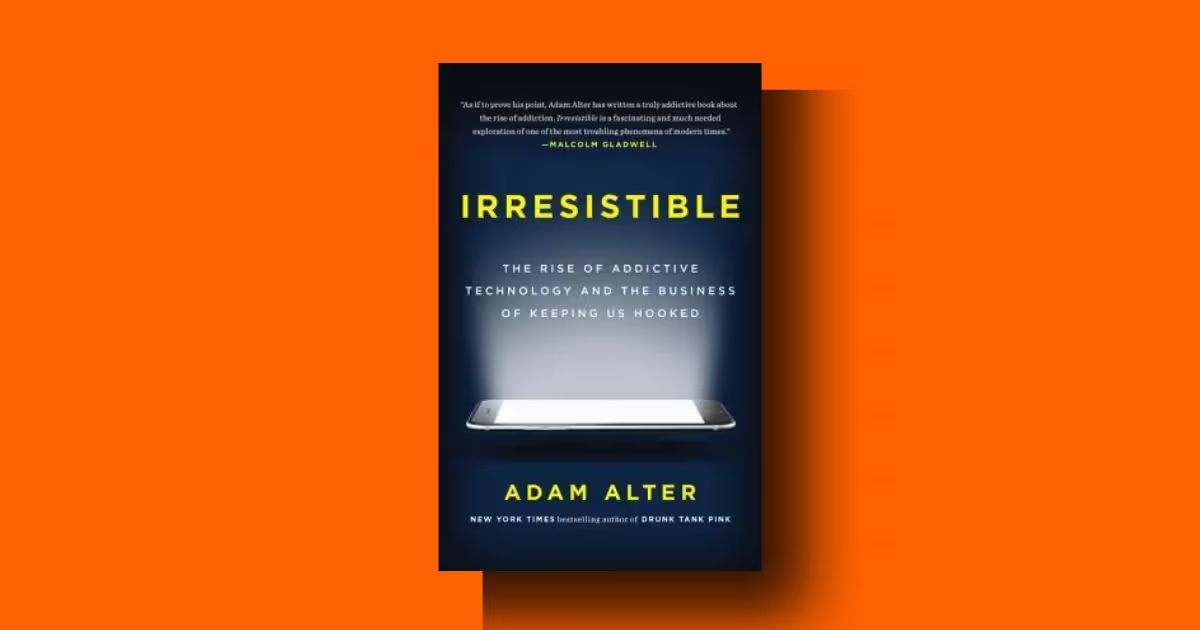
Adam Alter’s Irresistible: The Rise of Addictive Technology and the Business of Keeping Us Hooked (Penguin Press, 2017) is a masterclass in understanding why we can’t put our devices down.
A professor of psychology and marketing at New York University, Alter reveals that 41% of the population has suffered from at least one behavioral addiction in the past twelve months—and these aren’t substance addictions. They’re the apps on your phone, the games you play, and the social media feeds you scroll through.
Alter doesn’t just diagnose the problem; he breaks down the six psychological ingredients that make technology irresistible, then offers practical solutions for reclaiming your attention. It’s part exposé, part user manual for the digital age.
Irresistible is best for:
- Anyone who’s ever wondered why they can’t stop checking their phone
- Parents worried about their children’s screen time
- Professionals who feel chained to their email
- Anyone who’s ever binge-watched a show and regretted it the next morning
- People who want to understand why they behave the way they do online
Not for:
- Readers looking for a quick-fix “unplug your life” manifesto
- Those who prefer purely anecdotal self-help over research-backed analysis
- Anyone unwilling to confront uncomfortable truths about their own behavior
Table of Contents
1. Introduction
Irresistible: The Rise of Addictive Technology and the Business of Keeping Us Hooked was published by Penguin Press in 2017. The author, Adam Alter, is a professor of marketing and psychology at New York University’s Stern School of Business, with a Ph.D. in social psychology from Princeton.
He’s also the author of the New York Times bestseller Drunk Tank Pink. Alter’s unique position—at the intersection of psychology, marketing, and technology—makes him exceptionally qualified to dissect why we behave the way we do online.
Context: What This Book Is About
Irresistible is about behavioral addiction—not the kind involving substances like heroin or cocaine, but the kind that comes from checking email, scrolling Instagram, playing video games, and binge-watching Netflix.
As Alter writes, “We tend to think of addiction as something inherent in certain people—those we label as addicts. Heroin addicts in vacant row houses. Chain-smoking nicotine addicts. Pill-popping prescription-drug addicts”. But this view is dangerously narrow.
Alter argues that “addiction is produced largely by environment and circumstance”. The same psychological mechanisms that drive substance addiction also drive our relationships with technology. The difference? You can avoid heroin. You cannot avoid email.
Purpose: The Book’s Central Thesis
The book’s central argument is straightforward but profound: technology companies have engineered their products to be addictive, and understanding how they’ve done this is the first step toward regaining control. Alter writes, “There are a thousand people on the other side of the screen whose job it is to break down the self-regulation you have”.
The book has three parts:
- Understanding behavioral addiction—what it is, how common it is, and how it works in the brain
- The six ingredients of addiction—the psychological tricks that make experiences irresistible
- Solutions—how to protect yourself and your family
2. Background
Behavioral addiction isn’t new. Gambling has existed for centuries. But what is new is the scale and sophistication of modern addictive experiences.
In the 1960s, addictive hooks were limited to cigarettes, alcohol, and drugs—substances that were relatively expensive and difficult to access. Today, as Alter notes, “those same waters are littered with hooks. There’s the Facebook hook. The Instagram hook. The porn hook. The email hook. The online shopping hook. And so on”.
The stakes are staggering. According to Alter, 41% of the population has suffered from at least one behavioral addiction in the past year. In 2015, there were 280 million smartphone addicts worldwide. If they formed a country, it would be the fourth most populous on Earth.
Irresistible builds on decades of research on addiction, from the famous rat experiments of James Olds and Peter Milner in the 1950s to the Vietnam War heroin studies that showed how environment shapes addiction.
Alter weaves together neuroscience, psychology, and real-world examples to build a compelling case that we’re all vulnerable to behavioral addiction—not because we’re weak, but because we’re human.
3. Irresistible Summary
Part One: The Rise of Behavioral Addiction
Alter opens with a confession that hits uncomfortably close to home. Kevin Holesh, an app developer, created an app called Moment to track his smartphone usage. He discovered he was spending an hour and fifteen minutes a day on his phone. When he shared the app with others, “people to guess what their daily usage was and they were almost always 50 percent too low”.
I downloaded Moment myself while reading this book. I guessed I used my phone for about an hour a day. The app reported I was using it for three hours—twenty hours a week. Alter notes that Moment’s users average “just under three hours” of screen time per day and pick up their phones thirty-nine times daily.
Alter introduces the term “nomophobia” —the fear of being without mobile phone contact. This isn’t hyperbole. In one study, 46% of people said they couldn’t bear to live without their smartphones. Some would rather suffer physical injury than damage to their phones.
The Vietnam War Heroin Study
One of the most powerful examples in the book is the story of Vietnam War veterans and heroin. By the war’s end, 35% of enlisted men had tried heroin, and 19% said they were addicted. The government prepared for a wave of addicts returning home.
But when researcher Lee Robins tracked the returning veterans, she found something shocking: only 5% relapsed. Somehow, 95% stayed clean. The reason? They had left the environment that triggered their addiction.
Alter writes: “The reason why her Vietnam vets escaped their heroin addictions was because they had escaped the circumstance that ensnared them”. This is why most heroin users struggle to stay clean—they return to the same neighborhoods, the same friends, the same cues.
The Brain and Addiction
Alter explains that behavioral addictions and substance addictions activate the same brain regions. As neuroscientist Claire Gillan puts it, “Drugs and addictive behaviors activate the same reward center in the brain”. Both trigger dopamine release in the brain’s pleasure centers.
But here’s the twist: addiction isn’t just about dopamine. As Kent Berridge’s research shows, there’s a crucial difference between “liking” and “wanting”. Addicts don’t necessarily like the object of their addiction—they want it desperately. Alter explains: “Addicts weren’t people who happened to like the drugs they were taking—they were people who wanted those drugs very badly even as they grew to dislike them for destroying their lives”.
This explains why relapse is so common. Even after you come to hate Facebook for consuming your time, your brain still wants that dopamine hit.
Part Two: The Ingredients of Behavioral Addiction
This is where Irresistible gets really practical. Alter identifies six ingredients that make experiences addictive:
1. Goals
Humans are driven by goals. Alter shows this through surprising examples. In the New York City Marathon, far more runners finish in 3:59 than in 4:01—they find hidden reserves of energy to beat the four-hour milestone.
But goals can become traps. Alter tells the story of Michael Larson, who won $110,237 on the game show Press Your Luck by memorizing the board’s patterns. Instead of celebrating, Larson became addicted to new goals. He spent his winnings on increasingly dubious schemes, lost his marriage, and died penniless.
Alter writes: “When you approach life as a sequence of milestones to be achieved, you exist ‘in a state of near-continuous failure.’ Almost all the time, by definition, you’re not at the place you’ve defined as embodying accomplishment or success”.
2. Feedback
Unpredictable feedback is more addictive than predictable feedback. Alter cites the research of Michael Zeiler, who found that pigeons pecked more feverishly when food was delivered unpredictably.
This explains why the Facebook “like” button changed everything. As Alter writes, “Users were gambling every time they shared a photo, web link, or status update. A post with zero likes wasn’t just privately painful, but also a kind of public condemnation”.
The unpredictability is what hooks us. One photo gets a hundred likes; the next gets three. We keep posting, chasing that high.
Alter also introduces the concept of “losses disguised as wins” in slot machines. Modern video slots allow you to play multiple lines simultaneously. You might win on one line while losing overall—but the machine celebrates the win with flashing lights and music. As Alter notes, “If our brains convince us that we’re winning even when we’re actually losing, how are we supposed to muster the self-control to stop playing?”
3. Progress
Beginner’s luck is a powerful hook. Alter describes how his brother became obsessed with bowling after an early lucky streak. Game designers know this. As researcher Nick Yee explains, “Rewards are given very quickly in the beginning of the game. You kill a creature with 2-3 hits. You gain a level in 5-10 minutes. But the intervals between these rewards grow exponentially fairly quickly”.
This creates a slippery slope—you start because it’s easy and fun, but by the time it gets hard, you’re already invested.
4. Escalation
Games like Tetris escalate difficulty as you improve. This keeps you in what psychologist Mihaly Csikszentmihalyi called “flow” —the state of being so immersed in an activity that you lose track of time.
Alter explains: “Flow—the channel that runs from the bottom left to the top right of the diagram—describes the experience of tackling a moderate challenge with the skill to master that challenge”. If the challenge is too high and your skill is too low, you experience anxiety. If your skill is too high and the challenge is too low, you experience boredom. The sweet spot in between is where addiction thrives.
5. Cliffhangers
Unresolved tension drives engagement. Alter introduces the Zeigarnik Effect: incomplete experiences occupy our minds far more than completed ones.
This explains the addictive power of podcasts like Serial, documentaries like Making a Murderer, and TV shows that end episodes on cliffhangers. It also explains why Netflix’s “post-play” feature—which automatically loads the next episode—was so effective.
Before August 2012, you had to decide to watch the next episode. After, you had to decide not to.
Alter reports that 61% of Americans binge-watch TV, defined as watching between two and six episodes in one sitting. Netflix’s own research found that most people complete a season in just four to six days.
6. Social Interaction
Social connection is the most powerful ingredient of all. Alter describes the rise of Instagram and Hipstamatic—two apps that offered similar features. Hipstamatic cost $1.99; Instagram was free. But the key difference was that Instagram was a social network.
Alter explains: “What makes Facebook and Instagram so addictive is that every activity you post either does—or doesn’t—attract likes, regrams, and comments”.
The social element is so powerful that even simple text-based games like MUDs (multi-user dungeons) could be deeply addictive. Game designer Ryan Petrie told Alter he spent six to eight hours a day playing a MUD—not because of flashy graphics, but because of the friends he made there.
But there’s a dark side. As Hilarie Cash of the reSTART addiction center explains, online friendships can’t fully replace real-world connections: “If we’re good friends, and we’re sitting together, that interaction, that energetic exchange releases a whole bouquet of neurochemicals that keeps us each regulated emotionally and physiologically”.
Online interactions are “a lot like feeding sugar to a hungry person… It’s pleasurable in the short-term, but eventually, they’ll starve”.
Part Three: Solutions
Alter doesn’t just diagnose the problem—he offers solutions. He acknowledges that abstinence isn’t an option for most behavioral addictions. You can’t avoid email or smartphones entirely.
Behavioral architecture is the key. This means designing your environment to make good habits easy and bad habits hard. Alter suggests:
- Putting your phone in another room while you work or sleep
- Using tools like the Facebook Demetricator to hide like counts
- Setting email to auto-delete during vacations, as Daimler does
- Using the “I don’t” language instead of “I can’t” when refusing temptation—it’s more empowering
Alter also discusses gamification—using game mechanics for good. He cites examples like FreeRice, which donates rice to the hungry for every correct vocabulary answer, and Fitocracy, which turns exercise into a game.
But he’s also cautious. As game designer Ian Bogost argues, gamification can trivialize important activities. “Not everything should be a game,” Alter writes.
4. Irresistible Analysis
What Makes This Book Exceptional
Irresistible is a genuinely important book—one that should be required reading for anyone who owns a smartphone. Alter has done something rare: he’s taken complex psychological research and made it accessible without dumbing it down.
Irresistible‘s greatest strength is its balance. Alter doesn’t demonize technology. He acknowledges that tech has brought enormous benefits.
He writes: “When my brother and I moved with my parents to Australia in 1988, we left our grandparents in South Africa. We spoke to them once a week on expensive landline calls, and sent letters that arrived a week later”. Technology has made the world smaller and more connected.
But he also doesn’t let tech companies off the hook. He quotes Tristan Harris, a “design ethicist” who says the problem isn’t that people lack willpower—it’s that “there are a thousand people on the other side of the screen whose job it is to break down the self-regulation you have”.
The anecdotes are memorable. The story of Michael Larson and Press Your Luck is both entertaining and illuminating.
The Vietnam War heroin study is a powerful reminder that addiction is about context, not character. The tale of Isaac Vaisberg, who lost months of his life to World of Warcraft, is heartbreaking and relatable.
The research base is impressive. Alter draws on studies from neuroscience, psychology, and behavioral economics. He interviews experts from around the world. The result is a book that feels both rigorous and accessible.
What Could Have Been Better
No book is perfect, and Irresistible has its limitations.
The solutions section feels rushed. After spending 200 pages detailing the problem, Alter devotes only about 50 pages to solutions. Some of his suggestions—like using the Facebook Demetricator or putting your phone in another room—are helpful but feel like Band-Aids on a bullet wound.
The book is already dated in some respects. Published in 2017, it predates the explosion of TikTok, the rise of AI, and the full impact of the COVID-19 pandemic on screen time. (Global screen time surged during lockdowns, and while it has since declined somewhat, patterns have permanently shifted.) The core principles remain valid, but the examples feel like they’re from another era.
Some critics have noted that Alter leaps to conclusions without always justifying them. He tells stories well, but the connection between anecdote and argument isn’t always airtight.
The book could have gone deeper on systemic solutions. Alter focuses mostly on individual behavior change. He doesn’t spend much time on what governments or tech companies could do differently. (China and South Korea have experimented with “Cinderella laws” that limit children’s gaming hours; the U.S. has done almost nothing.)
5. Strengths and Weaknesses
Strengths
Deeply researched: Alter draws on decades of psychology and neuroscience research. The Vietnam War heroin study, the rat experiments of Olds and Milner, and the work of Kent Berridge on liking versus wanting are all presented clearly and compellingly.
Accessible writing: This is not a dry academic text. Alter writes with energy and clarity. The stories he tells—about Bob Beamon’s long jump, Michael Larson’s game show win, Isaac Vaisberg’s World of Warcraft addiction—are memorable and human.
Practical insights: The six ingredients of addiction provide a useful framework for understanding why we behave the way we do. Once you understand these mechanisms, you can start to resist them.
Balanced perspective: Alter doesn’t call for a Luddite revolution. He acknowledges the benefits of technology while warning about its dangers.
Weaknesses
Solutions feel incomplete: Irresistible is better at diagnosing the problem than solving it. Alter’s suggestions are helpful but don’t feel adequate to the scale of the challenge.
Already dated: Published in 2017, the book predates TikTok, the AI explosion, and the pandemic’s impact on screen time. The principles are still valid, but the examples feel old.
Occasional overreach: Some critics have noted that Alter sometimes draws broad conclusions from limited evidence. The stories are compelling, but they don’t always prove the point he’s making.
Lack of systemic focus: Alter focuses primarily on individual behavior change. He doesn’t spend much time on what governments or tech companies could do to address the problem.
6. Comparison with Similar Works
The Shallows by Nicholas Carr (2010)
Carr’s book argues that the internet is literally rewiring our brains, making us less capable of deep reading and sustained attention. Alter takes a broader view, focusing on all forms of behavioral addiction, not just attention. Carr is more pessimistic; Alter is more hopeful.
Hooked by Nir Eyal (2014)
Eyal’s Hooked is a guide for product designers on how to build habit-forming products. Alter’s book is the consumer’s counterpoint—an explanation of how those hooks work and how to resist them. They make excellent companion reads.
Digital Minimalism by Cal Newport (2019)
Newport advocates for a radical reduction in technology use. Alter is more moderate—he recognizes that abstinence isn’t realistic for most people. Newport is about what to do; Alter is about why it’s so hard.
The Attention Economy by various authors
Alter’s book fits into a growing body of work on how technology companies compete for our attention. What sets Irresistible apart is its focus on the psychological mechanisms of addiction—the six ingredients—and its emphasis on behavioral addiction as a legitimate clinical phenomenon.
7. Conclusion
Who Should Read This Book?
Anyone who owns a smartphone. That’s not hyperbole. If you’ve ever felt like you spend too much time on your phone, or if you’ve ever wondered why you can’t stop checking email, this book will give you answers.
Parents will find the chapters on children and technology particularly valuable. Alter’s research on how screen time affects developing brains—and his practical advice on setting limits—is worth the price of the book alone.
Professionals who feel chained to their email will recognize themselves in Alter’s descriptions. The section on how email disrupts productivity and well-being is eye-opening.
Anyone interested in psychology or behavioral economics will appreciate Alter’s synthesis of research from multiple fields.
Final Verdict
Irresistible is an outstanding book—one of the most important I’ve read in years. It’s not perfect. The solutions section feels rushed, and some of the examples are already dated. But the core argument is powerful and persuasive: we are all vulnerable to behavioral addiction, and understanding how it works is the first step toward regaining control.
As Alter writes in the epilogue, “Half of the developed world is addicted to something, and for most people that something is a behavior”. The question isn’t whether we’re addicted—it’s what we’re going to do about it.
Malcolm Gladwell called Irresistible “a truly addictive book,” and he’s right. It’s the kind of book that makes you want to put down your phone—so you can keep reading.