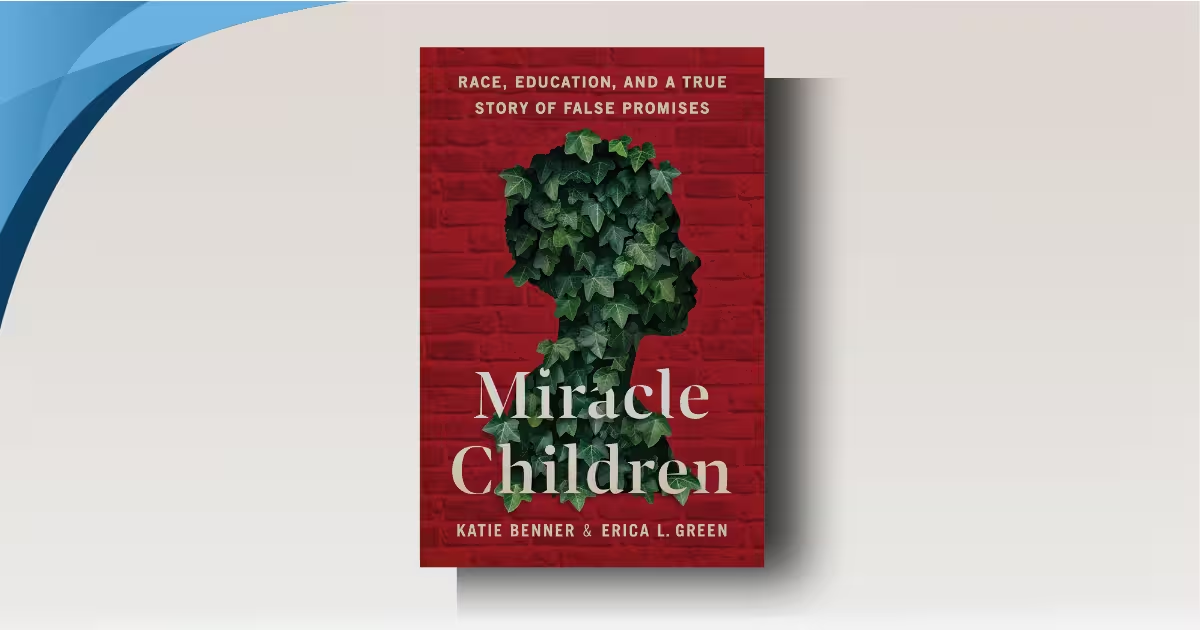
Did you ever watch a “miracle school” story go viral and felt your chest warm up—only to wonder, later, why the glow fades into something like anger? Miracle Children: Race, Education, and a True Story of False Promises helped me name that feeling—and it changed how I look at elite college admissions forever.
Miracle Children is a true-story investigation of how one Louisiana school’s viral Ivy League “miracles” were built on coercion, fabricated narratives, and America’s hunger to believe Black children can “beat the odds” without the country ever fixing the odds.
Miracle Children is best for* readers who want a full, spoiler-heavy, deeply reported account of the T.M. Landry scandal and what it reveals about race, education, and elite admissions.
- Anyone interested in the machinery behind “holistic admissions,” feeder-school trust, legacy preference, and why prestige behaves like a currency.
- Educators, parents, counselors, and students navigating the emotional pressure of “success stories” and “grit narratives.”
Not for
- Readers who want a gentle, uplifting “inspiration-only” read. This book shows the cost of inspiration when it becomes a business model.
- Anyone looking for a quick summary without uncomfortable details: the book documents allegations of abuse and coercion.
Table of Contents
1. Introduction
Miracle Children: Race, Education, and a True Story of False Promises is written by Katie Benner and Erica L. Green and published by Metropolitan Books (an imprint referenced in the book’s copyright and publication page).
The edition in the PDF identifies “First edition: 2026” and lists an e-ISBN: 9781250405159.
This is narrative nonfiction / investigative reporting—the kind that reads like a story but is built on documents, interviews, and receipts.
In their Authors’ Note, Benner and Green explain they conducted more than sixty-five interviews, relying on court records and public documents, and they note that some people are identified with limited details to protect privacy.
The authors frame the T.M. Landry story as more than one scandal. They argue it’s a lens into how Americans reconcile the belief in equality with “gravely unequal systems,” and how we fall in love with Black exceptionalism stories that let the country feel innocent.
2. Background
Before the scandal, most people encountered T.M. Landry the way I did: through viral acceptance videos and the cultural rush that follows them. Miracle Children opens with that feeling—joy that looks pure, contagious, and almost sacred.
In the prologue, the authors describe the Little brothers—Alex and Ayrton—sitting at computers, refreshing their admissions screens, with the room erupting each time an acceptance appears. The clip of Ayrton’s Harvard acceptance “racked up more than eight million views on YouTube alone.”
Then the story reaches peak myth: The Ellen DeGeneres Show. Ellen lists hardships—single mom, near-homelessness, “no heat and no food,” using “oven burners” for warmth—and ties those hardships to academic excellence and Ivy League outcomes.
Here’s the emotional trap the book exposes: the audience doesn’t just cheer the boys—they cheer a version of America where the system is harsh but fair, where the “right” effort plus the “right” mentor produces a clean escape hatch.
But the authors make the point that this kind of celebration can function as a national sedative—an “escape hatch” from racial reality—because the story of T.M. Landry lets people believe the problem is solved if a few exceptional kids “make it.”
3. Miracle Children summary
The story, in one breath
T.M. Landry was a small college-prep operation in Breaux Bridge, Louisiana that built national fame by sending Black students to elite colleges and documenting those moments in viral videos. Over time, the school’s success story attracted students from stronger academic backgrounds, intensified its prestige obsession, and relied on an admissions ecosystem that assumes honesty from schools it trusts.
Underneath the viral joy, the authors report a darker pattern: students and families describe coercion, punishment, pressure to perform suffering, and—critically—fabrications in transcripts and financial aid documents that students say they did not understand or control.
And then: the story collapses. Investigations, lawsuits, alleged abuse reports, and the deep ache of realizing that some of what was sold as “rescue” was also exploitation.
Prologue: the miracle goes mainstream
The prologue is the hook that shows how fast myth becomes fact.
The acceptance videos go viral; public figures praise the story; and America’s imagination fills in the rest. Michelle Obama shares a congratulatory message; Jeremy Lin praises the “awesome story” of chasing dreams.
The key detail is that nobody needs to say “race” out loud, because the audience already carries the context: achievement gaps, Louisiana’s education rankings, poverty, health disparities. The authors write that the supporters “didn’t have to” explicitly explain the obstacles; the public already understood what was implied.
And then the prologue lands its thesis seed: “They were the exception to the rules around race and achievement that implicitly defined the nation.”
That sentence—honestly—stayed in my throat for days. Because it sets up the book’s big question: What happens when a whole system is built around celebrating exceptions?
Chapter 1–2: Mike Landry’s origin story and the “savior model”
The early chapters trace Mike Landry’s background and show how his personal story became an admissions-friendly narrative—compelling, painful, and (the authors say) “for the most part” supported by records and interviews.
Miracle Children repeatedly draws attention to a cultural archetype: the tough, charismatic educator who “saves” Black kids with discipline and grit. Later, the authors explicitly connect Mike’s persona to pop culture: Joe Clark, the principal depicted in Lean on Me (1989).
This matters because the “savior model” primes communities and outsiders to excuse harm if outcomes look impressive.
Chapter 3–5: how elite admissions creates an opening for manipulation
One of the most educational parts of the book (and honestly one of the most alarming) is its explanation of why elite admissions is vulnerable—not just to wealthy cheating scandals, but to institutional trust exploitation.
A key passage explains that admissions offices reading thousands of applications have “no way of knowing” if transcripts, essays, recommendation letters, or extracurriculars are legitimate.
Instead, they rely on trust networks: feeder schools, known counselors, and established pipelines.
Miracle Children argues that T.M. Landry learned to operate like a feeder school—without the oversight and constraints most public schools face.
And once you see that, the story stops being “how did nobody notice?” and becomes “the system was built so noticing is optional.”
The authors also situate this within the longer history of Ivy League power. They write that Harvard (1636), Yale (1701), and Princeton (1746) have “always been synonymous with power” because they historically educated wealthy families, with prep-school feeder pipelines reinforcing generational wealth.
Chapter 6: the acceptance videos become a machine
T.M. Landry’s earliest acceptance videos are described as crude—grainy, soundless. But the school refines them into a format that “would eventually garner millions of views.”
This chapter (and the ones around it) show how success became content, and content became recruitment, and recruitment became a feedback loop.
The book describes the school’s first Ivy League “breakthrough” video (Brown) getting minimal engagement at the time—just “twenty-eight likes.”
That detail matters: viral fame wasn’t guaranteed. It was built.
Then in December 2015, the authors describe a Harvard acceptance video that finally detonates into true virality, with thousands of likes and comments and a production style closer to what we now recognize as the T.M. Landry brand.
Chapter 7–9: students arrive—hope, pressure, and “grit” as currency
The middle of the book becomes a rotating close-up of students and families who enter the orbit.
One striking example is Raymond, a student who comes to T.M. Landry after conflict at another school. The authors describe Mike’s interest in him, his strong ACT performance, and the “ready nickname”: “the Rebel.”
But the chapter doesn’t just tell Raymond’s story—it zooms out to the structure of elite power. The authors argue that changing admissions at the “top sliver” of schools could reshape the most powerful institutions in the United States.
Then they hit you with numbers that feel like cold water:
- “Less than 1 percent” of American students attend that top tier, yet those schools produced “five of the last six presidents,” “nearly every Supreme Court justice in the modern era,” “a third of Congress,” and a significant share of Fortune 500 CEOs.
- Graduating from one “triples” a person’s chances of joining the top 1% of wealth.
- Students born into that wealthy bracket are “seventy-seven times more likely” to attend an Ivy than a student from a $30,000-a-year family.
When you hold those stats beside the miracle narrative, you start to see the emotional deal being offered: suffer, perform resilience, and maybe you get a golden ticket into the 1%.
Later the book explicitly says Mike chose “grit” as the advantage and “embrace[d] and perpetuate[d] the punishing pressure on black students to stand out as survivors of hardship.”
That line is the moral center of the story for me.
Chapter 10–11: coercion, alleged abuse, and “it was easier to just obey”
As the book progresses, the reporting becomes increasingly disturbing.
Students describe being required to obey Mike Landry’s control over “every step” of their lives, with punishments for those who didn’t comply.
They describe hitting, harsh discipline, humiliation, and fear. One student says of Mike: “If you were to do something he didn’t like, he would just hit you.”
Another describes an atmosphere where students believed it was “easier to just obey him.”
The book also details how the Landrys pushed a specific kind of suffering narrative into college essays. In one section, the authors describe how a student’s applications claimed a “drug-addicted mother” and “abusive father,” while the student later says that “none of it was true,” and that Landry urged him to “milk that for the little it was worth.”
That is one of the most sickening moments in the book—not just because it’s a lie, but because it’s a lie that depends on what elite institutions want to hear from Black applicants: hardship, trauma, and endurance.
And this is where the title False Promises hits hardest: the “promise” wasn’t only “we’ll get you into Harvard.” It was also “your pain is a currency, and I know the exchange rate.”
The exposé, fallout, and the epilogue: what happens when the story breaks
Miracle Children does not treat the scandal as a clean ending. It treats it as a messy afterlife.
Families confront educational gaps and allegations. Colleges distance themselves. The authors report that Harvard even sent a cease-and-desist letter demanding Mike stop claiming a special relationship with admissions and Dean William Fitzsimmons, describing the statements as “serious misrepresentations.”
They also report that prosecutors chose not to bring a case, and that the Justice Department “quietly dropped the case.” (I’m relying on the book’s reporting here; I’m not independently verifying DOJ decision-making beyond the text.)
Miracle Children captures a tragic psychological truth: many families were willing to overlook “abnormalities” because the outcome—college acceptance—was real. A former student explains: “What he was selling was just something that you want to believe in so much that you’re subconsciously willing to overlook the abnormalities.”
Then, in one of the most haunting passages, the authors remind readers: even non-Ivy colleges still matter economically. They write that colleges like those still produce graduates who “earn an average of 60 percent more than those with a high school diploma.”
That line complicates everything. Because it means even after the Ivy door closes, the dream remains powerful—and exploitable.
“Where Are They Now?”: the book widens into national policy (and recent history)
The “Where Are They Now?” section brings the story into the broader political era of affirmative action rollbacks.
The book references the 2023 Supreme Court decision overturning affirmative action, calling it an impetus for the country to retreat from a mission of racial equality in education.
For independent context on that decision, see reporting on Students for Fair Admissions v. Harvard/UNC (decision issued June 29, 2023). (Wikipedia)
The book then makes claims about subsequent enrollment declines at elite institutions and political changes after 2024.
I can confirm the 2023 Supreme Court decision via independent sources, but I cannot independently verify the book’s forward-looking claims about post-2024 federal actions without additional sources beyond this search session.
4. Miracle Children analysis
Does Miracle Children support its arguments?
In my view, yes—because it doesn’t rely on vibes. It relies on:
- A stated methodology: dozens of interviews + court/public records.
- A structural explanation of admissions vulnerabilities (trust networks, feeder school logic).
- Direct testimony and documented patterns that connect the micro (students) to the macro (elite gatekeeping).
Where Miracle Children is especially effective is its refusal to let readers settle into a single villain narrative. It doesn’t excuse Mike Landry—far from it. But it also insists that the conditions that made him powerful are national: a prestige economy, a racialized appetite for “grit,” and a system that rewards storytelling over fairness.
One of the sharpest lines in the book states the paradox plainly: while the extreme distortions are rare, exaggeration and embellishment pressures are relatively common in elite admissions.
That’s the point: T.M. Landry wasn’t a glitch in the system—it was a stress test.
Does it contribute meaningfully to its field?
Yes, because it connects:
- Race (Black exceptionalism, stereotype performance, the philanthropic framing of educating Black children)
- Education (discipline culture, power, parental desperation, and uneven school quality)
- Admissions (trust, prestige, legacy/wealth dynamics, the “tiny fraction” logic)
It’s not only a scandal narrative—it’s an anatomy lesson.
5. Strengths and weaknesses
Strengths (what worked powerfully for me)
1) It captures the emotional mechanics of virality.
The prologue’s description of the acceptance videos—joy that looks “pure and true”—reminded me how quickly my own skepticism collapses when I see kids celebrating.
2) It explains the admissions system in plain language, with sharp stats.
The “less than 1 percent” and “seventy-seven times more likely” figures are the kind of numbers that rewire your understanding.
3) It doesn’t let “miracle” narratives off the hook.
The passage about education being treated as “a philanthropic enterprise” for Black children—rather than a public good accessed by right—is devastating and clarifying.
4) It’s honest about the ugliness of incentives.
The quote about “milk that for the little it was worth” is an indictment of a system that can be manipulated by trauma storytelling.
Weaknesses (what didn’t work as well for me)
1) The intensity can feel relentless.
Because Miracle Children stacks harm upon harm—allegations, fear, coercion—there were moments I needed to step away. The reporting is valuable, but emotionally heavy.
2) Some broader political claims need independent verification.
The “Where Are They Now?” section makes assertions about post-2024 federal actions and trends. I can verify the 2023 Supreme Court decision via external sources, but I can’t fully confirm the rest without additional reporting beyond what I accessed here.
6. Comparison with similar works
If Miracle Children gripped you, these are strong companions:
- Savage Inequalities (Jonathan Kozol, 1991) — classic reporting on structural inequality in U.S. schools.
- The Color of Law (Richard Rothstein, 2017) — for how policy, not accident, built racial segregation and inequality.
- The Meritocracy Trap (Daniel Markovits, 2019) — for how elite credential systems reproduce hierarchy while claiming fairness.
- For college-admissions mechanics and the “brand-name college” pipeline logic, the book itself references admissions journalist Jeffrey Selingo’s work.
7. FAQ
What is Miracle Children about?
It’s the true story of T.M. Landry College Prep in Louisiana—its viral Ivy League acceptance videos, the allegations of coercion and abuse, and how the scandal exposes the incentives and vulnerabilities in elite college admissions.
Are the T.M. Landry acceptance videos real?
Miracle Children reports the acceptances were real in many cases, but it also documents allegations of manipulated applications, fabricated hardship narratives, transcript irregularities, and financial aid misrepresentations.
Why did the story go so viral?
Because it offered a compelling national myth: Black children beating the odds and accessing elite power through grit—an “escape hatch” story that makes America feel fairer than it is.
8. Conclusion
I recommend Miracle Children to anyone who wants to understand the true cost of “miracle school” narratives—especially when those narratives depend on young people performing pain for institutional approval.
If you’re a parent or student, this book is a hard read—but it arms you with awareness: how prestige pipelines work, why admissions trust networks matter, and why “success stories” can be used to hide systemic failure.
If you’re an educator, Miracle Children is a warning about the savior model: strictness and outcomes can look like love from the outside, while doing damage on the inside.
And if you’re simply a human being who cried at those acceptance videos (I did), this book doesn’t shame that emotion. It just asks you to grow it up into something sturdier than applause.