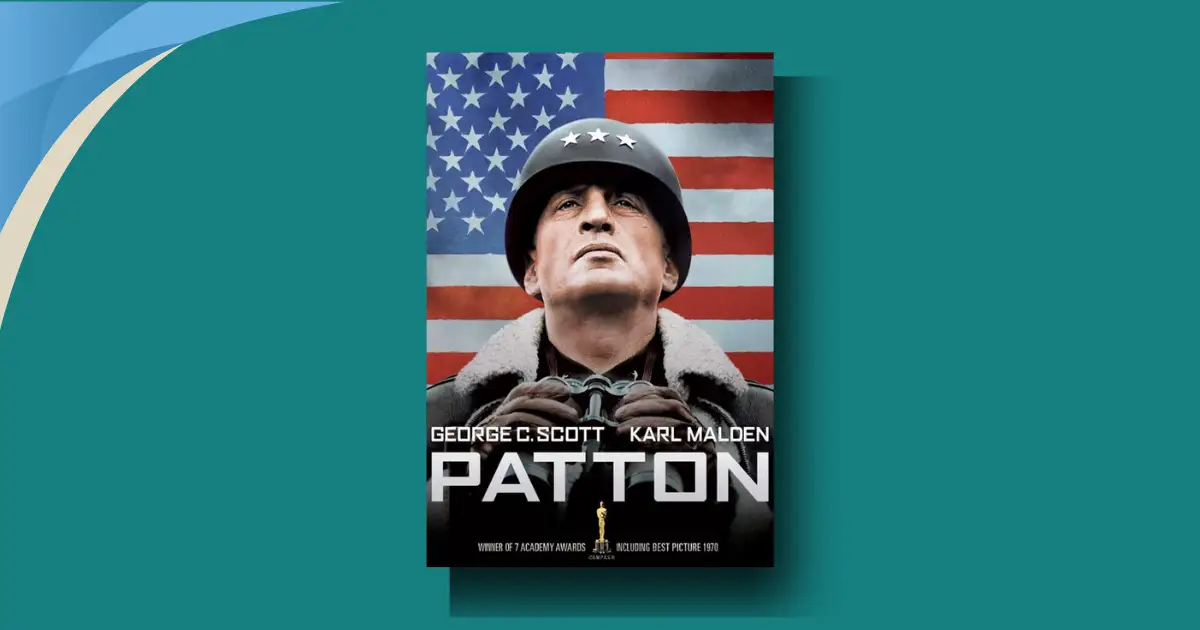
What if a man could win battles for a nation and still lose the right to command, simply because his mouth moved faster than the politics around him? Patton (1970) is the kind of war biopic that doesn’t ask you to “like” its hero so much as to survive him.
Directed by Franklin J. Schaffner, Patton (1970) was released in 1970 as a sweeping biography-war-history drama that tracks US General George S Patton Jr through his World War II campaigns and controversies.
It runs close to three hours, and it uses that time to build a portrait that is grand, abrasive, occasionally funny, and strangely intimate.
My overall impression is simple: Patton (1970) feels like watching genius argue with itself in public.
On my own probinism.com list of “101 Best Films You Need to See,” Patton (1970) sits right there as entry number 49. That placement fits, because this is one of those films that teaches you how cinema can think.
And yet, Patton (1970) isn’t only a history lesson.
It’s also a character study about power, ego, belief, and the lonely appetite to be remembered.
Rotten Tomatoes’ summary captures the arc neatly: the film begins with North Africa and ends with Patton being removed from command after criticizing US post-war strategy.
Even if you already know the outcomes, Patton (1970) still finds ways to surprise you emotionally.
Commercially, Patton (1970) was no small footprint: Box Office Mojo lists a domestic total of $61,749,765 and a budget of $12,000,000, while The Numbers assigns a 1970 gross of $62,500,000.
That scale matters, because the film’s ambition is not subtle.
So, let me walk you into Patton (1970) the way the film itself walks you in: boldly, then uneasily, and then—almost against your will—with respect.
Table of Contents
Background
Patton (1970) arrived as a big-statement Hollywood epic at a moment when audiences were increasingly skeptical of simple patriotic storytelling.
The film positions itself as biography rather than pure combat spectacle, and that choice shapes everything from pacing to tone.
Instead of pretending war is only strategy, Patton (1970) keeps returning to temperament, reputation, and the cost of being “right” in the wrong way. It’s why the film can feel both triumphant and uncomfortable in the same breath.
From a numbers perspective, the production scale shows up plainly in the financial reporting, with the budget listed at $12,000,000 on Box Office Mojo. For a 1970 release, that budget signals a studio treating Patton (1970) as prestige cinema, not niche history.
The reception story also matters because Patton (1970) didn’t just perform well; it endured.
The Library of Congress’ National Film Registry listing includes “Patton 1970 2003,” marking its selection for preservation. That’s one of the clearest institutional signals that Patton (1970) is viewed as culturally and historically significant.
Awards, too, help explain why Patton (1970) became “canon” so quickly.
On the Oscars’ official ceremony page for 1971 (honoring films released in 1970), George C Scott is listed as the Best Actor winner for Patton, and Franklin J. Schaffner is listed as the Directing winner for Patton.
Even just those two categories hint at what the film does best: it marries performance to control.
That’s the mood I want to keep as we go into the story itself, spoilers and all.
Patton (1970) Cast
| Cast (Actor as Role) | Why they matter |
|---|---|
| George C. Scott as General George S. Patton | The driving force of the film—sent in after the Kasserine Pass defeat to impose discipline, then later leads major WWII campaigns and is ultimately removed after controversies. |
| Karl Malden as General Omar N. Bradley | Patton’s key American counterpart—Patton reports to him after Normandy, and their clashes highlight Patton’s brilliance versus his political liabilities. |
| Michael Bates as Field Marshal Bernard Montgomery | Patton’s major Allied rival figure—Patton believes Montgomery is “monopolizing” credit, and later supply/fuel allocations to Montgomery’s forces become a major tension point. |
| Jack Gwillim as Field Marshal Sir Harold Alexander | The Allied decision-maker who chooses Montgomery’s more cautious Sicily plan—creating the strategic context for Patton’s push toward Palermo and Messina. |
| Karl Michael Vogler as Field Marshal Erwin Rommel | A marquee Axis commander presence in the film’s WWII landscape—represented as a top German field marshal figure in Patton’s war story. |
| Edward Binns as Lieutenant General Walter Bedell Smith | Part of the high-command ensemble around Patton—an Allied senior-officer presence in the film’s command-and-politics layer. |
| John Doucette as Major General Lucian Truscott | A prominent operational commander in Patton’s orbit—featured as part of the campaign command structure. |
| Michael Strong as Brigadier General Hobart Gay | Patton’s staff-level command presence—shown among the generals running the machine behind Patton’s battlefield momentum. |
| Paul Stevens as Colonel Charles R. Codman | A named colonel in Patton’s command circle—part of the film’s on-the-ground officer perspective supporting Patton’s arc. |
| Tim Considine as a shell-shocked soldier | Tied to the film’s most infamous moral rupture: Patton’s field-hospital incident where he slaps a soldier, triggering outrage and an apology. |
Patton (1970) Plot
The film Patton is a biographical epic that chronicles the military career of U.S. General George S. Patton during World War II, focusing on his leadership, controversies, and personal philosophy.
It opens with an iconic monologue delivered by Patton (George C. Scott) standing in front of a massive American flag, addressing his troops in a rousing, profanity-laced speech about the nature of war and the American spirit.
This sets the tone for Patton’s character as a bold, uncompromising warrior with a deep sense of history and destiny.
The main narrative begins during World War II, where the U.S. II Corps suffers a severe defeat at the Battle of Kasserine Pass in North Africa against German forces.
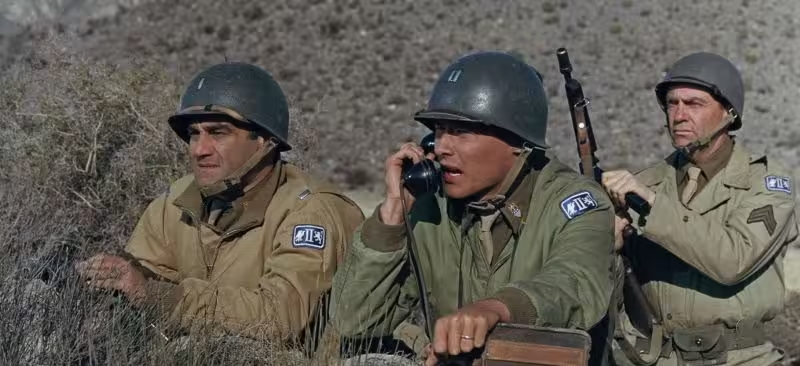
General George S. Patton is sent to take command of the demoralized unit. He immediately reorganizes the corps, imposing strict discipline—including fining soldiers for uniform violations and drilling them relentlessly—to restore order and morale.
Frustrated by what he sees as British General Bernard Montgomery‘s (Michael Bates) monopolization of the Allied campaign and glory-seeking tactics, Patton leads his forces to a redemptive victory at the Battle of El Guettar, turning the tide in North Africa.
After the Allied victory in North Africa, Patton and Montgomery propose competing plans for the invasion of Sicily. Patton advocates for an aggressive strategy: landing his U.S. Seventh Army at Gela and pushing northward to capture Palermo and Messina before the British can claim them.
However, Allied commander Harold Alexander (Jack Gwillim) opts for Montgomery’s more cautious plan, positioning Patton’s forces at Gela primarily to support the British advance.
Defying his limited role, Patton aggressively pushes his army northwest, capturing Palermo and racing to Messina ahead of Montgomery, securing a key victory but straining Allied relations.
During the Sicilian campaign, Patton visits a field hospital where he encounters a soldier suffering from shell shock (battle fatigue). Mistaking it for cowardice, Patton slaps the soldier and berates him publicly, calling him a “yellow bastard.”
This incident sparks widespread public outrage back home, leading to Patton being forced to issue a formal apology to the soldier, his troops, and the press to salvage his career.
As a result of the slapping incident and his outspoken nature, Patton is sidelined from the main Allied invasion of France (D-Day).
Instead, he is placed in command of the fictitious First United States Army Group in London, a decoy operation designed to mislead the Germans into believing the main invasion will come at Pas-de-Calais rather than Normandy.
While in England, at a public gathering in Knutsford, Patton makes controversial remarks implying that the postwar world will be dominated by “the British and the Americans,” omitting the Soviets and alarming Allied leaders. This gaffe prompts General George Marshall to consider sending Patton home in disgrace, but he is ultimately spared due to his military value.
Weeks after the successful Normandy landings, Patton is reinstated and takes command of the Third Army, now reporting to his former subordinate, General Omar Bradley (Karl Malden).
Under Patton’s dynamic leadership, the Third Army sweeps across France at a rapid pace, liberating towns and outpacing other Allied forces. However, the advance is halted just before entering Germany due to fuel and supply shortages, as resources are diverted to support Montgomery’s operations.
Frustrated, Patton confronts Bradley about the decision, but Bradley warns him once again about the perils of speaking too freely against superiors.
The film then depicts the German counteroffensive during the Battle of the Bulge in the winter of 1944–1945. Patton’s staff devises a bold plan to pivot his Third Army northward in harsh weather to relieve the besieged 101st Airborne Division trapped in Bastogne.
Patton executes the maneuver successfully, breaking the siege and turning the battle in the Allies’ favor.
After Germany’s capitulation in May 1945, Patton’s candid and inflammatory comparisons of American politics to Nazism—suggesting similarities in party systems—create further controversy.
As a result, he is relieved of command of the Third Army. However, he is retained in a lesser role to oversee the occupation and denazification of Bavaria in Germany.
In the film’s closing sequence, Patton is shown walking with his bull terrier, Willie, when he narrowly avoids a fatal accident (a cart nearly runs him over).
The scene transitions to a voiceover narration by Patton reflecting on the fleeting nature of glory, drawing a parallel to ancient Roman triumphs: “For over a thousand years, Roman conquerors returning from the wars enjoyed the honor of a triumph—a tumultuous parade. In the procession came trumpeters and musicians and strange animals from the conquered territories, together with carts laden with treasure and captured armaments.
The conqueror rode in a triumphal chariot, the dazed prisoners walking in chains before him. Sometimes his children, robed in white, stood with him in the chariot, or rode the trace horses.
A slave stood behind the conqueror, holding a golden crown, and whispering in his ear a warning that all glory … is fleeting.”
The film ends on this poignant note, emphasizing Patton’s belief in reincarnation, historical destiny, and the ephemeral quality of military success. (Note: In real history, Patton died in a car accident in December 1945, shortly after the war, but the film avoids depicting his actual death, opting instead for this symbolic close.)
Analysis
The film works because it refuses to sand down its main character into something easy to clap for.
Franklin J. Schaffner directs Patton (1970) like a public myth being built in real time, with scenes that often feel like ceremonies rather than mere plot points.
The storytelling is episodic but purposeful, because the film keeps asking whether a war hero can survive the peace he helped create. When I watch Patton (1970) now, I’m struck by how the film lets admiration and unease sit in the same chair.
The cinematography in the film leans hard into scale, using real locations and large-format spectacle to make command feel physically heavy. The American Society of Cinematographers notes Koenekamp’s extensive use of natural locations and the practical realities of lighting those spaces, which helps explain why the film’s “realism” still bites.
George C. Scott’s performance in Patton (1970) is the engine, and Rotten Tomatoes’ critics’ consensus flat-out calls it “definitive” for American biopics.
Karl Malden’s steadier presence as Omar Bradley gives Patton (1970) a moral counterweight, and the cast listing on Metacritic underlines how central that dynamic is to the experience.
The screenplay of Patton (1970) is credited to Francis Ford Coppola and Edmund H. North, and the Writers Guild Foundation points to the script’s roots in Bradley’s memoir and Farago’s biography. That factual foundation matters because the dialogue often sounds like it’s been carved, not casually spoken, with Patton constantly thinking in aphorisms and challenges.
Still, Patton (1970) can feel long-winded if you’re expecting a forward-thrusting battlefield thriller instead of a personality epic.
I didn’t mind the pacing as much as I expected, because the film uses “waiting” to show how strategy is often boredom interrupted by violence.
And when Patton (1970) slows down, it’s usually because it’s watching the consequences catch up.
Jerry Goldsmith’s score for Patton (1970) doesn’t just decorate scenes, it argues with them. Sources discussing the music highlight Goldsmith’s echoing trumpet effects (via echoplex) as a distinctive sonic idea tied to Patton’s inner mythology.
In the end, Patton (1970) is less about “how to win a war” and more about what a nation does with the kind of man who only feels alive inside conflict.
Patton (1970) keeps circling themes of leadership, ego, morality, and the uneasy boundary between courage and cruelty.
One reason Patton (1970) stays modern is that it understands image-management as a battlefield, long before social media made that obvious. It can read as patriotic and anti-war at the same time, because it shows glory as inseparable from damage. When I finished Patton (1970) again recently, I didn’t feel “inspired” so much as thoughtfully disturbed.
The film’s most uncomfortable moral rupture is the hospital-slapping thread, which echoes real 1943 incidents during the Sicily campaign.
Those accounts also connect Patton’s rage to his dismissal of combat stress (then often labeled “battle fatigue” or “shell shock”), which makes the scenes land as more than mere temper.
Patton (1970) also keeps hinting at a private spirituality—almost superstition—beneath the swagger.
That inner myth-making is even built into the music, with commentary on the score describing how the trumpet echoes can represent Patton’s belief in reincarnation.
For comparison, I often think of The Bridge on the River Kwai as another “war + obsession” masterpiece, but Patton (1970) is louder and more outwardly political about the cost of ego.
If you want visceral modern combat realism, Saving Private Ryan is the obvious reference point, yet Patton (1970) is chasing a different truth—how command distorts the soul.
Within Schaffner’s own career, it’s interesting to place Patton (1970) beside Planet of the Apes, because both films use spectacle to smuggle in discomforting ideas about humanity.
What sets Patton (1970) apart, for me, is that it refuses to give you a simple moral posture to copy.
It hands you a hero and then keeps showing you the shrapnel.
Audience-wise, Patton (1970) is ideal for cinephiles, history-minded viewers, and anyone who likes character studies disguised as epics. Reception data backs the classic status: Rotten Tomatoes lists 92% (critics) and 93% (audience), and Metacritic shows a Metascore of 86.
And if you’re wondering whether Patton (1970) is “worth it” today, the awards history makes the film’s case before I even open my mouth.
Patton (1970) didn’t just win awards, it swept with the kind of confidence the film itself dramatizes
On the Oscars’ official 1971 ceremony page, Patton is listed with major wins including Best Director (Franklin J. Schaffner), Best Actor (George C. Scott), and Writing (Edmund H. North) for Patton.
Patton (1970) was also selected for the National Film Registry in 2003, which is basically an official stamp of cultural permanence.
And yes, Patton (1970) is one of the 101 must-watch films I’ve already highlighted on probinism.com.
Personal Insight and lessons today
Watching Patton (1970) now, I keep thinking about how modern life quietly rewards “Pattons” and then publicly punishes them when they become embarrassing.
In workplaces, politics, and even online communities, the most aggressive performers can look like saviors when things are on fire.
But once the crisis settles, the same traits read as instability.
Patton (1970) makes that pattern feel old, structural, and painfully human. It also makes it feel avoidable, if we learn the right lessons.
The slapping episodes are the bluntest warning label, because they show what happens when performance, stress, and certainty turn into contempt for weakness. The historical accounts describe Patton’s lack of belief in combat stress reaction and his fury toward soldiers he saw as cowards, and that is the kind of “moral error” that can’t be fixed by winning the next battle. When I think about leadership today, I think about that: competence is not the same thing as character.
Patton (1970) also feels eerily relevant in the age of permanent recording, where every comment can outlive the moment that produced it.
Its ending—Patton being removed from command after outspoken criticism—lands like a reminder that institutions often tolerate brilliance only while it stays controllable.
I don’t read Patton (1970) as a simple “anti-Patton” film, because it’s too honest about why people followed him in the first place. The film shows charisma as a kind of social technology: it can focus fear into action, and it can make exhausted people believe they matter.
At the same time, it shows how charisma can become an excuse to stop listening.
That’s the leadership trap I see everywhere now: the louder a person is, the easier it becomes for everyone else to outsource judgment to them.
Patton (1970) argues—quietly but repeatedly—that this is how you drift toward cruelty.
There’s also a subtler lesson about the stories we tell ourselves in order to keep going.
Commentary on Jerry Goldsmith’s score points to the echoplex trumpet idea as a way of reflecting Patton’s belief in reincarnation, and I find that strangely moving even if I don’t share the belief.
It suggests that even the hardest men sometimes need a private myth to justify the public cost of their choices. Today we call that “narrative,” “brand,” or “purpose,” but it’s the same human need underneath.
Patton (1970) made me reflect on my own: which stories help me act better, and which stories just help me feel right.
If you want a practical takeaway, Patton (1970) is basically a masterclass on how results do not erase responsibility. It made me think of other war films I’ve explored on probinism.com—like The Bridge on the River Kwai and Saving Private Ryan—because each one, in its own way, shows how “duty” can turn into a moral blindfold.
The lesson I carry forward is this: be decisive, but don’t become addicted to being the loudest voice in the room.
Quotations
Patton (1970) is full of lines that sound like they were minted for memory.
Here are a few that still ring in my head, partly because they reveal character as much as they reveal attitude.
“At ease, men.”
“Rommel… you magnificent bastard, I read your book!”
And the famous opening-speech idea is often quoted as: “No bastard ever won a war by dying for his country.”
Pros and Cons
Pros:
- Monumental, location-rich cinematography that still looks massive today
- Gripping central performance that critics regularly call definitive
- A score with a distinctive sonic identity (the echoing trumpet idea really sticks)
- Smart script foundations rooted in memoir/biography, not pure invention
- A rare war epic that can feel patriotic and uneasy at the same time
Cons:
- Slow pacing in parts, especially if you’re expecting constant frontline action
- Patton’s personality is intentionally abrasive, which can exhaust some viewers
Conclusion
Patton (1970) is one of those films that gets bigger the older you get, because you start noticing the price tags attached to “great men.”
It’s a must-watch for cinephiles, history lovers, and anyone fascinated by leadership as both gift and threat.
My recommendation: watch Patton (1970) when you want a film that respects your intelligence and challenges your comfort.
Rating
4.5/5 stars.