

Do you ever get that unsettling feeling about someone at work—the one everyone seems to love, yet something feels off? You’re not paranoid.
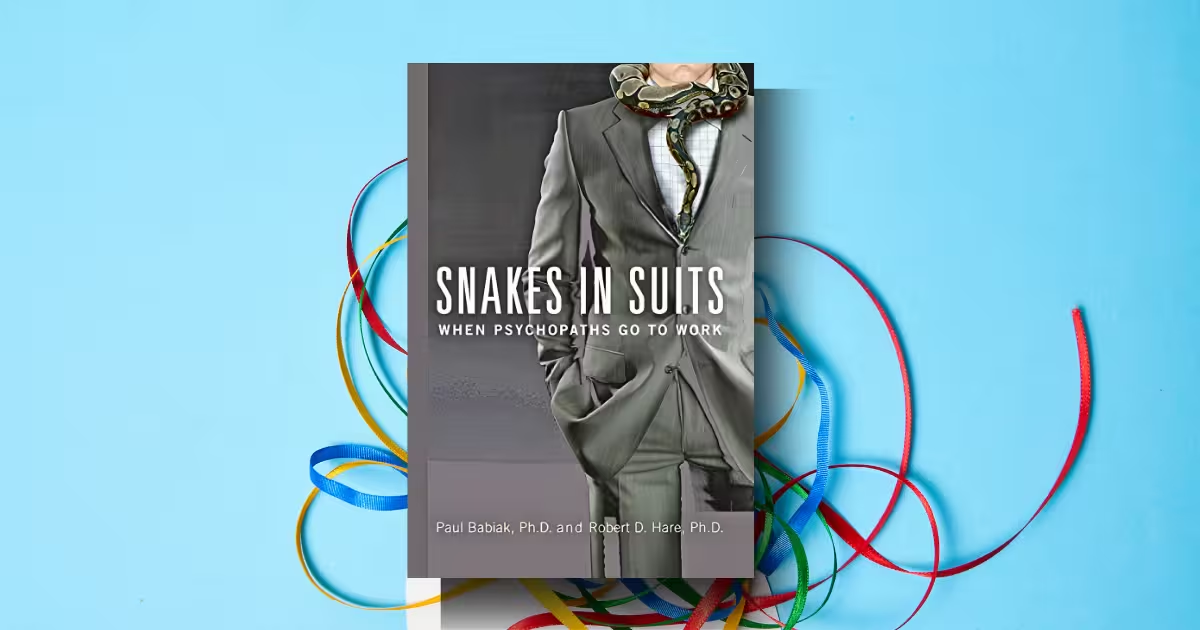
I bought Snakes in Suits: When Psychopaths Go to Work by Paul Babiak and Robert D. Hare expecting a dry academic text. What I got was a spine-chilling revelation that changed how I see every office interaction. This isn’t just another business book. It’s a survival guide for the modern workplace.
Overview
Snakes in Suits exposes a uncomfortable truth: psychopaths aren’t just in prisons or on movie screens. They’re in boardrooms, corner offices, and possibly the cubicle next to yours.
The book, published in 2006 by industrial psychologist Paul Babiak and psychopathy expert Robert D. Hare (creator of the Hare Psychopathy Checklist), reveals exactly how these “corporate predators” infiltrate organizations, climb the ladder, and destroy careers and companies along the way.
The authors argue that modern business environments—with their emphasis on speed, risk-taking, and charismatic leadership- have accidentally created the perfect hunting ground for psychopaths. What makes this book genuinely valuable isn’t just the theory; it’s the practical framework for spotting these individuals before they derail your career.
Reader recommendation
Snakes in Suits is best for:
- Anyone who’s ever had a boss that left them feeling confused, drained, or questioning their own sanity
- HR professionals who want to understand why some “perfect” hires turn into nightmares
- Managers who keep losing good people and can’t figure out why
- Anyone climbing the corporate ladder who wants to avoid becoming someone else’s pawn
I do not recommend Snakes in Suits to:
- People who want a quick, light read (this one requires attention)
- Those looking for sympathy toward psychopaths (the authors take a firm victim-protection stance)
- Anyone who prefers to stay blissfully unaware of office politics
Table of Contents
Snakes in Suits Summary
Let me be direct: after reading Snakes in Suits, I started seeing office dynamics in an entirely new light. The book delivers a comprehensive breakdown of how corporate psychopaths operate, and it’s both fascinating and deeply unsettling.
The Core Argument
The central thesis is straightforward but revolutionary: psychopaths aren’t just criminals—they’re also in our offices, often thriving. As the authors state, “psychopaths do work in modern organizations; they often are successful by most standard measures of career success; and their destructive personality characteristics are invisible to most of the people with whom they interact”.
The book argues that four key factors have made modern organizations vulnerable to psychopathic infiltration:
- The charm factor: Psychopaths can be “very charming, able to talk their way past even the most seasoned interviewers”
- Leadership confusion: Hiring managers “mistakenly attribute ‘leadership’ labels to what are, in actuality, psychopathic behaviors”
- Organizational change: The shift from bureaucracy to “flatter, more free-form, faster-paced organizational environment” created opportunities for psychopaths
- The attraction factor: “Psychopaths are more attracted to work for businesses that offer fast-paced, high-risk, high-profit environments”
The Psychopathy Checklist: What to Look For
Hare’s Psychopathy Checklist-Revised (PCL-R) forms the scientific backbone of the book. The authors break psychopathy into four domains:
Interpersonal: Superficial charm, grandiosity, pathological lying, manipulative behavior
Affective: Lack of remorse or guilt, shallow emotions, callousness, failure to accept responsibility
Lifestyle: Impulsivity, irresponsibility, need for stimulation, lack of realistic long-term goals
Antisocial: Poor behavioral controls, juvenile delinquency, early behavioral problems, revocation of conditional release
The book emphasizes that “most people in the general population would score less than 5 on the PCL-R,” while a score of 30 or above indicates psychopathy. About 1% of the general population meets this threshold, but the prevalence in corporate settings is significantly higher.
The Five-Phase Model of Corporate Psychopathy
One of the most useful frameworks the book provides is the five-phase model of how corporate psychopaths operate:
Phase 1: Entry
The psychopath uses “highly developed social skills and charm to obtain employment in an organization”. During this stage, “new employees might perceive the psychopath to be helpful and even benevolent”. The authors describe how Dave, the book’s central case study, walks into interviews with “a smooth, strong, and confident entrance” that leaves everyone impressed.
Phase 2: Assessment
“Once on to the assessment stage, the psychopath considers an employee’s usefulness and could recognize them either as a pawn (who has some informal influence and can be easily manipulated) or a patron (who has formal power and can be used by the psychopath to protect against attacks)”.
This is where the psychopath identifies who’s useful and who’s a threat. The book explains that psychopaths are “astute students of human nature” who “identify a person’s likes and dislikes, motives, needs, weak spots, and vulnerabilities”.
Phase 3: Manipulation
“Manipulation involves the psychopath creating a scenario of ‘psychopathic fiction'”. This is the “creation of a shroud of charm and deceit”. The psychopath builds one-on-one relationships with useful people, feeding them carefully crafted messages while constantly using feedback to maintain control.
Phase 4: Confrontation
When someone threatens to expose the psychopath, the tables are turned. The book describes how “the credibility of the complaining employee has already been ‘managed’ and undermined”. Former pawns who try to speak up find themselves labeled as the problem.
Phase 5: Ascension
The final phase sees the psychopath “moving up into higher-level positions”, often into the very role once held by their patron. The book chillingly notes that “the patron becomes a patsy, losing organizational status and often his or her job to the psychopath”.
The Psychopathic Bond: How They Trap You
Perhaps the most personally useful section of the book explains how psychopaths forge bonds with their victims. The authors describe a four-message process:
- “I like who you are” — The psychopath positively reinforces your self-presentation
- “I am just like you” — They mirror your values, beliefs, and experiences
- “Your secrets are safe with me” — They create a sense of safety and trust
- “I am the perfect friend/partner for you” — They become exactly what you need
The terrifying part? “What makes the psychopath-victim relationship any different from a real bond… For one, the persona of the psychopath—the ‘personality’ the person is bonding with—does not really exist. It was built on lies, carefully woven together to entrap you”.
The Roles in the Psychopath’s Drama
The book introduces a cast of characters that exist in every organization with a corporate psychopath:
Patrons: “Influential executives who take talented employees ‘under their wing’ and help them progress through the organization”. These are the psychopath’s unwitting protectors.
Pawns: Individuals the psychopath manipulates for resources, information, or influence. “The more I know about the guy, the more I know what buttons to push,” admits one psychopath in the book.
Patsies: Those who take the fall when things go wrong. Often, these are former pawns or even the patrons themselves.
Organizational Police: HR professionals, auditors, and security personnel who sense something wrong but often can’t get management to listen.
The Manipulation Techniques
The book details the specific tactics psychopaths use:
Divide and conquer: Creating conflict among staff members, claiming one person said something negative about another. “This ‘divide and control’ technique increases tension and distrust among individuals, effectively shutting down communication”.
Information hoarding: Keeping others “out of the loop” to maintain power. “Knowledge really is power in an organization”.
Blame shifting: “Psychopaths rarely, if ever, take responsibility for their actions… they will not only blame others but also create ‘evidence’ that others are to blame”.
Disparate treatment: Treating some people well and others poorly based on their utility. “Because psychopaths see people playing different roles… they will treat some better than others”.
Snakes in Suits Analysis
Let me be honest: Snakes in Suits isn’t always an easy read. It’s dense with research, clinical terminology, and case studies that can feel repetitive. But I’d argue that’s precisely why it’s so valuable.
The Authoritative Foundation
The book’s credibility rests on an extraordinary foundation. Robert D. Hare is the creator of the Psychopathy Checklist-Revised, “the gold standard for measuring psychopathy” used worldwide. His research on criminal psychopaths spans decades.
Paul Babiak is an industrial-organizational psychologist who spent years consulting with corporations before realizing that some of the most problematic executives fit the psychopathy profile.
Together, they bring something rare: the scientific rigor of a criminal psychologist combined with the practical experience of a business consultant. This isn’t armchair psychology—it’s research-driven analysis backed by real cases.
What the Book Gets Right
The invisible predator concept: The book’s central metaphor—”snakes in suits”—perfectly captures the reality that psychopaths don’t look like monsters. They look like successful professionals. As the authors note, “psychopaths can be very charming, able to talk their way past even the most seasoned interviewers”.
The organizational vulnerability argument: The book convincingly argues that modern business practices—fast hiring, emphasis on charisma, constant change—have inadvertently created ideal conditions for psychopaths. “The general state of confusion that change brings to any situation can make psychopathic personality traits—the appearance of confidence, strength, and calm—often look like the answer to the organization’s problems”.
The practical framework: The five-phase model and the patron/pawn/patsy framework give readers concrete tools for understanding workplace dynamics. These aren’t abstract concepts—they’re patterns you can actually observe.
The statistics: The book cites that “about 15 percent of the prison population” meets the criteria for psychopathy, and while only about 1% of the general population qualifies, the number in corporate settings is significantly higher. More recent research has found that “one in five CEOs exhibits clinically significant psychopathic traits”.
Where the Book Falls Short
The repetitive structure: The book uses fictional case studies (following a character named Dave) interwoven with analysis. While this makes the concepts concrete, it can feel repetitive. Some readers might wish for more direct, less narrative-driven content.
The lack of treatment discussion: The authors make clear they’re focused on “protecting potential victims” rather than treating psychopaths. This is understandable but might leave some readers wondering if change is possible (the answer, according to the book, is essentially no).
The dated examples: Published in 2006, some of the corporate examples feel dated. However, the core principles remain remarkably relevant.
The clinical tone: Despite the accessible writing, parts of the book read like a textbook. The graphs and detailed psychological breakdowns might not appeal to casual readers.
Comparison With Similar Works
Snakes in Suits occupies a unique space in the business-psychology genre:
Compared to Without Conscience (Hare’s earlier book): Without Conscience is broader, covering psychopathy in all contexts—criminal, personal, and professional. Snakes in Suits is more focused, zeroing in on the corporate environment with practical business applications.
Compared to The Psychopath Test (Jon Ronson): Ronson’s book is more narrative and entertaining, focusing on the cultural fascination with psychopathy. Snakes in Suits is more practical and research-driven, offering actionable frameworks rather than journalistic exploration.
Compared to The Corporation (documentary): While the documentary argues that corporations themselves are psychopathic, Snakes in Suits focuses on individuals within corporations.
The book takes a more nuanced view, noting that “if the PCL-R… were to be applied to a random set of corporations, some might qualify for a diagnosis of psychopathy, but most would not”.
Conclusion
Here’s my honest take: if you work in any kind of organization, Snakes in Suits might be one of the most important books you’ll ever read.
The book’s value isn’t just in helping you spot psychopaths—it’s in helping you understand the dynamics of manipulation, power, and trust that exist in every workplace. Even if you never encounter a true psychopath (though statistically, you probably will), the frameworks for understanding organizational politics, building genuine relationships, and protecting your reputation are invaluable.
The authors offer specific advice for different roles:
For employees: Build and maintain a reputation as a good performer, document everything, avoid confrontations with suspected psychopaths, and keep your options open.
For managers: Continuously improve leadership skills, build rapport with staff, maintain strong relationships with your own boss, keep good documentation, and use performance management processes.
For HR professionals: Improve hiring practices, check references thoroughly, look for red flags, and don’t assume that impressive candidates are necessarily good ones.
The book ends with a sobering thought: “The world is made up of many types of people, some of them, unfortunately, psychopaths”. But it also offers hope: knowledge is power. Understanding how these individuals operate is the first step in protecting yourself and your organization.
Final verdict: Snakes in Suits is an essential resource for anyone who wants to understand the darker side of corporate life. It’s not always an easy read, but it’s a necessary one. If you’ve ever wondered why some people seem to succeed at the expense of everyone around them, this book will give you answers—and tools to protect yourself.